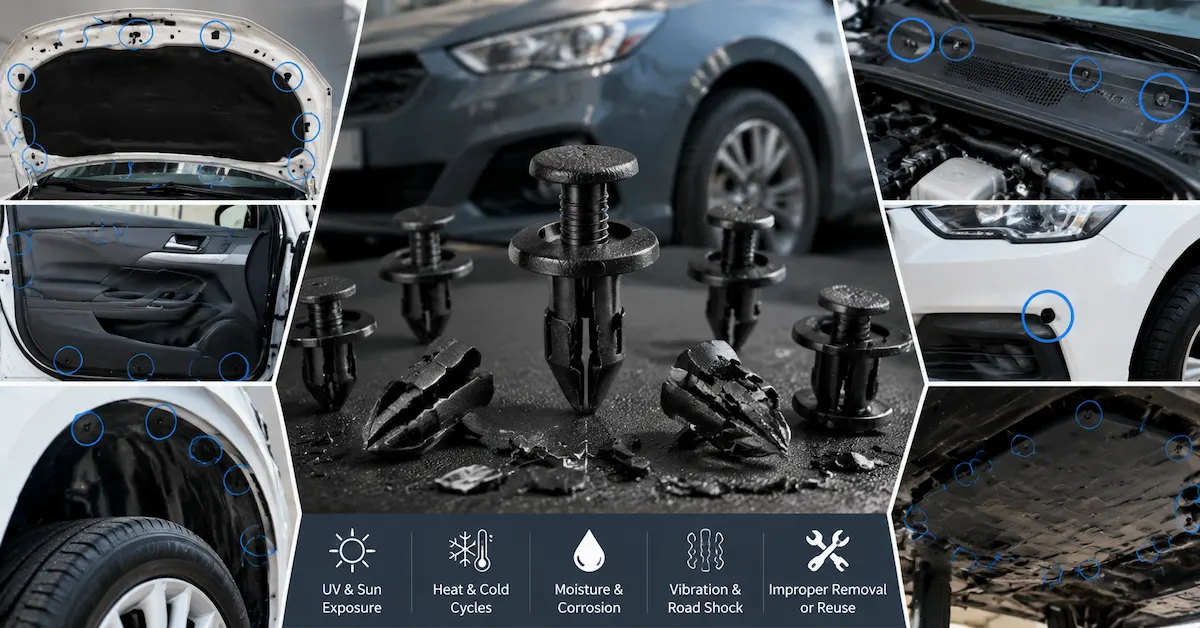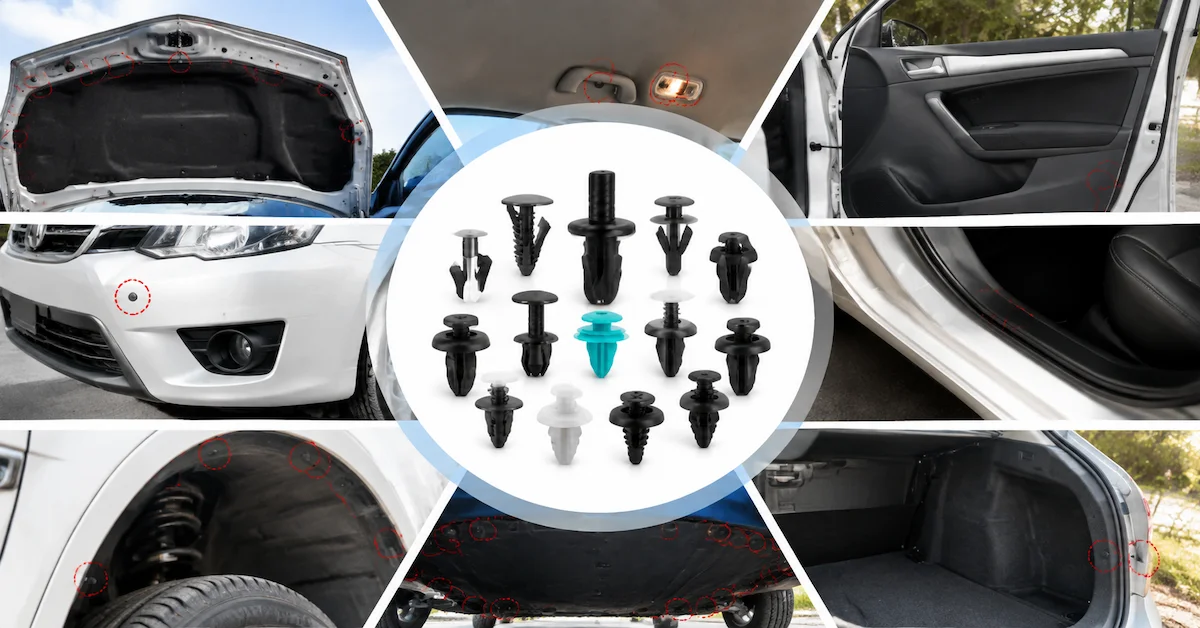

For an automotive clips distributor, managing car clips is not as simple as filling a warehouse with random plastic fasteners. Automotive clips come in many shapes, sizes, materials, colors, and vehicle applications. Some clips move quickly because they are used in common bumper, fender, and door panel repairs. Others may sit in stock for months if the distributor does not plan SKUs carefully.
A successful distributor needs three things: a clear SKU structure, practical packaging formats, and a reliable reorder strategy. Without these, buyers may face slow-moving inventory, wrong-fit complaints, stockouts, and higher return rates.
QEEPEI supplies a wide range of automotive clips and fasteners, including car body clips, car clip kits, specific fit clips, and clip tools for distributors, repair channels, online sellers, and retail buyers.
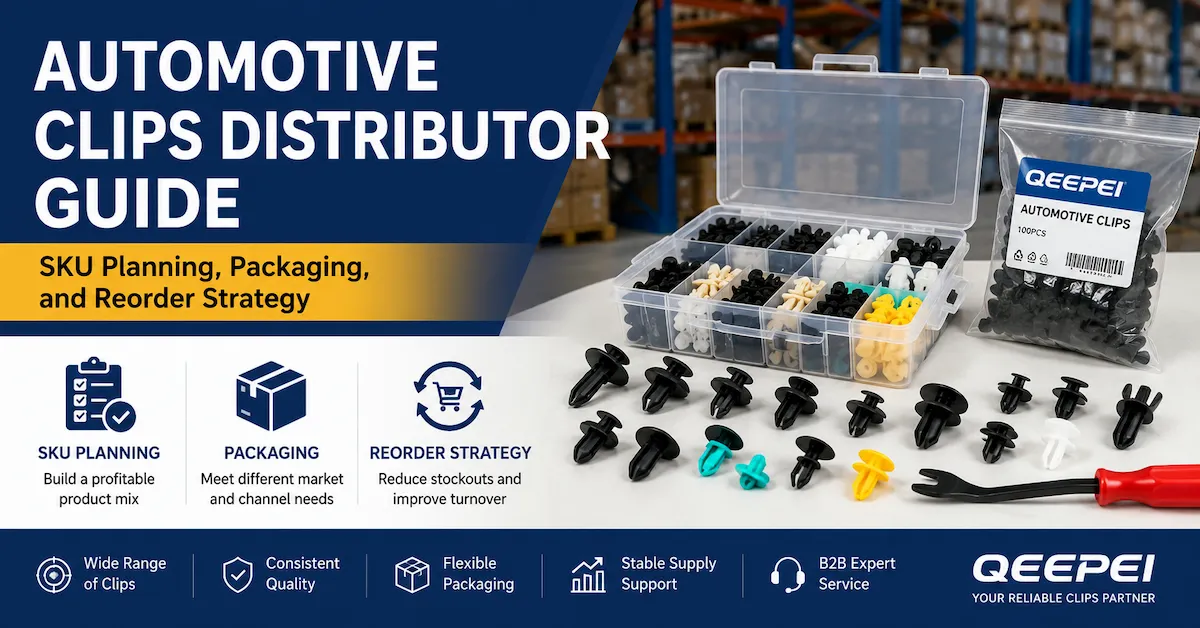
Why SKU Planning Matters for Automotive Clips Distributors
Automotive clips are small parts, but they create complex inventory challenges. Many clips look similar, but they may have different head diameters, stem lengths, hole sizes, panel thickness ranges, and locking structures. If SKUs are poorly organized, warehouse teams may ship the wrong clips, sales teams may recommend the wrong products, and customers may return products due to poor fitment.
A strong automotive clips distributor should organize SKUs by:
- Vehicle application area
- Clip type
- Material
- Color
- Size and dimension
- Vehicle brand or model
- Packaging format
- Sales channel
- Reorder frequency
This structure helps distributors serve customers faster and reduce selection errors.
Core Automotive Clip Categories to Stock
A distributor should not rely only on universal clips. Universal clips are useful, but professional buyers often need clips by vehicle position or repair type.
| Product Category | Common Application | Distributor Value |
|---|---|---|
| Bumper clips | Front and rear bumper repair | High replacement frequency |
| Fender liner clips | Wheel arch and inner lining repair | Strong body shop demand |
| Door panel clips | Interior trim and door repair | Common repair item |
| Push retainers | General panel fastening | Broad application coverage |
| Plastic rivet clips | Trim and underbody panels | Easy installation |
| Screw grommets | Screw base and panel fastening | Stronger fixing support |
| Seal strip clips | Weatherstrip and sealing areas | Helps reduce noise and leakage |
| Hood insulation clips | Engine bay and hood liner fixing | Needs heat resistance |
| Dashboard clips | Interior dashboard and navigation trim | Requires accurate fitment |
| Car clip kits | Repair, retail, and online sales | Easy inventory and resale format |
For distributors, this category structure makes it easier to decide which products should be stocked in bulk and which should be handled as lower-volume specialty items.
How to Build a Practical SKU System
A practical SKU system should help your team answer three questions quickly: what the clip is, where it is used, and how often it sells.
A useful SKU structure may include:
| SKU Layer | Example | Purpose |
| Product type | Bumper clip / door panel clip | Identifies application |
| Size code | Head diameter, stem length, hole size | Reduces fitment errors |
| Material | PA nylon, PP, POM | Supports quality selection |
| Color | Black, white, gray | Helps visual matching |
| Packaging | Bulk bag, kit, retail pack | Supports sales channel |
| Vehicle fit | Universal or specific model | Improves selection accuracy |
For example, a distributor selling to repair shops may use bulk packaging for fast-moving bumper clips and door panel clips. An online seller may prefer assortment kits with clear product labels and application guidance.
A well-planned SKU system helps the distributor manage both wholesale and retail demand more efficiently.
Packaging Strategy for Different Customer Types
Packaging is not only about appearance. It affects picking speed, inventory accuracy, product presentation, and customer trust.
Different buyers need different packaging formats.
| Buyer Type | Recommended Packaging | Why It Works |
| Auto parts distributors | Bulk bags or cartons | Lower cost and easier replenishment |
| Repair shops | Assortment kits | Faster repair selection |
| Online sellers | Retail kits and labeled bags | Better conversion and fewer returns |
| Supermarket buyers | Color boxes and barcode packs | Shelf-ready presentation |
| Private label brands | Branded packaging | Builds market identity |
| Vehicle-specific sellers | Labeled model packs | Reduces compatibility confusion |
A strong automotive clips distributor should not only stock products, but also choose packaging that matches its customer base.
QEEPEI supports B2B buyers with product selection, wholesale supply, and packaging options. Buyers can learn more through the QEEPEI Wholesale page.
Reorder Strategy: Avoid Stockouts and Dead Stock
A good reorder strategy helps distributors avoid two common problems: running out of fast-moving clips and overstocking slow-moving items.
Distributors can divide SKUs into three groups:
1. Fast-moving SKUs
These should be stocked regularly and reordered before they run low.
Common examples include:
- Bumper clips
- Fender liner clips
- Door panel clips
- Push retainers
- Screw grommets
- Wheel arch clips
These products are frequently used by repair shops and body shops.
2. Medium-demand SKUs
These should be stocked in moderate quantities and reviewed monthly or quarterly.
Examples include:
- Dashboard clips
- Hood insulation clips
- Seal strip clips
- Specific fit clips for popular models
3. Specialty SKUs
These should be ordered based on customer demand or market data.
Examples include:
- Rare vehicle-specific clips
- Custom color clips
- Special structure fasteners
- Private label kits
This reorder structure helps distributors reduce inventory pressure while still supporting a broad product range.
Fitment Control: The Key to Lower Returns
Fitment is one of the biggest risks for any automotive clips distributor. A clip may look correct but fail during installation because it does not match the required size or structure.
To reduce wrong-fit orders, distributors should confirm:
- Head diameter
- Stem length
- Hole diameter
- Panel thickness range
- Locking structure
- Material flexibility
- Vehicle application
- OE reference if available
- Installation position
Clear product photos, size charts, application notes, and SKU labels can reduce customer confusion. This is especially important for online sellers and repair supply chains.
QEEPEI’s product categories help buyers source automotive clips by application area, clip type, and vehicle fitment needs.
Material and Quality Consistency
A distributor’s reputation depends on product consistency. If one batch performs well and the next batch breaks easily, customers may lose confidence.
Common materials include:
| Material | Advantage | Common Use |
| PA Nylon | Flexible, strong, wear-resistant | Bumper clips, trim clips, push retainers |
| PP | Lightweight and cost-effective | Interior and light-duty fasteners |
| POM | Good dimensional stability | Precision locking clips |
| Reinforced plastic | Higher strength under stress | High-load fastening points |
For distributors, material quality should not be judged only by appearance. A reliable supplier should help maintain stable material quality, accurate molding, and consistent packaging across repeat orders.
Supplier Support for Distributors
An automotive clips distributor needs more than a product list. A distributor needs supplier support that helps with product selection, SKU planning, packaging, and reorder stability.
Before choosing a supplier, check whether they can support:
| Supplier Capability | Why It Matters |
| Wide product range | Helps build a complete catalog |
| Stable inventory | Supports repeat wholesale orders |
| Fitment guidance | Reduces wrong orders |
| Packaging options | Supports different sales channels |
| OEM/ODM service | Helps create private label lines |
| Product images and data | Helps online and catalog sales |
| Quality control | Reduces complaints and returns |
| Export experience | Makes international purchasing smoother |
QEEPEI focuses on automotive clips, plastic fasteners, car clip kits, specific fit clips, and clip tools. To understand the company background and service capability, visit the About Us page.
Why QEEPEI Supports Automotive Clips Distributors
QEEPEI can support distributors with product range, application matching, wholesale supply, packaging flexibility, and OEM/ODM cooperation. This makes it easier for buyers to build a reliable fastener product line instead of sourcing scattered clips from multiple suppliers.
QEEPEI is suitable for:
- Auto parts distributors
- Regional wholesalers
- Repair shop suppliers
- E-commerce sellers
- Private label automotive brands
- Supermarket and retail buyers
- Vehicle-specific clip sellers
For bulk orders, packaging customization, or product selection support, buyers can contact QEEPEI through the Contact Us page.
FAQ
1. What does an automotive clips distributor need most?
An automotive clips distributor needs wide SKU coverage, stable inventory, accurate fitment data, reliable packaging, and fast reorder support.
2. What automotive clips should distributors stock first?
Distributors should start with bumper clips, fender liner clips, door panel clips, push retainers, screw grommets, trim clips, and car clip kits.
3. Why is SKU planning important?
SKU planning helps reduce warehouse confusion, wrong shipments, slow-moving inventory, and customer returns caused by poor fitment.
4. What packaging is best for automotive clips distributors?
Bulk bags are good for wholesale supply, while assortment kits, barcode packs, and color boxes are better for repair shops, online sellers, and retail channels.
5. How can distributors reduce fitment risk?
They should use clear size data, application notes, product images, fitment charts, OE references, and specific fit clip categories.
6. Are car clip kits good for distributors?
Yes. Car clip kits are useful because they combine common clips into one package, making selection easier for repair shops, online sellers, and retail buyers.
7. How should distributors manage reorder frequency?
Fast-moving clips should be reordered regularly, medium-demand clips should be reviewed monthly or quarterly, and specialty clips should be stocked based on customer demand.
8. Can automotive clips be private labeled?
Yes. Many automotive clips and car clip kits can be customized with private label packaging, barcode labels, color boxes, and branded assortment kits.
9. Why is material consistency important?
Material consistency affects clip flexibility, strength, durability, and customer satisfaction across repeat orders.
10. Where can I source automotive clips for distribution?
You can browse QEEPEI’s automotive clips and fasteners or contact QEEPEI through the Contact Us page for distributor sourcing, bulk orders, and packaging support.
Conclusion
For an automotive clips distributor, success depends on structured SKU planning, practical packaging, accurate fitment control, and a reliable reorder strategy. Distributors who manage these areas well can reduce dead stock, avoid stockouts, lower return rates, and serve repair shops and retail buyers more efficiently.
QEEPEI supports global buyers with automotive clips, plastic fasteners, car clip kits, specific fit solutions, packaging support, and B2B supply service.
Explore QEEPEI’s full automotive clips product range to build a stronger distributor product line.