
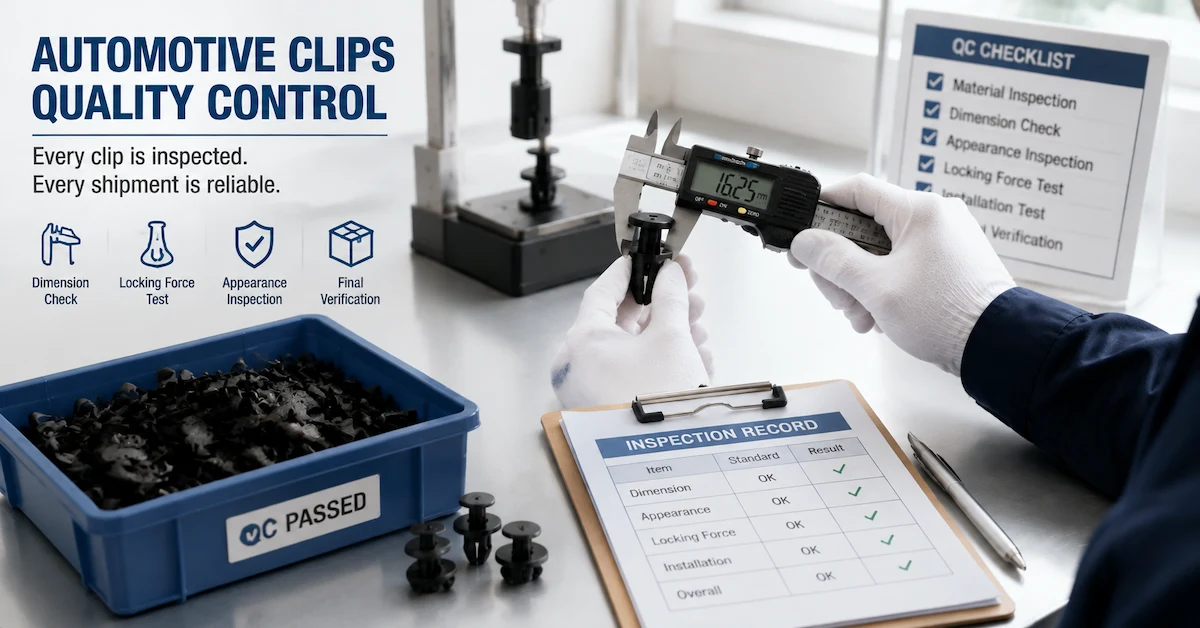
When purchasing automotive clips in bulk, product quality is one of the most important factors for distributors, repair chains, and OEM buyers. A reliable automotive clips quality control system ensures that every clip meets required dimensions, strength standards, and installation performance before reaching customers.
Although automotive clips are small components, their failure can create major problems. Incorrect dimensions, weak locking force, poor material stability, or deformation during installation may result in loose panels, vehicle noise, repair delays, and customer complaints.
For professional buyers, choosing an automotive clips supplier with strict quality control processes helps reduce returns, improve repair efficiency, and maintain long-term customer trust.
QEEPEI provides automotive fastening solutions including car clips, plastic fasteners, clip kits, and vehicle-specific fastening products for global B2B buyers.
Why Automotive Clips Quality Control Matters
Automotive clips are used in many critical vehicle areas, including:
- Bumper systems
- Fender liners
- Door panels
- Interior trims
- Wheel arches
- Dashboard components
- Underbody covers
- Hood insulation panels
Each application requires different performance characteristics.
For example:
| Application | Key Quality Requirement |
|---|---|
| Bumper clips | Strong locking force and impact resistance |
| Fender clips | Vibration resistance and durability |
| Door panel clips | Stable fit and noise reduction |
| Underbody fasteners | Weather and aging resistance |
| Interior clips | Accurate dimensions and appearance |
Without proper inspection, even small defects can affect vehicle assembly and aftermarket repair quality.
Common Quality Problems in Automotive Clips
Before discussing testing methods, buyers should understand the common issues that quality control aims to prevent.
Incorrect Dimensions
Automotive clips must match specific mounting holes and panel thickness ranges.
Dimension errors may cause:
- Loose installation
- Difficult assembly
- Poor panel alignment
- Incorrect fitment
Weak Locking Performance
The locking structure determines whether the clip can securely hold the component.
Problems include:
- Weak retention force
- Clip movement after installation
- Easy removal during vibration
Material Inconsistency
Plastic quality directly affects durability.
Poor materials may cause:
- Cracks
- Brittleness
- Deformation
- Reduced service life
Surface Defects
Injection molded clips may develop defects such as:
- Flash
- Sink marks
- Warping
- Incomplete molding
Professional quality control helps identify these problems before shipment.
Material Inspection for Automotive Clips
Material inspection is the first step in automotive clips quality control.
A reliable supplier should verify:
- Material type
- Material consistency
- Color stability
- Physical performance
Common materials include:
| Material | Advantages |
|---|---|
| PA Nylon | Strong, flexible, wear-resistant |
| PP | Lightweight and cost-effective |
| POM | High dimensional stability |
| Reinforced plastic | Higher mechanical strength |
Different applications require different material characteristics.
For example:
- Exterior clips require weather resistance;
- Engine compartment clips require heat resistance;
- Interior clips require flexibility and appearance quality.
A professional automotive clips supplier should select suitable materials based on application requirements.
Dimensional Inspection: Ensuring Accurate Fitment
Dimensional accuracy is one of the most important quality factors for automotive clips.
Key measurements include:
| Measurement | Purpose |
|---|---|
| Head diameter | Ensures proper panel coverage |
| Stem diameter | Matches mounting hole size |
| Clip length | Ensures correct installation depth |
| Panel thickness range | Maintains proper locking |
| Overall dimensions | Ensures assembly compatibility |
Common inspection tools include:
- Digital calipers
- Measuring equipment
- Precision inspection tools
- Sample comparison methods
Accurate dimensions help prevent wrong-fit products and reduce customer complaints.
Locking Force and Installation Testing
Automotive clips must maintain reliable holding performance after installation.
Locking tests evaluate:
- Retention strength
- Expansion performance
- Clip stability
- Installation and removal behavior
A quality clip should:
- Install smoothly;
- Lock securely;
- Resist vibration;
- Maintain performance over time.
This is especially important for:
- Bumper clips
- Fender clips
- Wheel arch clips
- Underbody fasteners
Appearance Inspection Before Shipment
Visual inspection helps identify defects that may affect installation or customer perception.
Quality inspectors check:
- Surface finish
- Color consistency
- Cracks
- Burrs
- Deformation
- Missing features
For distributors and online sellers, appearance quality is also important because customers expect consistent products.
Injection Molding Process Control
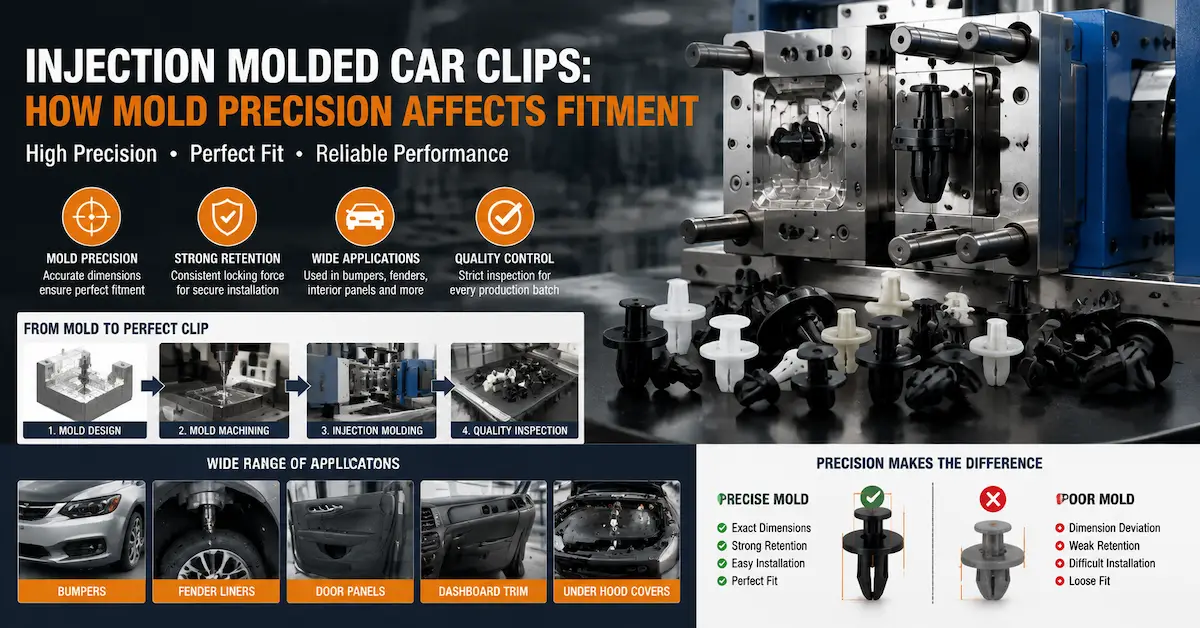
Most automotive clips are produced through injection molding. Therefore, production control directly affects final quality.
Important manufacturing control points include:
| Production Stage | Quality Focus |
|---|---|
| Mold design | Structural accuracy |
| Material preparation | Stable raw materials |
| Injection molding | Consistent dimensions |
| Cooling process | Prevent deformation |
| Trimming | Remove excess material |
| Final inspection | Confirm product performance |
For injection molded products, mold precision and production stability determine whether every batch performs consistently.
Batch Inspection and Traceability
For bulk buyers, consistent quality between different orders is essential.
A professional supplier should maintain:
- Production records
- Batch identification
- Inspection records
- Product traceability
This helps buyers:
- Track product issues;
- Manage repeat orders;
- Maintain consistent inventory quality.
For distributors handling thousands of SKUs, traceability improves supply chain management.
Packaging Inspection Before Delivery
Quality control does not end after product inspection. Packaging accuracy is also important.
Before shipment, suppliers should verify:
- Product quantity
- Packaging condition
- Labels
- SKU information
- Customer requirements
Proper packaging helps prevent:
- Wrong shipments
- Warehouse confusion
- Inventory problems
QEEPEI supports different packaging solutions for distributors, repair suppliers, and retail buyers.
How Buyers Evaluate an Automotive Clips Supplier
When selecting a supplier, buyers should evaluate more than product pricing.
| Evaluation Factor | Importance |
|---|---|
| Quality control system | Ensures stable products |
| Manufacturing capability | Supports bulk production |
| Material management | Improves durability |
| Inspection process | Reduces defects |
| Product range | Supports different applications |
| OEM capability | Enables customization |
| Packaging support | Improves supply management |
A reliable supplier should be able to explain its quality process clearly.
Why Choose QEEPEI for Automotive Clips Quality Control?
QEEPEI focuses on automotive clips, plastic fasteners, car clip kits, and vehicle-specific fastening solutions.
For global B2B buyers, QEEPEI provides:
- Stable automotive clip production
- Strict quality inspection
- Consistent product dimensions
- OEM/ODM support
- Packaging customization
- Application matching support
QEEPEI serves:
- Automotive distributors
- Repair chains
- OEM buyers
- Aftermarket suppliers
- Online automotive sellers
Learn more about QEEPEI’s manufacturing capability through the About Us page.
For bulk orders, supplier cooperation, and customized automotive fastening solutions, contact QEEPEI through the Contact Us page.
FAQ
What is automotive clips quality control?
Automotive clips quality control refers to the inspection processes used to verify material, dimensions, performance, appearance, and packaging before shipment.
Why is quality control important for automotive clips?
Quality control prevents wrong fitment, installation problems, product returns, and customer complaints.
What tests should automotive clips pass before shipment?
Common tests include material inspection, dimensional measurement, appearance inspection, locking force testing, and packaging verification.
How does material affect automotive clip quality?
Material affects flexibility, strength, durability, heat resistance, and long-term performance.
Why are dimensions important for car clips?
Correct dimensions ensure that clips match vehicle mounting holes and panel thickness requirements.
What causes automotive clips to break?
Common causes include poor materials, incorrect dimensions, aging, excessive force, and improper installation.
How can distributors reduce quality risks?
Distributors should work with suppliers that provide inspection records, stable production, accurate specifications, and consistent batches.
Are injection molded car clips easier to control?
Yes. With proper mold design and process control, injection molding allows consistent production of automotive clips.
Can automotive clips suppliers provide customized testing?
Yes. OEM suppliers can often provide customized inspection requirements based on customer needs.
Where can I source quality automotive clips?
You can explore QEEPEI automotive fastening solutions through the Products page.
Conclusion
Reliable automotive clips quality control is essential for ensuring product performance, accurate fitment, and customer satisfaction. Before shipment, automotive clips should go through material inspection, dimensional checks, locking tests, appearance inspection, and packaging verification.
For distributors, repair chains, and OEM buyers, working with a supplier that prioritizes quality control helps reduce risks and build a more reliable supply chain.
QEEPEI provides automotive clips, plastic fasteners, clip kits, and customized fastening solutions with professional quality management for global automotive buyers.
Explore QEEPEI’s complete automotive fastening product range to build a stronger sourcing strategy.