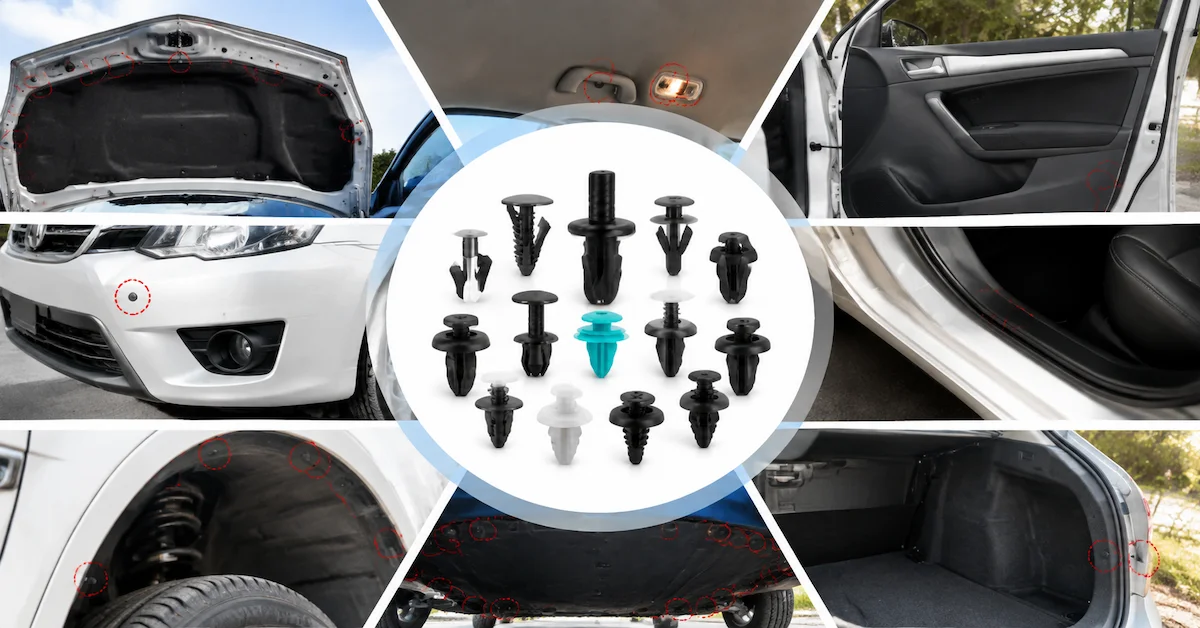

Why Choosing an Automotive Clips Supplier Is More Than Comparing Prices
For automotive distributors, wholesalers, and aftermarket sourcing teams, the lowest unit price does not always produce the lowest total purchasing cost.
Two plastic retainers can look almost identical while differing in hole diameter, stem dimensions, panel thickness range, locking geometry, material, or installation position. A small mismatch can lead to difficult installation, loose trim, damaged panels, customer returns, duplicated inventory, or repeated sourcing work.
That is why an automotive clips supplier should be evaluated on more than price.
A reliable partner should help buyers answer three basic questions:
- Can the correct clip be identified accurately?
- Can the approved dimensions, material, and fitment be reproduced consistently?
- Can the supplier support stock replenishment, packaging, and future product development?
For distributors managing hundreds or thousands of fastener SKUs, these factors can have a greater impact on profitability than a small difference in piece price.
Buyers can begin by reviewing the available automotive clips and fastener categories to determine whether a supplier covers the applications, vehicle types, and assortment structure required for their market.
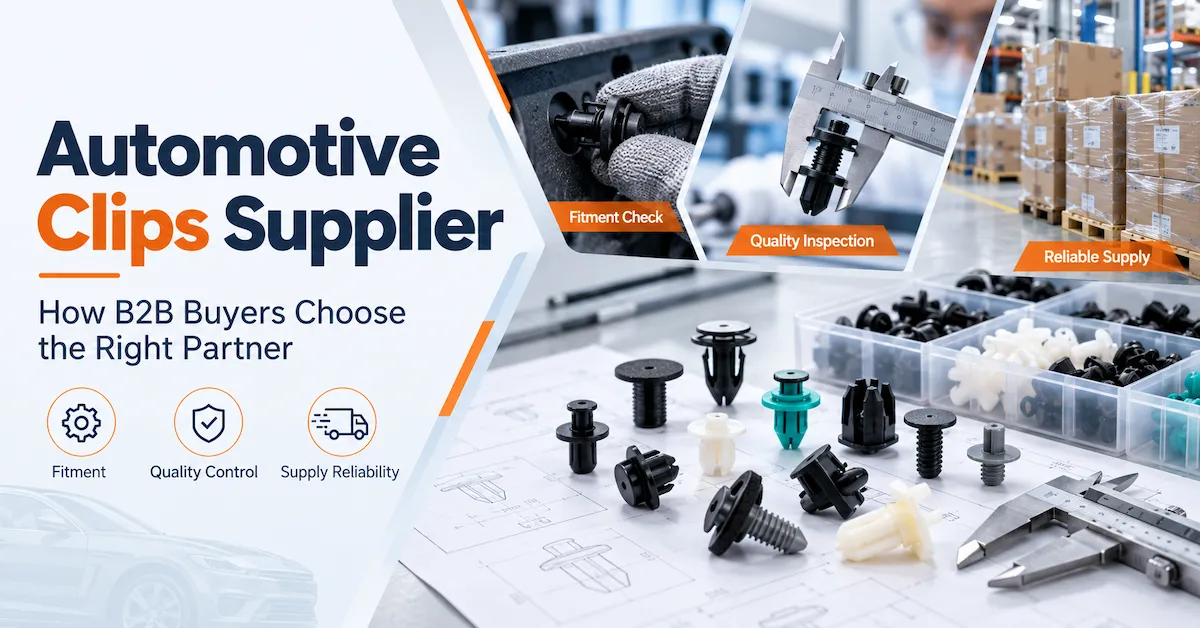
Fitment Capability Should Come Before the Quotation
One of the most common sourcing mistakes is selecting an automotive clip mainly by appearance.
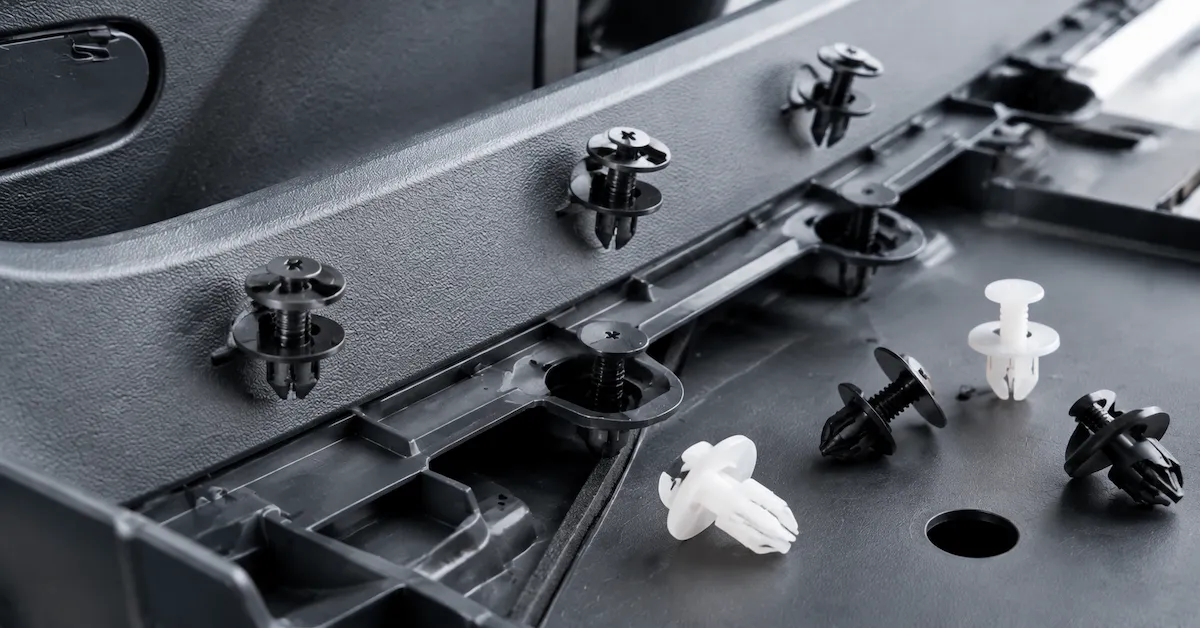
A black push-type retainer may resemble several other parts but still use a different mounting-hole size or locking structure.
Professional product identification should consider several variables together.
| Selection Factor | Why It Matters |
|---|---|
| Hole diameter | Determines whether the clip can enter and lock in the mounting hole |
| Stem diameter | Affects insertion and hole engagement |
| Stem length | Determines installation depth |
| Head diameter | Influences panel coverage and appearance |
| Panel thickness | Determines where the clip locks |
| Locking geometry | Influences insertion and retention behavior |
| Material | Affects flexibility, strength, dimensional stability, and environment resistance |
| Installation position | Bumper, door, dashboard, fender, and headliner have different requirements |
| Vehicle information | Make, model, year, and generation narrow the fitment range |
| OE/reference number | Provides another useful matching reference |
A professional automotive fasteners supplier should therefore ask for more than a product photograph.
For vehicle-specific sourcing, a stronger identification process is:
Make → Model → Year/Generation → Installation Position → OE/Reference Number → Dimensions → Sample/Fitment Verification
This is particularly important when a distributor is building a repeatable SKU database rather than purchasing a one-time replacement part.
Material Selection Must Match the Clip Application
Automotive plastic fasteners are produced from different engineering plastics because not every installation environment has the same requirements.
PA, PP, and POM are commonly used in different automotive clip structures, but the material should be selected together with the part geometry and application.
PA / Nylon
PA is commonly selected when toughness, mechanical strength, and elastic recovery are important.
It can be suitable for many body, panel, trim, and retaining applications where the clip needs to deform during installation and then recover sufficiently to maintain engagement.
PP
PP can provide useful flexibility, low weight, and chemical resistance.
Depending on the clip design, it can be used for interior lining, trim, and other general automotive fastening applications.
POM
POM is known for dimensional stability, wear behavior, and relatively low friction.
It can be useful in certain precision fastening or locking structures where consistent geometry is important.
For buyers, the correct question is therefore not:
“Which plastic is the best?”
The better question is:
“Which material and grade match this geometry, mounting location, temperature, vibration, moisture, and retention requirement?”
A capable plastic car clips manufacturer should be able to discuss material together with structural design rather than offering one material for every product.
You can review QEEPEI's current manufacturing and material background on the About Us page.
Compare Supplier Models Before Comparing Unit Prices
Different automotive clip suppliers may offer very different levels of control.
| Supplier Model | Typical Strength | Potential Limitation | Best Fit |
|---|---|---|---|
| General trading supplier | Broad sourcing flexibility | Manufacturing and QC may depend on external factories | Consolidated purchasing |
| Stock wholesaler | Fast supply of popular items | Limited engineering for new parts | Small distributors and fast replenishment |
| Manufacturing-focused supplier | Better control of tooling and molding | May have a narrower stocked aftermarket range | OEM projects and high-volume SKUs |
| Manufacturer + inventory partner | Combines manufacturing, stock, tooling, and customization | Exact project capability still needs verification | Distributors, brands, repair chains |
The right choice depends on the buyer.
A distributor may prioritize product breadth, stocked SKUs, fitment documentation, and repeat-order consistency.
An e-commerce seller may care more about packaging, product images, clear dimensions, barcodes, and return reduction.
An OEM/ODM customer may prioritize tooling, engineering, sample approval, confidentiality, and production repeatability.
Supplier evaluation should therefore begin with the buyer's operating model rather than a single price comparison.
Injection Molding Quality Affects Repeat Orders
Automotive clips are relatively small components, but small dimensional changes can create large downstream problems.
A typical manufacturing process may include:
Product analysis → Engineering design → Material preparation → Mold development → Injection molding → Inspection → Testing → Packaging → Shipment
The important question for procurement teams is not simply whether a supplier owns injection molding machines.
Buyers should understand whether the supplier can control the manufacturing variables that influence the finished part.
Mold and tooling control
Tool wear, poor maintenance, or inaccurate cavities can affect flash, locking legs, dimensions, and surface appearance.
Molding process stability
Injection parameters can influence filling, deformation, shrinkage, and dimensional repeatability.
Material consistency
Changes in resin or uncontrolled material sources can alter flexibility and mechanical behavior between batches.
Dimensional control
Critical dimensions should be checked against an approved specification or reference sample.
Repeat-order control
A product purchased six months later should still match the agreed dimensions, packaging, identification, and quality requirements.
For this reason, buyers comparing an automotive clip manufacturer should evaluate engineering and molding capability together with catalog size.
Quality Control Should Be Based on Failure Risk
Statements such as “high quality” provide very little information to a professional buyer.
A more useful quality discussion begins with a simple question:
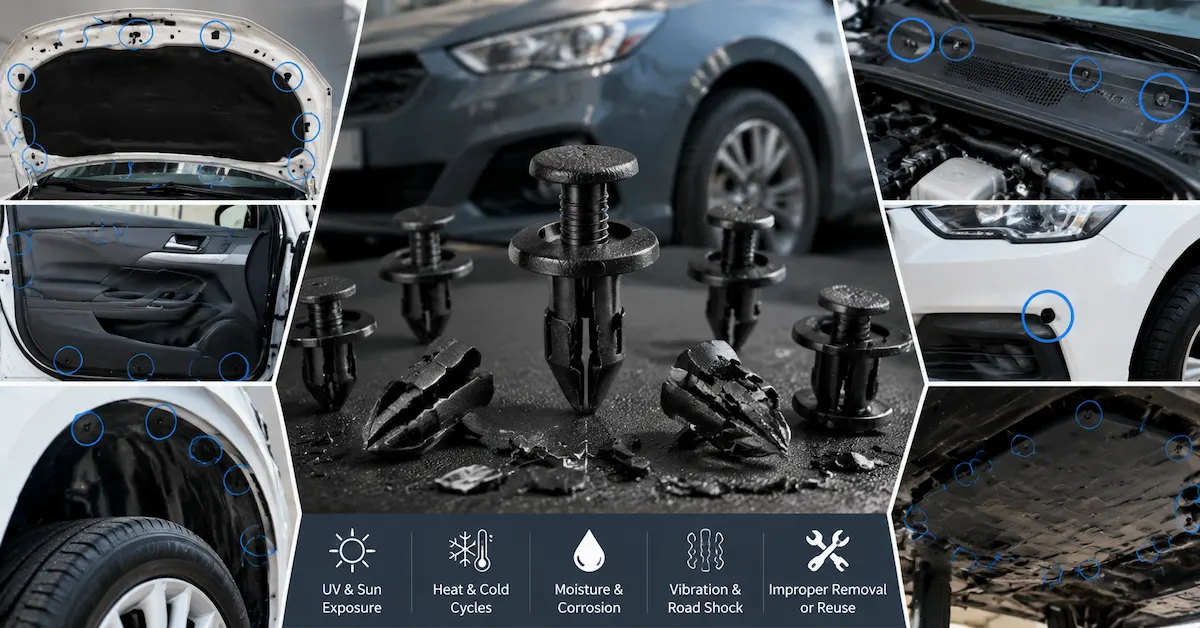
How could this clip fail in its actual installation environment?
A bumper or wheel-arch fastener may be exposed to vibration, moisture, dirt, impact, and temperature changes.
A door-panel retainer may need to hold trim securely while helping control movement or noise.
A headliner fastener may have different mechanical and appearance requirements.
QC should therefore relate to the specific application.
A practical inspection chain can include:
Raw material control → Molding inspection → Appearance inspection → Dimensional inspection → Fitment verification → Functional testing → Final inspection → Batch traceability
Depending on the product and customer requirement, additional evaluation may include temperature, impact, tensile, aging, or related performance testing.
B2B buyers should ask what is actually controlled for the SKU or custom project being purchased instead of assuming that every automotive fastener receives an identical test program.
Fitment Data Is Part of the Product
For distributors and e-commerce sellers, the physical clip is only part of what they are purchasing.
Poor product data creates commercial problems.
It can lead to:
- incorrect customer orders,
- marketplace returns,
- customer-service questions,
- warehouse identification problems,
- duplicated SKUs,
- poor stock planning,
- and slow-moving inventory.
Useful automotive clip documentation may include:
- supplier product code,
- dimensions,
- material,
- clip type,
- installation position,
- vehicle reference,
- OE or cross-reference information,
- pack quantity,
- product photography,
- and application notes.
This is particularly important for vehicle-specific car clips.
A product being classified as “for Toyota,” “for BMW,” or “for Volkswagen” should not automatically be interpreted as compatible with every vehicle from that brand.
Model, year, generation, mounting position, OE reference, dimensions, and physical verification can still matter.
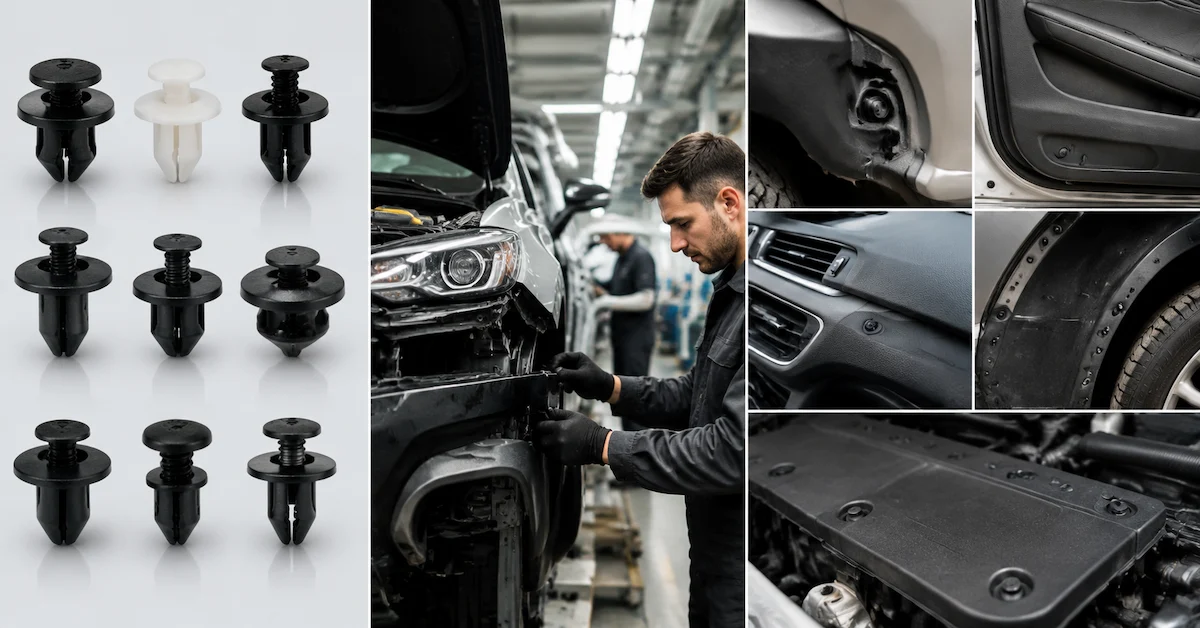
QEEPEI's product range is organized across both application-based and vehicle-oriented categories, including bumper, door interior, fender, ceiling, seal strip, hood, glass, wheel-arch, specific-fit clips, clip kits, and removal tools.
Product Range and Stock Depth Are Not the Same Thing
Procurement teams should distinguish between three different supplier metrics:
Catalog range tells buyers how many different products the supplier can potentially provide.
Stocked SKUs indicates how many part numbers are routinely maintained as inventory items.
Physical inventory quantity describes how many individual pieces are available.
These numbers serve different purposes.
A broad catalog can help a distributor consolidate suppliers.
A strong stocked-SKU program helps reduce replenishment lead time.
High physical inventory quantities matter when demand is concentrated on fast-moving products or when emergency supply is required.
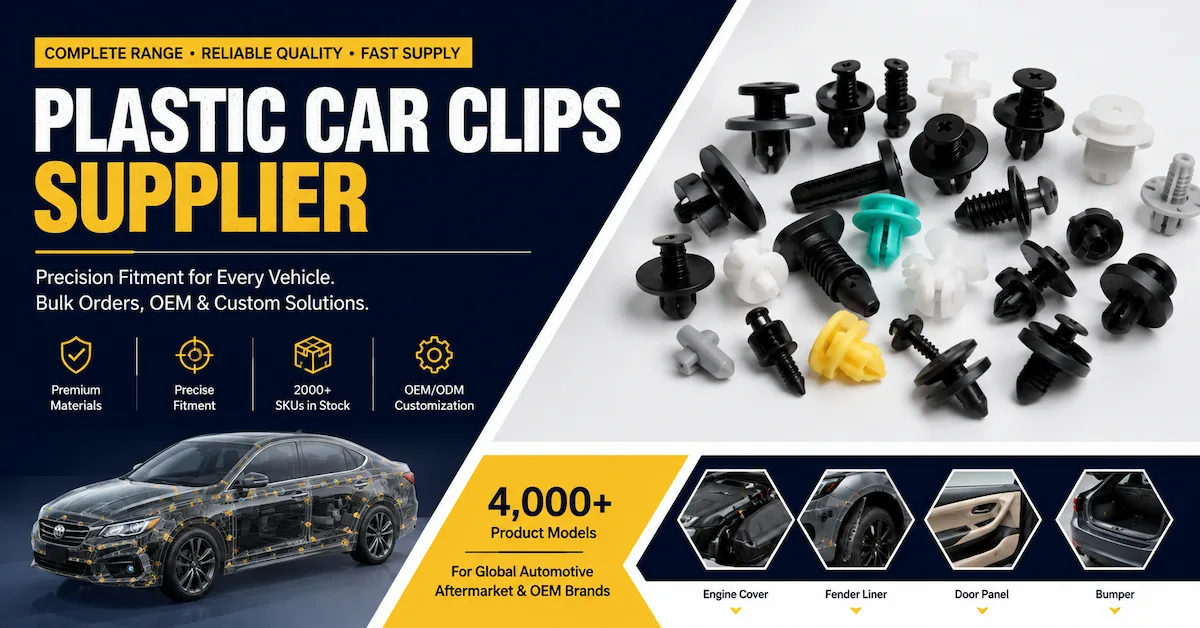
QEEPEI currently presents more than 4,000 product models and more than 2,000 stocked SKUs across its automotive fastener business.
For B2B buyers, this combination can support both assortment development and routine replenishment.
However, buyers should still confirm the actual stock status and requested quantity for individual SKUs before finalizing an order.
Packaging Can Change the Commercial Value of the Same Clip
A bulk bag of automotive clips and a private-label retail kit may contain similar fasteners but serve completely different business models.
For wholesalers supplying workshops, simple bulk packaging may be the most efficient option.
For e-commerce sellers, supermarkets, and aftermarket brands, packaging can directly affect warehouse handling, listing consistency, retail presentation, and customer experience.
Packaging options may include:
- bulk bags,
- defined-quantity packs,
- assortment kits,
- retail boxes,
- barcode labels,
- branded bags,
- custom logos,
- color boxes,
- and buyer-specific labeling.
This means packaging should be discussed early in the sourcing process rather than after production is complete.
Brand owners developing their own automotive clip line can review QEEPEI's brand-owner and customization capabilities when evaluating private-label packaging, product development, and OEM/ODM requirements.
Different Buyers Need Different Supplier Scorecards
There is no universal supplier-selection formula.
A distributor and a repair chain may buy similar clips but measure supplier performance differently.
| Buyer Type | Highest-Priority Supplier Criteria |
|---|---|
| Auto parts distributor | SKU coverage, fitment data, replenishment, batch consistency |
| E-commerce seller | Accurate dimensions, photos, packaging, barcode, return reduction |
| Repair shop / chain | Common repair SKUs, quick identification, kits, emergency replenishment |
| Body-shop supplier | Bumper, fender, liner, molding, and trim coverage |
| Private-label brand | Tooling, OEM/ODM, packaging, product differentiation, IP protection |
| Supermarket buyer | Retail-ready packaging, barcode control, volume stability |
| Vehicle-fit buyer | Make/model/year/OE matching, dimensions, sample verification |
Repair networks should pay particular attention to identification speed.
If technicians spend unnecessary time searching for the correct clip, the purchasing problem becomes a labor-efficiency problem as well.
QEEPEI's auto repair chain solution focuses on fastener supply, assortment planning, replenishment, and repair-channel support.
What Buyers Should Expect From an Integrated Automotive Clips Supplier
For long-term sourcing, several capabilities work better when they are connected rather than managed independently.
QEEPEI's current automotive fastener business combines:
Product range: more than 4,000 product models covering multiple body applications, specific-fit parts, kits, and tools.
Stock support: more than 2,000 stocked SKUs for aftermarket sourcing and replenishment.
Manufacturing: in-house injection molding, tooling, engineering, and production support.
Material options: PA, PP, and POM for different automotive clip designs and applications.
Fitment support: product identification based on application, vehicle information, dimensions, reference information, and samples.
OEM/ODM: support from existing sample or project requirements through tooling, trial samples, validation, and production.
Private label: custom packaging, logos, labels, barcodes, assortment configuration, and retail presentation.
Sales support: product images, SKU information, fitment documentation, and related materials for B2B channels.
These capabilities become more valuable when a buyer needs to move from individual product purchases to a repeatable supply program.
A 10-Point Automotive Clips Supplier Checklist
Before approving a supplier, B2B buyers should verify the following:
- Product identification: Can the supplier work from samples, dimensions, OE references, or vehicle information?
- Fitment confirmation: Are make, model, year, mounting location, and dimensions checked where relevant?
- Material control: Can the supplier clearly define and maintain the required material?
- Manufacturing control: Does it control molding and tooling for the products being supplied?
- Quality control: Are appearance, critical dimensions, fitment, and functional requirements checked?
- Sample approval: Can the buyer approve a reference sample before mass production or a custom order?
- Inventory support: Are relevant fast-moving SKUs actually stocked?
- Packaging capability: Can the supplier support bulk, retail, barcode, and private-label formats?
- OEM/ODM capability: Can new or modified clips be developed when standard products do not meet the requirement?
- Repeat-order consistency: Can future orders reproduce the agreed product specification and packaging?
The strongest supplier is usually the one that can reduce sourcing uncertainty across several of these areas at the same time.
Common Red Flags When Comparing Automotive Clip Suppliers
An unusually low quotation should trigger more questions rather than an immediate purchasing decision.
Potential warning signs include:
- unclear dimensions,
- no confirmed material information,
- fitment based only on appearance,
- inconsistent product codes,
- vague packaging quantities,
- no sample-approval process,
- overly broad vehicle compatibility claims,
- and no clear repeat-order control.
A clip labeled for a particular vehicle brand does not necessarily fit every model or mounting position from that brand.
The real cost of a sourcing mistake can include much more than the clip itself:
wrong fitment + returns + rework + duplicated inventory + customer support + emergency replenishment
For professional procurement, supplier evaluation should therefore consider total sourcing risk rather than purchase price alone.
FAQ
1. What should I ask an automotive clips supplier before ordering?
Ask for dimensions, material, application, fitment information, packaging quantity, stock status, sample availability, QC procedures, and repeat-order control. For custom parts, also discuss tooling and sample approval.
2. Can automotive clips be selected only by vehicle brand?
No. Vehicle brand should normally be combined with model, year or generation, installation location, OE/reference number, dimensions, and fitment verification.
3. Which material is best for automotive clips?
There is no universal best material. PA, PP, and POM offer different characteristics, so material selection should depend on clip geometry and the actual service environment.
4. Which dimensions are most important when matching a clip?
Hole diameter, stem diameter, stem length, head diameter, panel thickness, and locking geometry are among the most useful measurements.
5. Should distributors purchase individual SKUs or clip kits?
High-volume repeat applications are often better managed as individual SKUs, while assortment kits can help workshops, retailers, and service technicians cover multiple clip types efficiently.
6. Can an automotive clip be developed from an existing sample?
Yes, when the supplier has engineering and tooling capability. The normal process may include sample analysis, measurement, material selection, mold development, trial sampling, verification, approval, and production.
7. Why does repeat-order consistency matter?
Small changes in dimensions, material, or locking geometry can change installation and retention behavior. Repeat orders should therefore follow an approved specification or reference sample.
8. Can automotive clips use private-label packaging?
Yes. Depending on the sourcing program, packaging may include custom bags, boxes, labels, logos, barcodes, and different assortment configurations.
9. How can e-commerce sellers reduce automotive clip returns?
Use accurate dimensions, clear application information, complete kit contents, consistent photography, vehicle references where relevant, and easy-to-identify packaging.
10. What information should I send when requesting a quotation?
Send the product code if known, photos or samples, OE/reference number, vehicle information, critical dimensions, required quantity, target packaging, and any OEM/ODM requirements. You can submit this information through the QEEPEI contact page.
Conclusion
Choosing the right automotive clips supplier means evaluating fitment support, material control, injection molding, QC, inventory, packaging, and repeat-order consistency together—not simply comparing unit prices. A supplier that reduces wrong-fit parts, returns, stock gaps, and sourcing complexity can deliver greater long-term value for distributors and automotive aftermarket buyers.
If you are planning a new sourcing program, review QEEPEI's automotive clips and fastener range, then contact QEEPEI with your OE numbers, dimensions, samples, target quantities, or packaging requirements to discuss product matching, samples, bulk quotations, or OEM/ODM development.