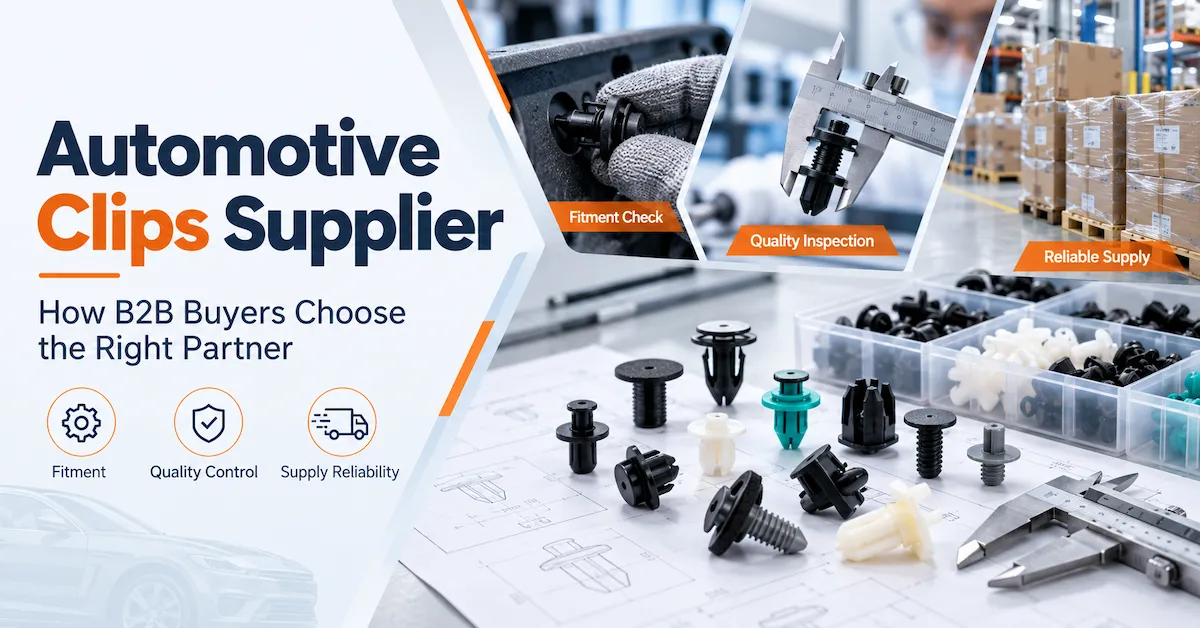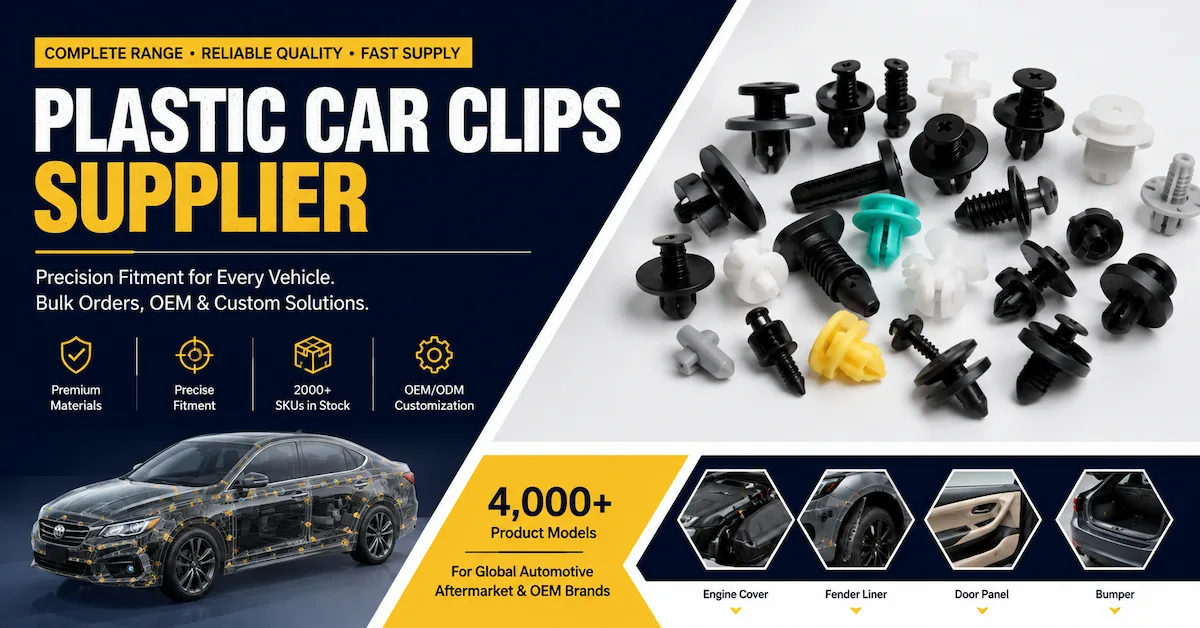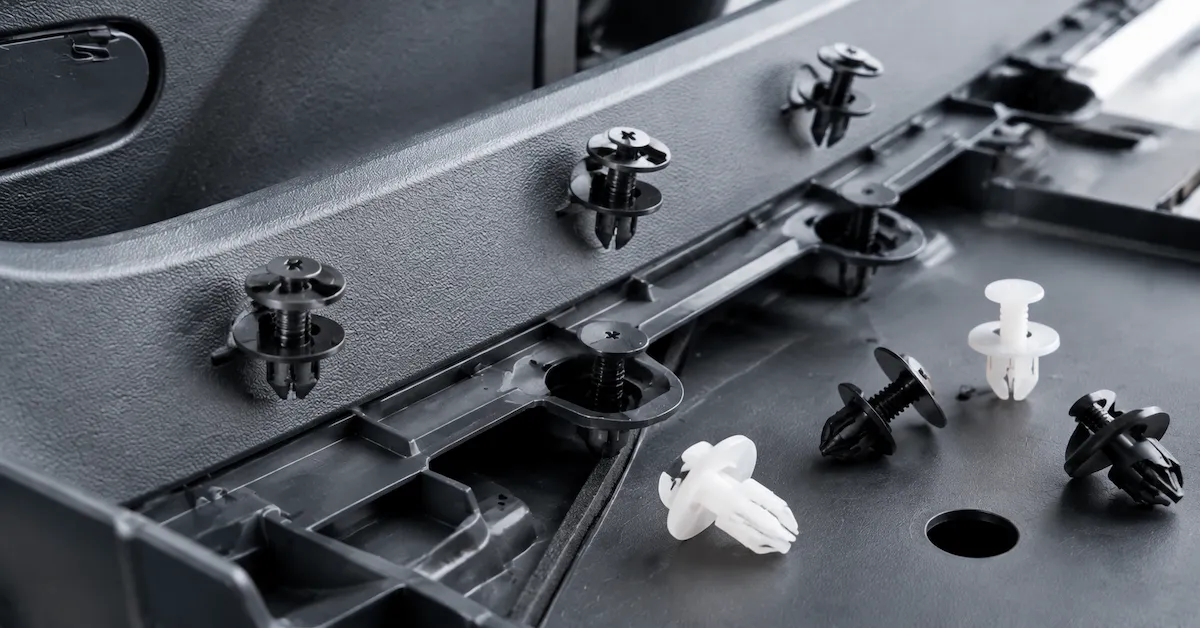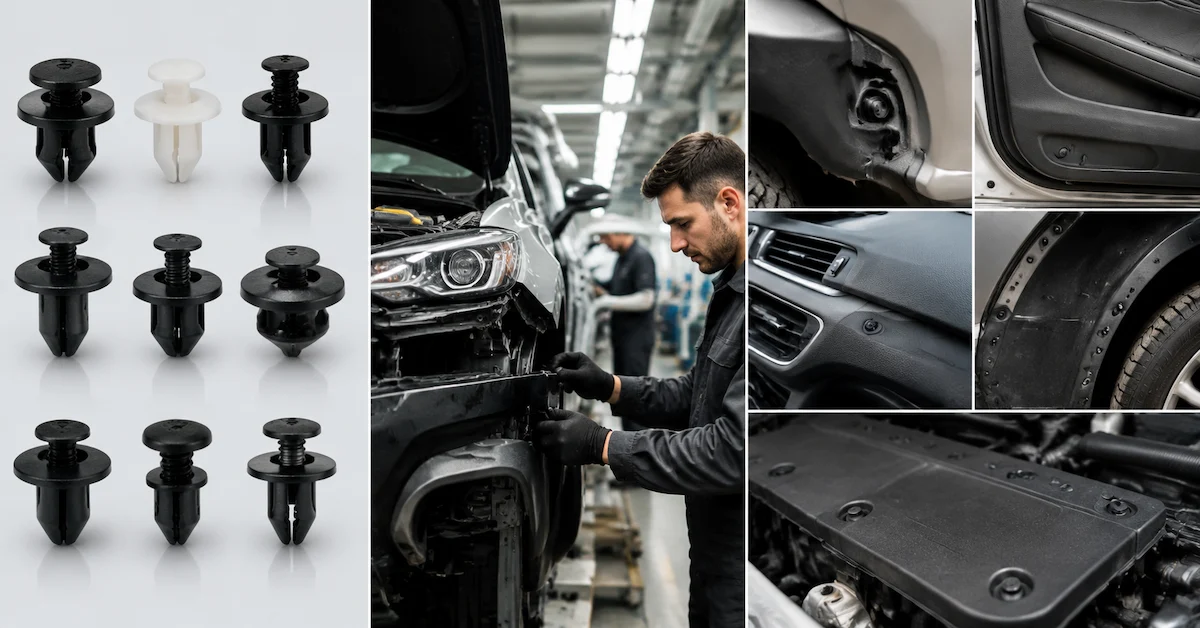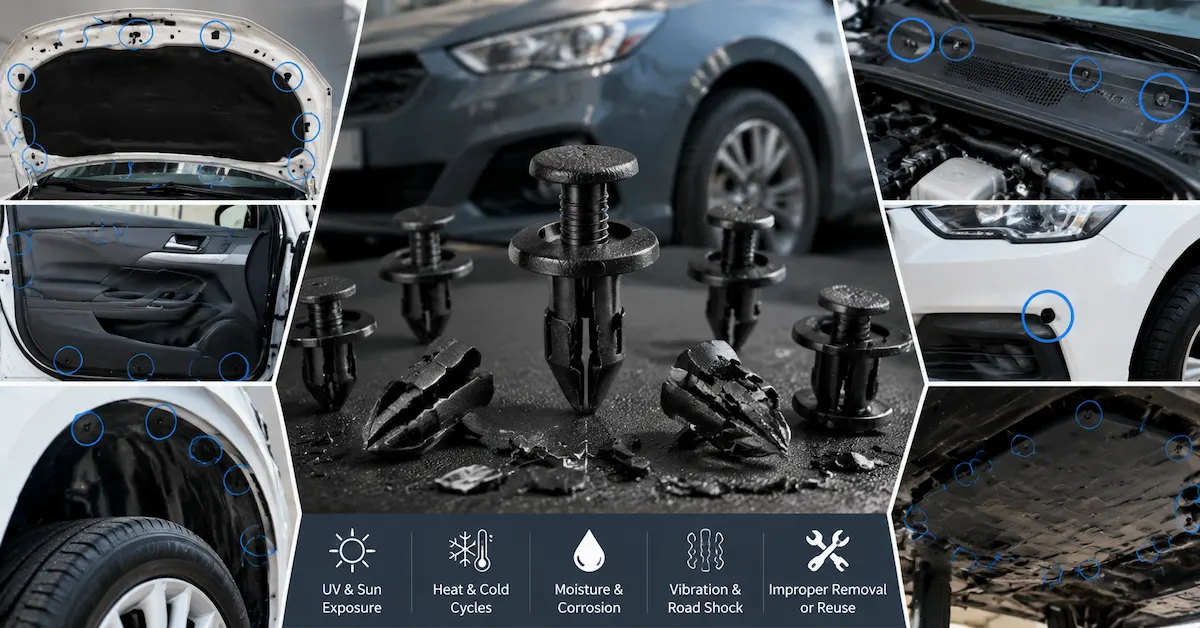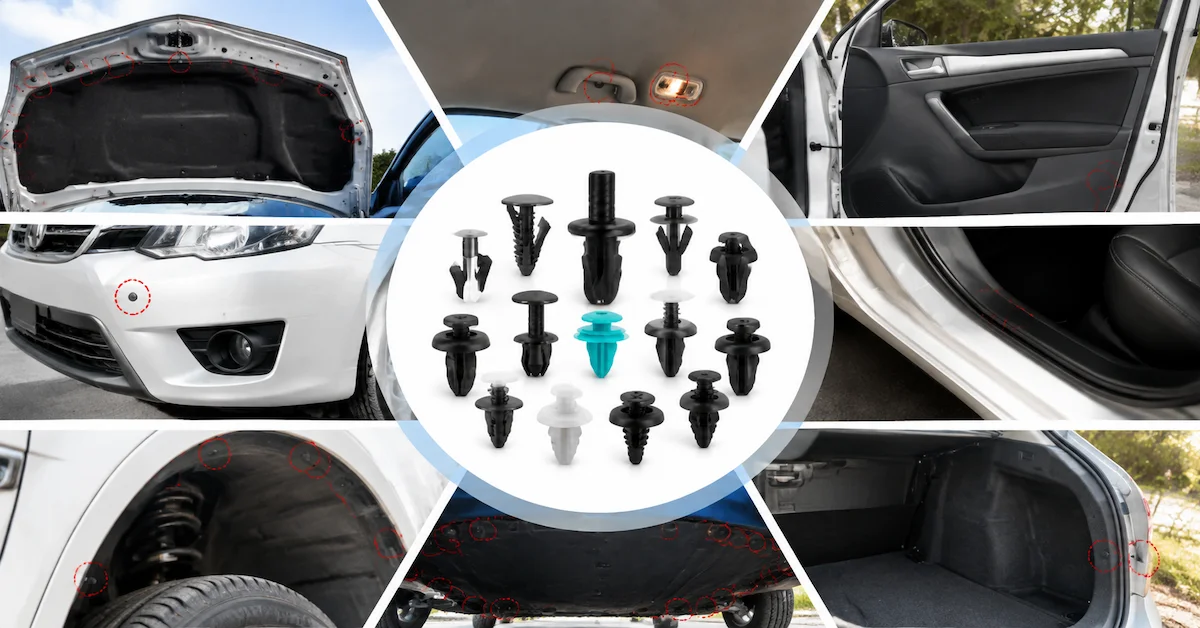

When B2B buyers search for a car clips manufacturer, they often face two choices: buying directly from a factory or working with a trading company. Both options can supply automotive clips, bumper clips, door panel clips, fender liner clips, push retainers, screw grommets, and car clip kits. However, the right choice depends on your order volume, quality requirements, customization needs, packaging plan, and long-term supply goals.
For small trial orders, a trading company may seem convenient because it can collect different products from multiple sources. But for bulk orders, private label projects, stable replenishment, and OEM/ODM development, working with a real manufacturer usually provides stronger control over quality, cost, lead time, and technical support.
QEEPEI provides a wide range of automotive clips and car fasteners, including car body clips, car clip kits, specific fit car clips, and clip tools for global B2B buyers.
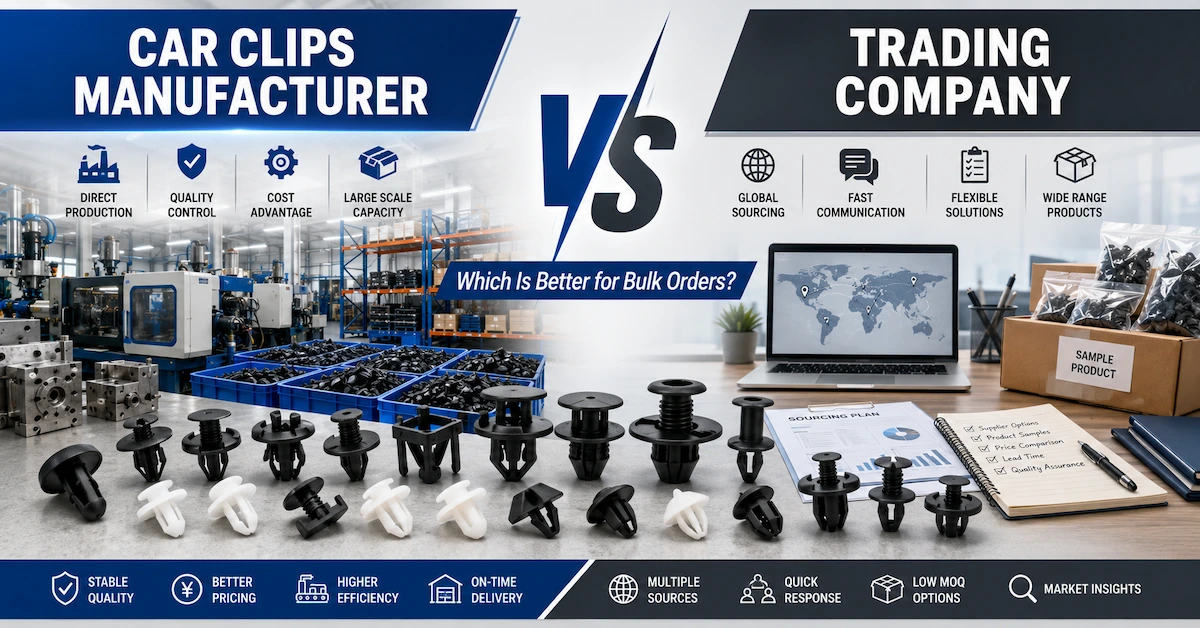
What Is a Car Clips Manufacturer?
A car clips manufacturer is a factory that produces automotive plastic clips and fasteners through manufacturing processes such as injection molding, mold development, material selection, production inspection, and packaging.
A manufacturer usually controls:
- Raw material selection
- Mold design and maintenance
- Injection molding production
- Dimensional consistency
- Quality inspection
- Product development
- OEM/ODM customization
- Bulk packaging and private label packaging
- Long-term stock planning
For buyers who need stable quality and repeat supply, a manufacturer can provide better visibility into how products are made and controlled.
What Is a Trading Company?
A trading company does not always produce the clips itself. It usually sources products from different factories and sells them to overseas buyers. Some trading companies have strong sourcing ability and can help buyers collect different products quickly.
A trading company may be useful when:
- The order quantity is small
- The buyer wants to test many product types
- The buyer does not need customization
- The buyer only needs standard market items
- The buyer prefers one contact for mixed sourcing
However, for bulk car clips orders, the buyer should carefully check whether the trader can control quality, maintain consistent batches, and support repeat supply.
Manufacturer vs Trading Company: Key Comparison
| Comparison Point | Car Clips Manufacturer | Trading Company |
|---|---|---|
| Production control | Direct control over molding, materials, and QC | Depends on supplier network |
| Price stability | Usually stronger for bulk orders | May include extra sourcing margin |
| Customization | Better for OEM/ODM, mold, color, size, packaging | Limited by factory partners |
| Quality consistency | Easier to trace and control | Can vary between factories |
| Product development | Stronger technical support | Usually weaker technical depth |
| MOQ flexibility | May require reasonable factory MOQ | May be flexible for small orders |
| Lead time control | More direct production planning | Depends on third-party factories |
| Long-term supply | Better for repeat orders | Depends on sourcing stability |
| Communication | Technical questions can be answered faster | May need to relay information |
| Best for | Bulk buyers, distributors, OEM projects | Small trial orders or mixed sourcing |
For serious B2B buyers, the decision should not be based only on price. It should be based on which partner can reduce long-term sourcing risk.
Why Bulk Orders Usually Need a Manufacturer
Bulk orders create higher business risk. If one batch has weak clips, wrong dimensions, poor packaging, or inconsistent material, the problem may affect thousands of products. This can lead to customer complaints, returns, repair delays, and lost trust.
A car clips manufacturer is usually better for bulk orders because it can control the full production process.
Key advantages include:
1. Better Material Control
Plastic car clips must withstand vibration, heat, moisture, aging, and repeated installation pressure. If a supplier uses poor material, clips may become brittle, crack, or lose locking force.
Common materials include:
| Material | Main Advantage | Suitable Use |
| PA Nylon | Flexible, strong, wear-resistant | Bumper clips, trim clips, push retainers |
| PP | Lightweight and cost-effective | Interior and light-duty clips |
| POM | Good dimensional stability | Precision locking clips |
| Reinforced plastic | Higher strength under stress | High-load fastening points |
A real manufacturer can better control material consistency from batch to batch. This is important for distributors and repair supply chains that need stable repeat sales.
2. Better Mold and Size Control
Many car clips look similar but differ in head diameter, stem length, hole size, panel thickness range, and locking structure. Small dimension errors can cause poor fitment.
A manufacturer can control mold precision and adjust product dimensions when needed. This is especially important for:
- Bumper clips
- Door panel clips
- Fender liner clips
- Wheel arch clips
- Dashboard clips
- Screw grommets
- Specific fit clips
If you need to source clips by vehicle application or OE reference, manufacturing capability becomes more important than simple product trading.
3. Stronger OEM/ODM Support
For private label brands, distributors, and large retailers, standard products are not always enough. They may need custom packaging, custom colors, specific sizes, branded kits, or new product development.
A car clips manufacturer can support:
- Sample-based development
- Drawing-based development
- Mold modification
- Material selection
- Color customization
- Retail packaging
- Barcode labels
- Private label kits
- Bulk and mixed packaging
If you are developing your own product line, manufacturer support can help you build a stronger and more differentiated catalog.
When a Trading Company May Still Be Useful
A trading company is not always a bad choice. It may be useful for certain buying situations, especially when the buyer is still testing the market.
A trading company may work well if:
- You need very small trial quantities
- You want to combine many unrelated products
- You are not ready for OEM/ODM development
- You want market samples before deciding
- You do not have strict technical requirements
However, once your business moves into regular bulk orders, private label packaging, or stable SKU planning, a manufacturer is usually the better long-term partner.
What B2B Buyers Should Check Before Choosing
Before choosing between a manufacturer and a trading company, buyers should ask practical questions.
| Question | Why It Matters |
| Do they produce the clips themselves? | Confirms factory capability |
| Can they show product categories clearly? | Shows sourcing and production range |
| Can they explain materials? | Indicates technical knowledge |
| Can they provide dimensions and fitment support? | Reduces wrong orders |
| Can they support repeat bulk orders? | Ensures supply stability |
| Can they customize packaging? | Supports resale and private label business |
| Do they have QC procedures? | Reduces defective products |
| Can they support OEM/ODM? | Helps custom projects |
| Can they handle mixed SKUs? | Useful for distributors |
| Do they respond professionally? | Affects long-term cooperation |
If a supplier cannot answer these questions clearly, buyers should be cautious.
Product Range Matters for Bulk Buyers
A professional car clips manufacturer should provide more than one universal clip. Bulk buyers usually need a complete product structure.
Important product categories include:
| Product Category | Common Application | Buyer Value |
| Bumper clips | Front and rear bumper repair | High replacement demand |
| Door panel clips | Interior door trim repair | Common workshop item |
| Fender liner clips | Wheel arch and liner fixing | Strong body repair demand |
| Push retainers | General panel fastening | Wide use |
| Screw grommets | Screw base fastening | Stronger connection |
| Seal strip clips | Weatherstrip fixing | Helps sealing and noise control |
| Hood clips | Engine bay and hood liner fixing | Needs heat resistance |
| Dashboard clips | Navigation and interior panels | Needs accurate fitment |
| Car clip kits | Repair shops and online sales | Easy inventory solution |
| Clip tools | Trim removal and installation | Supports repair workflow |
QEEPEI’s product page helps buyers source clips by application area, kit type, and vehicle-specific needs.
Packaging and Private Label Support
For many B2B buyers, packaging is part of the product value. A bulk bag may be enough for a repair shop supplier, but online sellers and retail buyers often need better presentation.
Common packaging options include:
| Packaging Type | Best For |
| Bulk bags | Distributors and repair shops |
| Small packs | Retail stores and DIY users |
| Assortment kits | Workshops and e-commerce |
| Color boxes | Supermarkets and retail shelves |
| Private label packaging | Brand owners and online sellers |
| Barcode packaging | Inventory and retail management |
A manufacturer with packaging support can help buyers build retail-ready products, reduce repacking costs, and improve product presentation.
For B2B cooperation and wholesale solutions, buyers can visit the QEEPEI Wholesale page.
Quality Control: The Biggest Difference
Quality control is often where manufacturers and trading companies differ most. A manufacturer can inspect raw materials, molding quality, dimensions, locking force, appearance, and packaging before shipment.
Important QC points include:
- Raw material inspection
- Injection molding consistency
- Head diameter and stem length checks
- Hole fit and locking function
- Flexibility and breakage inspection
- Appearance and burr inspection
- Quantity and packaging verification
- Batch traceability
Trading companies may also perform inspection, but they often depend on the factory’s process. For large orders, direct factory QC gives buyers more confidence.
Why QEEPEI Is Suitable for Bulk Car Clips Buyers
QEEPEI focuses on automotive clips, plastic fasteners, car clip kits, specific fit clips, and clip tools. For global B2B buyers, QEEPEI supports product selection, bulk supply, packaging, OEM/ODM development, and application matching.
QEEPEI is suitable for:
- Auto parts distributors
- Repair shop suppliers
- Online sellers
- Private label automotive brands
- Supermarket and retail buyers
- Buyers needing specific fit car clips
To understand QEEPEI’s company background and supply capability, visit the About Us page. For quotation, bulk order support, or custom packaging requests, contact QEEPEI through the Contact Us page.
FAQ
1. Is a car clips manufacturer better than a trading company?
For bulk orders, OEM/ODM projects, and long-term supply, a car clips manufacturer is usually better because it controls production, material, mold, and QC more directly.
2. When should I choose a trading company?
A trading company may be useful for small trial orders, mixed sourcing, or early market testing when customization and strict QC are not required.
3. What should I check before choosing a car clips manufacturer?
Check product range, material quality, mold capability, fitment support, quality control, stock capacity, packaging options, and export experience.
4. Can a manufacturer support private label car clips?
Yes. A manufacturer can usually support private label packaging, barcode labels, color boxes, assortment kits, and customized product lines.
5. Why is mold capability important?
Mold capability affects dimension accuracy, clip locking performance, product consistency, and the ability to develop custom clips.
6. What car clips are common in bulk orders?
Common products include bumper clips, door panel clips, fender liner clips, push retainers, plastic rivets, screw grommets, and car clip kits.
7. Does a lower price always mean better value?
No. Low price may come with poor material, weak fitment, inconsistent quality, or slow replenishment. Bulk buyers should evaluate total sourcing risk.
8. Can car clips be customized by size or color?
Yes. Many plastic car clips can be customized by size, color, material, structure, mold, and packaging through OEM/ODM service.
9. How can buyers reduce wrong-fit orders?
Use accurate dimensions, application data, product images, samples, and supplier fitment support before confirming bulk orders.
10. Where can I source car clips in bulk?
You can browse QEEPEI’s car clips and automotive fasteners or contact QEEPEI through the Contact Us page for bulk orders, OEM/ODM projects, and packaging customization.
Conclusion
When comparing a car clips manufacturer and a trading company, the best choice depends on your business stage and purchasing goal. A trading company may be useful for small test orders or mixed sourcing. But for bulk orders, long-term replenishment, private label projects, and OEM/ODM development, a manufacturer usually provides stronger control and better long-term value.
For B2B buyers, the right partner should provide more than low pricing. It should offer stable materials, accurate fitment, quality control, packaging flexibility, stock support, and professional communication. QEEPEI supports global buyers with automotive clips, plastic fasteners, car clip kits, specific fit solutions, and custom packaging options.
Explore QEEPEI’s full automotive clips product range to build a more reliable bulk sourcing plan.