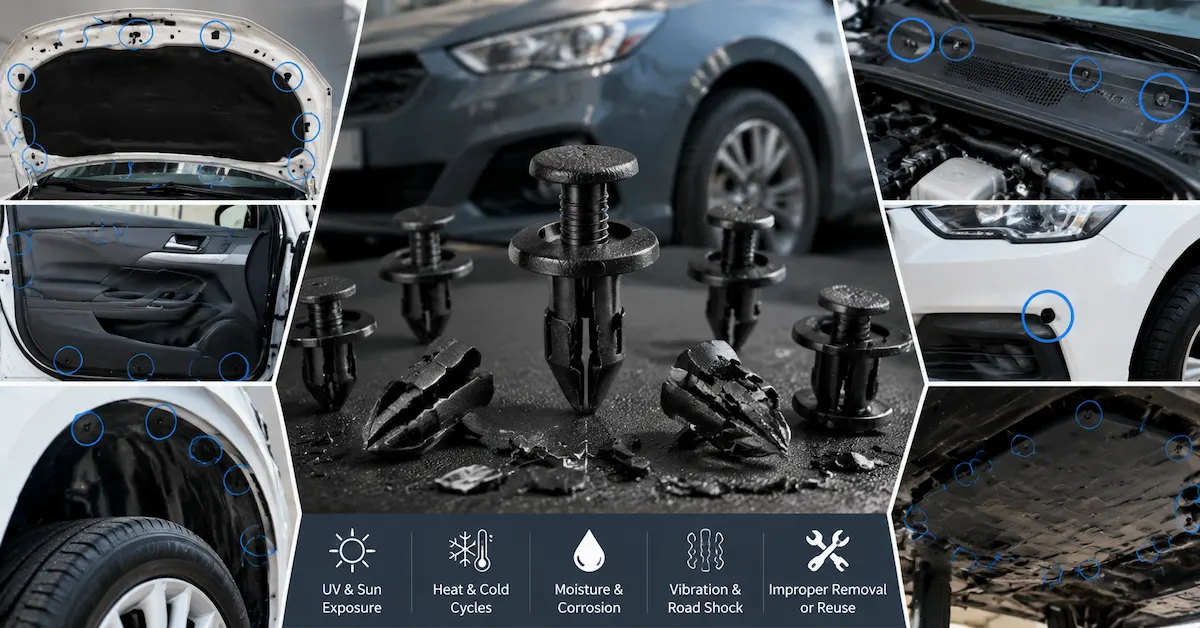

The best material for an automotive clip is not simply the strongest plastic or the most expensive engineering polymer.
A reliable clip must combine the correct material, geometry, mounting-hole size, panel thickness, insertion force, retention force, temperature resistance, and service environment. A material that works well for a door trim retainer may not be the right choice for a clip located near an engine compartment, wheel arch, weatherstrip, or exterior molding.
For distributors, repair-parts suppliers, private-label brands, and automotive aftermarket buyers, this distinction matters because two clips can look almost identical while behaving very differently after installation.
One important clarification should also be made immediately:
Nylon is not a separate polymer family from PA. Nylon is the common name used for many polyamide materials, including PA6 and PA66.
BASF's automotive polyamide portfolio, for example, includes PA6, PA66 and related polyamides, and highlights their mechanical strength, stiffness and thermal stability.
So when a supplier describes a fastener only as a “nylon clip,” a professional buyer should ask:
Which nylon? PA6? PA66? Modified PA? Reinforced or unreinforced?
That answer can be more useful than the word “nylon” itself.
Why Material Selection Matters in Automotive Clips
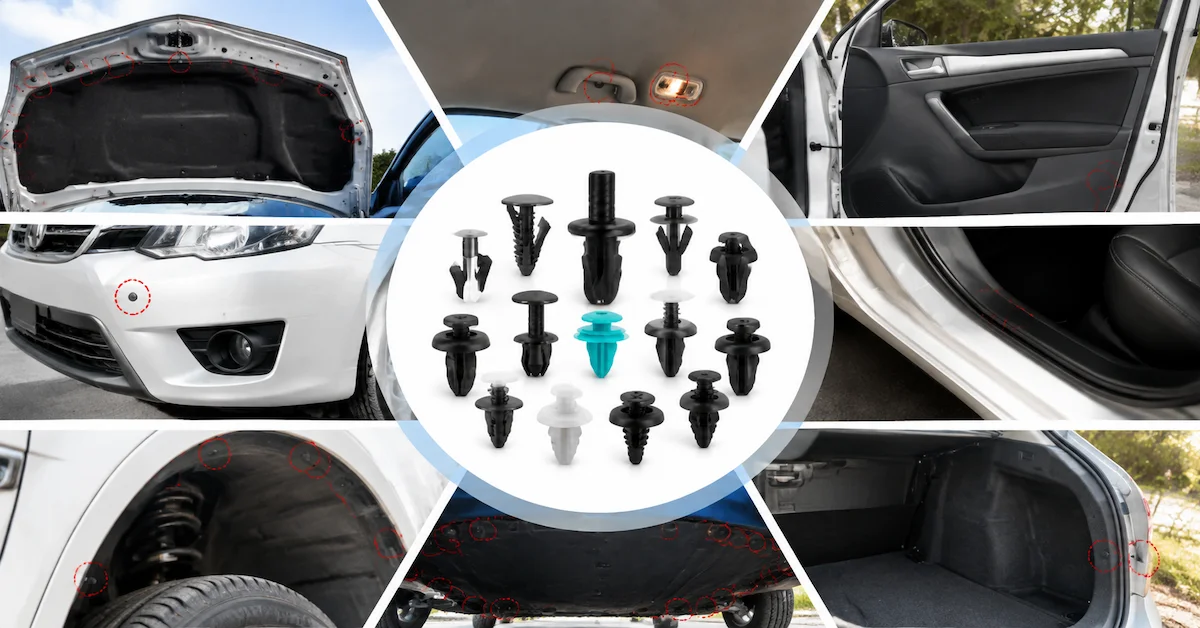
An automotive clip is a small component, but its job is mechanically demanding.
Depending on the application, the clip may need to:
- flex during installation without cracking;
- recover after its locking legs pass through the mounting hole;
- maintain retention under vibration;
- resist creep during long-term loading;
- tolerate heat and cold cycles;
- remain dimensionally stable;
- withstand moisture, oils, cleaners, dirt, or road chemicals;
- survive removal and reinstallation;
- avoid squeaks, rattles, and panel movement.
This is why material selection should be considered together with clip geometry.
A thicker or stiffer material does not automatically create a better fastener. If the locking leg becomes too stiff, insertion force may rise and the part may become harder to install. If the resin is too soft for the geometry, long-term retention may suffer.
When comparing products in the QEEPEI automotive clips range, material should therefore be treated as one part of the complete fitment specification rather than as an isolated selling point. QEEPEI's own company information identifies PA, PP and POM among the raw materials used for its automotive fastening products.
PA, PP, POM, and Nylon Car Clips at a Glance
The following comparison is a practical selection guide rather than a universal material specification. Actual performance depends on the resin grade, additives, reinforcement, clip geometry, molding conditions, and operating environment.
| Material | Key Characteristics | Main Advantage for Clips | Main Selection Concern | Typical Application Direction |
|---|---|---|---|---|
| PA6 / Nylon 6 | Tough, strong, flexible engineering polyamide | Good balance of snap action and mechanical performance | Moisture can influence dimensions and properties | Trim clips, panel retainers, general automotive fasteners |
| PA66 / Nylon 66 | Strong, stiff, thermally capable polyamide | Suitable for more demanding mechanical or thermal conditions | Grade and moisture conditioning still matter | Higher-load or warmer fastening locations |
| PP | Lightweight, chemically resistant, processable, available in impact-modified grades | Useful where flexibility, low density and economical molding matter | May not provide the same stiffness or thermal performance as some engineering polymers | Interior trim, lighter-duty retainers, selected exterior applications |
| POM / Acetal | Dimensionally stable, low friction, wear resistant | Excellent for precise molded locking and sliding features | Geometry must account for its different stiffness and impact behavior | Precision retainers, locking parts, moving or sliding fastener features |
| Glass-Filled PA | Higher stiffness and structural capability | Useful where additional rigidity is required | Extra stiffness is not automatically better for flexible snap legs | Selected structural fasteners designed specifically for reinforced resin |
BASF describes PA materials as offering high mechanical strength, stiffness and thermal stability, while Celanese highlights POM for dimensional stability, wear behavior, toughness and moisture resistance. LyondellBasell describes polypropylene as an important automotive thermoplastic used across interior and exterior applications.
PA and Nylon Car Clips: The Most Important Terminology to Understand
PA Means Polyamide
“PA” is the material-family abbreviation for polyamide.
“Nylon” is a commonly used commercial term for several polyamides.
Therefore:
- Nylon 6 = PA6
- Nylon 66 = PA66
A purchasing specification saying only “nylon fastener” is incomplete if mechanical consistency matters.
PA6 Car Clips
PA6 can provide a useful combination of toughness, strength, elastic behavior, and moldability.
For snap-fit automotive parts, those characteristics can be valuable because the legs or barbs of the clip need to deform temporarily during installation and then recover enough to hold the panel.
PA6 may be considered for applications such as:
- interior trim clips;
- door panel retainers;
- lining clips;
- bumper-related retainers;
- general push-type fasteners.
However, buyers should not select PA6 simply because the original part looks like nylon. Hole diameter, stem diameter, panel thickness, head size, locking geometry, and application temperature still need to match.
PA66 Car Clips
PA66 is also widely used as an engineering polyamide and is often considered where stiffness, strength, or thermal demands are higher.
BASF specifically markets PA66-based grades for automotive applications requiring high mechanical and thermal performance.
This does not mean every PA66 clip is automatically superior to a PA6 clip.
For a flexible snap arm, additional stiffness may increase insertion force if the geometry was not designed for it. Material and tooling therefore have to be engineered together.
Moisture Matters for Polyamide
One of the major differences between polyamide and materials such as PP or POM is moisture behavior.
Polyamide can absorb moisture from its environment. That moisture can influence mechanical behavior and dimensional stability, which is why professional material selection should consider both the dry condition and the conditioned service state. BASF also notes the influence of humidity on PA mechanical performance in its engineering-polymer documentation.
For B2B buyers, this creates an important question:
Was the clip designed and tested using the actual resin condition expected in service?
PP Car Clips: When Flexibility and Lightweight Design Matter
Polypropylene, or PP, is widely used throughout the automotive industry. LyondellBasell identifies PP as a major automotive thermoplastic and offers impact-modified polypropylene compounds for vehicle applications.
PP can be attractive for fastener applications because it offers:
- low density;
- good processability;
- chemical resistance;
- useful toughness;
- flexibility depending on grade;
- economical high-volume injection molding.
For certain interior retainers and lighter-duty clips, this combination can be more appropriate than simply specifying a high-stiffness engineering resin.
Where PP Can Make Sense
Potential application areas include:
- interior trim;
- lightweight covers;
- panel attachments;
- selected flexible retainers;
- non-high-temperature fastening positions.
Automotive PP compounds are also used in bumper, grille, cladding and other exterior systems, although the compound formulation for a large molded automotive panel is not necessarily the same formulation that should be used for a small clip.
This distinction is important.
A buyer should never assume:
“The bumper is PP, so the bumper clip must also be PP.”
The two parts perform different mechanical functions.
For example, a car bumper clip must be selected according to its locking structure, hole fit, retention requirement and service location—not merely the material of the surrounding bumper cover.
POM Car Clips: A Strong Choice for Precision and Dimensional Stability
POM stands for polyoxymethylene, commonly called acetal.
Its material behavior differs significantly from both PP and PA.
Celanese describes its Hostaform/Celcon POM materials as providing dimensional stability, wear resistance, toughness, sliding properties and resistance to moisture and several chemicals.
Those characteristics make POM particularly interesting where a fastener includes:
- precise locking geometry;
- moving engagement surfaces;
- sliding contact;
- tight dimensional relationships;
- repeated mechanical interaction;
- mechanisms where low friction is useful.
When POM May Be Better Than Nylon
POM may deserve consideration where dimensional stability and low moisture sensitivity are more important than the specific elastic behavior offered by a nylon grade.
Examples may include precision latches, locking elements, guides, or specialized retainers.
But again, “POM is better” is not a valid universal conclusion.
A highly flexible snap-fit geometry may behave differently in POM than in PA6 or PA66. The mold and part geometry must be developed for the selected resin.
PA vs PP vs POM: Which Material Is Best for Different Car Clip Applications?
Door Panel and Interior Trim Clips
For car door interior clips, buyers usually need a balance between:
- controlled insertion force;
- good elastic recovery;
- sufficient retention;
- resistance to vibration;
- reduced risk of cracking during removal.
PA-based materials can be strong candidates where the snap geometry requires good mechanical performance.
PP may be useful for lighter-load applications where flexibility is valuable.
POM may be considered when precise dimensions or sliding/locking behavior dominate the design.
The correct answer ultimately depends on the OEM geometry and mounting interface.
Bumper and Fender Clips
Bumper and fender applications can face:
- vibration;
- water;
- dirt;
- temperature cycling;
- impact;
- outdoor exposure.
Material selection should therefore account for both mechanical requirements and environmental exposure.
For exterior clips, the specific formulation—including impact modification, heat stabilization or UV stabilization where required—can matter as much as the base polymer name.
Hood and Engine-Bay Fasteners
Under-hood applications can expose fasteners to higher temperatures and automotive fluids.
A buyer evaluating nylon fasteners for these areas should specify the expected operating environment rather than simply asking for a “high-temperature nylon clip.”
BASF's automotive PA portfolio illustrates how different PA formulations are developed for different thermal requirements, including specialized heat-resistant grades.
The practical sourcing lesson is simple:
Choose a verified resin grade for the actual temperature range—not a generic material label.
Weatherstrip and Seal Retainers
Seal-strip fasteners must maintain reliable engagement while interacting with flexible sealing components.
Important factors may include:
- clip geometry;
- installation force;
- retention;
- dimensional stability;
- exposure to moisture;
- repeated vehicle vibration.
The best material will depend on whether the clip needs more elastic deformation, more precision, or greater environmental stability.
Material Alone Does Not Determine Retention Force
One of the biggest sourcing mistakes is evaluating a car clip only by polymer type.
Retention is a system-level result.
It is influenced by:
Stem and Hole Diameter
If the mounting hole is too large relative to the clip, the locking feature may not engage correctly.
If it is too small, installation force can become excessive.
Panel Thickness
A clip designed for one panel thickness may not lock correctly on another even if the hole diameter is identical.
Barb or Expansion-Leg Geometry
The angle, thickness, undercut and flexibility of the locking features affect both insertion and removal.
Resin Stiffness
Changing from one polymer to another without redesigning the clip may change how much the legs deflect during insertion.
Molding Consistency
Warpage, shrinkage, flash, short shots, and dimensional variation can change fitment even when the nominal drawing is correct.
That is why serious buyers should combine material selection with physical fitment verification.
For vehicle-specific replacement projects, QEEPEI also offers a Specific Fit Car Clips category organized around vehicle compatibility.
What B2B Buyers Should Specify When Ordering Automotive Clips
A stronger RFQ should contain more than:
“Need black nylon car clips.”
Instead, provide as much of the following information as possible:
| Procurement Item | Information to Provide |
|---|---|
| Vehicle | Make, model, year |
| OEM Reference | OE or replacement part number if known |
| Application | Door, bumper, fender, hood, trim, grille, etc. |
| Hole Diameter | Actual mounting-hole dimension |
| Panel Thickness | Thickness of the connected panel(s) |
| Clip Dimensions | Head diameter, stem diameter, stem length |
| Material | PA6, PA66, PP, POM, or required grade |
| Environment | Interior, exterior, under-hood, wet, chemical exposure |
| Performance | Insertion, pull-out, retention or durability requirements |
| Color | Black, natural, white, custom color |
| Quantity | Sample, trial order or mass production |
| Packaging | Bulk, kit, private label, retail packaging |
This specification reduces the risk of receiving a clip that visually matches the sample but performs differently in the vehicle.
How to Evaluate Car Clip Material Quality Before Bulk Purchasing
1. Ask for the Actual Resin Type
Do not accept “plastic” or “nylon” as the entire material specification.
Ask whether the resin is:
- PA6;
- PA66;
- PP;
- POM;
- reinforced;
- modified;
- virgin or recycled;
- heat stabilized;
- impact modified;
- otherwise application-specific.
QEEPEI states that its automotive fasteners use new PA, PP and POM raw materials rather than recycled material.
2. Check Dimensions After Molding
Inspect:
- stem diameter;
- head diameter;
- total length;
- barb geometry;
- locking-leg thickness;
- critical fitment features.
Material shrinkage and processing conditions can influence the final molded part, so drawing control should be connected to actual inspection.
3. Test the Clip in the Real Mounting Interface
A caliper measurement is useful, but it cannot reproduce installation behavior.
Whenever possible, test the fastener in:
- the actual vehicle;
- an OEM-equivalent panel;
- a controlled fixture reproducing the correct hole and panel thickness.
4. Evaluate Retention and Removal
If the project has performance requirements, define measurable tests rather than relying on descriptions such as “strong clip.”
Depending on the application, testing may include insertion, retention, pull-out, tensile, impact, temperature or aging evaluation.
QEEPEI states that its in-house quality system includes high/low-temperature, impact, tensile and aging testing as well as batch traceability.
5. Consider Environmental Aging
A clip may perform correctly when new but behave differently after exposure to:
- heat;
- cold;
- moisture;
- UV;
- automotive fluids;
- long-term static load;
- repeated vibration.
For exterior or under-hood applications, these conditions should be included in the material-selection discussion.
A Practical Material Selection Matrix
| Requirement | PA6 / Nylon 6 | PA66 / Nylon 66 | PP | POM |
|---|---|---|---|---|
| Snap-fit potential | Very Good | Very Good | Good | Good |
| Stiffness potential | Good | Very Good | Moderate | Very Good |
| Dimensional stability | Good, moisture dependent | Good, moisture dependent | Good | Excellent |
| Moisture resistance | Moderate | Moderate | Very Good | Very Good |
| Low friction / sliding | Good | Good | Good | Excellent |
| Automotive heat capability | Good by grade | Very Good by grade | Application dependent | Good by grade |
| Lightweight design | Good | Good | Excellent | Good |
| Precision locking parts | Good | Very Good | Moderate | Excellent |
| General trim retainers | Excellent candidate | Excellent candidate | Good candidate | Application dependent |
These ratings are relative engineering guidance rather than guaranteed performance specifications. Resin formulation, reinforcement, conditioning, geometry and testing can change the result substantially. BASF, Celanese and LyondellBasell each offer multiple grades within these polymer families for different automotive requirements.
How QEEPEI Approaches Material Selection for Automotive Fasteners
QEEPEI positions itself as an automotive fastener manufacturer integrating product development, injection molding, mold development, quality control and vehicle-fitment support. Its company page specifically lists PA, PP and POM among its materials and describes an in-house mold workshop, R&D capability, injection-molding equipment and laboratory testing.
For buyers sourcing standard or customized automotive fasteners, the practical process should therefore be:
Application → Fitment → Material → Geometry → Sample → Testing → Production
rather than:
Material → Production.
If you are developing a new clip, replacing an unavailable OEM fastener, or comparing materials for a private-label product range, review the QEEPEI automotive clip categories or contact QEEPEI with your vehicle model, OE number, drawing, dimensions, sample, application environment and expected order quantity. The website also states that QEEPEI provides vehicle-specific OEM matching and customized size, shape and color development.
FAQ: Car Clips Material Guide
Is PA the same as nylon in automotive clips?
Yes, in common automotive-material terminology, nylon usually refers to a polyamide. PA6 is Nylon 6 and PA66 is Nylon 66. Therefore, asking whether a clip is “PA or nylon” is incomplete; the more useful question is which PA grade is being used.
Is PA6 or PA66 better for car clips?
Neither is universally better. PA6 can provide an effective balance of toughness and flexibility, while PA66 grades can offer greater stiffness and thermal capability. The correct choice depends on clip geometry, installation force, operating temperature and environmental conditions.
Is PP suitable for automotive clips?
Yes. PP is widely used in automotive applications and can work well in clips requiring lightweight construction, flexibility, impact performance or economical high-volume molding. The exact grade should still be matched to the application.
When should I consider POM for a car fastener?
POM is particularly useful when dimensional stability, low friction, wear resistance or precise locking geometry is important. It may be suitable for precision retainers and moving fastening features.
What is the best material for high-temperature car clips?
There is no single answer based only on polymer name. Heat-stabilized PA grades are frequently considered for demanding automotive thermal environments, but the actual continuous and peak temperatures must be matched to a verified resin grade.
What material is best for flexible trim clips?
PA6, PA66 and selected PP grades can all be candidates. Geometry matters as much as material because the locking legs must deform and recover without producing excessive insertion force.
Does a glass-filled nylon clip always perform better?
No. Glass fiber can increase stiffness and structural capability, but additional stiffness may be undesirable for a snap arm that must flex significantly. Reinforced material should be selected together with an appropriate fastener design.
Why can two nylon clips have different quality?
“Nylon” describes a broad material family rather than one exact formulation. Resin grade, additives, moisture condition, molding parameters, dimensions, tool quality and part geometry can all affect final performance.
Should I choose a replacement clip by material or OEM number?
Start with fitment. An OEM number, vehicle model, mounting location and physical dimensions usually provide a stronger identification basis. Material should then be verified for the application. QEEPEI's vehicle-specific clip range is structured around this type of fitment approach.
What information should I send when requesting custom automotive clips?
Provide a drawing or physical sample when possible, along with the vehicle/application, hole diameter, panel thickness, required dimensions, desired material, service environment, expected quantity and packaging requirements. For custom sourcing, these details can be submitted through the QEEPEI contact page.
Conclusion
A useful car clips material guide should not end with the claim that PA is stronger, PP is cheaper, or POM is more precise.
The correct material is the one that works with the clip's geometry and actual vehicle environment.
PA6 and PA66 are strong candidates for many snap-fit automotive fasteners because of their mechanical and thermal capabilities. PP can provide lightweight, flexible and economical solutions for suitable applications. POM is especially valuable where dimensional stability, wear behavior and precision locking features are important. And when a supplier says “nylon,” always ask which polyamide grade they mean.
For distributors, repair-part suppliers and private-label buyers, the safest selection process is:
identify the vehicle and mounting position → confirm dimensions and panel interface → define environmental requirements → choose the resin grade → validate insertion and retention → approve samples before bulk production.
You can explore QEEPEI's automotive fastener products, learn more about its manufacturing and material capabilities, or request a material and fitment evaluation for an existing or customized car clip. QEEPEI's published capabilities include PA, PP and POM processing, mold development, vehicle matching and multiple forms of product testing.
This car clips material guide helps distributors, repair suppliers, and automotive brands make better material decisions before bulk purchasing.