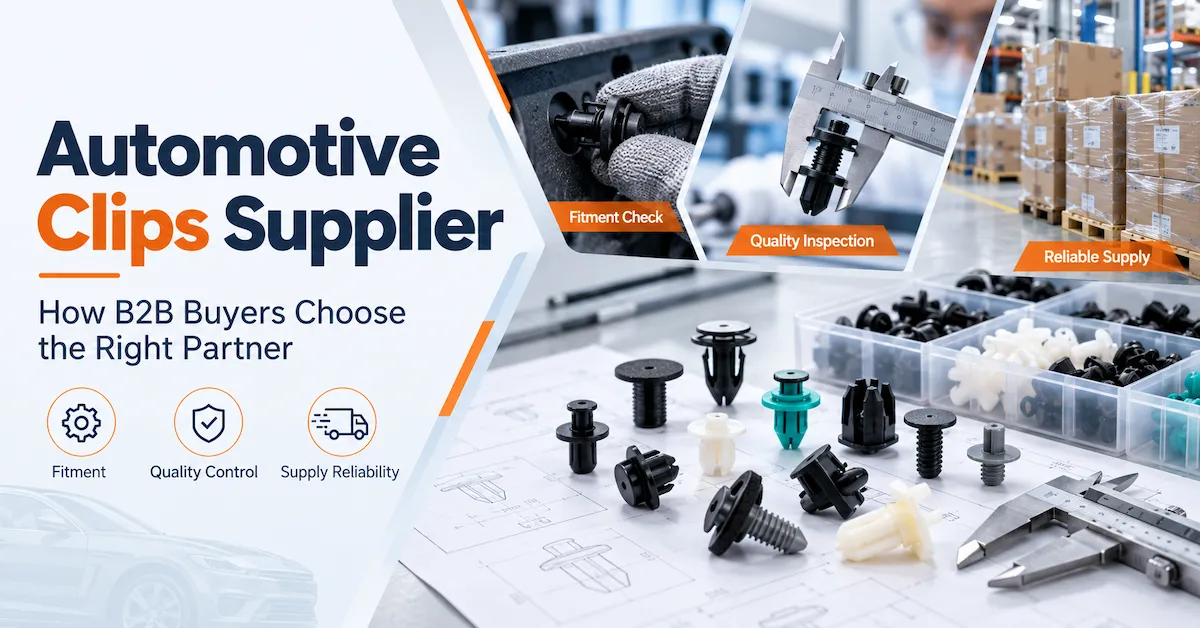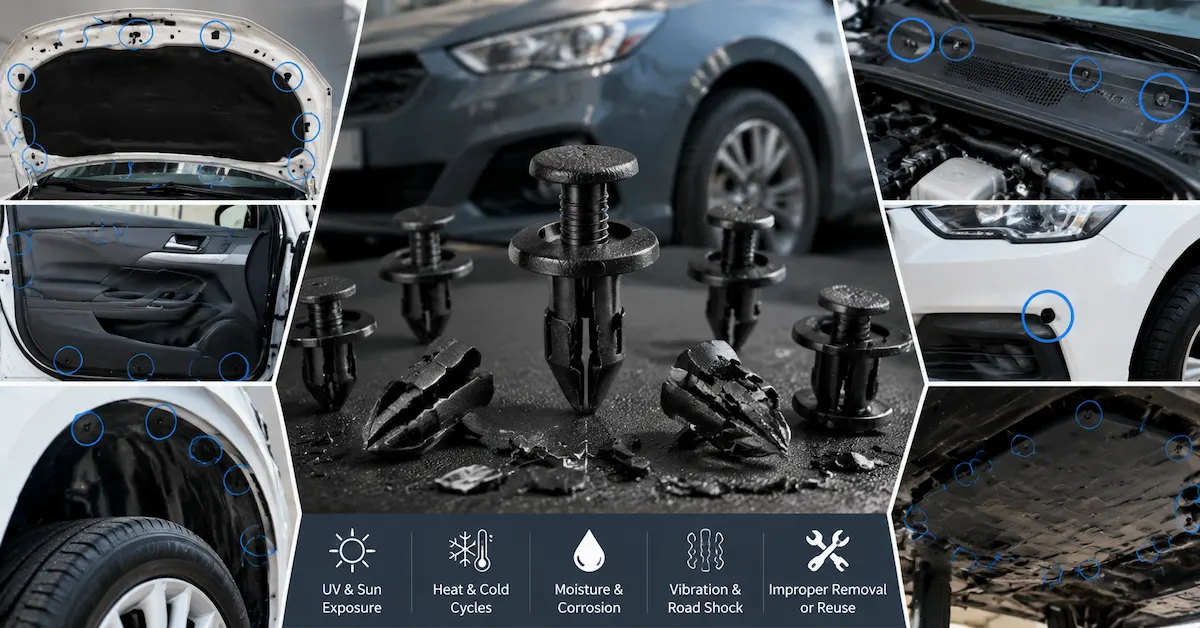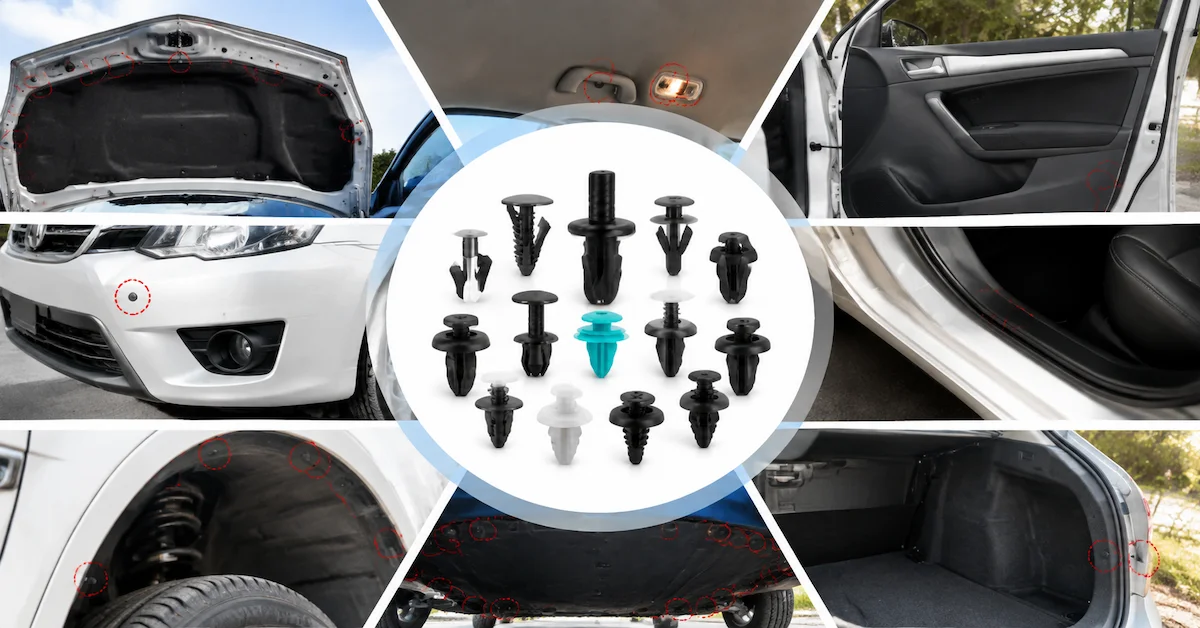

Selecting the correct automotive clip is essential for vehicle repair, assembly, and aftermarket replacement. Many buyers ask how to choose car clips because different clips can look almost identical while having completely different dimensions and installation requirements.
A wrong clip may fit into the hole but fail to lock properly, causing loose panels, vibration noise, poor appearance, or customer complaints. For repair shops, distributors, and automotive parts sellers, choosing the right clip requires understanding several key specifications, including hole size, head diameter, panel thickness, material, and locking design.
For professional buyers, the right clip selection process helps reduce return rates, improve repair efficiency, and build a more reliable automotive fastener inventory.
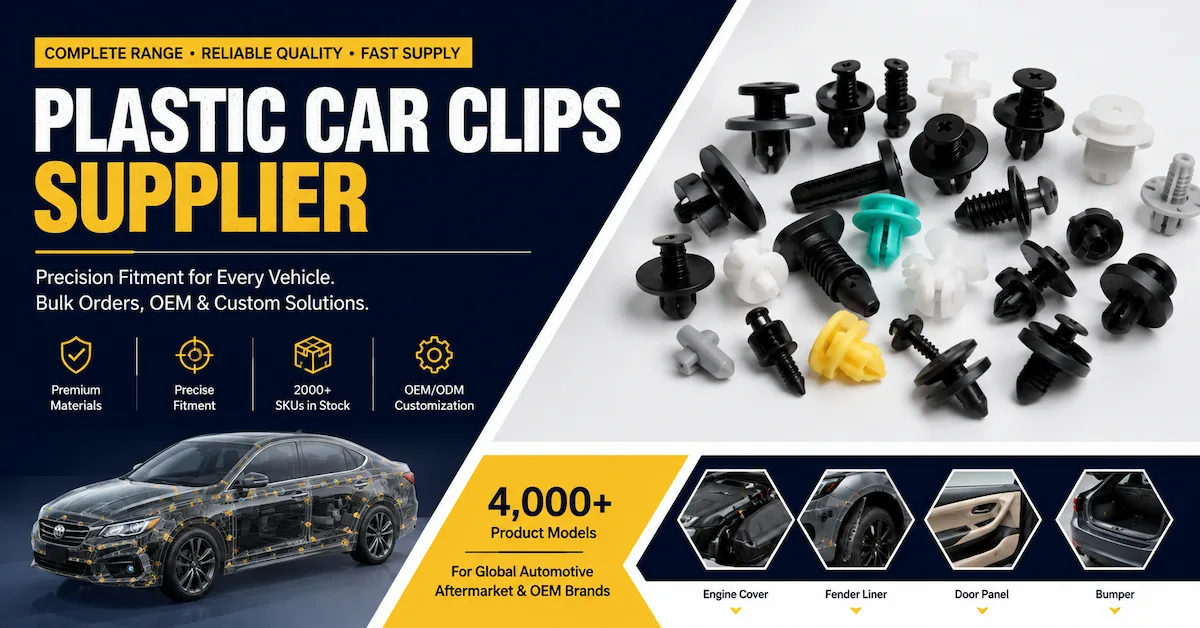
QEEPEI provides a wide range of automotive clips and plastic fasteners, including push clips, retainers, car clip kits, and vehicle-specific fastening solutions for global B2B buyers.
Why Correct Car Clip Selection Matters
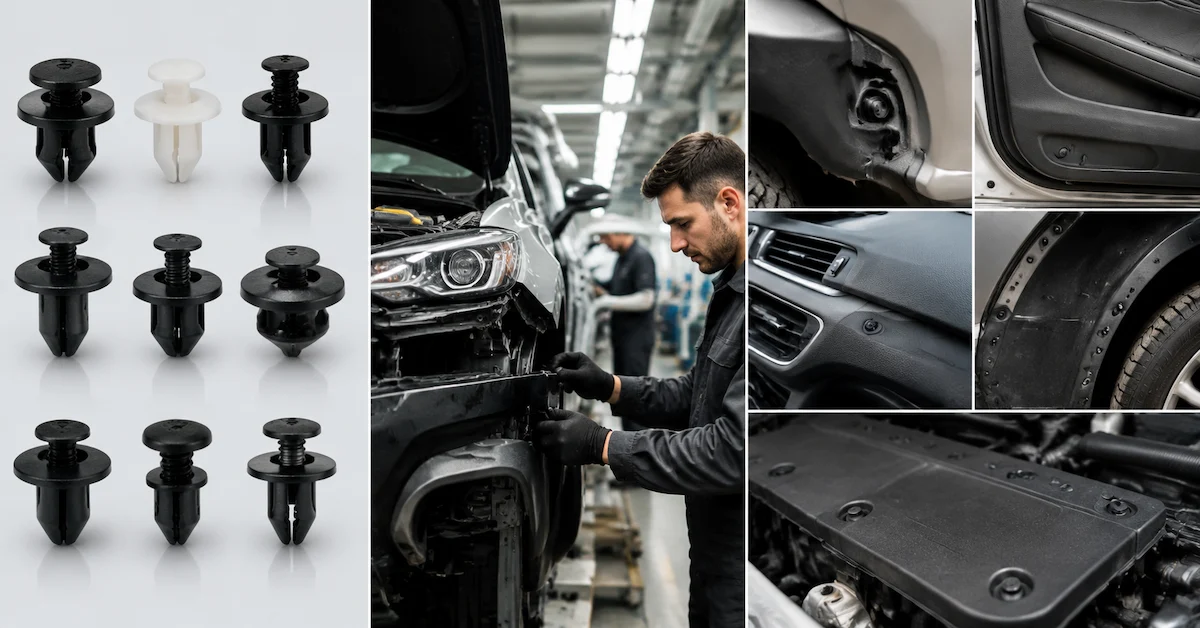
Automotive clips may be small components, but they perform important fastening functions throughout a vehicle.
They are commonly used in:
| Application Area | Common Clip Usage |
|---|---|
| Bumper | Exterior panel fixing |
| Fender liner | Wheel arch protection |
| Door panel | Interior trim installation |
| Dashboard | Interior component assembly |
| Underbody cover | Protective panel fastening |
| Hood insulation | Engine compartment fixing |
| Wheel arch molding | Exterior trim support |
When the wrong clip is selected, common problems include:
- Loose panels
- Broken fasteners
- Increased repair time
- Abnormal noise
- Poor vehicle appearance
- Customer returns
For distributors and repair chains, accurate clip selection directly affects customer satisfaction and operational efficiency.
The Three Most Important Car Clip Dimensions
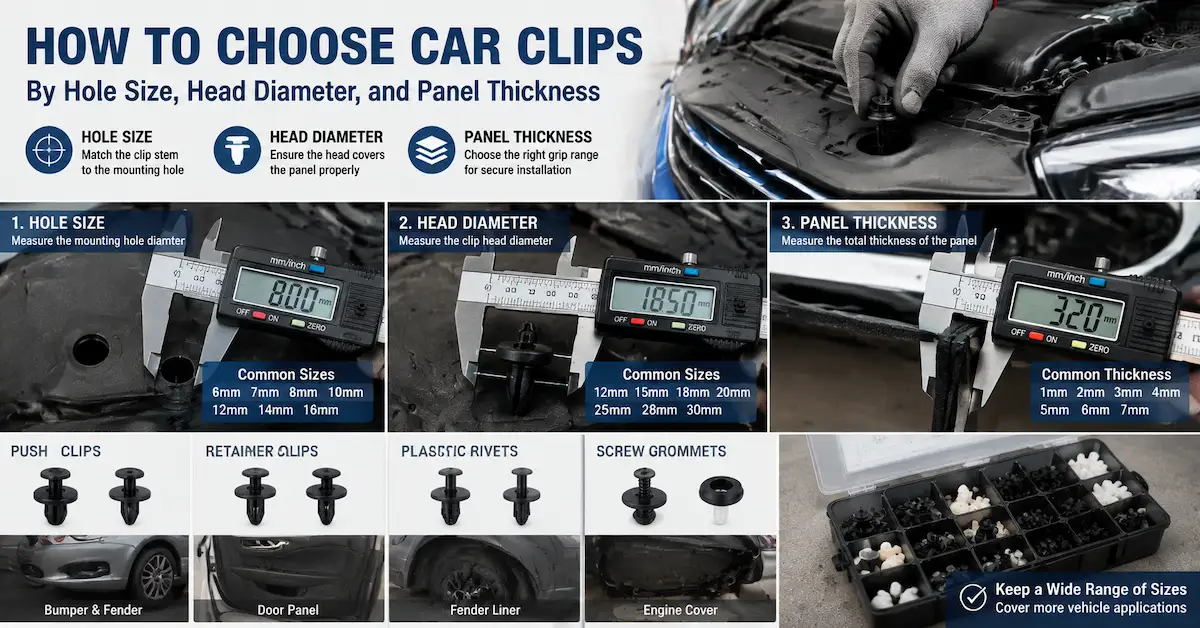
When learning how to choose car clips, buyers should focus on three critical measurements:
- Hole size
- Head diameter
- Panel thickness
These three factors determine whether the clip can securely fit the vehicle component.
Hole Size: The First Measurement to Check
Hole size is one of the most important factors when selecting automotive clips.
The clip stem or expansion section must match the vehicle mounting hole. If the hole is too large, the clip may become loose. If the hole is too small, installation may damage the clip or panel.
Common hole size considerations include:
- Mounting hole diameter
- Clip stem diameter
- Expansion structure size
- Installation position
For example:
| Hole Condition | Possible Problem |
|---|---|
| Hole too large | Clip cannot lock securely |
| Hole too small | Clip may break during installation |
| Correct size | Stable fastening performance |
Before ordering bulk clips, buyers should confirm the exact hole size required for the application.
Head Diameter: Matching the Surface Area
The clip head diameter determines how much surface area the fastener covers.
A larger head can provide better support for certain panels, while a smaller head may be suitable for narrow trim applications.
Head diameter affects:
- Panel stability
- Appearance
- Pressure distribution
- Installation reliability
Common applications:
| Head Diameter Requirement | Application |
|---|---|
| Larger head | Bumper covers, exterior panels |
| Medium head | Fender liners, trim panels |
| Smaller head | Interior components |
For automotive distributors, keeping clips with different head diameters helps cover more repair scenarios.
Panel Thickness: Ensuring Proper Locking
Panel thickness is another key factor when selecting car clips.
The clip must match the thickness of the material it secures. If the panel is too thin, the clip may not hold correctly. If the panel is too thick, the clip may not fully lock.
Common factors include:
- Plastic panel thickness
- Metal bracket thickness
- Interior trim thickness
- Combined material thickness
A professional supplier should provide thickness ranges instead of only product photos.
Understanding Different Car Clip Structures
Different vehicle applications require different clip designs.
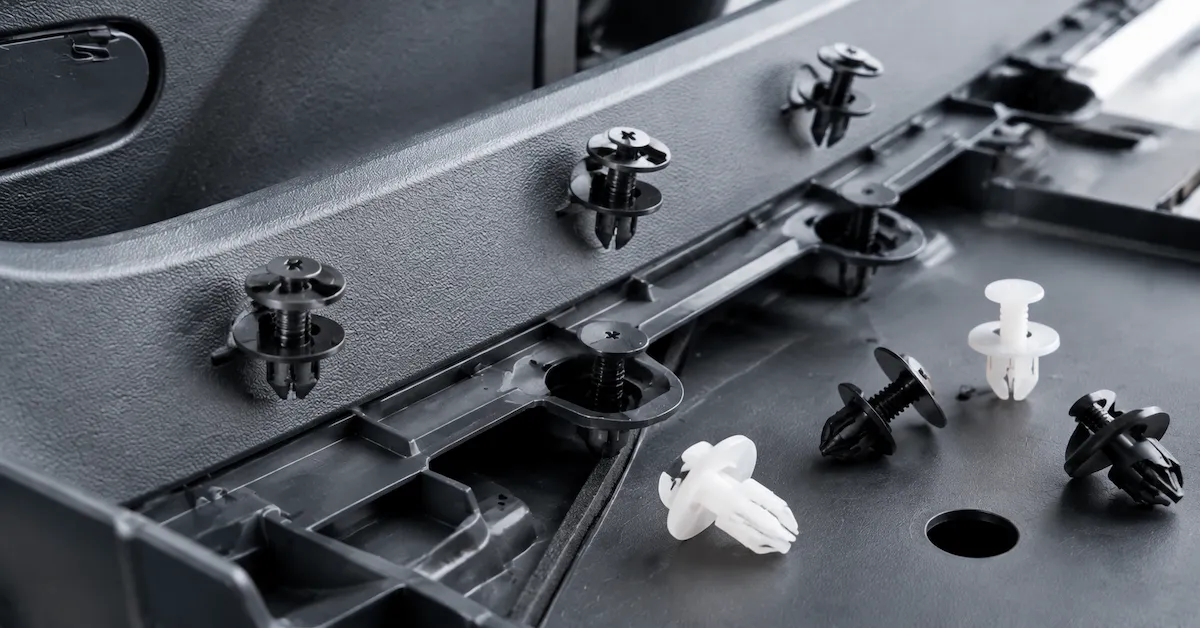
Push Clips
Push clips are among the most common automotive fasteners.
Advantages:
- Quick installation
- Low cost
- Easy replacement
- Suitable for high-volume repairs
Common applications:
- Bumpers
- Door panels
- Fender liners
- Interior trims
Retainer Clips
Retainer clips provide stronger holding performance for specific applications.
Common uses:
- Body panels
- Trim pieces
- Exterior moldings
Plastic Rivets
Plastic rivets use expansion structures to secure components.
Applications:
- Underbody covers
- Wheel arches
- Exterior panels
Screw Grommets
Screw grommets are designed for screw-based fastening.
Advantages:
- Higher retention strength
- Better for vibration areas
- Suitable for heavier components
A complete automotive fastener catalog usually includes multiple clip types to meet different vehicle requirements.
How Repair Shops Should Select Car Clips
Repair shops often need fast replacement solutions. A practical selection process includes:
Step 1: Identify the Application Area
Determine where the clip is installed:
- Bumper
- Door panel
- Fender liner
- Dashboard
- Wheel arch
- Underbody
Step 2: Measure the Existing Clip
Check:
- Hole diameter
- Head diameter
- Clip length
- Panel thickness
Step 3: Confirm Material Requirements
Consider:
- Heat exposure
- Vibration
- Moisture
- Exterior conditions
Step 4: Test Fit Before Bulk Purchase
For repair chains and distributors, sample confirmation can prevent large quantity mistakes.
How Distributors Can Build a Better Car Clip Inventory
For automotive distributors, choosing the right clips is also an inventory management decision.
A balanced inventory should include:
| Product Category | Demand Level |
|---|---|
| Bumper clips | High |
| Fender clips | High |
| Push retainers | High |
| Door panel clips | High |
| Plastic rivets | Medium-high |
| Screw grommets | Medium |
| Vehicle-specific clips | Based on market demand |
Distributors should avoid stocking only one universal clip size. Different customers require different applications.
QEEPEI supports buyers with various car clips and fastener categories, helping distributors build a complete automotive fastening product line.
Material Selection Also Affects Clip Performance
Besides dimensions, material quality determines long-term performance.
Common materials include:
| Material | Features |
|---|---|
| PA Nylon | Strong, flexible, wear-resistant |
| PP | Lightweight and cost-effective |
| POM | Excellent dimensional stability |
| Reinforced Plastic | Higher strength performance |
A high-quality automotive clip should maintain:
- Stable shape
- Good elasticity
- Reliable locking force
- Resistance to aging
For wholesale buyers, consistent material quality is important because repeated orders must maintain the same performance.
How to Choose a Reliable Car Clips Supplier
When purchasing automotive clips in bulk, buyers should evaluate suppliers based on more than price.
Important factors include:
| Evaluation Factor | Why It Matters |
|---|---|
| Product range | Supports different applications |
| Size information | Reduces wrong selection |
| Material quality | Improves durability |
| Fitment support | Reduces returns |
| Inventory capability | Ensures supply stability |
| Packaging options | Supports different markets |
| OEM/ODM ability | Enables customization |
A reliable automotive clips supplier should provide technical information, product matching support, and consistent quality.
Why Choose QEEPEI for Automotive Clip Solutions?
QEEPEI focuses on automotive clips, plastic fasteners, car clip kits, specific fit clips, and automotive fastening solutions.
For global B2B buyers, QEEPEI provides:
- Wide automotive clip categories
- Product matching support
- Bulk supply solutions
- OEM/ODM customization
- Packaging options
- Aftermarket fastening solutions
To learn more about QEEPEI’s company capability, visit the About Us page.
For bulk orders, distributor cooperation, and customized automotive clip solutions, contact QEEPEI through the Contact Us page.
FAQ
How do I choose car clips correctly?
To choose car clips correctly, check hole size, head diameter, panel thickness, material, and locking structure.
Why do car clips have different sizes?
Different vehicle components require different fastening dimensions and holding forces.
What happens if I choose the wrong car clip?
Wrong clips may cause loose panels, broken fasteners, vibration noise, or installation failure.
Are universal car clips suitable for all vehicles?
No. Universal clips cover common applications, but many vehicles require specific-fit clips.
What measurements are needed before buying car clips?
Buyers should measure hole diameter, head diameter, clip length, and panel thickness.
Which car clips are most commonly used?
Common types include push clips, retainer clips, plastic rivets, and screw grommets.
Can automotive clips be customized?
Yes. Clips can be customized by size, material, color, structure, and packaging.
Why is material important for automotive clips?
Material affects strength, flexibility, durability, and resistance to heat and vibration.
Should distributors stock different clip sizes?
Yes. Different repair applications require different clip dimensions.
Where can I buy automotive clips in bulk?
You can explore QEEPEI automotive clip solutions through the Products page.
Conclusion
Understanding how to choose car clips helps repair shops, distributors, and automotive buyers avoid fitment problems and improve repair efficiency. Hole size, head diameter, panel thickness, material, and clip structure all play important roles in selecting the right fastener.
For businesses purchasing automotive clips in bulk, working with a reliable supplier can reduce inventory risks, improve product quality, and support long-term growth.
QEEPEI provides automotive clips, plastic fasteners, car clip kits, and customized fastening solutions for global automotive aftermarket customers.
Explore QEEPEI’s complete automotive clips product range to find the right fastening solutions for your business.