
What Should a Plastic Car Clips Supplier Provide?
Plastic clips are easy to overlook until one does not fit, cracks during installation, or fails to hold a panel securely.
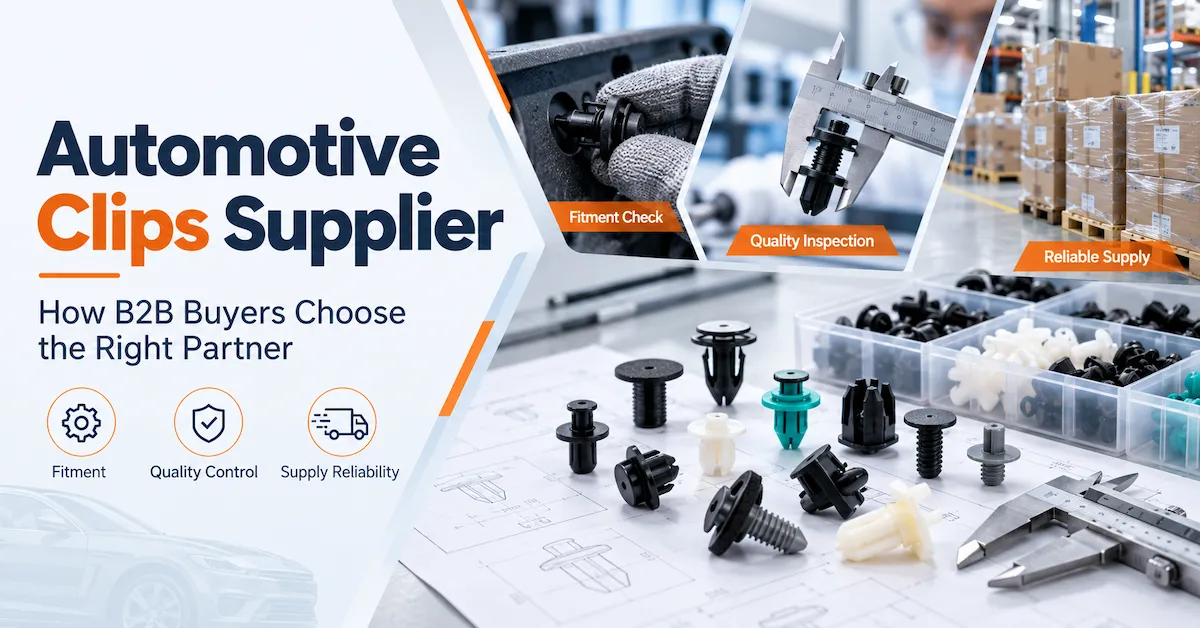
For automotive distributors and aftermarket buyers, a reliable plastic car clips supplier needs to provide more than a large product catalog. The supplier should understand the relationship between material, clip geometry, vehicle fitment, production consistency, and the environment where the fastener will be installed.
A useful supply program normally covers:
- standard automotive clips;
- vehicle-specific fasteners;
- different polymer materials;
- dimensional matching;
- quality inspection;
- bulk supply;
- packaging;
- OEM/ODM development.
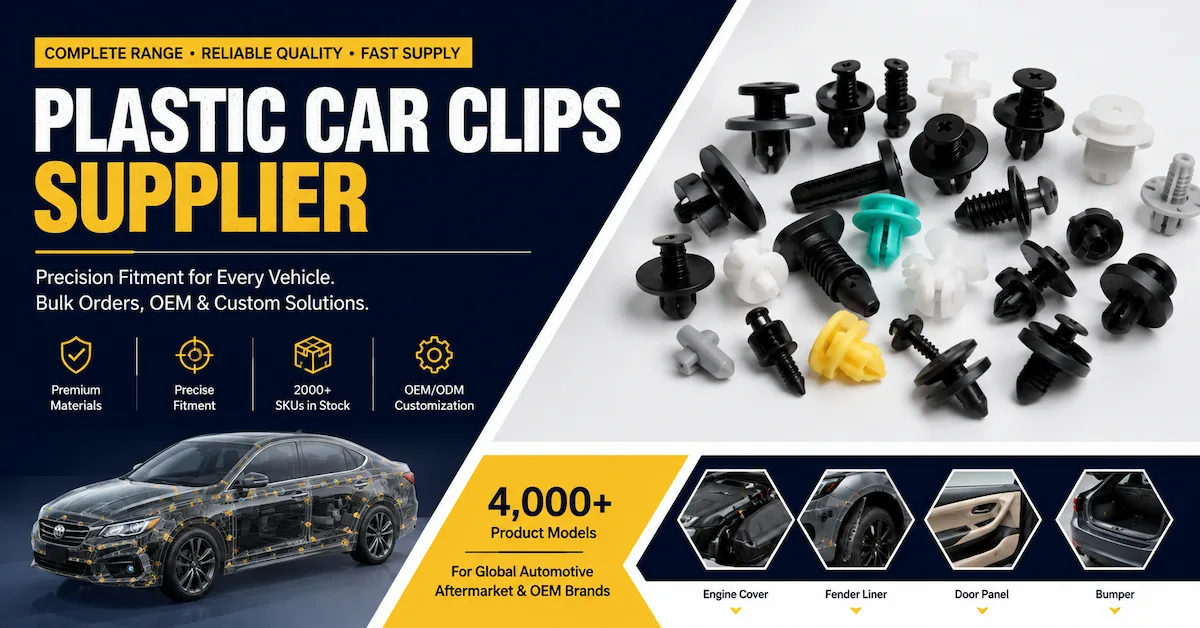
QEEPEI's current website states that its product system covers more than 4,000 product models, with 2,000+ SKUs in standard inventory. It also describes its own injection molding and mold-development capabilities, vehicle-specific products, and OEM/ODM support.
For B2B buyers, this creates a more practical question than simply asking for the lowest price:
Can the supplier consistently provide the right plastic clip for the right vehicle application and continue supplying it as your sales volume grows?
Who Buys Plastic Car Clips in Bulk?
The purchasing requirements are different depending on the business model.
Automotive Parts Distributors
Distributors usually need a broad range of replacement fasteners.
Their priorities often include:
- SKU coverage;
- vehicle compatibility;
- stable inventory;
- consistent quality;
- repeat-order capability;
- packaging flexibility.
A supplier with both standard and vehicle-specific products can help distributors reduce sourcing complexity.
Automotive Aftermarket Wholesalers
Wholesalers often purchase clips in larger quantities and resell them to:
- repair shops;
- local parts stores;
- online sellers;
- regional distributors.
They typically need competitive landed cost without sacrificing fitment consistency.
Repair and Maintenance Suppliers
Repair businesses need products that can be identified and installed quickly.
For these buyers, the most useful information may be:
- vehicle model;
- installation location;
- OE reference;
- hole diameter;
- panel thickness;
- clip dimensions.
Online Automotive Parts Sellers
E-commerce sellers may need:
- standardized product photos;
- accurate fitment information;
- SKU sheets;
- assortment kits;
- private-label packaging.
QEEPEI states that it provides product images, videos, fitment documents, SKU sheets, marketing materials, packaging design, and private-label support for customers.
Automotive Brands and Private-Label Companies
Brands generally require greater control over:
- product selection;
- packaging;
- colors;
- labeling;
- quality specifications;
- repeat production.
This is where an experienced plastic car clips supplier with manufacturing capability becomes more valuable than a simple catalog reseller.
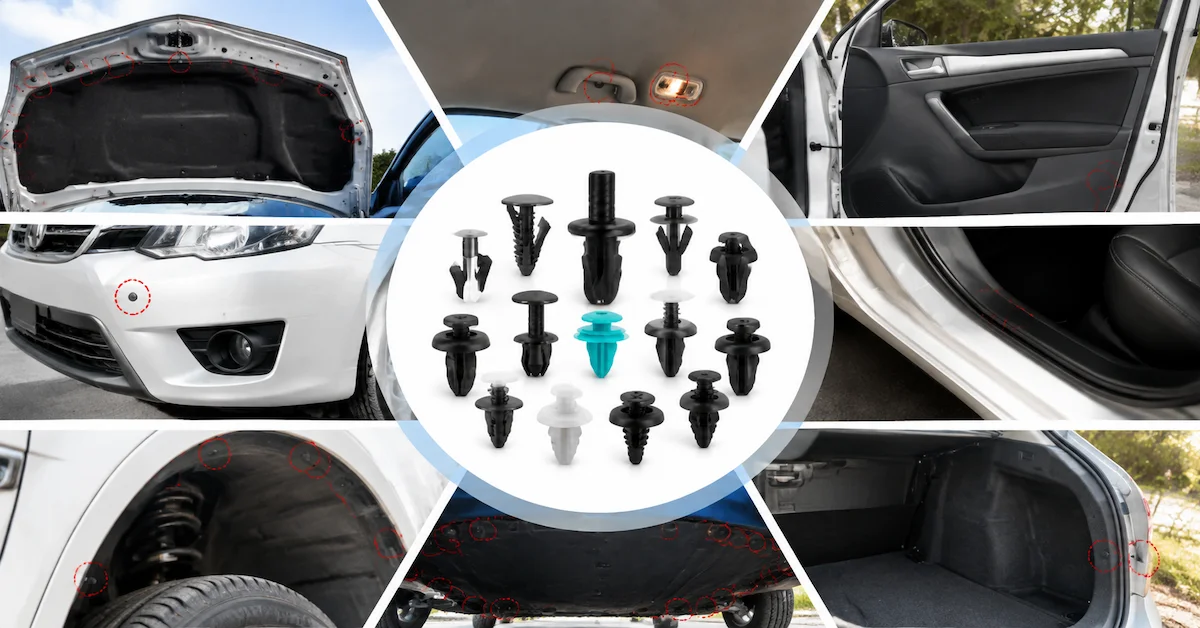
Where Are Plastic Car Clips Used?
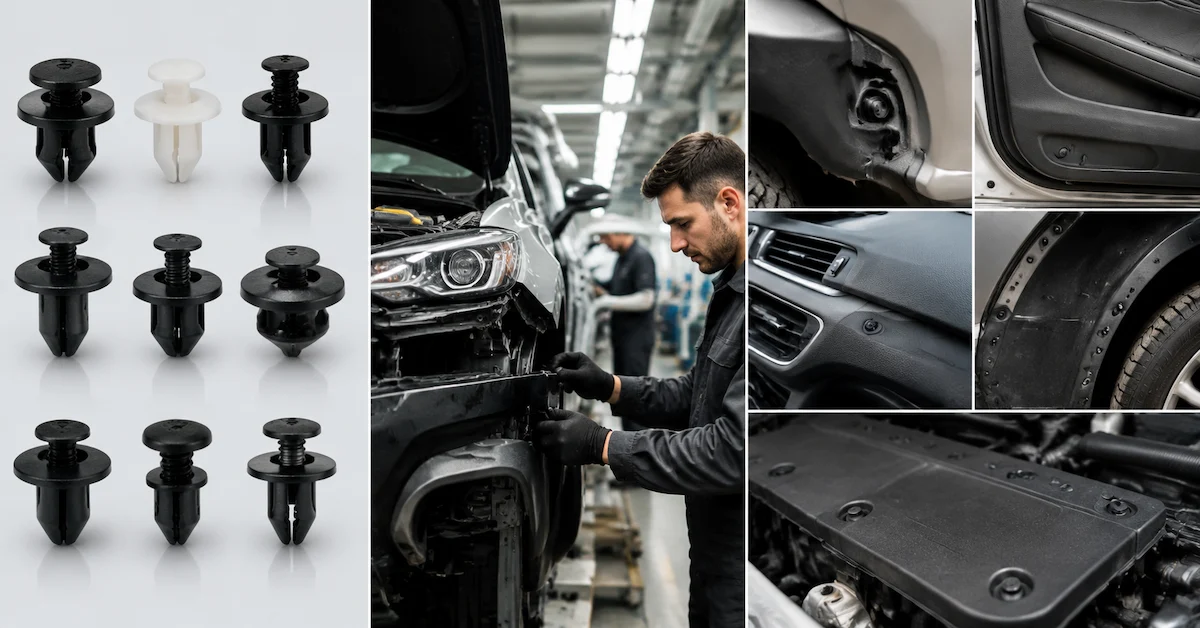
Plastic automotive fasteners appear throughout a vehicle.
The correct clip depends heavily on the mounting location.
Bumper and Exterior Panels
Typical applications include:
- bumper covers;
- grille surrounds;
- splash shields;
- fender liners;
- wheel arch liners.
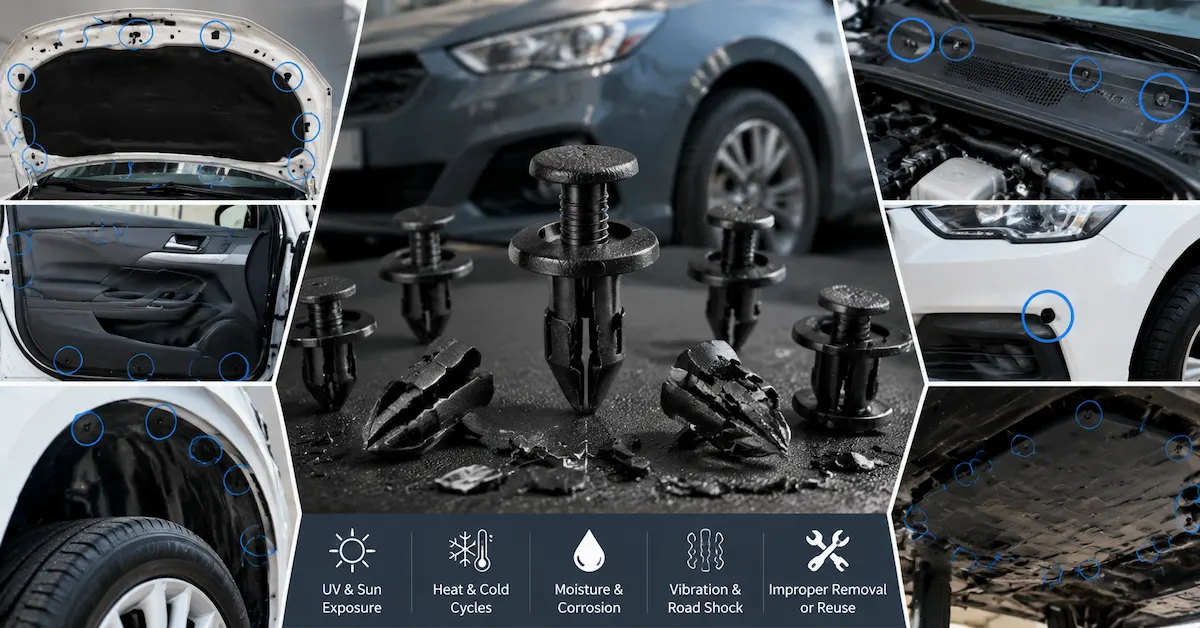
Exterior fasteners may face:
- vibration;
- moisture;
- road debris;
- temperature changes;
- repeated service.
Door Interior Panels
Door trim clips hold:
- door cards;
- decorative trim;
- insulation;
- armrest-related panels.
They need enough retention to prevent movement without making removal unnecessarily difficult.
Dashboard and Interior Trim
Interior applications may include:
- dashboard panels;
- instrument surrounds;
- center consoles;
- pillar trims.
Here, dimensional consistency matters because excessive retention force can damage the surrounding trim during service.
Engine Covers and Underbody Components
These applications can place greater demands on material and environmental resistance.
Depending on the location, buyers may need to consider:
- elevated temperature;
- oil or chemical exposure;
- vibration;
- impact;
- long-term aging.
Roof, Trunk, and Luggage-Area Trim
Clips may also secure:
- headliners;
- trunk trim;
- storage covers;
- rear interior panels.
A broad catalog allows buyers to source several of these applications from one supplier.
What Types of Plastic Car Clips Are Available?
A plastic car clips supplier should be able to distinguish products by function rather than simply by appearance.
Push Retainer Clips
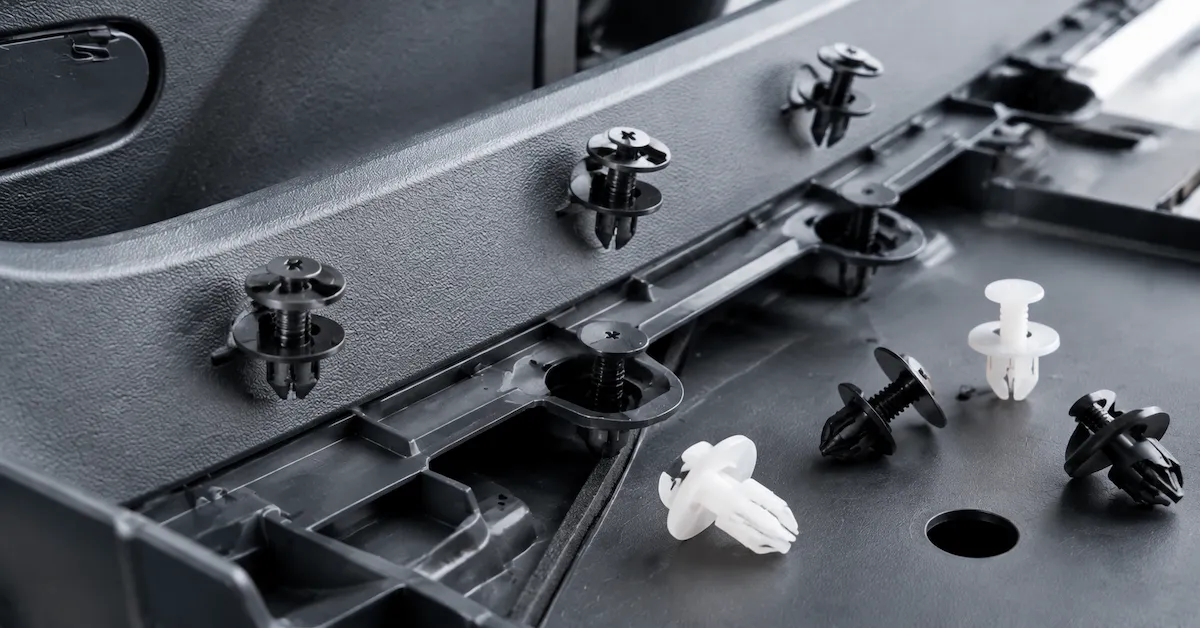
Push retainers use a stem and locking structure to hold panels in place.
They are commonly used for:
- body panels;
- bumpers;
- interior trim;
- underbody covers.
Screw-Type Push Clips
These combine a retaining body with a screw-style pin.
They can be useful when a fastening point needs easier removal during maintenance.
Fir Tree Clips
Fir-tree fasteners use flexible ribs to grip a mounting hole.
They are commonly found in:
- trim;
- insulation;
- interior panels;
- lightweight automotive components.
Panel Retainers
Panel retainers are designed around the relationship between the panel and its mounting structure.
Their dimensions can vary significantly even when two products look similar.
Specific-Fit Car Clips
These products are matched to particular vehicle applications.
QEEPEI currently organizes its catalog around both general car body clips and specific-fit clips, with vehicle-specific options covering brands including BMW, Honda, Nissan, Volkswagen, Ford, and Toyota.
Which Materials Are Used for Plastic Car Clips?
Material choice should follow the application rather than the other way around.
QEEPEI's current company information identifies PA, PP, and POM among the materials used for its automotive fastening products.
| Material | Main Characteristics | Potential Applications |
|---|---|---|
| PA6 | Strength, toughness, flexibility | Interior and structural clips |
| PA66 | Higher mechanical and thermal capability | More demanding fastening locations |
| PP | Lightweight, flexible,chemical resistance | Trim and general fastening |
| POM | Dimensional stability, low friction | Precision locking components |
PA6 Nylon
PA6 can provide a useful balance between strength and flexibility.
It can be considered for:
- interior clips;
- trim retainers;
- structural fastening points.
The actual performance still depends on the grade, formulation, geometry, and environment.
PA66 Nylon
PA66 is often considered where higher mechanical or thermal performance is required.
For demanding applications, buyers should ask about the exact grade rather than accepting a general “nylon” description.
PP
PP is useful when low weight and flexibility are important.
It is commonly considered for:
- interior trim;
- lining clips;
- general-purpose fastening.
POM
POM provides good dimensional stability and low friction.
It can be suitable for clips or fastening mechanisms where precise movement and consistent dimensions matter.
Plastic Car Clips Specification Checklist
A common purchasing mistake is to identify a replacement clip using only the head diameter.
Several dimensions can determine whether the clip actually fits.
| Specification | Why It Matters |
|---|---|
| Head diameter | Determines panel coverage |
| Stem diameter | Affects hole fit |
| Stem length | Determines insertion depth |
| Panel thickness | Determines locking position |
| Hole diameter | Defines mounting compatibility |
| Locking structure | Determines retention |
| Material | Influences strength and flexibility |
| Color | Useful for specific trim applications |
For vehicle-specific products, buyers should also provide:
- vehicle brand;
- model;
- model year;
- installation position;
- OE number where available.
This reduces the risk of supplying a clip that looks similar but does not actually fit.
Why Manufacturing Quality Matters
Plastic clips are small injection-molded components, so manufacturing consistency can have a disproportionate effect on performance.
A minor change in:
- stem diameter;
- locking-leg geometry;
- wall thickness;
- molding condition;
can change installation or retention behavior.
A capable supplier therefore needs control over the complete production process.
Mold Development
The mold determines the basic geometry of the finished clip.
Important areas include:
- cavity dimensions;
- locking features;
- ejector design;
- cooling;
- parting lines.
For custom products, the mold should be developed around the actual application rather than simply copying the outside appearance of an existing part.
QEEPEI states that it has an in-house mold workshop and supports product design, mold development, and customized automotive fastener projects.
Injection Molding
During injection molding, process conditions influence the final part.
Important variables include:
- material temperature;
- injection pressure;
- filling behavior;
- cooling;
- cycle consistency.
Poor process control can contribute to:
- flash;
- incomplete filling;
- warpage;
- dimensional variation.
For large automotive clip orders, consistent process control is particularly important because thousands of parts may need to perform in the same way.
How Should a Supplier Control Plastic Car Clip Quality?
Quality control should not begin after the finished product has already been produced.
A useful QC process includes:
Material → molding → dimensional inspection → functional verification → final inspection
Raw Material Control
The supplier should be able to identify the material used for the approved product.
This is important when the buyer has specified:
- PA6;
- PA66;
- PP;
- POM;
- a particular grade or formulation.
Dimensional Inspection
Critical dimensions should be monitored against the approved specification.
For example:
- head diameter;
- stem diameter;
- overall height;
- locking geometry.
Appearance Inspection
Inspectors can check for:
- flash;
- cracks;
- deformation;
- incomplete molding;
- contamination;
- surface defects.
Fitment Verification
For vehicle-specific products, actual installation testing is valuable.
A clip may meet a dimensional drawing yet still require verification against the mating panel and hole.
Performance Testing
Depending on the application, testing can include:
- insertion force;
- retention force;
- pull-out force;
- impact;
- temperature;
- aging.
QEEPEI's current website describes quality control and testing capabilities, including material strength and durability testing, dimensional inspection, and fitment verification.
What Certifications and Compliance Information Should Buyers Request?
Certification requirements depend on the destination market and the product.
QEEPEI currently states that its automotive clips are produced using PA nylon materials and references compliance with RoHS, REACH, and California Prop 65 on its website.
For B2B purchasing, do not stop at a logo on a website.
Ask the supplier for documentation relevant to the actual product and target market.
Useful documents can include:
- material documentation;
- test reports;
- inspection records;
- applicable compliance certificates;
- product specifications.
This is particularly important for distributors supplying regulated markets.
Stock and Lead Time: What Matters to Distributors?
A good product is not useful if it is repeatedly out of stock.
QEEPEI states that it maintains more than 2,000 SKUs in standard inventory and supports fast delivery within 24 hours for stocked products. Its current website also states that its overall catalog covers more than 4,000 product models.
For procurement purposes, separate products into three groups:
| Product Type | Supply Consideration |
|---|---|
| Stocked standard clip | Faster fulfillment |
| Existing mold, non-stock item | Production scheduling |
| New custom clip | Tooling + sample + mass production |
This distinction is important when planning aftermarket inventory.
A distributor should not treat a newly developed OEM clip as if it were a ready-stock replacement part.
Standard Plastic Car Clips vs Custom Clips
The right choice depends on your business model.
| Option | Advantages | Best For |
|---|---|---|
| Standard clip | Faster sourcing,established product | Aftermarket distributors |
| Vehicle-specific clip | Better fitment targeting | Repair and parts sellers |
| Custom clip | Specific dimensions and function | OEM projects |
| Private-label kit | Branding and retail presentation | Automotive brands |
Standard products are generally the efficient choice when an existing clip already meets the application.
Custom development makes more sense when:
- no suitable standard part exists;
- the original design needs improvement;
- a brand needs exclusive packaging;
- a specific vehicle application requires a unique geometry.
OEM and Custom Plastic Car Clip Supply
For OEM projects, the process usually begins with information from the buyer.
Useful inputs include:
- original sample;
- drawing;
- 3D model;
- OE reference;
- mounting-hole size;
- panel thickness;
- application environment.
The development process can then follow:
Requirement review → engineering analysis → mold development → sample → fitment approval → mass production
Customization can cover:
Size
- stem length;
- head diameter;
- overall height;
- locking structure.
Material
- PA6;
- PA66;
- PP;
- POM;
- application-specific formulations.
Color
Color matching may be useful for visible interior trim or branded aftermarket products.
Packaging
Options may include:
- bulk bags;
- assortment kits;
- retail boxes;
- private-label packaging;
- barcode labels.
QEEPEI states that it supports retail-ready boxes, private-label bags, labels, barcodes, assortment kits, and other OEM/ODM packaging options.
How to Choose a Plastic Car Clips Supplier
Before placing a bulk order, evaluate the supplier using a practical checklist.
Product Coverage
Can the supplier provide:
- body clips;
- bumper clips;
- door clips;
- trim clips;
- specific-fit clips;
- clip kits?
Fitment Capability
Can the supplier identify products from:
- vehicle information;
- OE number;
- sample;
- drawing?
Material Capability
Can they explain why a specific material is suitable for the application?
Manufacturing Capability
Ask whether they control:
- molds;
- injection molding;
- inspection;
- packaging.
Inventory
For aftermarket products, ask:
- Which SKUs are stocked?
- What is the replenishment cycle?
- How are batches identified?
Customization
For OEM projects, confirm:
- mold development;
- sample approval;
- custom material;
- color;
- packaging.
Communication and Documentation
A reliable supplier should be able to provide clear:
- quotations;
- specifications;
- drawings;
- test information;
- packaging details;
- delivery schedules.
Why Choose QEEPEI as Your Plastic Car Clips Supplier?
QEEPEI positions itself as a global automotive fastening solution provider rather than simply a reseller of individual clips.
Its current website identifies:
- 4,000+ product models;
- 2,000+ SKUs in stock;
- more than 10,000㎡ of storage area;
- its own injection molding equipment;
- an in-house mold workshop;
- R&D support;
- vehicle-specific clip solutions;
- OEM/ODM services.
The product range covers Car Body Clips, Car Clips Kits, Specific Fit Car Clips, and Car Clips Tool, giving distributors several ways to build their automotive fastener product lines.
For private-label and B2B customers, the company also promotes packaging customization, fitment documentation, product media, and sales-support materials.
Explore QEEPEI plastic car clips and automotive fasteners
What Should You Include in a Bulk RFQ?
A good RFQ saves time for both buyer and supplier.
For standard products, provide:
- product name;
- OE number;
- vehicle model;
- required quantity;
- target market.
For vehicle-specific products, add:
- vehicle year;
- installation location;
- original sample;
- dimensions.
For custom products, provide:
- 2D drawing;
- 3D file;
- sample;
- material requirement;
- color;
- estimated annual volume;
- packaging requirement.
For a large aftermarket program, it is also useful to specify the expected SKU range rather than asking for a single clip.
QEEPEI's website currently provides a quotation process that requests information including the vehicle model and contact details.
Request a quotation from QEEPEI
FAQ: Plastic Car Clips Supplier
What should I look for in a plastic car clips supplier?
Look for accurate fitment support, material knowledge, manufacturing capability, quality control, product coverage, inventory, customization, and reliable long-term supply.
What materials are commonly used for plastic car clips?
PA6, PA66, PP, and POM are common choices. The right material depends on strength, flexibility, temperature, chemical exposure, and the specific mounting application.
Can plastic car clips be customized?
Yes. Depending on the supplier's capabilities, buyers can request custom dimensions, materials, colors, locking structures, packaging, and private-label solutions.
How do I know whether a car clip will fit my vehicle?
Check the vehicle model, year, OE reference, mounting location, hole diameter, panel thickness, and clip dimensions. For uncertain applications, supplying the original clip or a sample is helpful.
Are all plastic car clips interchangeable?
No. Two clips can look similar while having different stem diameters, locking structures, panel ranges, or material properties. Fitment should be verified rather than judged by appearance alone.
What quality tests should a plastic car clip supplier perform?
Depending on the application, useful checks include dimensional inspection, fitment verification, insertion force, retention or pull-out testing, impact testing, temperature testing, and aging evaluation.
Can I buy plastic car clips in bulk?
Yes. Bulk purchasing is common for distributors, wholesalers, repair suppliers, and automotive brands. Stock availability, MOQ, packaging, and lead time should be confirmed before ordering.
Can a supplier make clips from an original sample?
A manufacturer with engineering and tooling capabilities can use an original sample as a reference for product analysis, mold development, sampling, and production. The final design should be validated for the intended application.
What information should I send for a custom automotive clip?
Provide a sample or drawing, vehicle information, application location, mounting-hole dimensions, panel thickness, material requirements, expected quantity, color, and packaging requirements.
Is a plastic car clips supplier suitable for private-label automotive products?
Yes. A supplier with OEM/ODM and packaging capabilities can support branded clip kits, labels, retail packaging, barcodes, and other private-label requirements.
Conclusion
The right plastic car clips supplier should solve more than a product availability problem.
For B2B buyers, the real value comes from connecting:
Product range → fitment → material → manufacturing → quality control → inventory → customization → delivery
Distributors may prioritize SKU coverage and stock. Repair suppliers may care more about accurate vehicle matching. Private-label brands need packaging and repeat production. OEM buyers require engineering, tooling, samples, and controlled specifications.
QEEPEI's current product and company information shows a supply model built around automotive clip coverage, stocked SKUs, injection molding, mold development, vehicle-specific solutions, quality control, and OEM/ODM support.
For buyers comparing suppliers, the best starting point is therefore not simply:
“What is your price per clip?”
Instead, ask:
“Can you consistently supply the right material, dimensions, fitment, quality, and packaging for our market?”
That question reveals much more about whether a supplier can become a long-term automotive fastening partner.