
Why Do Automotive Clips Become Loose After Installation — And How to Fix It Properly?
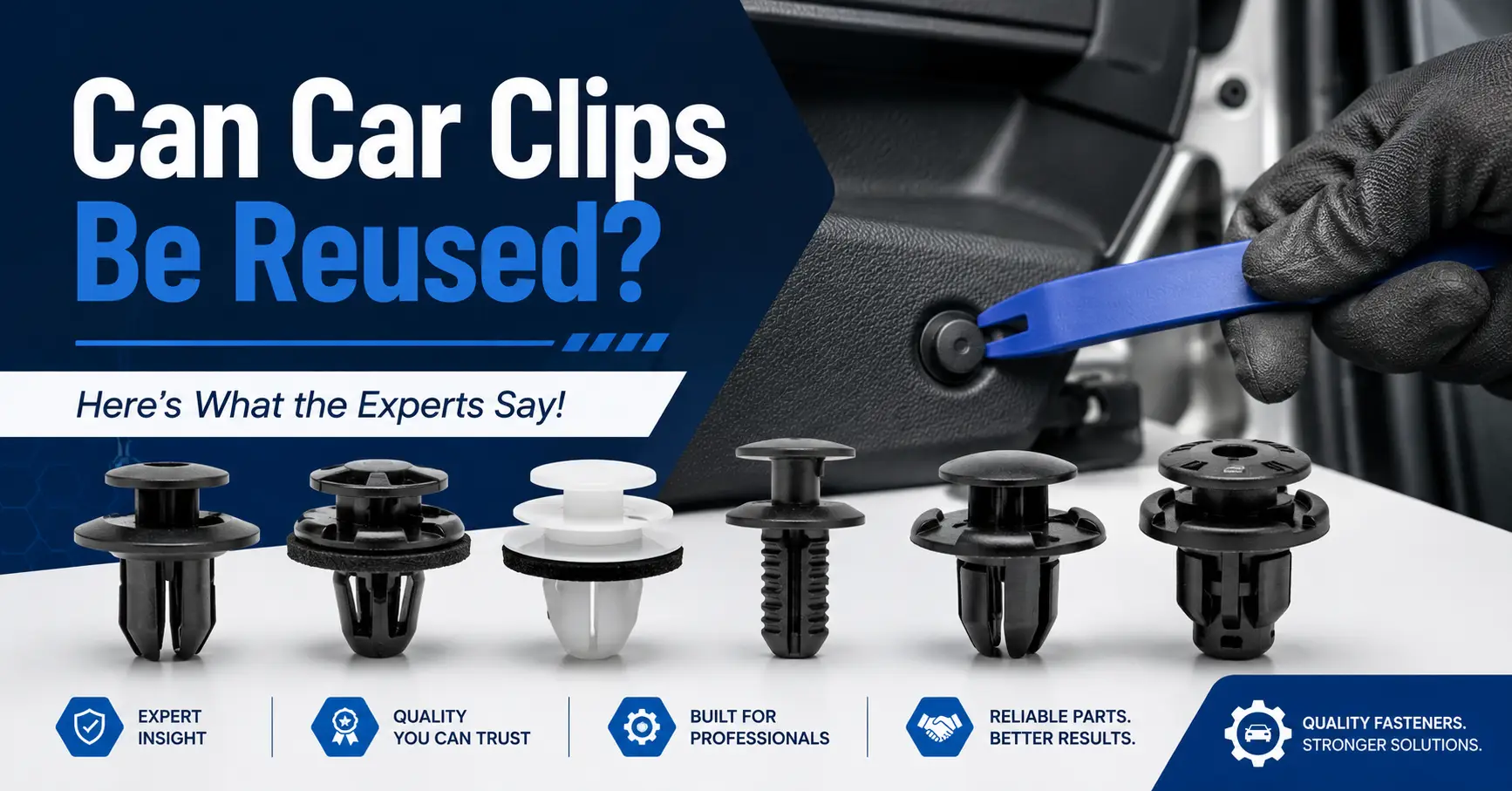
A newly installed automotive clip should lock firmly and remain stable for years. Yet in many workshops and fleet maintenance centers, clips loosen within weeks. Door trims begin to vibrate. Bumper edges shift slightly at highway speed. Interior panels generate subtle but persistent noise.
This is not random failure. It is mechanical imbalance.
At QEEPEI, our engineering team regularly investigates retention-loss cases for global distributors. As an experienced Automotive Clips manufacturer, we approach looseness not as a symptom—but as a measurable structural issue involving tolerance, material fatigue, and panel interface design.
Material and Structural Variables That Influence Retention Stability
Before troubleshooting a loose clip, it is critical to understand how the component is designed to function.
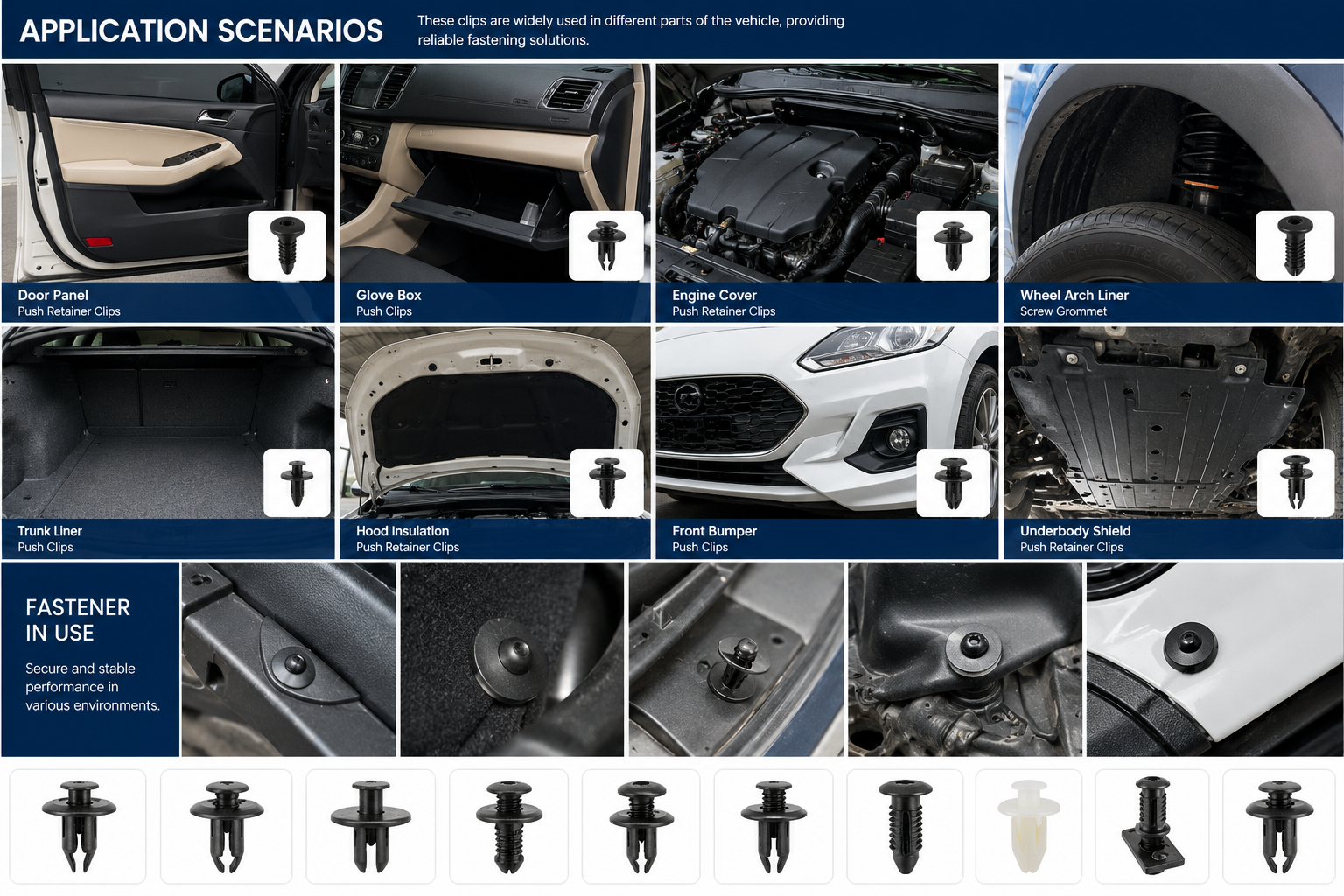
Automotive clips typically rely on elastic expansion. Once inserted, the retention legs compress and then expand beyond the panel hole. Long-term stability depends on:
-
Barb geometry angle (commonly 12°–18° for interior trim)
-
Elastic modulus of material (PA66: ~2.8 GPa)
-
Shaft diameter tolerance (±0.03 mm recommended)
-
Panel hole diameter control (usually ±0.1 mm)
-
Thermal deformation resistance (–30°C to 130°C range)
Glass-fiber reinforced nylon (PA66 GF) improves stiffness and dimensional stability by 30–40% compared to standard PA6. Without proper material selection, creep deformation may occur under continuous load.
This is why an Automotive Clips manufacturer must design for environmental stress—not just initial fit.
Why Professional Manufacturing Experience Matters
Retention stability does not start at installation. It begins at production.
At QEEPEI, we implement:
-
Multi-cavity CNC mold calibration (±0.02–0.03 mm precision)
-
Resin moisture control below 0.2% before molding
-
Cavity pressure monitoring to ensure uniform filling
-
Tensile testing for each production batch
-
IATF 16949 quality management compliance
(https://www.iatfglobaloversight.org)
According to guidelines discussed by SAE International (https://www.sae.org), fastening reliability directly affects NVH performance and perceived vehicle quality. Stable retention force is not optional—it is foundational.
Root Causes of Post-Installation Looseness
When clips loosen after installation, one or more of the following factors are usually present:
1. Hole Enlargement
Repeated removal can increase hole diameter beyond tolerance. An 8.0 mm hole expanding to 8.4 mm reduces retention force by up to 20%.
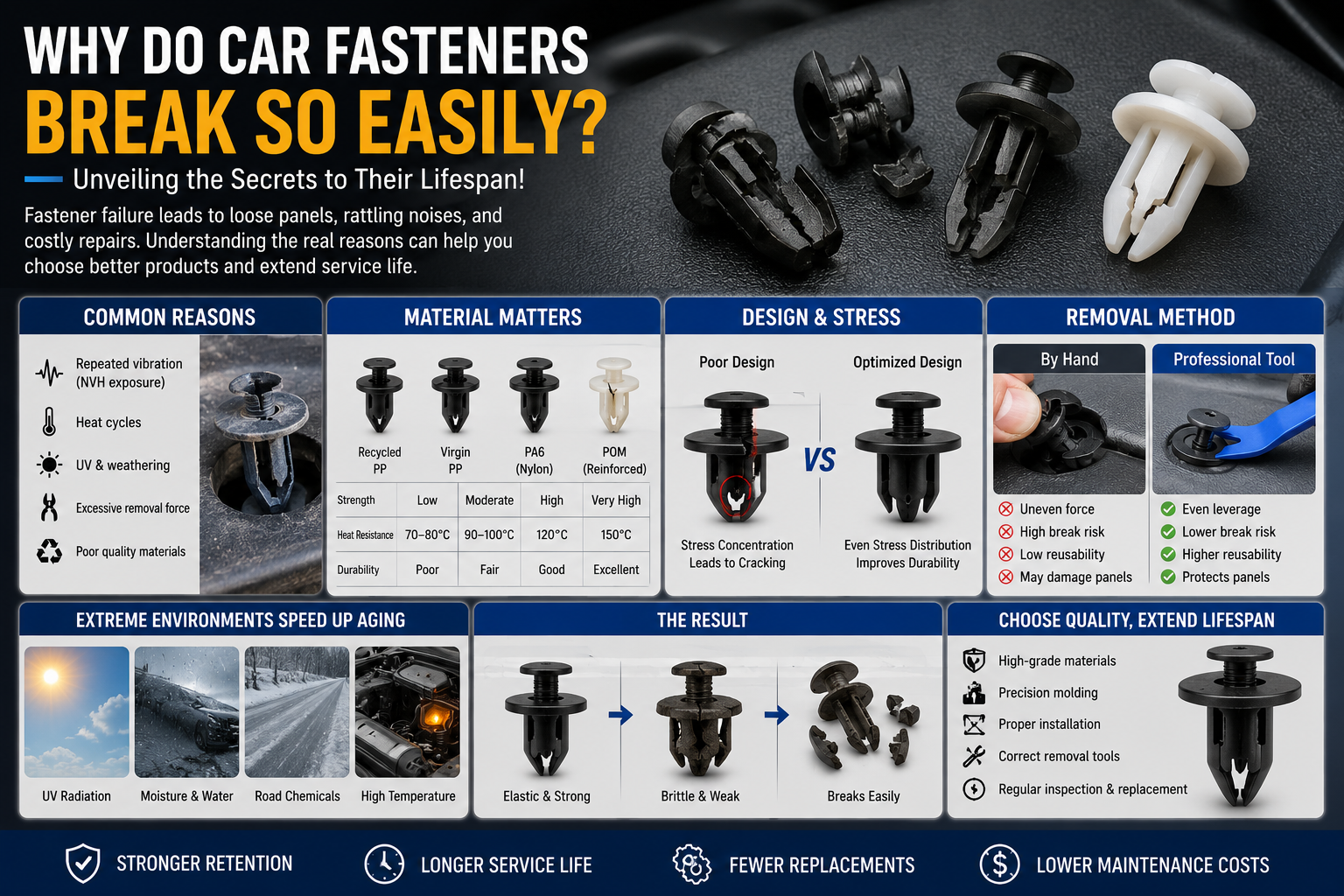
2. Material Fatigue
Nylon loses elastic recovery capacity after excessive deformation cycles. Micro-fractures near the barb base weaken expansion pressure.
3. Thermal Creep
Sustained high temperatures above 90°C may cause gradual dimensional relaxation.
4. Improper Clip Type
Using interior-grade clips in exterior bumper zones reduces long-term holding force.
Each cause requires a different correction strategy.
Practical Solutions to Restore Retention Strength
A loose clip should never simply be “pressed again.”
Professional correction involves:
Step 1: Measure Hole Diameter
If deviation exceeds +0.3 mm, consider upsized or expansion-type clips.
Step 2: Inspect Clip Integrity
Visible whitening near barb roots indicates structural fatigue.
Step 3: Upgrade Material Grade if Necessary
Switch from PA6 to PA66 GF for high-vibration areas.
Step 4: Validate Retention Force
Interior clips should achieve 180–220 N pull-out strength.
Exterior clips should exceed 220 N.
Step 5: Confirm Even Panel Seating
Uneven insertion creates uneven load distribution.
As a qualified Automotive Clips manufacturer, QEEPEI provides tensile test reports and panel compatibility data to support correct replacement decisions.
Real-World Case: Fleet Maintenance Instability in High-Temperature Region
A Southeast Asian fleet operator reported repeated interior trim loosening in commercial vans after 6–8 months.
Initial findings:
-
Clip material: Standard PA6
-
Cabin temperature exposure: 70°C sustained
-
Hole expansion: +0.2–0.3 mm
-
Retention strength reduced to 150 N
Solution implemented:
-
Switched to PA66 GF10 formulation
-
Adjusted shaft diameter +0.05 mm
-
Added UV stabilizer
Result:
-
Retention force restored to 210–230 N
-
Repeat failure rate dropped by 85% over 12 months
This illustrates how mechanical diagnosis—not guesswork—solves loosening issues.
Environmental Considerations That Affect Long-Term Fit
According to REACH regulatory documentation (https://echa.europa.eu/regulations/reach), polymer additives must meet environmental compliance standards.
Beyond compliance, environmental exposure matters:
| Climate | Risk | Recommended Material |
|---|---|---|
| Tropical humidity | Moisture absorption | Dried PA66 |
| Desert heat | Thermal creep | Heat-stabilized nylon |
| Cold region | Brittleness | Impact-modified PA66 |
| Coastal | UV + salt | UV-stabilized formulation |
Environmental mismatch is a frequent hidden cause of clip instability.
Selecting the Right Replacement Strategy
When clips loosen, consider:
-
Is the hole still within tolerance?
-
Is the material suitable for the temperature range?
-
Is the clip type correct for vibration load?
-
Has fatigue already compromised elasticity?
Corrective action must align with mechanical reality.
FAQ
Q: Can loose clips simply be reinserted?
A: If material fatigue or hole enlargement exists, reinsertion will not restore original retention strength.
Q: How much retention force is acceptable for interior clips?
A: 180–220 N is typical for stable interior trim fixation.
Q: Should adjacent clips be replaced if one loosens?
A: Yes. Uneven load distribution accelerates failure of neighboring clips.
Final Thoughts: Stability Begins with Structural Discipline
Loose clips are rarely random. They reflect tolerance mismatch, material fatigue, or environmental misalignment.
An experienced Automotive Clips manufacturer designs retention systems based on measurable load behavior and validated test data—not assumption.
At QEEPEI, we focus on dimensional precision, controlled material formulation, and lifecycle durability testing to ensure fastening reliability across global markets.
For technical specifications and cooperation: