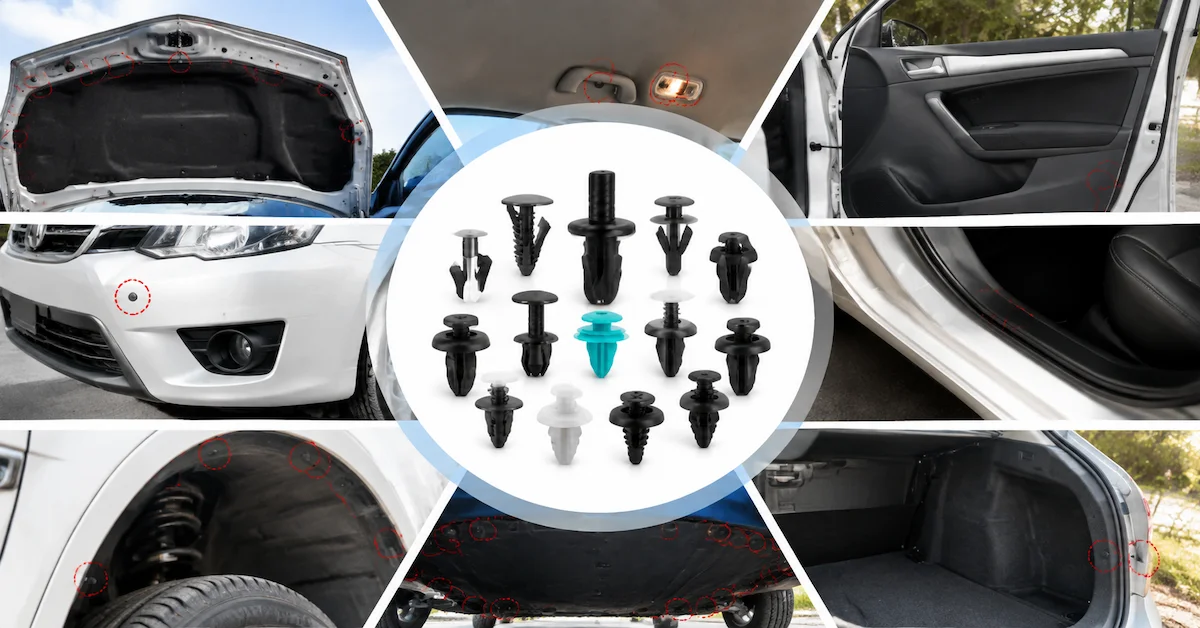

Why Do Plastic Car Clips Break?
Plastic car clips usually break because the material can no longer deform and recover in the way the clip geometry requires.
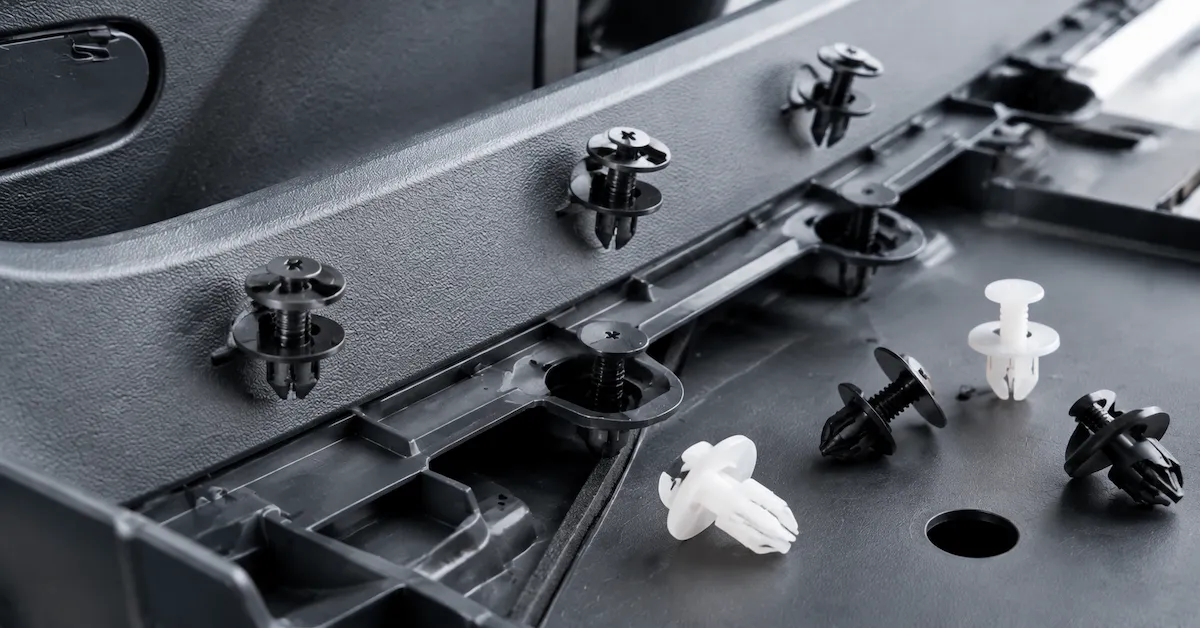
A new push retainer, trim clip, bumper clip, or panel fastener normally flexes as its locking legs pass through a mounting hole. Once installed, those legs recover and create retention. Failure occurs when aging, excessive stiffness, poor fitment, stress concentration, molding variation, environmental exposure, or improper removal prevents that controlled deformation.
Understanding why plastic car clips break therefore requires looking at the complete fastening system—not simply blaming “cheap plastic.”
For automotive distributors and repair-parts buyers, this distinction matters. A replacement clip may look almost identical to the original but still crack during installation, pull out after several months, or break the next time a technician removes the panel.
The most common failure causes are:
- polymer aging and loss of toughness;
- wrong material for the application;
- incorrect hole diameter or panel thickness;
- excessive installation or removal force;
- stress concentrated around locking legs and barb roots;
- molding defects or dimensional variation;
- repeated vibration and mechanical cycling;
- heat, cold, moisture, UV, and chemical exposure;
- reusing clips that already have damaged locking features.
The better solution is to treat the clip as an engineered component involving material + geometry + fitment + molding + environment + installation method.
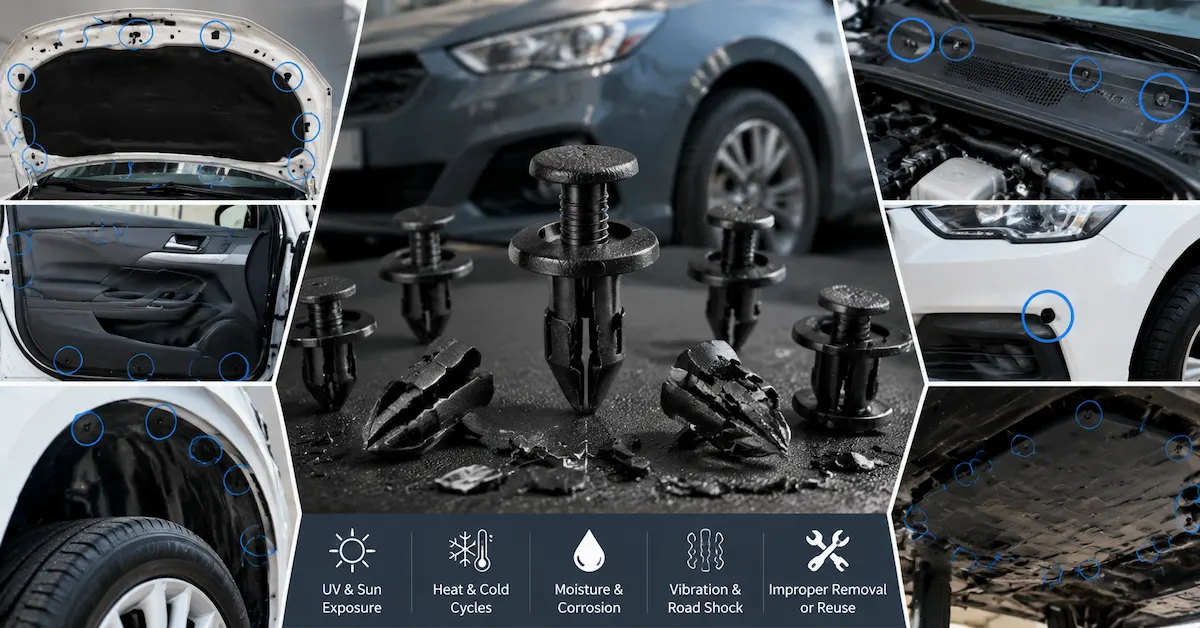
The 8 Main Reasons Plastic Car Clips Fail
| Failure Cause | What Happens to the Clip | Common Result |
|---|---|---|
| Material aging | Polymer becomes less capable of absorbing deformation | Cracking or brittle fracture |
| Wrong material | Resin behavior does not match the application | Deformation, fracture, or poor retention |
| Incorrect fitment | Hole/panel dimensions do not match clip geometry | Loose fit or excessive insertion force |
| Stress concentration | Load concentrates at thin ribs, corners, or barb roots | Local cracking |
| Poor molding control | Warpage, flash, short fill, or dimensional variation occurs | Inconsistent fitment |
| Improper removal | Uneven force bends or twists locking legs | Broken stems or barbs |
| Environmental exposure | Heat, cold, moisture, UV, or chemicals change performance | Aging and reduced durability |
| Excessive reuse | Locking features accumulate permanent damage | Lower retention and eventual breakage |
These causes often interact. An aged clip exposed to cold weather, for example, may survive normal service but fracture immediately when a technician pulls it sideways during panel removal.
Material Aging Is a Major Reason Car Clips Become Brittle
Plastic automotive fasteners do not remain in their original material condition forever.
Over time, polymers are subjected to:
- temperature changes;
- humidity;
- vibration;
- static loading;
- chemicals;
- sunlight in exposed locations;
- repeated installation or removal.
The effect depends strongly on the polymer grade.
For polyamide materials such as PA6 and PA66, BASF's technical documentation shows that mechanical behavior is influenced by temperature, time, and moisture content. BASF also notes that practical impact behavior depends on part shape, material rigidity, and moisture condition—not just the nominal polymer name.
This is one reason a simple specification such as “nylon clip” is not enough for a demanding automotive application.
A buyer should know:
- which polyamide grade is used;
- whether it is reinforced or unreinforced;
- whether stabilizers are required;
- where the clip will operate;
- how much elastic deformation the locking legs require.
For a broader comparison of PA, PP, POM, and nylon, your material-selection content should also connect naturally with the site's car clips material guide topic.
Why PA and Nylon Clips Can Still Break
PA6 and PA66 are widely used engineering polyamides because they can combine strength, toughness, stiffness, and elastic behavior. BASF lists high strength, rigidity, elastic properties, impact performance, and thermal stability among important characteristics of its PA engineering materials.
But using PA does not eliminate failure.
Moisture Changes Polyamide Behavior
Polyamide absorbs moisture.
That can affect stiffness, strength, dimensional behavior, and impact response. BASF's PA technical data specifically shows mechanical-property changes with moisture condition.
For clip engineering, that means a design should not be judged only from a dry resin datasheet.
Too Much Stiffness Can Be a Problem
A locking leg must flex.
If the selected PA grade is significantly stiffer than the material for which the clip was originally designed, insertion force can increase and stress at the root of the leg can rise.
This is especially relevant when changing:
- PA6 to PA66;
- unreinforced PA to glass-filled PA;
- one resin supplier or grade to another.
A stronger material is not automatically a better snap-fit material.
Old Nylon Can Fracture During Removal
When a clip has spent years under thermal, mechanical, or environmental exposure, its behavior during disassembly may differ from when it was new.
The clip may still hold the panel correctly but fracture as soon as its locking legs are forced backward.
This is why technicians often encounter broken clips during repair even when there was no obvious fastening problem beforehand.
Why PP Car Clips Break
Polypropylene is widely used in automotive applications, and impact-modified PP grades can be engineered specifically for improved impact performance. LyondellBasell describes PP impact copolymers as materials offering enhanced impact resistance and notes their use in automotive applications.
However, not every PP formulation performs the same way.
Low-Temperature Impact Can Matter
A material that flexes easily under normal workshop conditions may behave differently when exposed to low temperatures.
Exterior clips around:
- bumpers;
- wheel arches;
- splash shields;
- underbody panels;
can therefore require different impact behavior from a light-duty interior retainer.
Creep Can Reduce Retention
Plastic under continuous load can gradually deform.
For a clip, this may appear as:
- reduced barb engagement;
- relaxed locking legs;
- lower retention;
- panel movement;
- rattling.
A clip does not need to visibly crack to have failed.
Generic PP Is Not the Same as Automotive PP Compound
Automotive PP formulations can contain impact modifiers, fillers, stabilizers, and other additives selected for specific performance requirements. LyondellBasell's automotive PP portfolio illustrates how compounds are tailored for combinations such as impact resistance, stiffness, dimensional stability, and UV performance.
Therefore, buyers should avoid judging a clip only by the label “PP.”
What About POM Automotive Fasteners?
POM, or polyoxymethylene/acetal, is another material used where dimensional stability, wear behavior, low friction, or precise molded geometry is valuable.
Celanese describes its POM materials as offering properties including dimensional stability, wear resistance, toughness, and resistance to moisture.
These characteristics can benefit:
- precise locking elements;
- sliding mechanisms;
- guides;
- clips with tight dimensional relationships;
- fastening features involving repeated movement.
But POM is not automatically the best material for every flexible push clip.
A highly compliant snap leg may require a different balance of stiffness and elongation than a precision latch. The geometry needs to be designed for the actual resin.
Poor Fitment Can Break a Perfectly Good Clip
Many failures blamed on material are actually fitment failures.
The most important dimensions include:
- mounting-hole diameter;
- stem or shank diameter;
- panel thickness;
- stem length;
- head diameter;
- engagement depth;
- locking-leg geometry.
Hole Diameter Too Small
If the mounting hole is undersized, the clip must deform more than intended.
Possible results include:
- excessive insertion force;
- bent locking legs;
- stress whitening;
- cracked barbs;
- immediate fracture.
Hole Diameter Too Large
An oversized hole creates a different problem.
The clip may install easily but fail to develop enough interference or mechanical engagement.
The result can be:
- loose trim;
- reduced pull-out resistance;
- vibration;
- rattling;
- clip movement.
Incorrect Panel Thickness
Two clips can share the same nominal hole size but be designed for different panel thicknesses.
If the locking feature cannot engage behind the panel correctly, the clip may be overstressed or may never lock securely.
That is why vehicle model, mounting position, and physical dimensions should be checked together.
For replacement sourcing, QEEPEI's Specific Fit Car Clips range is organized around vehicle-specific compatibility rather than appearance alone. QEEPEI also states that it provides vehicle-model matching support for compatible clip selection.
Stress Concentration: Where Clips Usually Start to Crack
Plastic clips rarely experience perfectly uniform stress.
The highest stresses tend to develop around structural transitions such as:
- the root of an expansion leg;
- barb corners;
- thin-to-thick transitions;
- sharp internal corners;
- holes or slots;
- narrow locking ribs.
When insertion or removal bends a locking leg, those areas can become crack-initiation points.
BASF's PA design data emphasizes that finished-part impact behavior depends strongly on part shape as well as material rigidity and moisture condition.
This supports an important engineering principle:
Better resin cannot fully compensate for poor clip geometry.
What Better Clip Geometry Looks Like
Depending on the design, engineers may improve durability through:
- smoother transitions;
- appropriate radii;
- controlled wall thickness;
- sufficient flex-leg length;
- balanced barb geometry;
- avoiding unnecessarily sharp corners;
- controlling weld-line locations during molding.
The exact geometry depends on the clip and application, so these should be evaluated through samples and part testing rather than universal dimensions.
Injection Molding Quality Can Determine Whether Clips Survive Installation
A correct material and design can still fail if molding is inconsistent.
Potential injection-molding problems include:
Short Shots
If thin locking features are not completely filled, their effective cross-section decreases.
The clip may look acceptable from a distance but fracture under installation load.
Flash
Excess material around locking surfaces can increase interference and insertion force.
Warpage
A warped stem or uneven locking leg changes the way load is distributed during installation.
Poor Dimensional Repeatability
Small clips often rely on precise relationships between the mounting hole and locking geometry.
Batch-to-batch dimensional variation can therefore create inconsistent field performance.
Improper Material Processing
Engineering plastics need to be processed according to their resin requirements.
For PA materials in particular, moisture condition and processing history can influence finished-part performance; BASF's technical documentation specifically treats moisture as an important variable in PA mechanical behavior.
QEEPEI states that its manufacturing setup integrates injection molding, mold development, R&D, and quality control, with testing capabilities covering high/low temperature, impact, tensile, and aging evaluations. It also states that new PA, PP, and POM raw materials are used for its automotive fastener production.
More information is available on the QEEPEI About Us page.
Why Plastic Car Clips Break During Removal
Removal is one of the most common moments of failure.
A push-type clip was designed to lock.
Removing it often requires forcing the locking feature back through the same hole, so the clip experiences a different loading condition from installation.
Common removal mistakes include:
- pulling from only one side;
- twisting the stem;
- levering directly against a thin barb;
- pulling before releasing the center pin;
- using pliers on a brittle head;
- applying force at the wrong angle.
QEEPEI's existing fastener-lifespan content also identifies excessive removal force and damage to locking ribs or expansion legs as common failure mechanisms.
Use the Correct Removal Tool
A trim-removal tool can spread the load around the fastener head instead of concentrating force at one edge.
You can view QEEPEI's car clip removal and installation tools for repair and workshop applications. The product category is specifically positioned for workshops, distributors, and maintenance use.
Do Not Assume Every Clip Is Reusable
Before reinstalling a removed clip, inspect:
- locking legs;
- barbs;
- center pin;
- stem;
- head;
- signs of whitening;
- cracks;
- permanent deformation.
A clip that installs again is not necessarily a clip that still provides reliable retention.
Environmental Conditions Change Failure Risk
Different vehicle zones expose clips to very different conditions.
| Vehicle Area | Main Exposure | Typical Failure Risk |
| Door trim | Repeated service, vibration | Broken legs, reduced retention |
| Dashboard / interior | Cabin heat, vibration | Creep, loosening |
| Headliner | Cabin temperature cycling | Deformation, loss of retention |
| Bumper | Impact, vibration, weather | Cracking or pull-out |
| Fender liner | Water, dirt, debris, temperature | Damage and embrittlement |
| Wheel arch | Road contamination, vibration | Wear or fracture |
| Underbody | Water, debris, temperature cycling | Impact damage |
| Engine bay | Elevated temperature, fluids | Aging and deformation |
| Exterior molding | UV, weather, vibration | Surface aging and brittleness |
This is why one “universal clip material” should not be assumed suitable for every position.
Browse the full QEEPEI automotive clip product range to compare clips intended for different vehicle locations.
How to Diagnose Why a Plastic Car Clip Failed
Instead of immediately replacing a broken clip with an identical-looking part, inspect the failure pattern.
Failure Pattern 1: Clean Brittle Fracture
Likely areas to investigate:
- aging;
- low-temperature exposure;
- unsuitable material;
- excessive removal force;
- degradation.
Better response:
Review material grade and environment before reordering.
Failure Pattern 2: Bent but Not Broken Locking Legs
Likely areas to investigate:
- hole too small;
- excessive insertion force;
- repeated reuse;
- geometry mismatch.
Better response:
Check mounting-hole diameter and panel thickness.
Failure Pattern 3: Clip Installs but Pulls Out Easily
Likely areas to investigate:
- hole too large;
- wrong clip;
- insufficient barb engagement;
- panel too thin or too thick;
- permanent creep.
Better response:
Compare physical dimensions with the original mounting interface.
Failure Pattern 4: Same Part Breaks Repeatedly
Likely areas to investigate:
- material/application mismatch;
- structural stress concentration;
- tooling issue;
- wrong replacement cross-reference;
- installation method.
Better response:
Treat the problem as an engineering issue rather than continuing to replace clips from the same specification.
Better Material Solutions for Different Failure Modes
| Problem | Material / Design Direction to Evaluate |
| Clip cracks while flexing | Tougher or impact-modified grade; improve flex-leg geometry |
| Clip becomes loose over time | Review creep resistance, geometry, and engagement |
| Clip breaks in a warm location | Verify heat-capable resin grade |
| Clip breaks in cold service | Verify low-temperature impact performance |
| Dimensions change in humid service | Review moisture-sensitive materials and tolerances |
| Locking surfaces wear | Consider wear/friction behavior |
| Exterior clip ages quickly | Evaluate stabilized material appropriate for outdoor exposure |
| Clip fails during removal | Improve toughness and use correct extraction method |
These are selection directions, not automatic material substitutions.
Changing PP to PA66, for example, may solve one weakness but introduce excessive stiffness if the geometry remains unchanged.
The correct development sequence is:
failure analysis → application requirement → material selection → geometry review → tooling → sample validation → production.
What B2B Buyers Should Check Before Purchasing Replacement Clips
For distributors, importers, repair chains, and private-label brands, broken clips create more than a technical problem.
They can create:
- product returns;
- poor marketplace reviews;
- repair comebacks;
- warranty complaints;
- damaged trim panels;
- SKU confusion;
- inventory write-offs.
A stronger purchasing specification should therefore include the following.
Vehicle and Fitment Data
Provide:
- vehicle make;
- model;
- year;
- OE reference if available;
- installation position.
Physical Dimensions
Confirm:
- hole diameter;
- stem diameter;
- head diameter;
- stem length;
- panel thickness.
Material Requirement
Do not specify only “plastic.”
Ask whether the clip is:
- PA6;
- PA66;
- PP;
- POM;
- modified;
- reinforced;
- stabilized where necessary.
Application Environment
Tell the supplier whether the fastener is used:
- inside the cabin;
- on an exterior panel;
- under the hood;
- near the wheel arch;
- under the vehicle;
- in a frequently serviced panel.
Sample Validation
For important projects, evaluate the clip in the actual mounting interface before bulk approval.
A dimensional drawing is useful, but physical installation exposes problems that a measurement table cannot always predict.
How Quality Control Reduces Broken-Clip Complaints
A good clip inspection plan should focus on the causes that can produce field failure.
Important checks may include:
- raw-material verification;
- molded dimensions;
- appearance and completeness;
- locking-leg geometry;
- insertion behavior;
- retention or pull-out performance where specified;
- environmental or aging tests when required;
- packaging and batch identification.
QEEPEI describes its quality-control process as covering raw material through finished-product inspection and states that its laboratory can perform high/low-temperature, impact, tensile, and aging testing.
You can also read the related Automotive Clips Quality Control Testing Guide, which focuses on dimensional, locking, appearance, and production-quality considerations.
When Should a Broken Clip Be Redesigned Instead of Simply Replaced?
Replacement is appropriate when the failure comes from normal aging or accidental damage.
Redesign should be considered when the same fastening point repeatedly experiences:
- broken locking legs;
- excessive installation force;
- poor retention;
- stress whitening;
- cracking at the same location;
- unacceptable removal damage.
For an OEM/ODM project, useful inputs include:
- original clip sample;
- 2D or 3D drawing;
- panel hole dimensions;
- panel thickness;
- application location;
- material requirement;
- known failure mode;
- expected production quantity.
QEEPEI states that it supports customized clip sizes, shapes, colors, mold development, material optimization, and vehicle-specific matching.
For a failure-analysis or custom-fastener project, buyers can submit details through the QEEPEI Contact Us page.
A Practical Checklist for Preventing Plastic Car Clip Breakage
Before approving or installing a replacement clip, confirm:
- Fitment: Does it match the actual vehicle and mounting position?
- Hole size: Is the stem designed for the mounting-hole diameter?
- Panel thickness: Can the locking feature engage correctly?
- Material: Is the resin grade suitable for the service environment?
- Geometry: Are locking legs and barbs free from obvious defects?
- Molding: Is there flash, warpage, incomplete filling, or dimensional variation?
- Environment: Will the clip face heat, cold, moisture, UV, chemicals, or impact?
- Installation: Is the correct installation method being used?
- Removal: Is a proper trim tool required?
- Reuse: Has the locking structure already been permanently deformed?
If several of these factors are unknown, material alone cannot answer why plastic car clips break.
FAQ: Why Plastic Car Clips Break
Why do plastic car clips become brittle over time?
Material properties can change after long-term exposure to heat, moisture, UV, chemicals, vibration, and repeated stress. The effect depends on the polymer grade and application. For PA materials specifically, temperature and moisture can substantially influence mechanical behavior.
Why do car clips break when I remove a door panel?
The locking legs are forced through the mounting hole again during removal. Aging, side loading, excessive force, or pulling without releasing the locking mechanism can break the stem or barbs.
Are nylon car clips less likely to break?
PA6 and PA66 can offer strong mechanical and elastic properties, but “nylon” alone does not guarantee durability. The exact PA grade, moisture condition, geometry, molding quality, temperature, and fitment all matter.
Is PP too weak for automotive clips?
No. PP and impact-modified PP compounds are widely used in automotive applications. The correct question is whether the specific PP grade and clip design meet the load, impact, temperature, and retention requirements of the application.
Is POM better than PA for car clips?
Not universally. POM offers useful dimensional stability, wear, and low-friction properties, while PA can provide a different balance of toughness, stiffness, and elastic behavior. The choice should follow the clip's actual mechanical function.
Can the wrong hole size cause a clip to crack?
Yes. An undersized hole can require excessive deformation during insertion, while an oversized hole may provide insufficient locking engagement. Both conditions can cause fastening problems.
Can broken plastic clips be repaired?
A structurally cracked locking leg or stem should generally be replaced rather than trusted as a load-bearing fastener. Adhesive repair usually does not restore the designed snap-fit geometry and retention behavior.
Can automotive clips be reused?
Some clips can be reused if their locking features remain undamaged and the material has not permanently deformed. Clips showing cracks, whitening, bent legs, worn barbs, or damaged center pins should be replaced.
What should distributors ask a car clip supplier before bulk ordering?
Confirm vehicle fitment, OE references where available, critical dimensions, material grade, application environment, inspection requirements, sample approval, packaging, and batch consistency.
How can QEEPEI help when existing clips keep breaking?
QEEPEI provides automotive clips, vehicle-specific matching, material options including PA, PP and POM, mold development, customized clip design, and in-house quality-testing capabilities. Buyers can provide a failed sample, drawing, mounting dimensions, vehicle information, and order requirements for evaluation.
Conclusion
Understanding why plastic car clips break is not a matter of choosing between “good plastic” and “bad plastic.”
Most failures come from an interaction between polymer behavior, clip geometry, molding consistency, mounting-hole dimensions, environmental exposure, installation, and removal.
PA6 or PA66 may be appropriate when snap-fit strength and thermal performance are important. PP can work well where the selected grade provides the required flexibility and impact behavior. POM can be valuable for precise, wear-resistant locking features. But none of these materials can compensate for incorrect fitment or poorly designed geometry.
For repair shops, distributors, and automotive parts buyers, the most effective prevention strategy is:
identify the failure mode → confirm the vehicle and mounting dimensions → verify the material → inspect clip geometry → test actual fitment → approve production quality.
This approach explains why plastic car clips break and, more importantly, prevents buyers from repeatedly replacing a failed fastener with another part that has the same underlying problem.
Explore QEEPEI's complete automotive clips range, learn more about its manufacturing and quality-control capabilities, or contact QEEPEI with a failed clip, drawing, OE reference, vehicle model, or custom-fastener requirement.