
Advanced Manufacturing Processes Behind a Reliable Automotive Clips Manufacturer
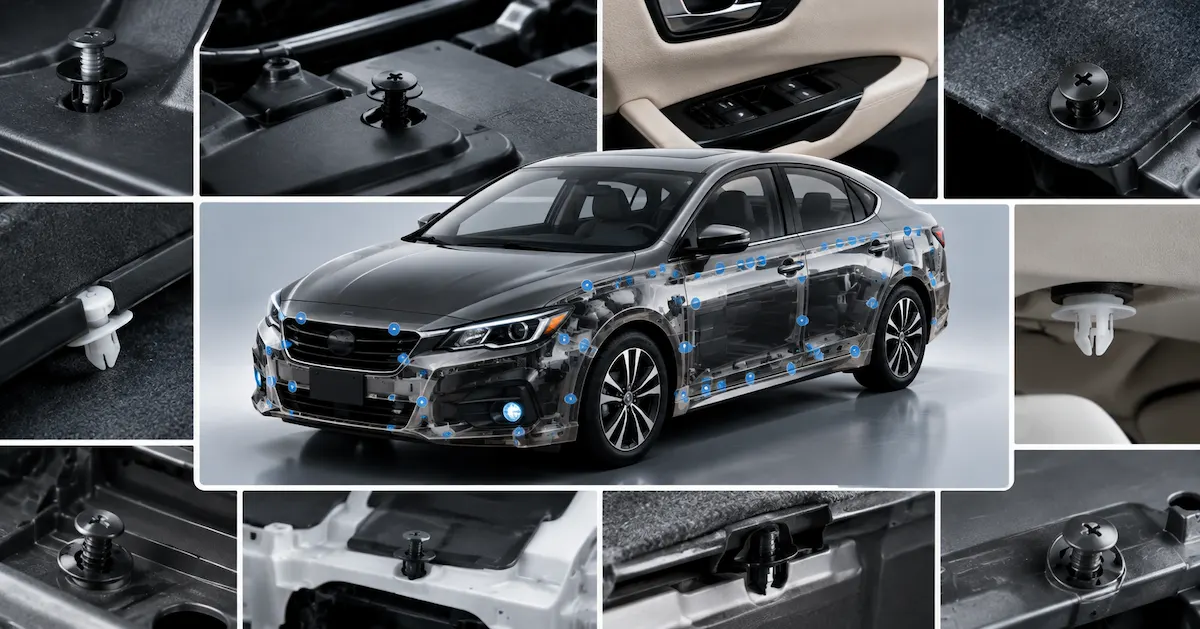
Automotive clips may look like simple plastic components, but their performance directly affects vehicle assembly quality, interior stability, vibration control, and long-term durability.
For automotive manufacturers, aftermarket distributors, repair networks, and private-label brands, choosing the right automotive clips manufacturer means evaluating much more than product appearance.
A reliable supplier needs to control the complete production chain:
- product engineering;
- material selection;
- mold development;
- precision injection molding;
- dimensional control;
- performance testing;
- packaging and delivery.
Small variations in a clip’s stem diameter, locking leg geometry, material performance, or molding accuracy can cause installation difficulties, loose panels, abnormal noise, or premature failure.
This is why professional automotive fastener production requires a combination of engineering knowledge, manufacturing experience, and quality management.
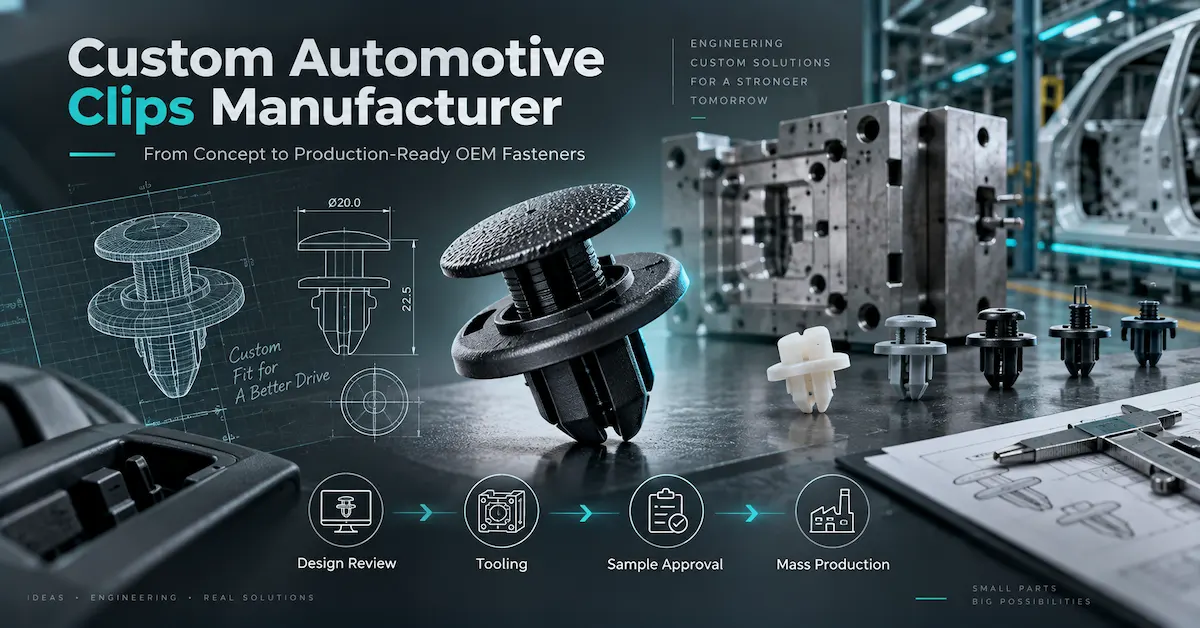
QEEPEI specializes in automotive clips and plastic fasteners, providing standard products, vehicle-specific solutions, and customized manufacturing support for global automotive aftermarket customers.
Why Manufacturing Capability Matters for Automotive Clips
Many buyers initially compare automotive clips based on:
- unit price;
- product appearance;
- available models;
- delivery time.
However, automotive clips are precision components.
The actual performance depends on:
| Key Factor | Why It Matters |
|---|---|
| Material selection | Determines flexibility, strength, temperature resistance |
| Mold accuracy | Controls dimensional consistency |
| Injection parameters | Influences strength and surface quality |
| Clip geometry | Determines retention force and installation behavior |
| Inspection process | Prevents defective parts entering the supply chain |
| Production control | Ensures stable quality between batches |
For distributors and OEM buyers, a supplier with strong manufacturing capability reduces:
- product returns;
- incorrect fitment problems;
- installation complaints;
- inventory risks.
Complete Manufacturing Workflow of Automotive Clips
A professional automotive clips manufacturer normally follows a structured production process.
The complete workflow includes:
- Product analysis
- Engineering design
- Material selection
- Mold development
- Injection molding
- Secondary processing
- Quality inspection
- Performance testing
- Packaging
- Shipment
Each stage affects the final reliability of the automotive fastener.
Step 1: Product Design and Engineering Analysis
Before manufacturing begins, engineers analyze the requirements of the clip application.
Important design factors include:
Mounting Position
Different vehicle locations require different clip characteristics.
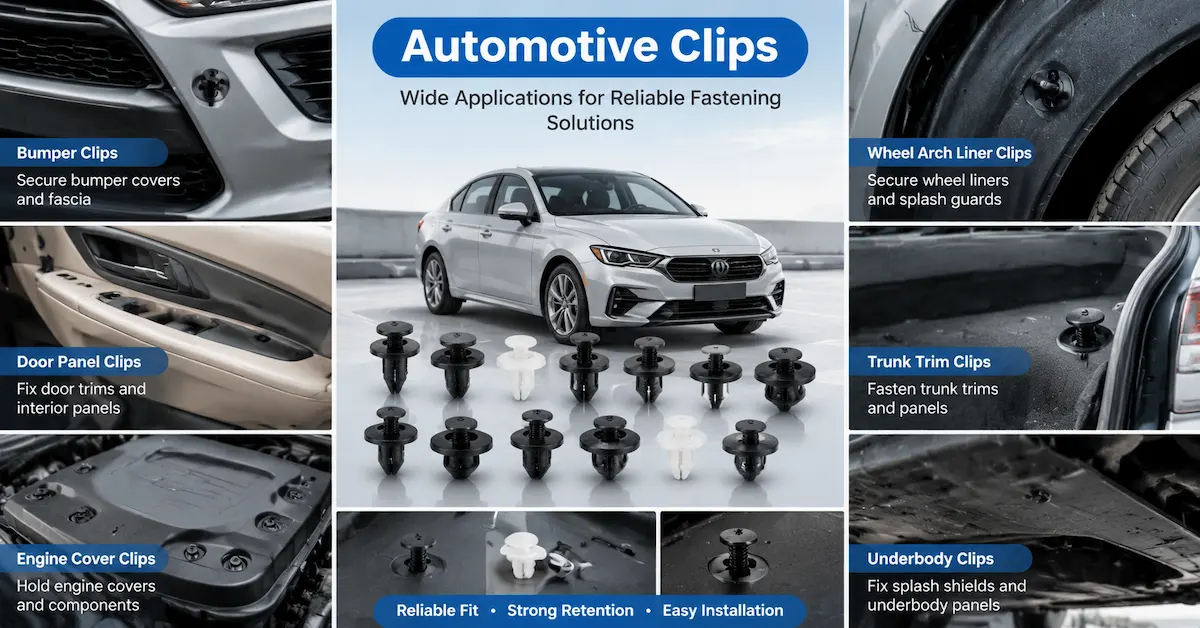
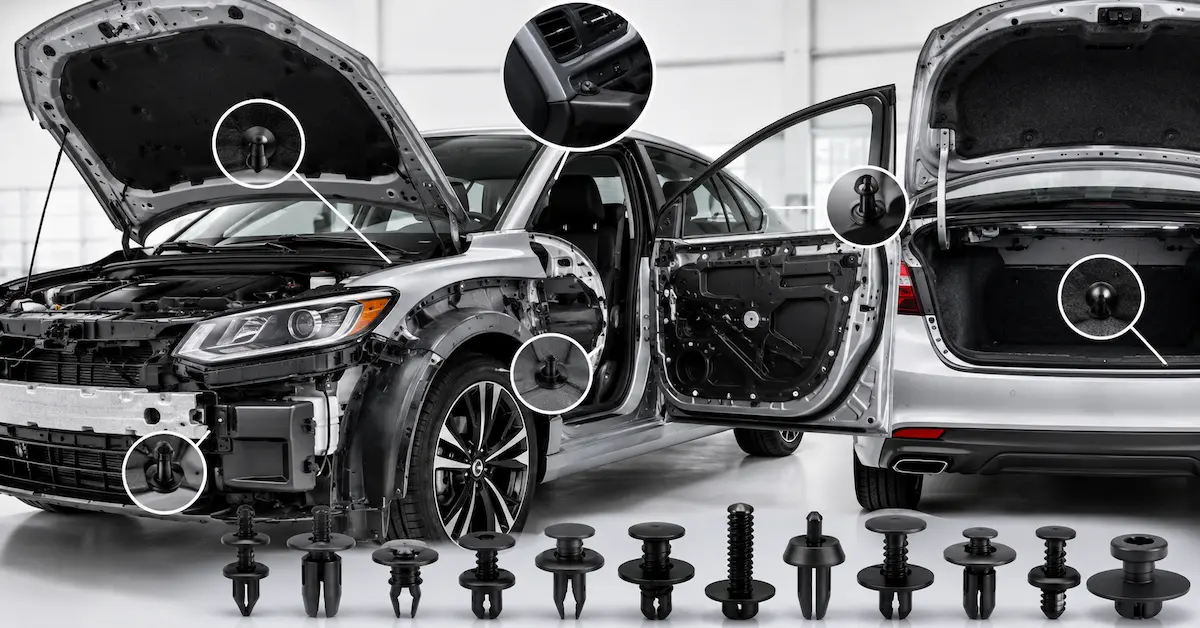
Examples:
- bumper clips require vibration resistance;
- door panel clips require repeated assembly performance;
- engine compartment clips require higher temperature resistance;
- wheel arch clips require environmental durability.
Dimensional Requirements
Engineers evaluate:
- hole diameter;
- stem diameter;
- head diameter;
- panel thickness;
- locking structure;
- insertion force;
- retention force.
A clip that visually matches the original part may still fail if these dimensions are incorrect.
Step 2: Material Selection for Automotive Clips
Material selection is one of the most important decisions in automotive clip production.
Common materials include:
PA6 / PA66 Nylon
Advantages:
- high mechanical strength;
- good toughness;
- good temperature capability;
- suitable elastic recovery.
Common applications:
- door trim clips;
- interior retainers;
- structural plastic fasteners.
PP (Polypropylene)
Advantages:
- lightweight;
- good chemical resistance;
- flexible performance;
- cost-effective molding.
Common applications:
- interior panels;
- lightweight fastening applications.
POM (Polyoxymethylene)
Advantages:
- dimensional stability;
- low friction;
- wear resistance;
- precision performance.
Common applications:
- precision locking components.
A professional supplier does not simply choose the cheapest resin.
Material selection must consider:
- application environment;
- temperature;
- vibration;
- moisture;
- chemical exposure;
- required retention performance.
Step 3: Automotive Clip Mold Development
The mold is one of the most important assets in automotive clip manufacturing.
A high-quality mold directly affects:
- product consistency;
- production efficiency;
- surface quality;
- dimensional accuracy.
The mold development process usually includes:
3D Design
Engineers create digital models based on:
- customer drawings;
- samples;
- OEM references;
- vehicle requirements.
Mold Flow Analysis
Simulation helps evaluate:
- material filling;
- cooling behavior;
- possible deformation;
- weld-line position.
Mold Manufacturing
Precision machining creates:
- cavities;
- cores;
- sliders;
- ejector systems.
Mold Testing
Before mass production, samples are checked for:
- dimensions;
- installation performance;
- appearance;
- mechanical behavior.
QEEPEI provides mold development support for customized automotive clips, helping customers move from concept or sample to production.
Step 4: Precision Injection Molding Process
Injection molding is the core production process for plastic automotive fasteners.
The process includes:
Material Preparation
Before molding:
- resin quality is checked;
- material conditions are controlled;
- additives are verified when required.
Injection
Molten plastic is injected into the mold cavity under controlled conditions.
Important parameters include:
- injection pressure;
- temperature;
- filling speed;
- cooling time.
Cooling and Ejection
After forming:
- parts cool inside the mold;
- ejector systems remove finished clips.
Visual Inspection
Operators check:
- incomplete filling;
- flash;
- deformation;
- surface defects.
For automotive components, stable molding conditions are critical because even small dimensional changes can affect installation.
Step 5: Quality Control During Automotive Clip Production
A professional automotive clips manufacturer needs a complete QC system.
Typical inspection stages include:
Incoming Material Inspection
Checking:
- resin type;
- supplier documentation;
- material consistency.
In-Process Inspection
Monitoring:
- molding parameters;
- product dimensions;
- appearance quality.
Finished Product Inspection
Checking:
- clip dimensions;
- locking structure;
- assembly performance;
- packaging accuracy.
QEEPEI states that its quality system covers raw material inspection, production inspection, finished-product inspection, and performance testing including temperature, impact, tensile, and aging evaluations.
Testing Automotive Clip Performance
Appearance alone cannot prove clip reliability.
Professional testing may include:
Retention Force Testing
Measures how securely the clip holds the panel.
Pull-Out Testing
Evaluates removal resistance.
Impact Testing
Checks resistance against sudden loads.
Temperature Testing
Evaluates performance under heat and cold conditions.
Aging Testing
Examines long-term durability.
These tests help ensure that clips perform consistently during real vehicle operation.
Step 6: Automation and Production Efficiency
For large-volume automotive clip orders, production efficiency is important.
Manufacturing capability includes:
- automated molding equipment;
- efficient mold change management;
- production monitoring;
- standardized inspection procedures.
A capable supplier can support:
- stable repeat orders;
- multiple SKU management;
- large distributor requirements;
- OEM projects.
For global buyers, manufacturing efficiency directly influences:
- lead time;
- supply stability;
- total purchasing cost.
OEM and Custom Automotive Clip Manufacturing
Many automotive buyers require more than standard products.
A professional automotive clips manufacturer should support:
Custom Dimensions
Examples:
- different stem length;
- different head diameter;
- different panel thickness range.
Custom Materials
Examples:
- PA;
- PP;
- POM;
- reinforced materials.
Custom Colors
Common requests:
- black;
- white;
- natural;
- customer-specific colors.
Private Label Packaging
Solutions may include:
- branded bags;
- labels;
- retail packaging;
- barcode management.
QEEPEI supports customized automotive clip development based on customer requirements, including product design, mold development, and manufacturing solutions.
How to Choose the Right Automotive Clips Manufacturer
When evaluating suppliers, buyers should consider:
| Evaluation Factor | Questions to Ask |
|---|---|
| Manufacturing capability | Does the supplier own production equipment? |
| Mold capability | Can they develop customized clips? |
| Material knowledge | Can they recommend suitable polymers? |
| Quality control | Are inspection processes documented? |
| Product range | Can they support multiple vehicle applications? |
| Custom support | Can they handle OEM/ODM projects? |
| Delivery capability | Can they maintain stable supply? |
A low-cost supplier may provide cheaper clips, but inconsistent quality can create higher long-term costs.
Why Global Buyers Choose QEEPEI as Their Automotive Clips Manufacturer
QEEPEI focuses on automotive clips and plastic fastening solutions for international customers.
The company provides:
- extensive automotive clip product categories;
- vehicle-specific clip solutions;
- plastic material expertise;
- mold development;
- injection molding;
- quality inspection;
- OEM/ODM customization.
For distributors, repair networks, and automotive brands, this integrated capability helps simplify sourcing and reduce supply-chain complexity.
Explore QEEPEI automotive clip products:
https://www.cnclip.com/products
Learn more about manufacturing capability:
https://www.cnclip.com/about-us
Contact QEEPEI for customized automotive clip projects:
https://www.cnclip.com/contact-us
FAQ: Automotive Clips Manufacturing
What does an automotive clips manufacturer do?
An automotive clips manufacturer designs, develops molds, produces plastic fasteners, performs quality inspection, and supplies automotive clip solutions for OEM and aftermarket applications.
What materials are commonly used for automotive clips?
Common materials include PA6, PA66, PP, and POM. The best choice depends on application requirements such as strength, flexibility, temperature, and environmental exposure.
Can automotive clips be customized?
Yes. Professional suppliers can customize dimensions, materials, colors, packaging, and branding based on customer requirements.
Why are automotive clip molds important?
The mold determines product accuracy, consistency, surface quality, and production efficiency. Poor mold quality can create installation problems.
What quality tests should automotive clips pass?
Depending on the application, tests may include dimensional inspection, retention force testing, impact testing, temperature testing, and aging evaluation.
How long does automotive clip production take?
Lead time depends on whether the product is standard stock or requires new tooling. Custom projects usually require additional mold development and sample approval time.
How can buyers verify automotive clip suppliers?
Buyers should review manufacturing capability, product range, quality control systems, customization ability, and previous automotive experience.
Can automotive clip manufacturers provide OEM replacement parts?
Yes. Many suppliers provide vehicle-specific replacement clips based on OE numbers, drawings, samples, or vehicle applications.
What information is needed for custom automotive clips?
Useful information includes:
- drawings;
- samples;
- vehicle models;
- installation location;
- material requirements;
- expected quantity.
Why choose a factory instead of a trading company?
A direct manufacturer usually provides better control over materials, tooling, production consistency, customization, and long-term supply.
Conclusion
A reliable automotive clips manufacturer is not defined only by the number of available products.
High-quality automotive fasteners require:
- correct material selection;
- precision mold development;
- stable injection molding;
- strict quality control;
- application knowledge;
- customized engineering support.
For global automotive buyers, choosing a manufacturer with integrated production capability helps reduce quality risks and create a more reliable supply chain.
QEEPEI provides automotive clips, plastic fasteners, OEM/ODM solutions, and manufacturing support for distributors, repair suppliers, and automotive brands worldwide.