
What Makes a Reliable Plastic Automotive Fasteners Manufacturer?
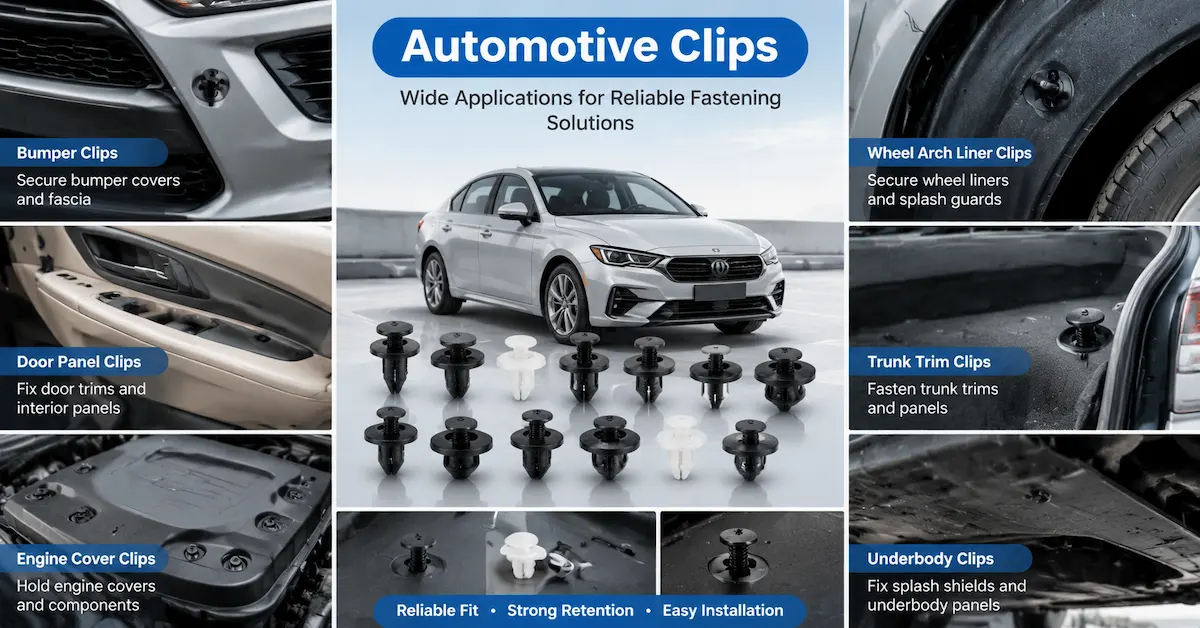
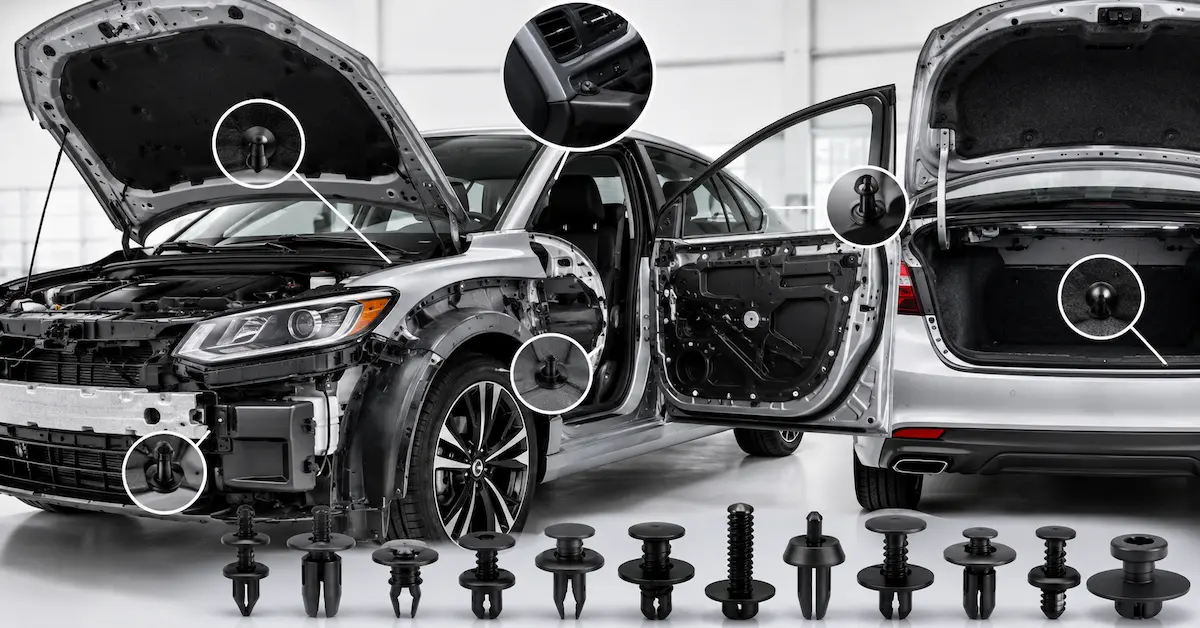
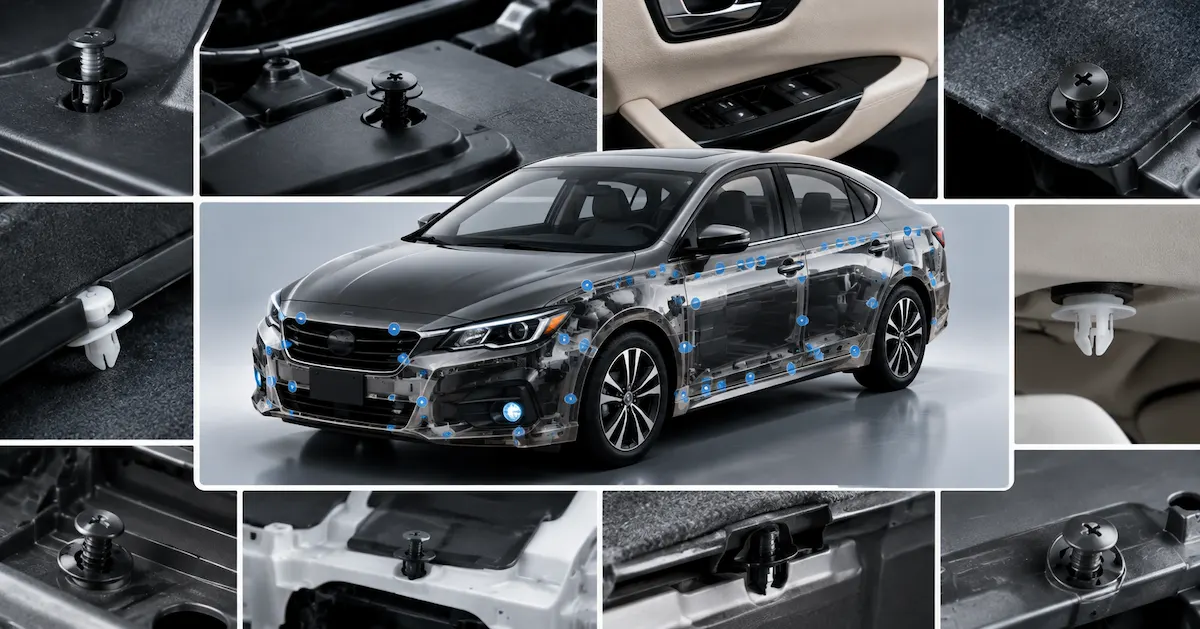
Plastic automotive fasteners are used in places where a vehicle needs secure fastening without adding unnecessary weight or using traditional metal hardware. They can be found in bumper assemblies, door trims, wheel liners, engine covers, interior panels, moldings, and other vehicle components.
For a distributor or aftermarket brand, however, buying plastic fasteners is rarely just a matter of finding a matching shape.
The supplier needs to get several things right at the same time:
- material;
- dimensions;
- locking structure;
- molding consistency;
- vehicle fitment;
- packaging;
- production continuity.
That is why choosing a plastic automotive fasteners manufacturer should start with manufacturing capability rather than price alone.
QEEPEI describes itself as an automotive fastener manufacturer integrating R&D, manufacturing, and global trade. Its current company information lists an 8,000㎡ headquarters, injection molding equipment, intelligent quality inspection systems, 2,000+ stocked SKUs, and support for OEM/ODM projects.
For buyers, the practical question is simple:
Can the supplier consistently produce the right fastener, in the right material, for the right vehicle application, and keep supplying it after the first order?
That is the standard worth using.
Who Should Buy Directly From a Plastic Automotive Fasteners Manufacturer?
Not every buyer needs a custom manufacturer.
The right sourcing model depends on what you are actually trying to accomplish.
Automotive Parts Distributors
Distributors usually need:
- a broad product range;
- reliable vehicle matching;
- repeatable quality;
- manageable MOQ;
- stable replenishment;
- organized packaging.
For these buyers, having access to stocked standard products can be as important as manufacturing capability.
QEEPEI currently lists 2,000+ SKUs in stock and states that regular items can be shipped within 24 hours.
Aftermarket and Repair Suppliers
Repair-oriented businesses often need replacement clips for multiple vehicle models.
Their main concerns are different:
- correct fitment;
- fast availability;
- easy identification;
- assortment kits;
- low return rates.
QEEPEI's product system includes vehicle-specific categories covering brands such as Honda, Ford, VW/Audi, Nissan, Toyota, Renault, Mazda, and BMW, alongside general clip categories.
Private-Label Automotive Brands
Private-label brands usually need more than a catalog item.
They may require:
- selected SKUs;
- custom packaging;
- branded labels;
- assortment kits;
- product documentation;
- repeat production.
In this case, a manufacturer with its own tooling and production capability can simplify the supply chain.
OEM and Engineering Buyers
OEM projects are a different category altogether.
The buyer may provide:
- an original sample;
- 2D or 3D drawings;
- an OE reference;
- mounting-hole dimensions;
- panel thickness;
- performance requirements.
The manufacturer then needs to convert that information into a repeatable molded component.
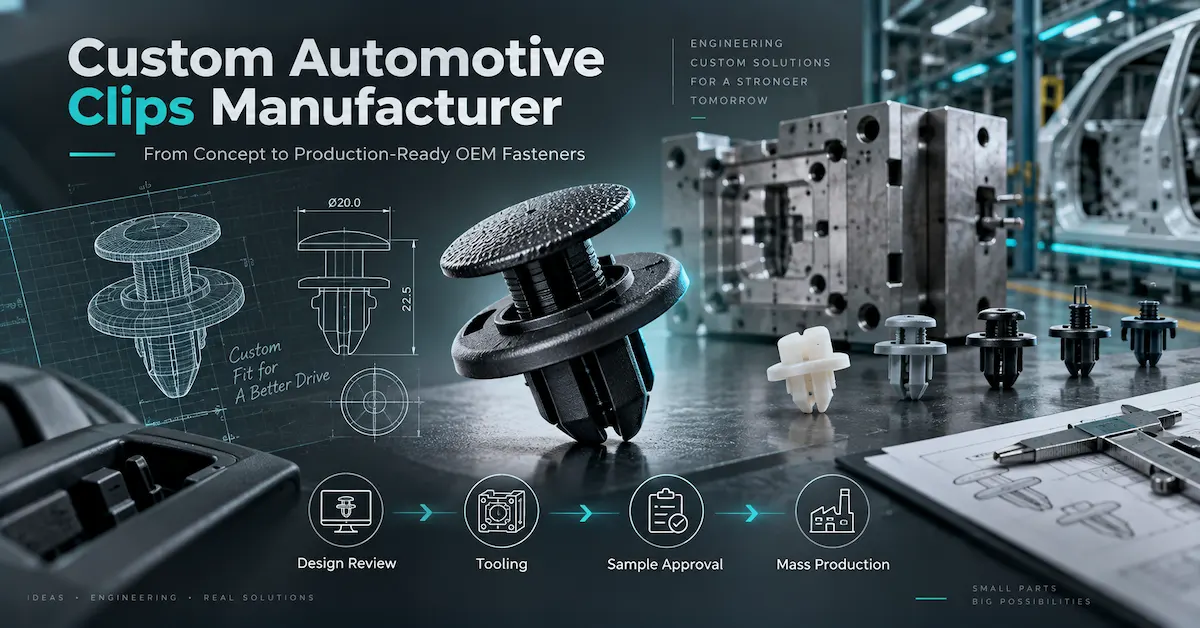
QEEPEI states that its R&D and manufacturing teams support snap-in structure design, material optimization, mold development, and customized automotive fastener solutions.
What Types of Plastic Automotive Fasteners Can Be Manufactured?
A broad product portfolio matters because vehicle fastening requirements vary significantly by location.
QEEPEI's current product categories include body clips, bumper clips, inner lining clips, door interior clips, fender clips, ceiling clips, seal strip clips, hood clips, light fixture clips, rear seat clips, center grille clips, dashboard navigation clips, glass clips, wheel arch clips, clip kits, specific-fit clips, and clip tools.
Push-Type Automotive Clips
Push retainers are widely used for vehicle trim and body components.
Their basic working principle is straightforward:
- The stem enters the mounting hole.
- Locking legs or ribs compress during insertion.
- The locking structure expands behind the panel.
- The head holds the component against the mounting surface.
The important variables are not just outside diameter.
They include:
- stem diameter;
- head diameter;
- insertion depth;
- panel thickness;
- locking-leg geometry;
- retention force.
Bumper and Fender Fasteners
Exterior applications generally experience more vibration, weather exposure, and service activity than protected interior locations.
These clips may be used around:
- bumper covers;
- fender liners;
- wheel arches;
- splash shields.
The material and geometry should therefore be selected around the actual environment.
Interior Trim Clips
Door panels, dashboards, pillar trims, ceiling panels, and decorative moldings often use clips that must balance retention with relatively easy removal.
For repair-oriented products, excessive insertion force can be just as undesirable as insufficient retention.
Vehicle-Specific Clips
A vehicle-specific clip is designed around a particular mounting interface rather than being selected only because it “looks similar.”
This is especially important for aftermarket distributors handling thousands of part numbers.
Which Materials Should a Plastic Automotive Fasteners Manufacturer Offer?
QEEPEI states that it uses new PA, PP, and POM materials and does not use recycled materials in its products. Its company information also identifies environmental certifications including RoHS and REACH.
The important point for buyers is that material selection should follow application requirements.
| Material | Typical Strengths | Common Considerations |
|---|---|---|
| PA6 | Toughness, strength, elastic behavior | Moisture and temperature conditions |
| PA66 | Higher strength and thermal capability | Can require tighter process control |
| PP | Lightweight, flexible,chemical resistance | Load and temperature requirements |
| POM | Dimensional stability, low friction, wear resistance | Better suited to specific precision applications |
PA6 and PA66
Polyamide is often selected when a clip needs a useful combination of mechanical strength and flexibility.
However, “nylon” is not a complete specification.
A purchasing team should still ask:
- PA6 or PA66?
- Reinforced or unreinforced?
- What grade?
- What application temperature?
- What environmental exposure?
- What dimensional tolerance?
PP
PP can be useful when lightweight construction and flexibility are priorities.
It is often considered for:
- interior trim;
- general fastening;
- lightweight panels.
POM
POM is useful where dimensional stability, low friction, and wear performance matter.
It may be considered for specific locking or precision fastening structures rather than being treated as a universal replacement for PA or PP.
How Is a Plastic Automotive Fastener Made?
The manufacturing process has a direct effect on fitment and durability.
A typical production route is:
Product analysis → mold design → material preparation → injection molding → inspection → testing → packaging
Product and Mold Development
Before the mold is built, engineers need to understand how the clip actually works.
This includes:
- mounting hole size;
- panel thickness;
- locking mechanism;
- required insertion force;
- required retention;
- available installation space.
For a custom part, the mold must reproduce these functional features consistently.
QEEPEI states that it has an in-house mold workshop and provides customized product development, while its R&D team focuses on snap-in structures and material optimization.
Injection Molding
Injection molding converts the selected polymer into the final clip shape.
Process variables can influence:
- dimensional stability;
- flash;
- incomplete filling;
- warpage;
- surface appearance;
- locking-leg consistency.
For small fasteners, seemingly minor molding variations can become significant when the component is installed into a precisely defined vehicle hole.
Post-Molding Inspection
After molding, manufacturers can inspect:
- overall dimensions;
- stem diameter;
- head diameter;
- locking features;
- flash;
- cracks;
- deformation;
- appearance.
For higher-risk applications, dimensional inspection should be combined with functional testing.
What Quality Control Should a Manufacturer Provide?
A serious automotive fastener program needs more than visual inspection.
QEEPEI states that its quality system includes raw-material inspection, production inspection, finished-product inspection, traceability, and laboratory testing. Its listed testing capabilities include high/low-temperature, impact, tensile-strength, and aging-resistance testing.
Material Control
The first question is whether the material entering production matches the approved specification.
This becomes particularly important when a buyer has approved a specific PA, PP, or POM formulation.
Dimensional Inspection
Critical dimensions should be monitored rather than checked only when a customer complains.
Typical dimensions include:
- overall length;
- head diameter;
- stem diameter;
- locking-leg position;
- wall thickness.
Fitment Verification
A clip can pass dimensional inspection and still perform poorly in the actual vehicle interface.
For vehicle-specific products, sample installation is therefore valuable.
Mechanical and Environmental Testing
Depending on the application, buyers may request:
- retention testing;
- pull-out testing;
- impact testing;
- temperature testing;
- aging testing.
The correct testing plan depends on how and where the clip is used.
Manufacturing and Certification Information Buyers Should Check
When qualifying a plastic automotive fasteners manufacturer, ask for evidence rather than relying only on a supplier profile.
Useful documentation can include:
- quality-system certificates;
- material documentation;
- test reports;
- inspection records;
- dimensional drawings;
- product specifications;
- batch traceability information.
QEEPEI's current About Us page states that the company works to ISO/TS 16949 requirements and lists SAE, CE, RoHS, REACH, SGS, and other international standards or certifications. Buyers should request the applicable certificate or report for the specific product and market rather than assuming every certification applies to every SKU.
Stock, Capacity, and Lead Time: What Should Buyers Expect?
For aftermarket businesses, manufacturing capability is only useful if products can actually be delivered.
QEEPEI states that it maintains 2,000+ SKUs in stock, uses categorized smart warehousing and traceable labeling, and offers 24-hour shipping for regular items.
Its product pages also describe bulk-order production capability, mold development, and packaging customization.
For procurement planning, separate your requirements into two groups:
| Requirement | Typical Supply Approach |
|---|---|
| Standard stocked clip | Inventory-based fulfillment |
| Existing mold,non-stock item | Production scheduling |
| New custom clip | Engineering + mold + sampling + production |
| Private-label kit | Product selection + packaging + production |
| Vehicle-specific range | Fitment confirmation + SKU management |
This distinction helps avoid a common purchasing mistake: expecting a newly developed custom clip to have the same lead time as a stocked replacement part.
Manufacturer Comparison: What Should B2B Buyers Evaluate?
Price is only one part of supplier selection.
| Evaluation Factor | Basic Supplier | Manufacturing Partner |
|---|---|---|
| Standard SKU supply | May be available | Available |
| Custom dimensions | Limited | Stronger |
| Mold development | Often outsourced | In-house capability |
| Material selection | Product-dependent | Engineering support |
| Production control | Indirect | Direct |
| Quality traceability | Varies | More controllable |
| Private-label packaging | Depends on supplier | Supported |
| Long-term OEM program | Limited | Better suited |
A manufacturer is especially valuable when the buyer expects:
- repeat orders;
- custom products;
- stable specifications;
- private labeling;
- new product development.
For simple one-time purchases, a standard distributor may be sufficient.
How to Reduce Purchasing Risk When Selecting a Manufacturer
The lowest quotation is not necessarily the lowest total cost.
Consider the cost of:
- incorrect fitment;
- returns;
- damaged clips during installation;
- inconsistent batches;
- delayed replenishment;
- excess inventory;
- new tooling after a supplier change.
A practical supplier qualification process can follow five steps.
Step 1: Confirm the Application
Provide:
- vehicle model;
- year;
- installation position;
- OE reference if available.
Step 2: Confirm the Physical Interface
Provide:
- mounting-hole diameter;
- panel thickness;
- required stem length;
- original sample if available.
Step 3: Confirm Material Requirements
Specify whether the project requires:
- PA6;
- PA66;
- PP;
- POM;
- another approved material.
Step 4: Approve Samples
Test the actual clip in the intended mounting interface before bulk approval.
Step 5: Lock the Production Specification
Once approved, maintain a controlled specification covering:
- material;
- dimensions;
- color;
- packaging;
- inspection requirements.
This makes future repeat orders much easier to manage.
OEM and Custom Plastic Automotive Fasteners
OEM development is where manufacturing capability becomes especially important.
A custom project may start with something as simple as a failed original clip.
The manufacturer can use the sample to investigate:
- locking structure;
- panel interface;
- dimensions;
- material behavior;
- installation method.
From there, the project can move into:
Sample analysis → design → mold → trial production → sample approval → mass production
QEEPEI states that it supports customized sizes, shapes, colors, mold development, vehicle-specific matching, and OEM/ODM services.
For brands, customized packaging can also be included. Its product information lists options such as retail-ready boxes, private-label bags, labels, barcodes, and assortment kits.
Explore QEEPEI's automotive fastener products
Why QEEPEI for Plastic Automotive Fastener Manufacturing?
QEEPEI combines product development, injection molding, mold development, inventory, quality control, and export support.
Its current company information identifies several capabilities relevant to B2B buyers:
- 8,000㎡ headquarters;
- 5 high-precision injection molding machines;
- 2,000+ SKUs in stock;
- vehicle-specific product matching;
- in-house mold workshop;
- R&D support;
- new PA, PP, and POM materials;
- full-process quality control;
- laboratory testing;
- OEM/ODM customization.
The product catalog also covers both general automotive clips and specific-fit products for multiple vehicle brands.
For a distributor, this creates an important advantage: standard replacement products and custom development can be handled through the same automotive fastening supply chain.
Learn more about QEEPEI's manufacturing capabilities
What Information Should You Send for a Fast Quotation?
The more complete the technical information, the less back-and-forth is required.
For a standard replacement clip, provide:
- part number;
- vehicle model;
- installation position;
- quantity.
For a custom project, add:
- original sample;
- 2D drawing;
- 3D file if available;
- hole diameter;
- panel thickness;
- material requirement;
- color;
- annual quantity;
- packaging requirement.
QEEPEI's inquiry form specifically requests vehicle-model information and promotes quotation requests through its website.
Request a quotation from QEEPEI
FAQ: Plastic Automotive Fasteners Manufacturer
What is a plastic automotive fasteners manufacturer?
A plastic automotive fasteners manufacturer produces molded plastic fastening components used in vehicle interiors, exteriors, body panels, trims, liners, and other assemblies. A full-service manufacturer may also provide mold development, material selection, testing, and OEM customization.
What materials are commonly used for automotive plastic fasteners?
PA6, PA66, PP, and POM are common material choices. The appropriate material depends on the required strength, flexibility, temperature resistance, environmental exposure, and fastening design.
Why should I buy directly from a manufacturer?
Direct cooperation can provide better control over specifications, tooling, material selection, quality, and repeat production. It is particularly useful for OEM, private-label, and large-volume projects.
Can a manufacturer produce custom automotive clips from a sample?
Yes.A sample can be used as a starting point for dimensional analysis, structure review, mold development, sampling, and mass production, provided the manufacturer has the required engineering and tooling capabilities.
What is the difference between PA6 and PA66 automotive clips?
Both are polyamide materials, but their mechanical and thermal characteristics differ by grade and formulation. The correct choice should be based on the actual application rather than the material name alone.
Are PP clips suitable for automotive applications?
Yes. PP can be suitable for various automotive fastening applications, particularly where lightweight construction, flexibility, and chemical resistance are useful. The specific PP grade and clip geometry still need to match the application.
What quality tests should automotive fasteners undergo?
Depending on the application, testing may include dimensional inspection, fitment verification, retention or pull-out testing, impact testing, high/low-temperature testing, and aging evaluation.
How long does custom automotive fastener development take?
There is no universal lead time.Existing products can usually move faster, while a new custom clip requires engineering, mold development, sampling, approval, and production. Buyers should request a project-specific schedule.
Can plastic automotive fasteners be supplied with private-label packaging?
Yes. QEEPEI states that it supports customized packaging, including retail boxes, private-label bags, labels, barcodes, and assortment kits.
What should I provide when requesting custom plastic automotive fasteners?
Provide the original clip or drawing, vehicle and application information, mounting-hole dimensions, panel thickness, material preference, estimated quantity, color, and packaging requirements. The more complete the information, the easier it is for the manufacturer to evaluate the project.
Conclusion
Choosing a plastic automotive fasteners manufacturer should be based on the complete supply chain rather than the unit price printed on a quotation.
A suitable manufacturing partner should be able to connect:
Material selection → product design → mold development → injection molding → quality control → fitment → packaging → delivery
For standard aftermarket products, inventory and vehicle matching are critical. For OEM and private-label projects, engineering, tooling, material control, and repeat-production capability become more important.
QEEPEI combines automotive clip manufacturing, mold development, R&D, inventory, quality control, vehicle-specific matching, and OEM/ODM support. Its current product system covers more than 4,000 product models, with 2,000+ SKUs listed as stocked products, while its manufacturing information highlights injection molding, new-material production, testing, and customization capabilities.
If you are sourcing plastic automotive fasteners for distribution, repair, aftermarket sales, or a new OEM project, start with the actual vehicle application and fastening requirements. Then evaluate the manufacturer's material capability, tooling, QC, stock, lead time, and customization support.