
When Does a Buyer Actually Need a Custom Automotive Clip?
A custom project should not begin simply because an existing clip is difficult to find.
For many aftermarket applications, the fastest and lowest-risk solution is still to identify an existing product that already matches the mounting hole, panel thickness, locking structure, material, and vehicle application. A new mold adds engineering work, tooling cost, sample approval, and production-control requirements that may be unnecessary when a suitable standard clip already exists.
Custom development becomes more relevant when:
- no standard fastener matches the mounting interface;
- an existing clip repeatedly breaks or releases;
- the panel thickness or mounting hole has changed;
- a customer needs a different head, stem, barb, or locking geometry;
- an aftermarket brand needs an exclusive product rather than only custom packaging;
- an obsolete or difficult-to-source clip must be recreated;
- a vehicle-specific application requires controlled dimensions;
- the current design is difficult to install or remove;
- a sample needs to be converted into a repeatable production specification.
Before requesting a new mold, buyers should first review the existing automotive clips product range and, where relevant, vehicle-specific clip solutions.
The key decision is not simply standard or custom. It is whether custom engineering creates enough functional or commercial value to justify controlling a new part.
| Sourcing Route | Best Used When | Main Buyer Risk |
|---|---|---|
| Existing standard clip | Dimensions and application already match | Incorrect identification |
| Existing clip with packaging customization | Product works, but branding or pack format must change | Confusing packaging customization with product engineering |
| Modified existing geometry | One or several dimensions need adjustment | Assuming a small change has no effect on fitment |
| Fully custom clip | No suitable standard product exists | Poor requirements definition before tooling |
Start With the Failure Mode, Not the Clip Shape
A custom automotive clips manufacturer needs to understand what the fastener must do, not only what it currently looks like.
This is especially important when development starts from a broken original clip.
A damaged sample may no longer represent:
- the original stem diameter;
- the complete locking leg geometry;
- the correct head profile;
- the original elastic recovery;
- the intended material behavior;
- or the actual installation condition.
Copying the damaged shape directly can reproduce the problem rather than solve it.
Instead, the development discussion should begin with the application.
Define where the clip is installed
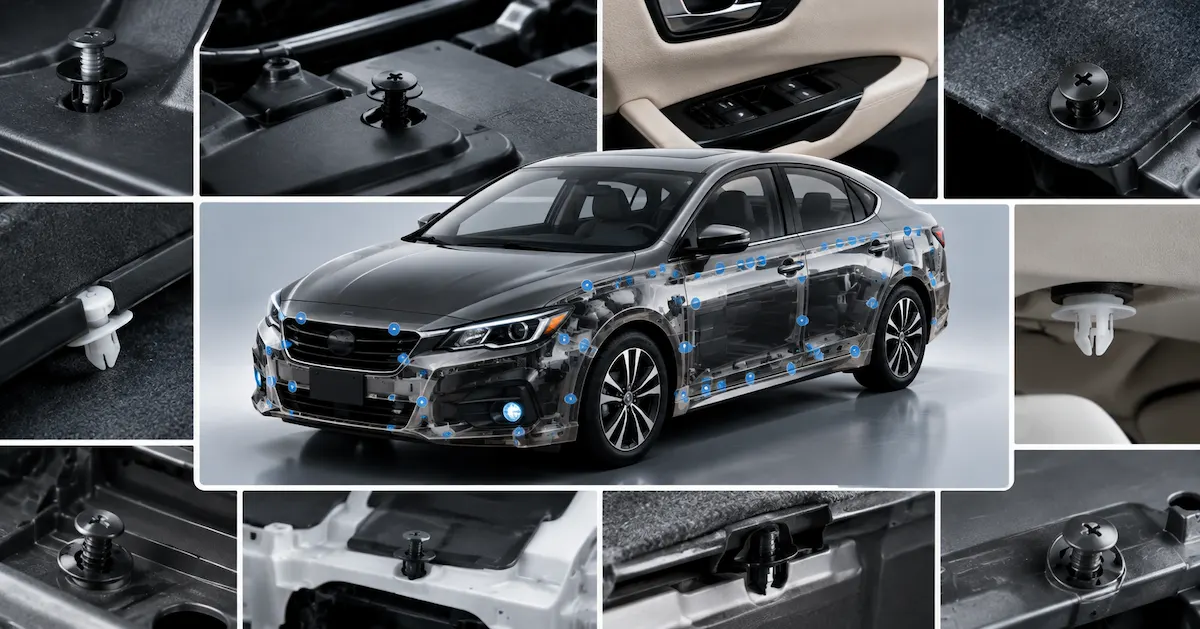
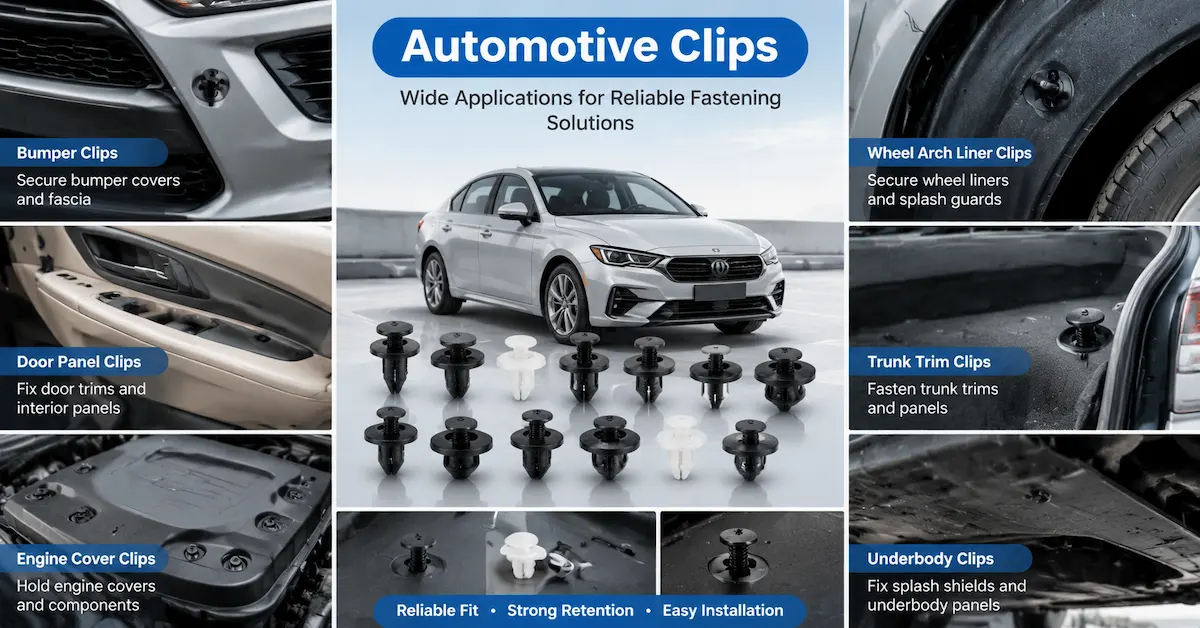
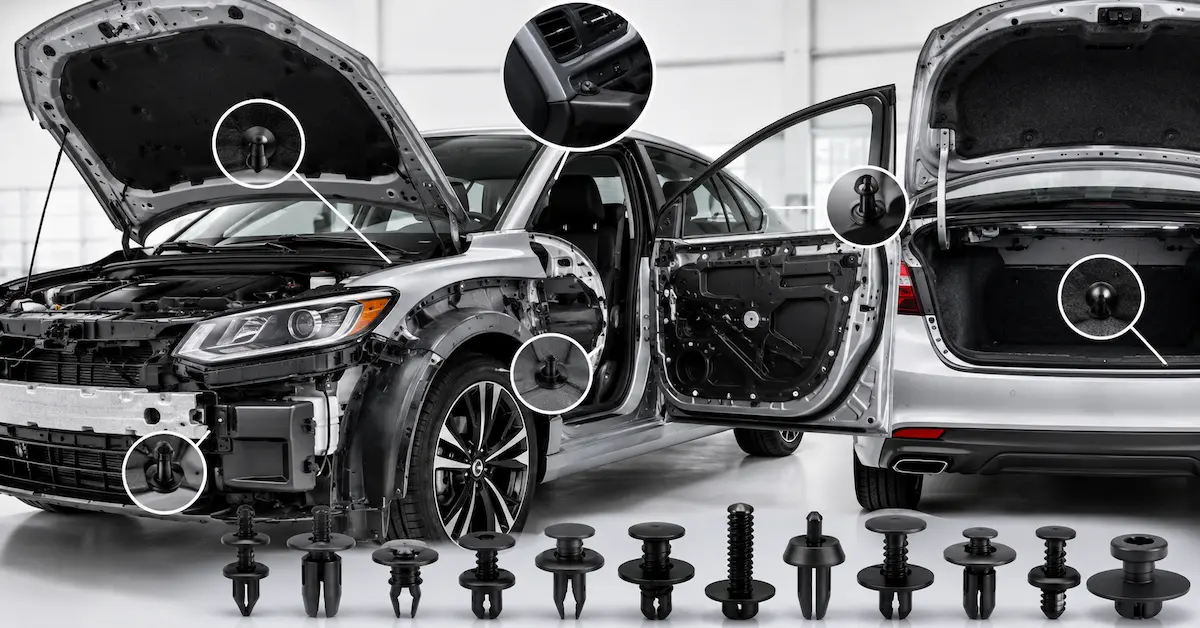
Examples include:
- door trim;
- dashboard panels;
- bumper covers;
- fender liners;
- wheel-arch moldings;
- headliners;
- grille assemblies;
- seal strips;
- hood insulation;
- interior panels.
Each location can expose the clip to different combinations of vibration, temperature, moisture, repeated removal, appearance requirements, and mechanical load.
Define why the current product is unacceptable
Typical failure descriptions are more useful than statements such as “make it stronger.”
For example:
- the clip cracks during insertion;
- the stem enters the hole but does not lock;
- the clip can be removed too easily;
- excessive insertion force damages the panel;
- the head does not cover the mounting hole;
- the clip becomes loose after repeated vibration;
- the locking legs deform after removal;
- the part fits one vehicle version but not another.
These observations give engineering teams a clearer starting point for material and geometry decisions.
Build a Complete RFQ Package Before Asking for Tooling
One of the most effective ways to shorten a custom project is to improve the information supplied before quotation.
A photo and requested quantity may be enough to start a conversation, but they are usually not enough to define a production-ready fastener.
A practical custom clip RFQ should include the following information.
| RFQ Information | What to Provide | Why It Matters |
|---|---|---|
| Existing reference | Sample, drawing, 3D model, OE number, or supplier code | Establishes product identity |
| Vehicle information | Make, model, year/generation where applicable | Helps confirm application |
| Installation position | Exact panel or body location | Provides environmental and functional context |
| Mounting hole | Shape and dimensions | Controls insertion and engagement |
| Panel stack | Material and total retained thickness | Defines usable grip range |
| Clip dimensions | Head, stem, length, locking features | Creates measurable geometry |
| Material | Known resin/grade or performance requirement | Affects flexibility and durability |
| Failure problem | What the existing clip does wrong | Guides redesign priorities |
| Installation method | Manual, tool-assisted, service removal, etc. | Affects geometry and force requirements |
| Quantity forecast | Prototype and expected production demand | Influences tooling and production planning |
| Packaging | Bulk, labeled bag, barcode, box, private label | Avoids late commercial changes |
| Approval method | Dimensions, fit test, appearance, functional checks | Defines when a sample is acceptable |
If a sample is available, buyers should send more than one piece when practical—particularly if one sample is already damaged.
Material and Clip Geometry Must Be Developed Together
Material selection should not be treated as a separate purchasing checkbox.
The same clip geometry can behave differently when molded in different polymers, while the same polymer can perform differently when wall thickness, barb geometry, stem diameter, or molding conditions change.
QEEPEI's current manufacturing scope includes commonly used automotive clip materials such as PA, PP, and POM. Buyers can review broader factory and material capabilities on the About Us page.
PA / Nylon
PA is commonly considered where a clip requires a useful balance of strength, toughness, and elastic behavior.
Potential applications include many:
- trim retainers;
- panel clips;
- door fasteners;
- body clips;
- push-type retainers.
However, specifying only “nylon” is not a complete material specification. Grade, formulation, moisture condition, application environment, and geometry can all affect performance.
PP
PP can be useful where flexibility, low weight, chemical resistance, and economical molding are important.
Depending on the design, it can be suitable for:
- interior applications;
- lining clips;
- lightweight retainers;
- general fastening components.
POM
POM is often considered where dimensional stability, wear behavior, and relatively low friction are useful.
It can be relevant to selected precision locking or engagement structures.
The correct engineering question is therefore not:
Which material is strongest?
It is:
Which material, geometry, and molding condition provide the required installation and retention behavior in the actual application?
DFM Should Happen Before the Mold Is Cut
A custom clip may look simple in CAD but still be difficult to mold consistently.
Design for manufacturability—or DFM—should therefore take place before tooling is finalized.
For automotive plastic clips, DFM discussions may include:
- draft angles;
- wall-thickness transitions;
- locking-leg thickness;
- undercuts;
- ejector positions;
- parting lines;
- gate position;
- potential weld lines;
- cooling behavior;
- deformation risk;
- dimensional shrinkage;
- mold-release behavior.
A design that functions perfectly in a CAD assembly but cannot be molded consistently is not production-ready.
If you want more detail on the relationship between tooling and final clip accuracy, see QEEPEI's injection molded car clips manufacturing guide.
A buyer should also clarify tooling control early
For a true OEM/ODM project, commercial questions around the mold should be defined before production rather than after a disagreement occurs.
Useful questions include:
- Is a new mold required?
- Is the tooling exclusive to the buyer?
- Who approves the final tool design?
- How will engineering revisions be recorded?
- What happens if the first trial requires modification?
- How is the approved revision identified?
- How will later production orders reference the same configuration?
Not every project needs an elaborate tooling agreement, but the more proprietary the product, the more important revision and ownership clarity becomes.
Sample Approval Must Create a Reproducible Standard
One of the biggest mistakes in custom automotive clip development is approving a sample with a comment such as:
“It fits.”
Fitment matters, but that statement alone does not create a specification that a manufacturer can reproduce six months later.
A useful approval record should connect the physical sample with measurable information.
Sample approval should cover four areas
1. Dimensions
Confirm critical measurements such as:
- mounting-hole interface;
- stem diameter;
- head diameter;
- overall length;
- locking-leg dimensions;
- panel grip range.
Not every dimension needs the same tolerance. Focus tighter control on characteristics that affect fitment and function.
2. Installation behavior
Record whether the clip:
- inserts correctly;
- locks fully;
- sits flush;
- avoids panel damage;
- can be removed if service removal is required.
3. Functional behavior
Depending on the application, evaluation may include:
- retention;
- pull-out behavior;
- repeated insertion/removal;
- vibration-related performance;
- temperature exposure;
- impact or aging requirements.
The exact test plan should be agreed for the product rather than assumed to apply universally.
4. Appearance and identification
For visible or retail products, confirm:
- color;
- surface appearance;
- flash limits;
- part marking where applicable;
- buyer SKU;
- packaging identification.
The objective is to turn the approved sample into a controlled production reference.
QEEPEI's related guide on sample approval and repeat bulk orders explains why repeat purchasing becomes more reliable when an approved part is tied to documented specifications.
Define Critical-to-Fit Characteristics Before Mass Production
Custom clips do not require every dimension to receive identical control.
Instead, buyers and manufacturers should identify the dimensions and features most likely to affect installation and retention.
These can be treated as critical-to-fit characteristics.
Typical examples include:
| Characteristic | Potential Problem if Incorrect |
|---|---|
| Stem diameter | Too tight or too loose in mounting hole |
| Locking-leg width | Poor engagement or excessive insertion force |
| Stem length | Incorrect engagement depth |
| Head diameter | Inadequate panel coverage |
| Grip range | Clip does not lock at the actual panel thickness |
| Barb geometry | Unstable retention or difficult removal |
| Wall thickness | Excessive flexibility or cracking |
| Molded flatness | Clip does not seat correctly |
This approach produces a more useful inspection plan than relying only on general statements such as “100% quality checked.”
Quality Control Should Connect to the Approved Part
For a custom product, QC should answer one central question:
Is the production part still equivalent to the version the buyer approved?
A practical control plan can include:
incoming material → molding process → appearance → critical dimensions → fitment/function → packaging → batch identification
Material control
Buyers should confirm:
- agreed polymer family;
- specified grade where required;
- color;
- any agreed formulation requirements;
- relevant documentation when applicable.
Dimensional inspection
Inspection should prioritize critical-to-fit dimensions rather than collecting measurements that have little influence on function.
Visual inspection
Potential molding defects can include:
- flash;
- incomplete filling;
- deformation;
- contamination;
- cracks;
- surface defects.
Functional verification
The correct method depends on the application.
A useful test should represent the approved assembly as closely as practical rather than applying an unrelated generic test.
Packaging verification
For OEM and private-label projects, packaging is also part of order conformity.
Verify:
- part number;
- quantity;
- label;
- barcode;
- bag or box;
- carton marking;
- revision where needed.
Standard Product, Modified Clip, or New Mold: Which Route Makes Sense?
Custom development is not automatically the best answer.
Before committing to a mold, buyers should compare the commercial value of each route.
| Route | Engineering Effort | Tooling Need | Best For |
|---|---|---|---|
| Existing standard product | Low | None | Known replacement applications |
| Existing vehicle-specific clip | Low | None | Defined fitment already available |
| Packaging/private-label customization | Low | None | Retail and brand differentiation |
| Modified clip geometry | Medium | Depends on change | Application mismatch in limited dimensions |
| Fully custom product | High | Usually yes | Unique mounting or exclusive product requirement |
The correct decision depends on more than tooling price.
Consider the cost of:
- wrong-fit returns;
- installation complaints;
- replacement labor;
- repeated emergency sourcing;
- duplicated inventory;
- obsolete parts;
- lost exclusivity;
- inconsistent repeat production.
A custom product creates value when it solves enough of these problems to justify the development work.
Packaging Customization Is Not the Same as Product Customization
B2B buyers often use “OEM” to describe very different projects.
These should be separated early.
Product engineering customization
This can include:
- dimensions;
- head shape;
- stem geometry;
- locking features;
- material;
- color;
- tooling.
Commercial customization
This can include:
- bag quantity;
- assortment configuration;
- labels;
- buyer part numbers;
- barcodes;
- retail boxes;
- private-label packaging.
A distributor may need no new clip at all—only a better pack configuration.
An aftermarket brand may need both a proprietary clip and branded retail packaging.
Keeping these two scopes separate makes quotations, sampling, approvals, and change control easier to manage.
For brand-focused projects, QEEPEI's brand owner solutions provide additional context on product development and private-label support.
How QEEPEI Supports Custom Automotive Clip Projects
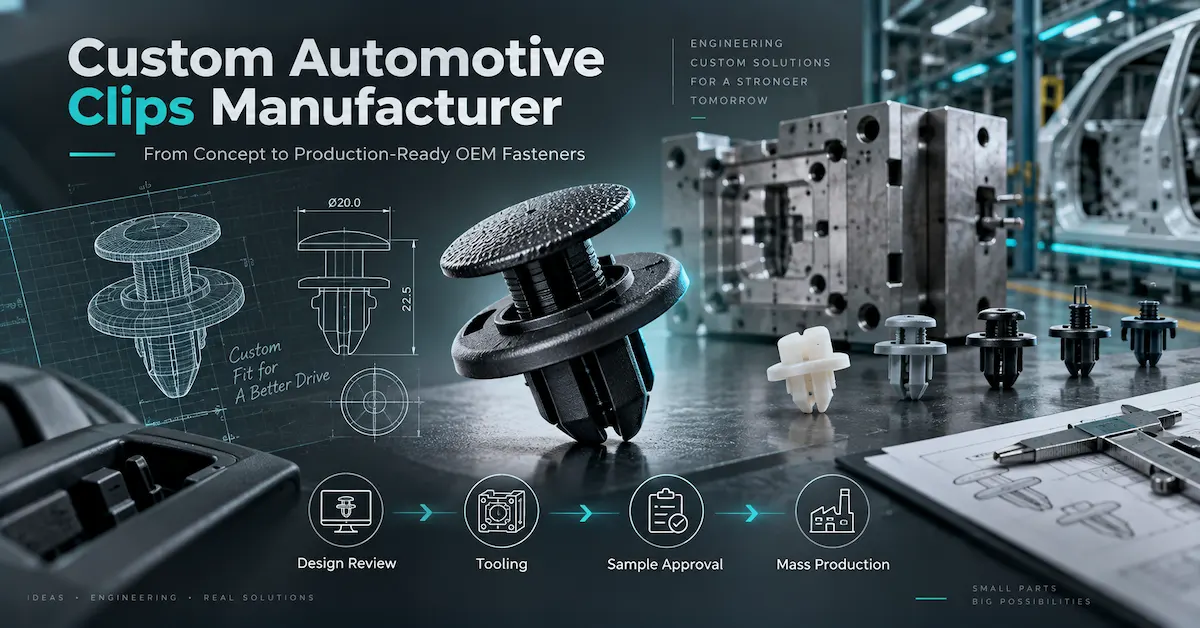
QEEPEI combines standard automotive clip sourcing with in-house product development, mold development, injection molding, material selection, quality inspection, and packaging support.
For a custom project, the practical workflow can be organized as:
Requirement → Application Review → Product Engineering → Material & Geometry Review → Mold Development → Trial Sample → Fitment/Functional Approval → Mass Production → QC → Packaging → Repeat Order Control
This structure is particularly useful for:
- automotive aftermarket brands;
- distributors developing exclusive SKUs;
- replacement-parts suppliers;
- vehicle-specific fastener programs;
- repair-chain product lines;
- private-label automotive clip kits;
- OEM/ODM projects requiring a new geometry.
However, buyers should still confirm project-specific details such as tooling scope, MOQ, sampling requirements, material grade, testing, packaging, and lead time before placing an order.
What to Send a Custom Automotive Clips Manufacturer
Before contacting a manufacturer, prepare as much of the following as possible:
- Existing sample, drawing, or 3D model
- OE/reference number if available
- Vehicle make/model/year where relevant
- Exact installation location
- Mounting-hole dimensions
- Panel thickness or material stack
- Current failure or improvement target
- Known material requirement
- Expected order volume
- Packaging and branding requirement
If some information is unknown, state that clearly rather than estimating.
A manufacturer can help investigate missing information, but incorrect input can push the design in the wrong direction.
Custom Automotive Clips Manufacturer Selection Checklist
Before moving from RFQ to tooling, use this checklist.
Engineering
- Can the manufacturer review samples, drawings, and application information?
- Does it understand clip geometry and panel interfaces?
- Can it distinguish a fitment issue from a material issue?
Tooling
- Can it develop and modify injection molds?
- Is revision control clear?
- Are sample changes documented before approval?
Materials
- Can it support the required PA, PP, POM, or application-specific material?
- Can it explain why the material is appropriate for the use case?
Validation
- Are critical dimensions identified?
- Is fitment checked against the intended panel or assembly?
- Are functional checks agreed before volume production?
Production
- Is the approved version linked to the production specification?
- Can the same part be supplied consistently on repeat orders?
Commercial
- Are packaging, labels, barcode, and buyer SKU requirements defined?
- Are tooling, sample, MOQ, production, and delivery expectations confirmed before commitment?
A capable manufacturer should make these requirements clearer—not make the buyer guess.
FAQ
1. What information does a custom automotive clips manufacturer need?
The most useful inputs are a sample or drawing, mounting-hole dimensions, panel thickness, application position, vehicle information where relevant, material requirements, expected quantity, and the problem the custom clip needs to solve.
2. Can a custom car clip be developed from a broken sample?
Yes, but the damaged sample should not be copied blindly. The manufacturer should reconstruct the intended geometry using the mounting interface, undamaged features, application information, and fitment testing.
3. Do I always need a new mold for a custom automotive clip?
No. An existing product may already work, and some projects involve packaging or assortment customization only. A new mold is more appropriate when the required geometry cannot be produced from an existing part.
4. How should I choose between PA, PP, and POM?
Choose material according to the actual geometry, temperature, vibration, flexibility, dimensional-stability, chemical, and installation requirements. Material should be evaluated together with part design.
5. What should be checked during sample approval?
At minimum, confirm the agreed dimensions, installation fit, locking behavior, appearance, material requirement, application, and product identification. Additional tests depend on the intended use.
6. How can buyers prevent changes between the approved sample and later orders?
Use a controlled drawing or measurement sheet, approved sample identification, material specification, packaging specification, revision record, and buyer/supplier SKU reference.
7. Can a custom automotive clip manufacturer support private-label packaging?
Yes, depending on the supplier's capabilities. Packaging can include branded bags, labels, barcodes, retail boxes, assortment configurations, and buyer-specific identification.
8. How is tooling cost different from product cost?
Tooling is generally a development investment used to create the production geometry, while piece price reflects ongoing manufacturing. The exact commercial arrangement depends on the project and should be confirmed before tooling begins.
9. How long does a custom automotive clip project take?
There is no universal lead time. Timing depends on design complexity, whether a new mold is required, number of trial revisions, sample approval, material requirements, testing, and production quantity. Confirm a project schedule after the technical scope is defined.
10. When should I use a vehicle-specific existing clip instead of a custom part?
Use an existing product when its dimensions, locking geometry, material, and application already satisfy the requirement. Custom development is more useful when no suitable existing solution is available or when a proprietary design creates clear functional or commercial value.
Conclusion
A custom automotive clips manufacturer should do more than reproduce the appearance of a plastic fastener. A successful OEM/ODM project depends on defining the mounting interface, material, geometry, failure mode, tooling scope, critical dimensions, sample-approval criteria, production controls, and packaging before volume manufacturing begins.
If you have an existing sample, drawing, OE reference, failed clip, or new fastening requirement, review QEEPEI's automotive clips product range first to determine whether an existing solution is available. For a new mold, modified geometry, vehicle-specific fastener, private-label project, or OEM/ODM development, contact QEEPEI with your application details, dimensions, samples, target quantity, and packaging requirements so the project can be evaluated before tooling and mass production.