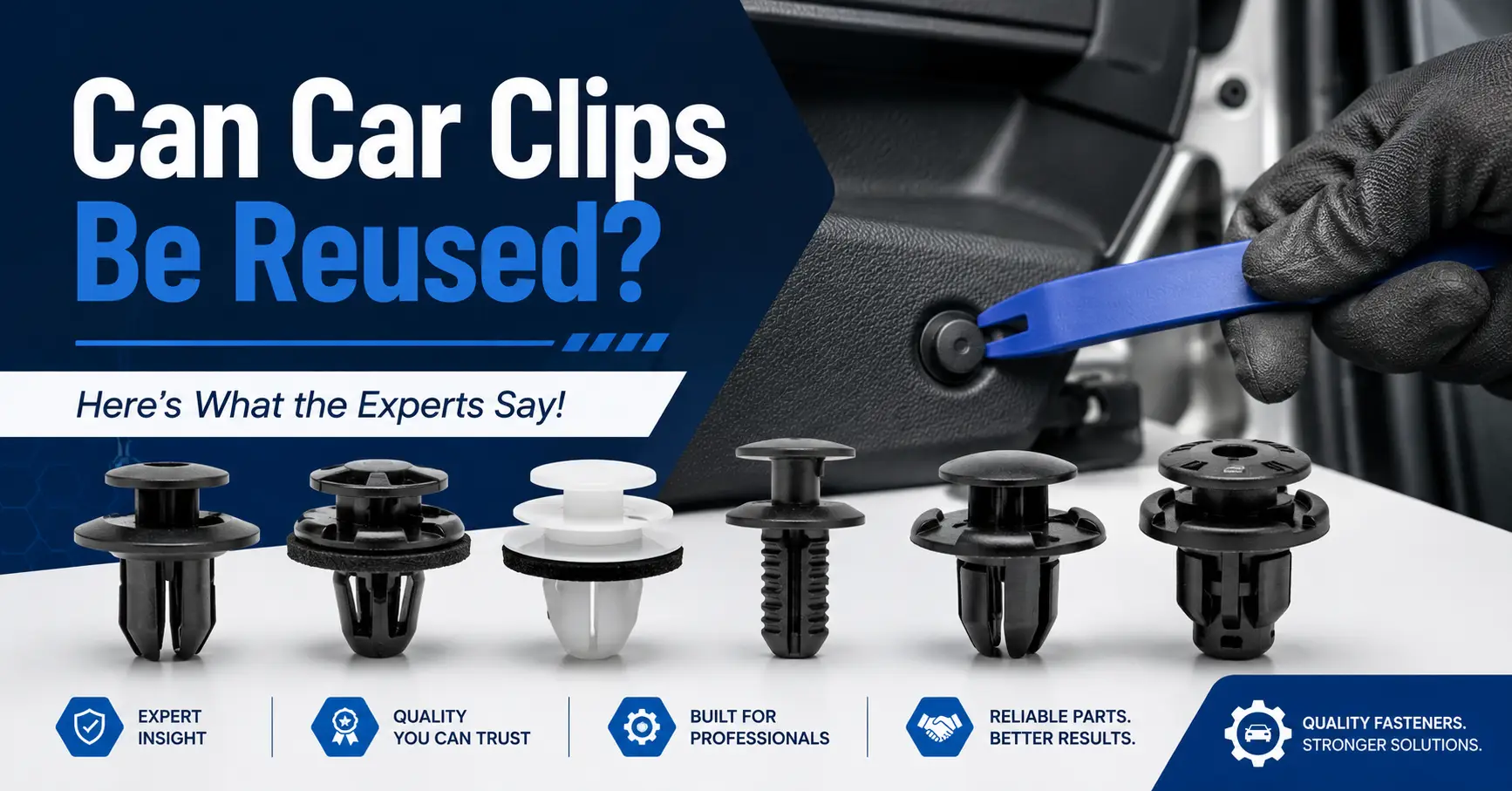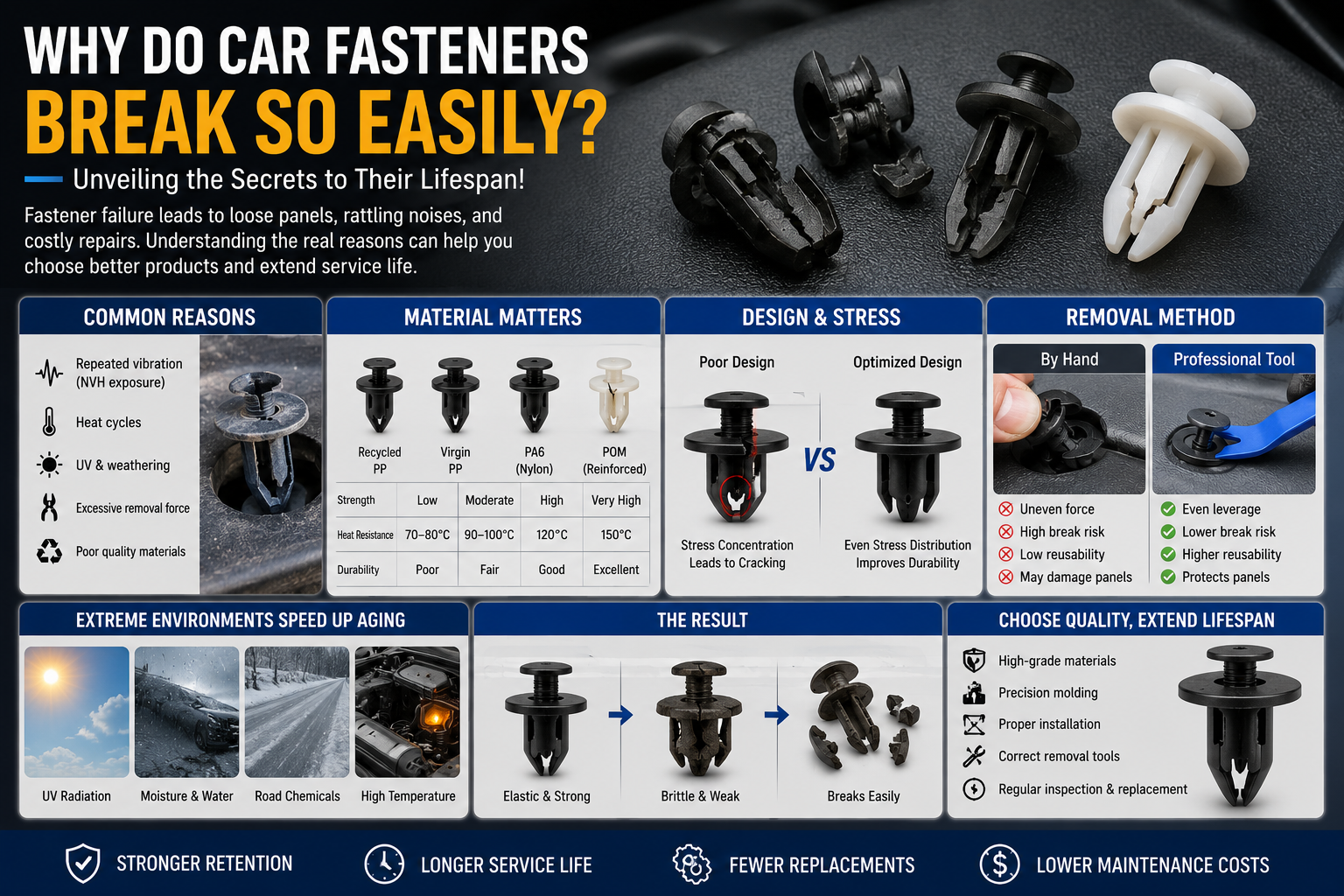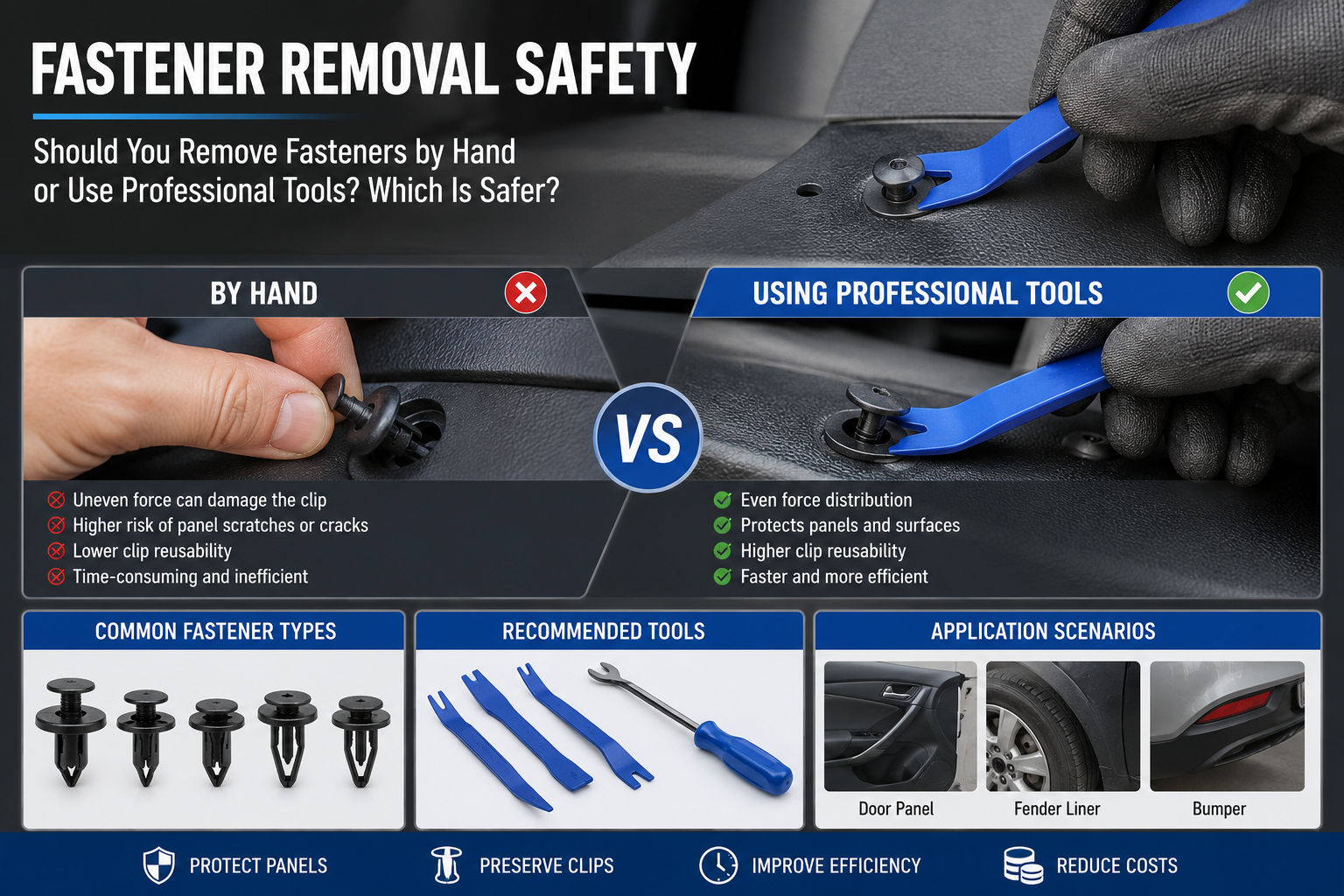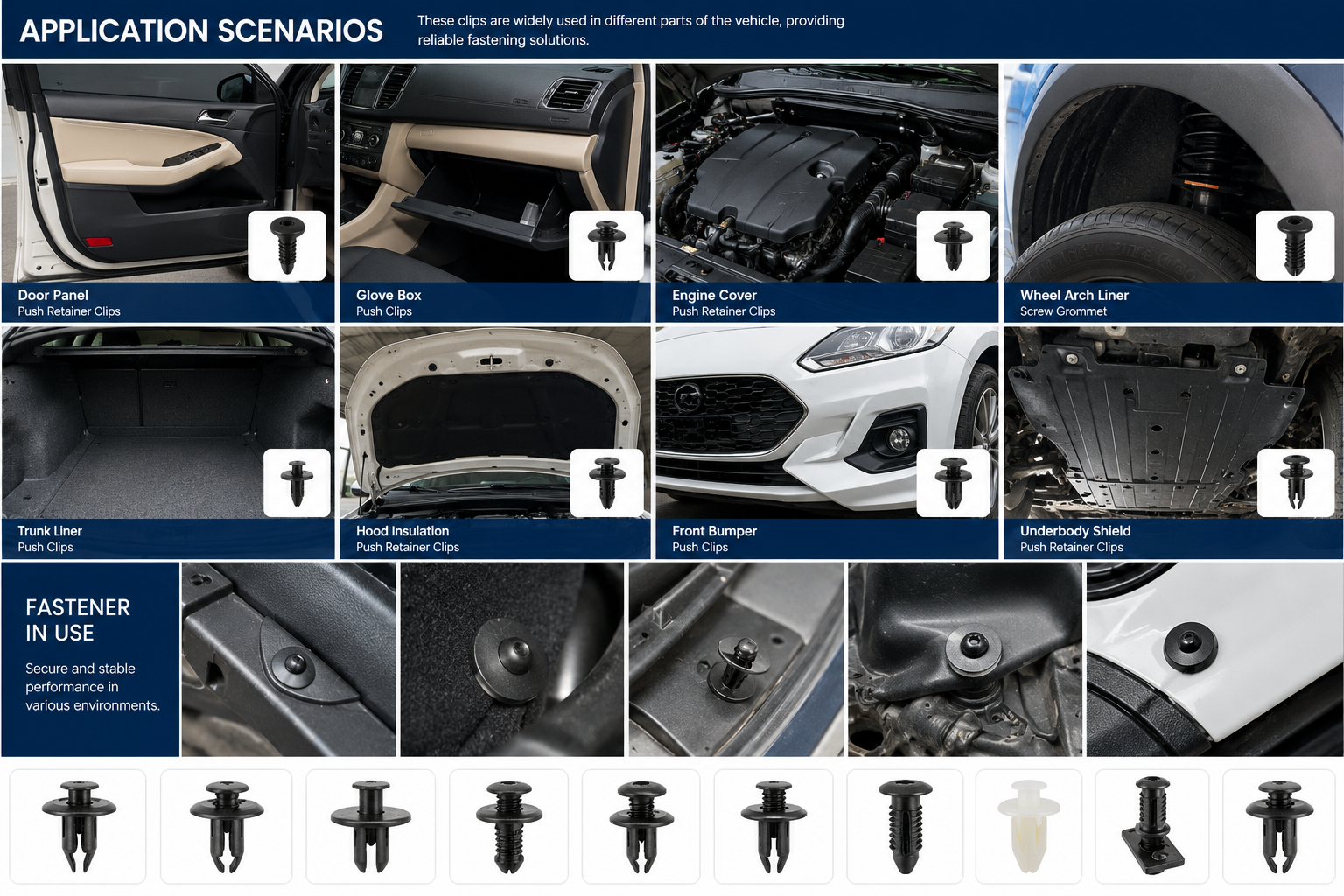

Automotive clips are small components with disproportionate impact. They do not power the vehicle. They are not visible in marketing brochures. Yet if they fail, panels loosen, bumpers misalign, dashboards rattle, and warranty costs escalate.
According to public OEM quality reports summarized by IATF 16949 audit data, fastening-related defects account for nearly 18–22% of non-electrical assembly complaints in interior and trim systems. In other words, the weakest mechanical interface often dictates perceived vehicle quality.
From the perspective of an experienced Automotive Clips manufacturer, classification is not cosmetic. It is structural. Clip type determines load distribution, vibration resistance, thermal endurance, and serviceability over a 10–15 year vehicle lifecycle.
This guide breaks down the real engineering logic behind automotive clip categories — not just names, but function, physics, and performance data.
Why Misclassification of Automotive Clips Creates Hidden Risk
Many distributors and procurement managers treat clips as generic SKUs. That assumption is expensive.
Common downstream failures include:
-
Retention loss after 3–6 thermal cycles
-
Brittle fracture below –20°C in northern markets
-
Warpage in engine bay zones exceeding 120°C
-
Excessive insertion force causing assembly-line slowdowns
-
High removal damage during service operations
SAE technical papers on polymer fasteners indicate that incorrect material selection can reduce retention performance by up to 35% under repeated vibration exposure.
The problem is rarely the clip itself. It is mismatch — between type and application.
Core Engineering Principles That Define Clip Categories
Before listing types, we need to understand what differentiates them structurally.
Every automotive clip design balances five mechanical variables:
-
Elastic deformation range
-
Retention barb geometry
-
Shear load capacity
-
Panel thickness accommodation
-
Thermal expansion tolerance
Material science plays a central role. Most automotive-grade clips use:
-
PA66 (Nylon 66)
-
PA66 + GF10–30 (glass fiber reinforced)
-
POM (polyoxymethylene)
-
PP impact-modified blends
Glass fiber reinforcement can increase tensile strength from approximately 75 MPa (PA66) to 110–140 MPa (PA66 GF30), while improving dimensional stability by up to 40%.
These are not minor differences. They determine real-world durability.
Common Types of Automotive Clips and Their Mechanical Role
Below is a functional classification widely recognized across OEM trim and body assembly systems.
| Clip Type | Typical Location | Material | Retention Strength (N) | Heat Resistance | Primary Function |
|---|---|---|---|---|---|
| Push-Type Retainer | Door panel, trim | PA66 | 180–220 | –30°C to 120°C | Quick-install interior fastening |
| Expansion Rivet | Bumper, fender | PA66 + GF10 | 220–260 | –40°C to 130°C | Impact-stable exterior fixation |
| Screw-Type Clip | Underbody shields | POM | 200–240 | –30°C to 120°C | Removable service fastening |
| Snap Clip | Headliner, insulation | Modified Nylon | 160–200 | –20°C to 110°C | Lightweight NVH control |
| Hybrid Metal-Insert Clip | Engine bay | Nylon + Steel core | 250–300 | –40°C to 140°C | High-load structural retention |
Each design solves a specific load condition. There is no universal clip.
An experienced Automotive Clips manufacturer evaluates load path and service life before recommending type.
Generic Factory Output vs Controlled Automotive Manufacturing
Not all factories operate at automotive system level.
| Parameter | Low-Control Factory | QEEPEI Production System |
|---|---|---|
| Mold Accuracy | ±0.10 mm | ±0.03 mm multi-cavity calibration |
| Resin Drying Control | Manual | Automated dehumidifying dryer <0.2% moisture |
| Retention Testing | Random sampling | 100% cavity traceability |
| Fatigue Test | <2,000 cycles | ≥8,000 cycles validated |
| Heat Aging | Basic oven test | 500 h thermal cycle (–40°C to 130°C) |
| Certification | ISO 9001 | IATF 16949 + REACH + RoHS |
Dimensional stability matters because panel holes in modern vehicles are laser-cut within ±0.05 mm tolerance. A ±0.10 mm clip deviation can cause either loose fit or insertion stress cracking.
This is where structured manufacturing makes a difference.
How QEEPEI Designs for Long-Term Stability
QEEPEI integrates several process controls:
-
Mold flow simulation to eliminate weld-line weakness
-
Cavity pressure sensors to ensure filling consistency
-
Automated tensile testers for batch validation
-
UV stabilization additives for exterior applications
-
Glass fiber dispersion control to prevent brittleness
The company’s export clients operate across Europe, Southeast Asia, and North America — markets with temperature extremes from –35°C winters to +50°C summer exposure. Design margins are calculated accordingly.
As an Automotive Clips manufacturer, QEEPEI does not treat clips as commodity plastics. They are engineered retention systems.
Application-Specific Selection Framework
Choosing the right clip depends on more than vehicle brand.
Consider these engineering questions:
Interior trim?
Focus on elasticity and low insertion force.
Exterior bumper?
Prioritize glass-fiber reinforcement and impact resistance.
Engine compartment?
Select heat-stabilized nylon or hybrid insert design.
Serviceable component?
Choose screw-type or reusable expansion clips.
Panel thickness compatibility should match within 0.2 mm tolerance for optimal retention.
Long-Term Cost Analysis: Cheap Clip vs Engineered Clip
A clip that costs $0.015 instead of $0.018 appears cheaper.
But if return rate increases from 1.5% to 6%, total cost escalates:
-
Replacement labor
-
Shipping returns
-
Customer dissatisfaction
-
Brand erosion
In fleet-level maintenance networks, studies show fastening-related service claims can raise operational cost by 8–12% annually when low-grade components are used.
The price difference is negligible. The lifecycle difference is not.
Frequently Asked Questions (Engineering-Focused)
Q: What material is most suitable for exterior bumper clips?
A: PA66 with 10–30% glass fiber offers the best balance between impact strength and dimensional stability.
Q: How many installation cycles should automotive clips withstand?
A: High-grade clips should survive ≥8,000 insertion/removal cycles without structural deformation.
Q: Are automotive clips regulated by international standards?
A: While clips themselves are component-level parts, automotive suppliers typically operate under IATF 16949 and comply with REACH/RoHS environmental standards.
Conclusion: Classification Is Engineering, Not Inventory
Automotive clips may look interchangeable. They are not.
Understanding clip types through load mechanics, material science, and thermal endurance transforms sourcing decisions from transactional to technical.
A professional Automotive Clips manufacturer provides more than supply — it provides controlled geometry, certified materials, and predictable long-term performance.
With advanced production systems and validated durability testing, QEEPEI supports OEM and aftermarket clients seeking fastening stability across global environments.
For technical drawings or cooperation inquiries:
https://www.cnclip.com/
https://www.cnclip.com/contact-us