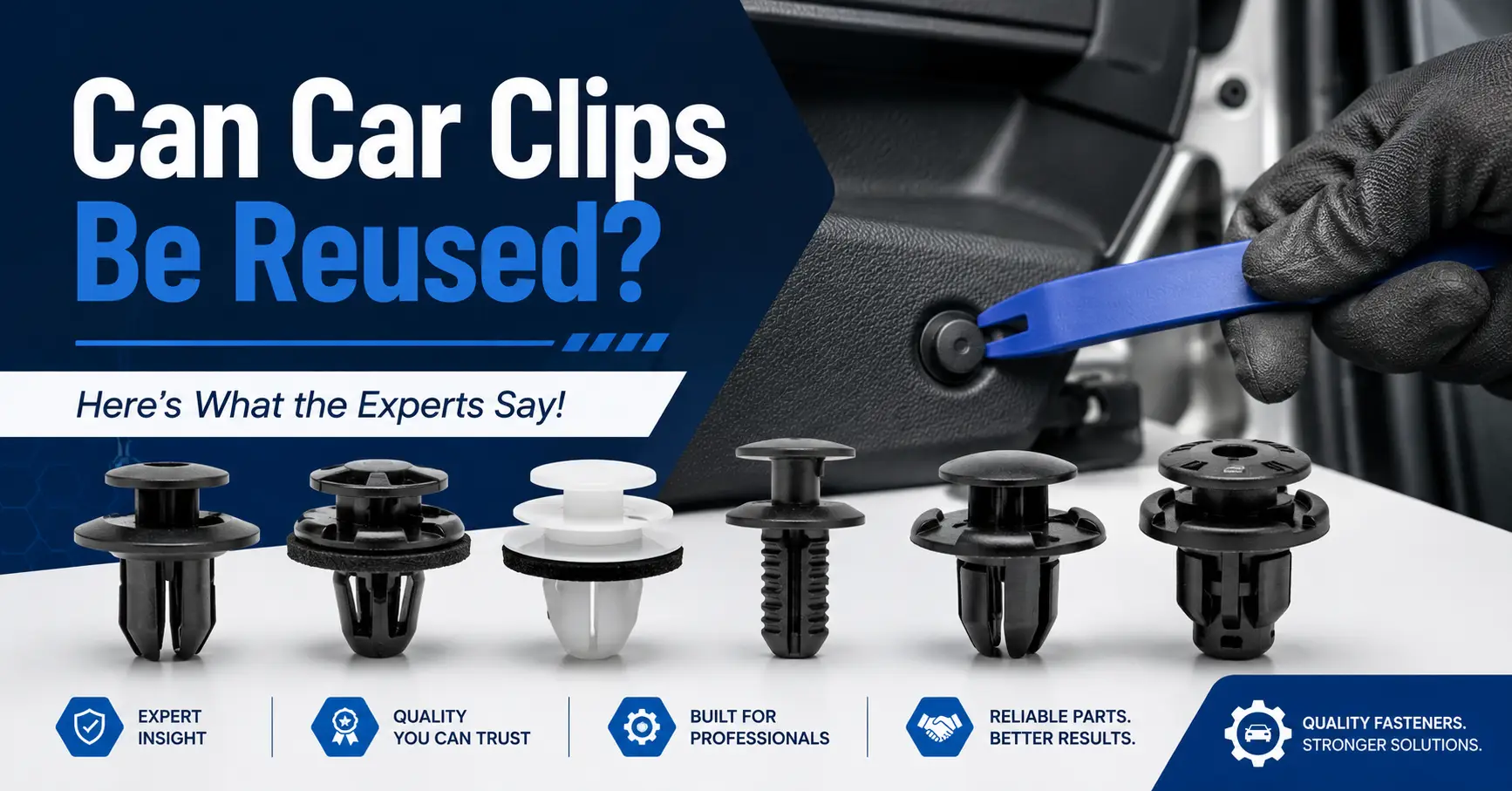

Clip failure rarely begins with breakage. It begins with wrong selection.
A bumper that loosens after six months. An interior panel that vibrates despite correct installation. A clip that cracks under winter stress. In many of these cases, installation was correct—the clip choice was not.
At QEEPEI, we regularly review misapplication cases from global distributors and fleet operators. As a professional Automotive Clips manufacturer, we know that clip selection determines long-term retention stability, noise control, and lifecycle cost.
Correct selection is engineering, not guesswork.
Structural Variables That Must Be Considered First
Before choosing any clip, engineers must evaluate structural interface conditions.
Critical factors include:
-
Panel thickness (commonly 1.5–4.0 mm for trim systems)
-
Hole diameter tolerance (±0.1 mm typical)
-
Load direction (shear vs pull-out)
-
Vibration intensity (measured in Hz ranges)
-
Removal frequency requirements
Retention force must align with application:
-
Interior trim: 180–220 N
-
Bumper assembly: 220–260 N
-
Engine bay: ≥250 N
Failure to match retention strength with load leads to early loosening.
An experienced Automotive Clips manufacturer evaluates these parameters before recommending product type.
Material Selection: Performance Begins at the Polymer Level
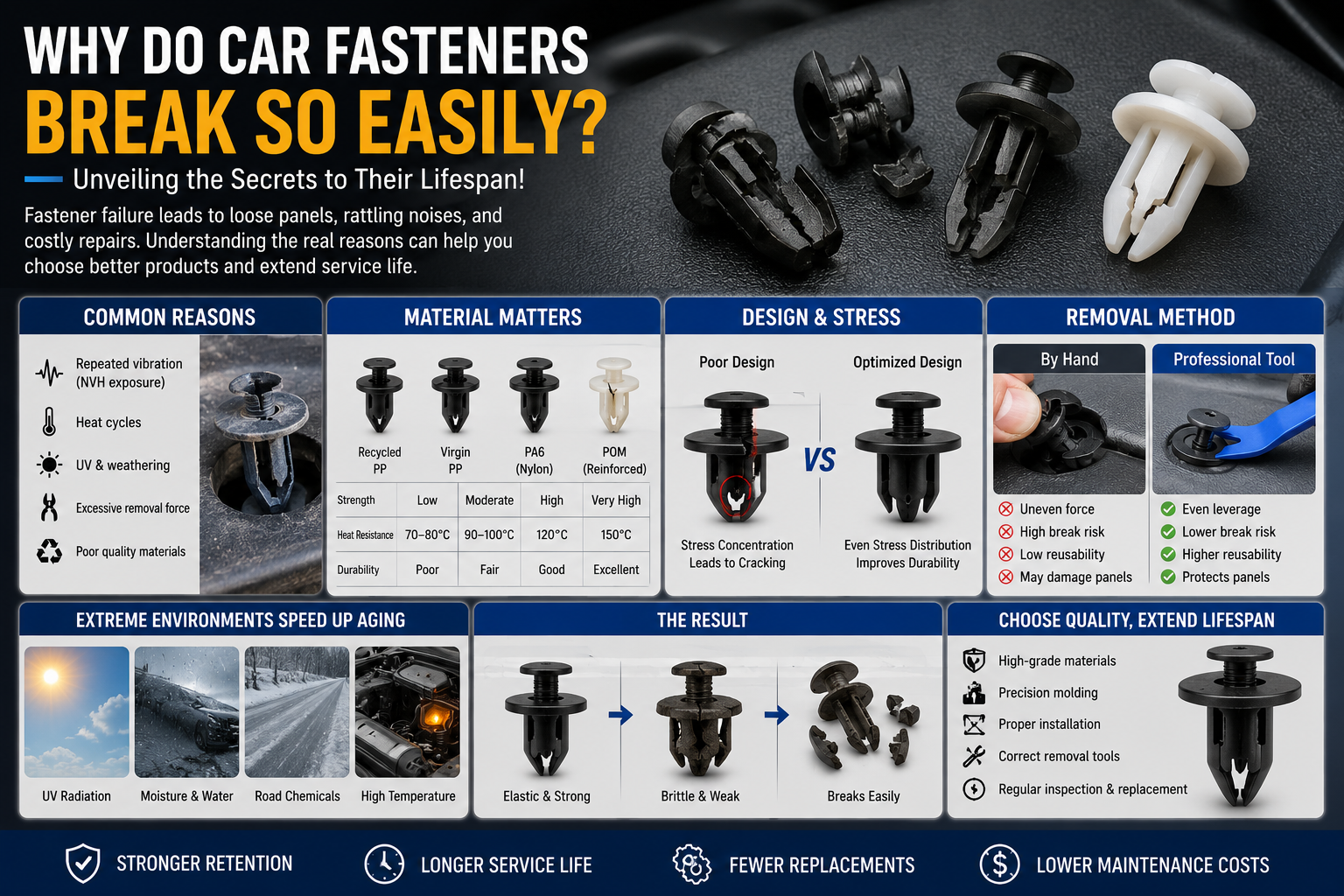
Clip type is only part of selection. Material determines durability.
| Material | Tensile Strength | Heat Resistance | Best For |
|---|---|---|---|
| PA6 | 65–75 MPa | ≤110°C | Interior trim |
| PA66 | 75–85 MPa | ≤120°C | Door panels |
| PA66 GF10 | 95–110 MPa | 130°C | Bumpers |
| PA66 GF30 | 110–140 MPa | 140°C | Engine zones |
| POM | 60–70 MPa | 120°C | Serviceable parts |
Glass fiber increases stiffness by up to 40% but reduces elasticity. Interior systems often require balanced flexibility.
According to SAE discussions on fastening durability (https://www.sae.org), polymer mismatch is a common contributor to NVH-related complaints.
Material must match environment.
Why Engineering Experience Matters in Clip Selection
Selection errors often come from price-driven purchasing rather than engineering evaluation.
At QEEPEI, our process includes:
-
Mold precision control (±0.02–0.03 mm)
-
Resin moisture management (<0.2%)
-
Batch tensile testing
-
Thermal cycle validation (–40°C to 130°C)
-
IATF 16949 quality compliance
(https://www.iatfglobaloversight.org)
As an established Automotive Clips manufacturer, we combine material science, dimensional accuracy, and lifecycle validation before final recommendation.
This reduces warranty risk and stabilizes supply chains.
Matching Clip Type to Application Function
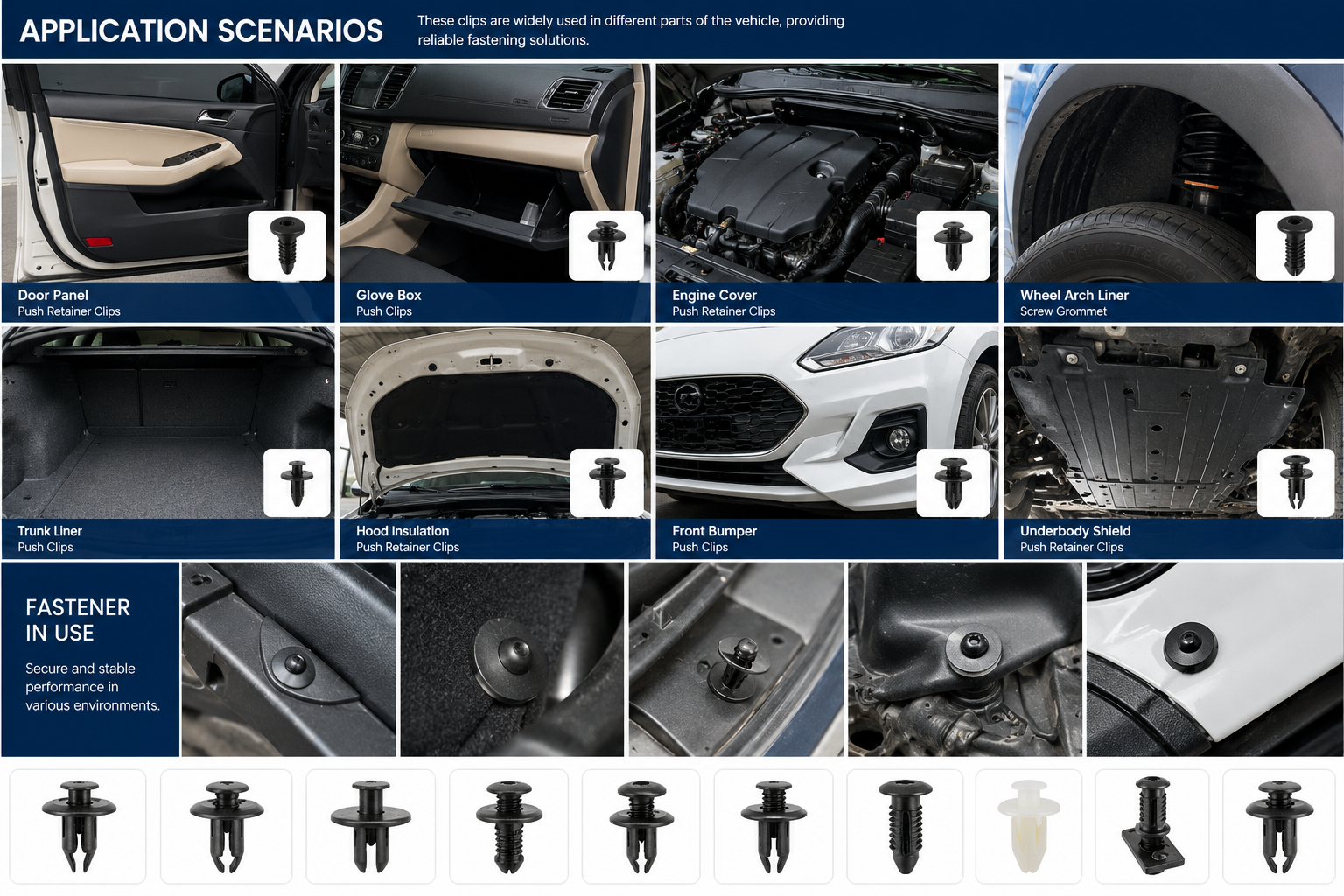
Different structural areas require different clip geometries.
| Application Area | Recommended Clip Type | Reason |
|---|---|---|
| Door panel | Push-type retainer | Quick assembly, balanced elasticity |
| Bumper | Expansion rivet | Impact absorption |
| Underbody | Screw-type clip | Service removal access |
| Engine compartment | Hybrid insert | High heat + structural load |
Selecting by function prevents future rework.
Real-World Case: Misapplication in High-Vibration Fleet
A logistics fleet operator used interior-grade PA6 clips for rear bumper fixation.
Observed issues:
-
Retention force drop of 20% within 6 months
-
Increased panel vibration at 300–500 Hz
-
Repeat maintenance visits
Solution:
-
Upgraded to PA66 GF10 expansion clips
-
Adjusted shaft tolerance by +0.05 mm
Outcome:
-
Retention stabilized above 240 N
-
Service repeat reduced by 70%
Selection correction delivered measurable improvement.
Environmental Exposure as a Selection Criterion
Selection must account for operating climate.
| Climate | Risk | Recommended Adjustment |
|---|---|---|
| Hot desert | Thermal creep | Heat-stabilized PA66 |
| Cold region | Brittleness | Impact-modified nylon |
| Humid zone | Moisture absorption | Dried PA66 |
| Coastal | UV exposure | UV-stabilized polymer |
Environmental mismatch is one of the most underestimated causes of clip instability.
Economic Perspective: Selection Impacts Lifecycle Cost
Unit price differences between materials may be $0.002–$0.005.
However:
-
Increased return rates
-
Reinstallation labor cost
-
Brand reputation impact
-
Warranty claims
Fleet data suggests improper clip selection can increase fastening-related maintenance cost by 8–12% annually.
Correct selection protects margins.
FAQ
Q: Should I always choose glass fiber reinforced clips?
A: Not necessarily. Interior panels often require flexibility rather than maximum stiffness.
Q: How do I determine correct clip size?
A: Measure panel thickness and hole diameter precisely before selection.
Q: Does temperature significantly affect clip performance?
A: Yes. Sustained exposure above material rating accelerates creep deformation.
Conclusion
Proper clip selection requires analysis of structure, material, environment, and load conditions.
An experienced Automotive Clips manufacturer ensures compatibility between polymer behavior and real-world application demands.
At QEEPEI, selection support integrates engineering data, certified manufacturing, and lifecycle validation to deliver fastening stability across global markets.
For technical drawings or cooperation inquiries: