
Start With the Product You Need to Reorder
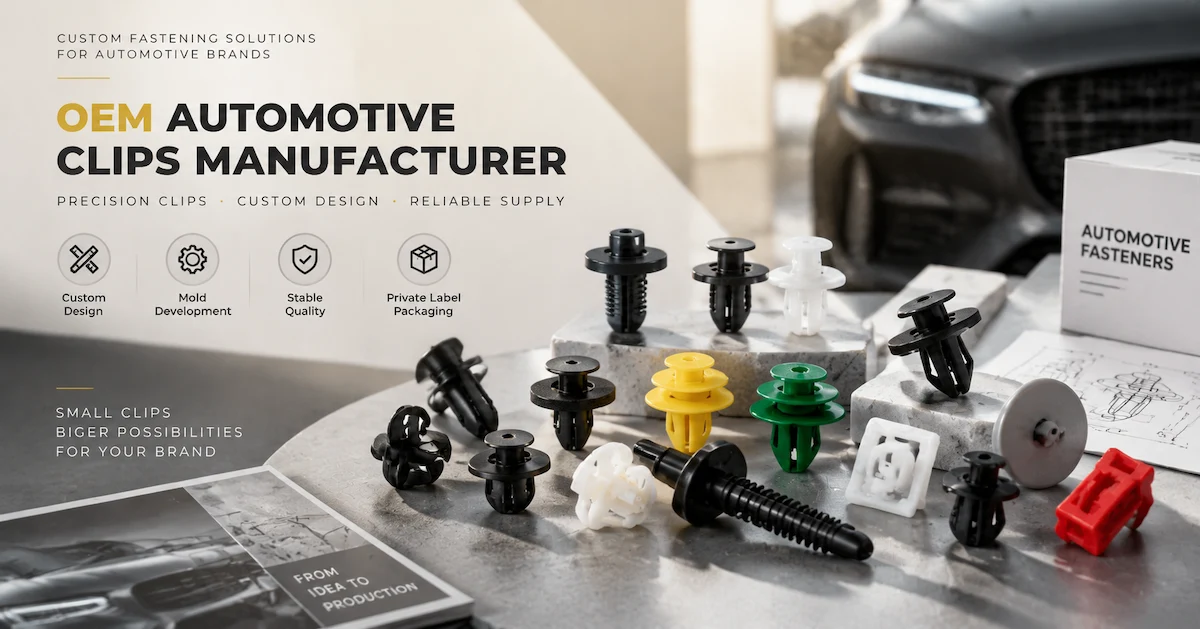
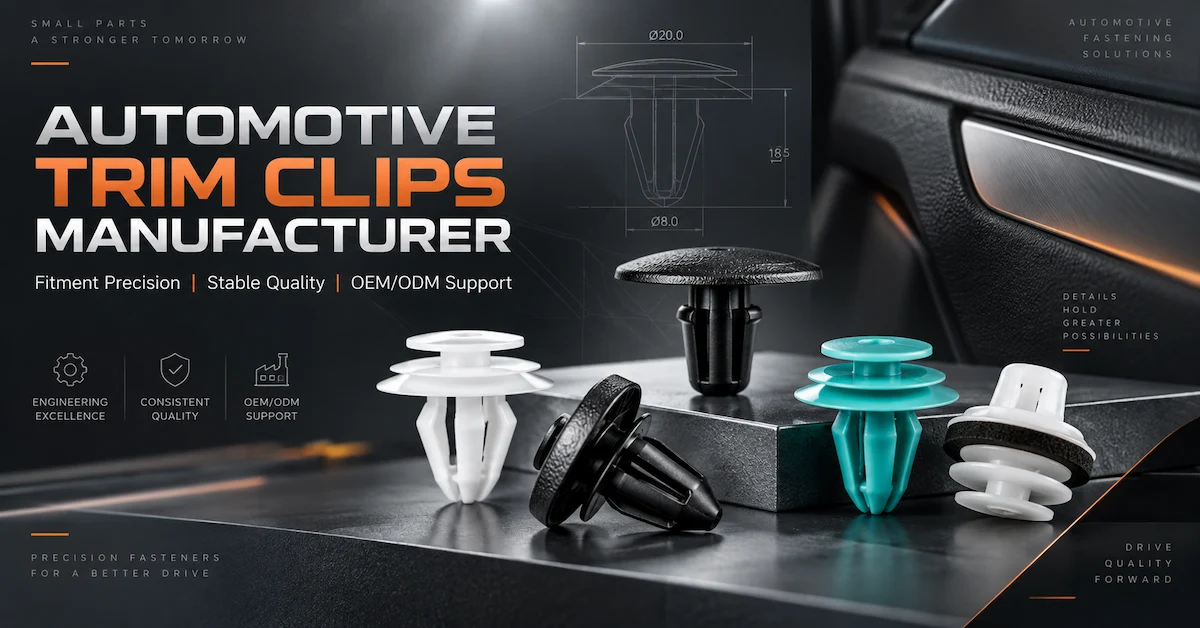
An automotive fasteners manufacturer should help you move from “this clip looks right” to an approved specification that can be supplied again. For bulk purchasing, assess four things together: application fit, material and geometry, inspection requirements, and repeat-order identification. This guide focuses on plastic clips, panel retainers, screw-base clips, and assortments for body and trim repair—not qualification of structural bolts or safety-critical joints. QEEPEI’s automotive fastener range covers body clips, clip kits, vehicle-specific clips, and removal tools. The purchasing objective is to identify the right product, document what was approved, and make the next shipment comparable with the first.
Match Manufacturing Support to Your Sales Channel
The right supplier arrangement depends on how you sell and use the fasteners. A distributor should prioritize identifiable SKUs, application information, and replenishment arrangements. A repair supplier should evaluate whether the selected clips match the jobs its customers actually perform. An online seller needs accurate photographs, understandable fitment descriptions, and a component list that agrees with the packaging. A private-label brand should clarify which parts of the product and presentation can be customized. QEEPEI’s wholesale services address distributors, online sellers, brand owners, and retail buyers. For a one-off replacement, focus first on finding the correct existing part; a custom manufacturing project should have a defined requirement that standard products cannot satisfy.
Separate Installation Location From Vehicle Compatibility
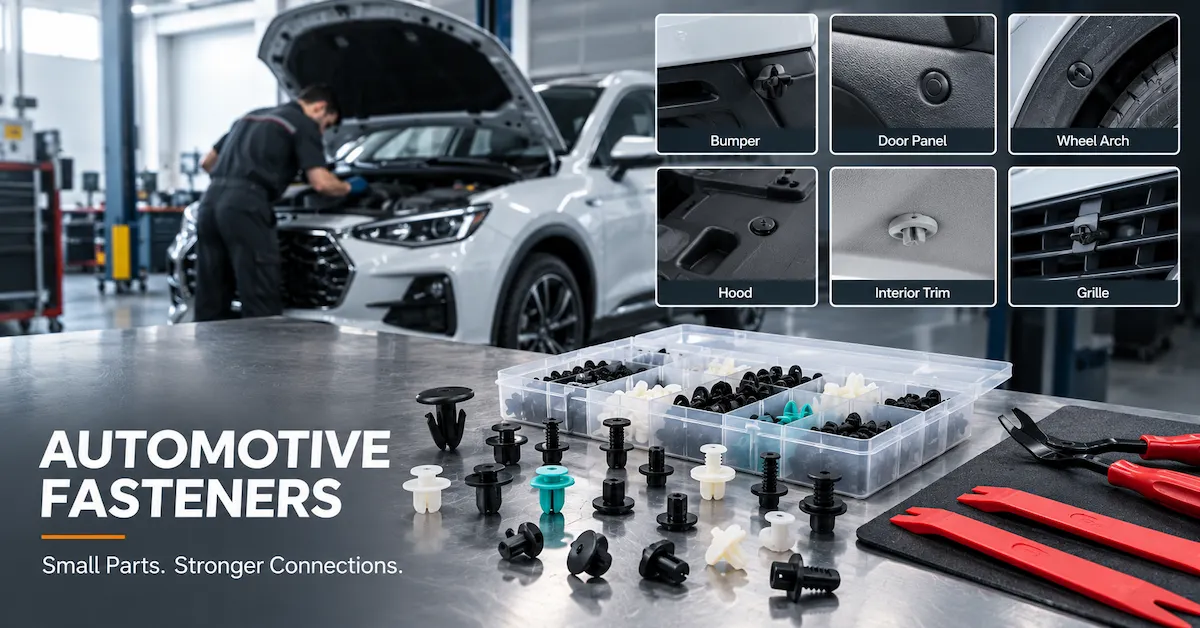
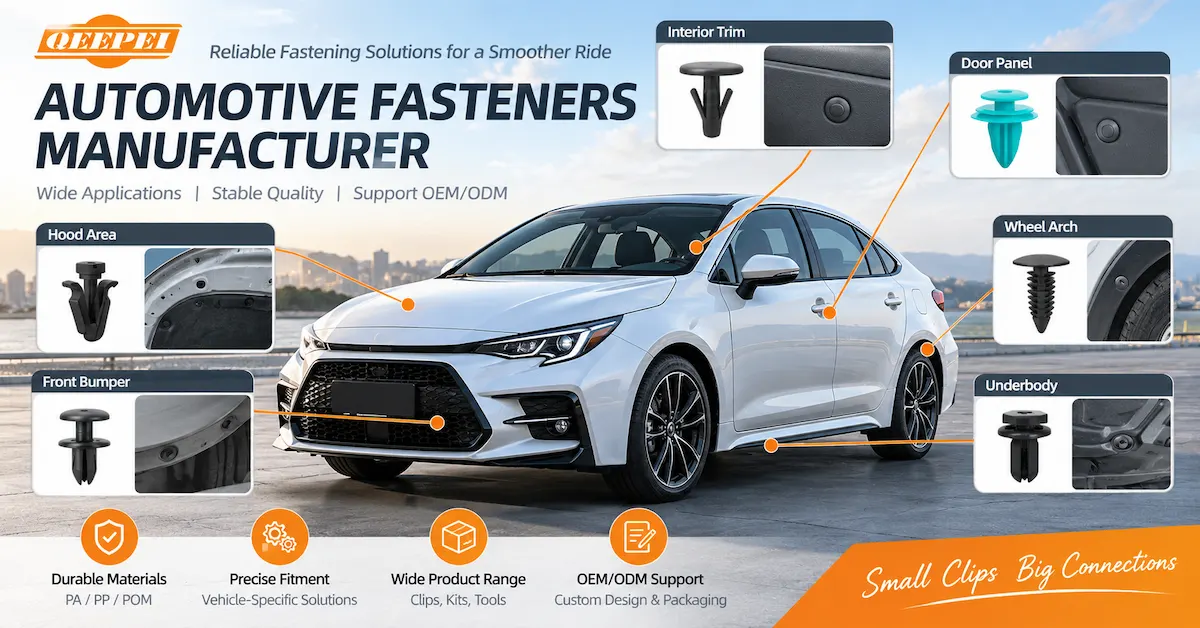
Start a sourcing list with the mounting location: bumper cover, door trim, fender liner, hood insulation, dashboard panel, or exterior molding. QEEPEI organizes body clips by application area and also provides vehicle-brand categories. Treat those as two ways to navigate the range, not as complete fitment confirmation. A vehicle brand identifies a search starting point; the specific model, year, mounting position, reference number, and dimensions still need checking. Equally, do not assume that a wheel-arch molding clip and a fender-liner clip are interchangeable because both are used near the wheel. Give each line in the purchasing list its own application description and request confirmation against that description.
Give the Automotive Fasteners Manufacturer an Approval Specification
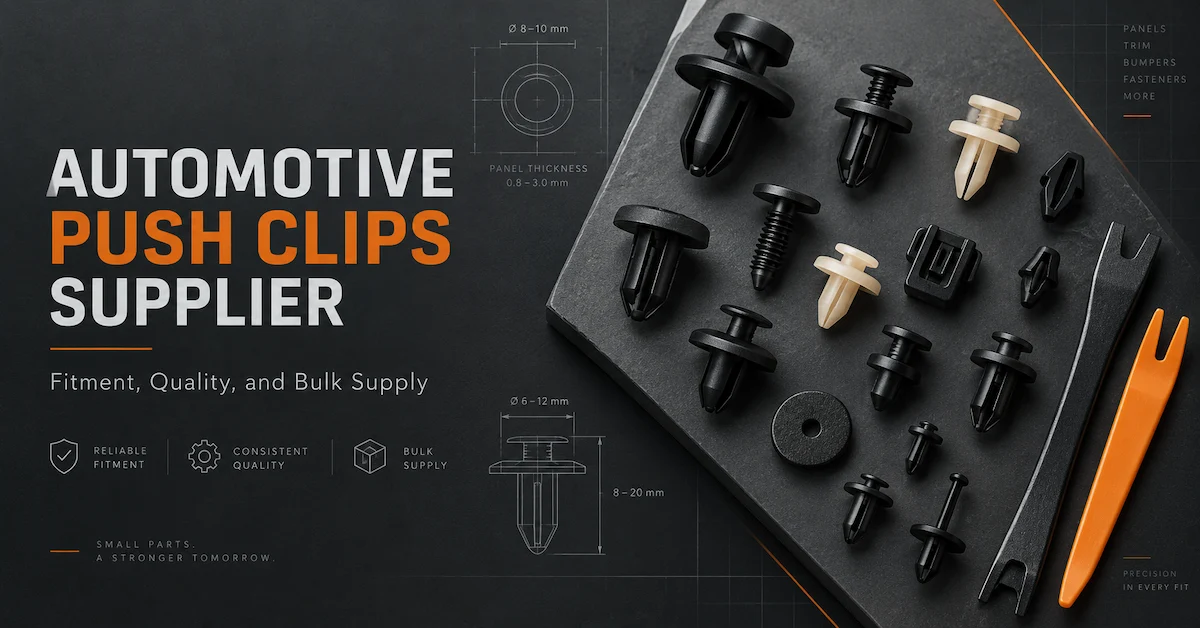
Product photographs help identify candidates, but the approval record should describe the mating hole, panel thickness, clip geometry, and required installation behavior. QEEPEI’s car clip size and fitment guide provides a starting point for these checks. Use the following table as a purchasing template, not a universal dimensional standard. Enter model-specific values and agreed acceptance criteria rather than accepting a description such as “standard size” or “strong nylon.”
| Specification Field | Record Before Approval |
|---|---|
| Product identity | Supplier SKU, drawing revision, and sample identification |
| Application | Vehicle details, mounting position, and OE reference where available |
| Mounting interface | Hole shape, dimensions, and agreed tolerances |
| Clip geometry | Head size, stem shape, length, and locking features |
| Panel stack | Combined thickness and required grip range |
| Material | Resin family, specified grade, color, and relevant modifications |
| Performance | Installation and retention requirements, test arrangement, and acceptance criteria |
| Packaging | Quantity per pack, kit component list, labeling, and batch identification |
Specify Materials for the Actual Service Environment
QEEPEI identifies PA, PP, and POM among the materials used in its automotive fastening products. These names describe polymer families; they do not establish a universal temperature rating or prove that two clips will behave identically. Ask the automotive fasteners manufacturer to identify the material for each proposed SKU and explain the basis for its selection. For wheel-area applications, define the relevant moisture, dirt, and environmental exposure. For hood-insulation retainers, clarify the actual thermal conditions. For visible interior trim, include appearance and installation requirements. A material substitution should be reviewed alongside geometry and fitment, rather than accepted solely because the replacement looks similar. The car clips material guide discusses these selection factors in more detail.
Review Mold Control, Not Just Finished-Part Appearance
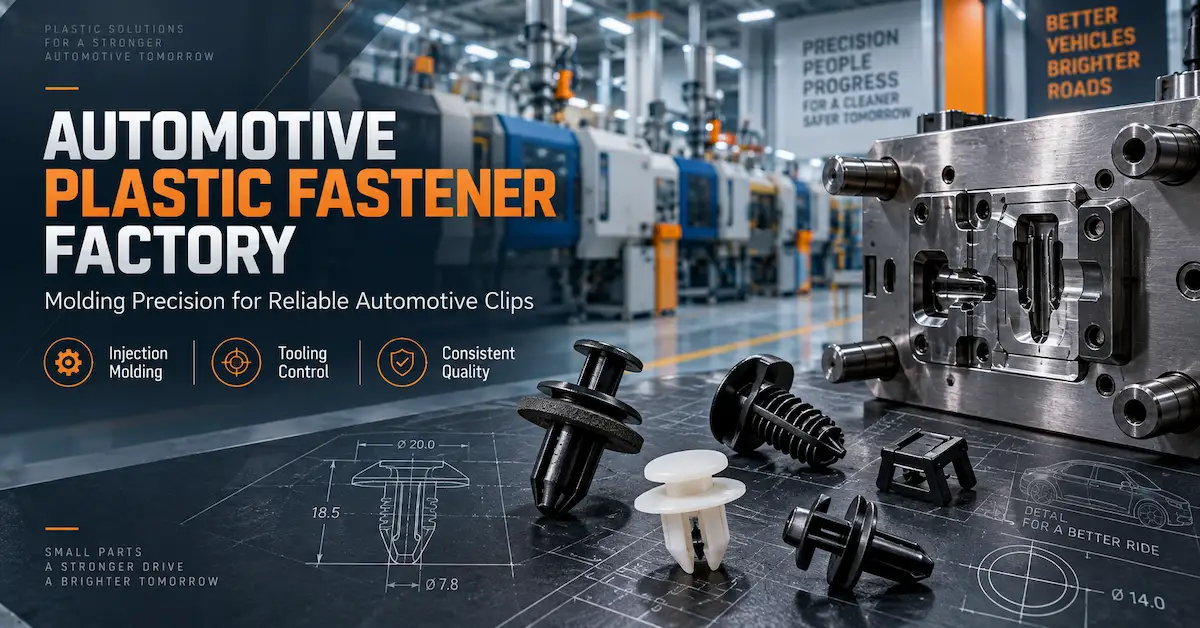
QEEPEI’s manufacturing profile describes injection molding equipment, an in-house mold workshop, and snap-fit structure development. During supplier evaluation, connect those capabilities to the proposed product: ask how critical dimensions are checked, how tooling condition is monitored, and how incomplete molding, flash, or deformation is identified. For a multi-cavity mold, ask how samples are selected to represent the cavities used for production. A clean-looking sample is useful, but your approval should also address the features that control assembly. QEEPEI’s injection-molded car clips guide explains the relationship between mold accuracy, locking geometry, and fitment. The practical goal is a documented way to reproduce the approved part, not merely an attractive factory photograph.
Turn Sample Approval Into Shipment Acceptance Criteria
Before committing to volume, agree with the automotive fasteners manufacturer on what the sample evaluation must demonstrate. Check dimensions, installation, retention, appearance, and packaging against the intended assembly and your purchasing specification. Record the test arrangement and result; “fits well” is less useful than identifying the panel, hole, sample, and observation. Ask which checks will be repeated during production and before shipment, and agree on sampling and acceptance requirements instead of assuming every check covers every piece. QEEPEI’s automotive clips quality-control guide addresses material, dimensional, functional, appearance, and packaging checks. Request complete supporting reports where relevant, and verify the named company, tested sample, date, method, and scope. Keep material-compliance documentation separate from evidence of mechanical fitment, and do not extend a report beyond the products and tests it identifies.
Compare Actual Models Without Assuming Interchangeability
A single retainer and an assortment kit solve different purchasing tasks. The examples below illustrate product formats in QEEPEI’s catalog, not interchangeable alternatives or a performance ranking. Use the published information to select candidates, then confirm drawings, quantities, and applications before approval. For kits, the component-by-component list should govern the order rather than a headline piece count alone.
| QEEPEI Model | Published Product Description | Suggested Evaluation Focus | Confirm Before Ordering |
|---|---|---|---|
| QGC-C066 | Nylon push-type, tree-shaped rivet; the description lists a 12.6 mm top diameter | A specific retainer for an identified application | Full drawing, mounting-hole requirements, grip range, and fitment |
| QGZ-763 | PA/POM assortment described as 680 retainer clips plus 45 additional components | A mixed clip-and-accessory assortment | Every component, quantity, material allocation, and tool list |
| QGZ-765 | PA/POM mixed kit described as a 635-piece set including 15 tools | An assortment for interior and exterior trim requirements | How tools are counted, clip quantities by type, and supported applications |
Confirm Stock, Capacity, and Lead Time by SKU
Separate three questions in the quotation: what is available now, what must be manufactured, and what still requires packaging or approval. Ask the automotive fasteners manufacturer to confirm available quantities for each SKU rather than relying on an overall inventory figure. For replenishment, request the proposed production schedule, order-release requirements, and arrangements for partial deliveries. For custom products, distinguish tooling, sampling, revisions, production, and packing milestones. QEEPEI describes stocked products and custom-development support, but the applicable schedule should be confirmed for the specific order. A dispatch estimate is not an arrival commitment; agree on the delivery basis and destination. This makes the purchase plan usable by both your warehouse team and your sales team.
Distinguish Private-Label Packaging From Product Development
Define the customization scope before comparing OEM/ODM quotations. Existing clips with branded bags or boxes are a different project from a revised kit composition, and both differ from developing new clip geometry and tooling. QEEPEI offers custom packaging and product-development support; its product pages describe options such as labels, barcodes, retail boxes, and assortment packs. For packaging work, approve the artwork, quantities, identification, and packing sample. For a custom fastener, agree on the drawing, material, tooling proposal, trial samples, fitment review, and production release. Ask the automotive fasteners manufacturer to quote development charges separately from recurring unit and packaging costs. Also clarify tooling ownership, maintenance responsibilities, and permission requirements for future design changes before authorizing the project.
Compare Procurement Cost Against the Usable Product Mix
Request quotations on the same basis: identical approved specifications, quantities, packaging, inspection requirements, and delivery terms. Separate tooling, samples, product supply, packaging, and freight so that one offer is not being compared with another that excludes essential work. For assortment kits, assess the quantities of relevant clip types—not only total pieces. As a purchasing example, a lower-priced kit containing many components outside your customers’ repair needs may tie up more stock than a smaller, better-matched assortment. This is a comparison method, not a claim about either QEEPEI kit above. Include the likely work of relabeling, sorting, or resolving mismatched contents in your evaluation. A clear specification lets you discuss price without quietly changing the product being priced.
Keep Repeat Orders Tied to the Approved Version
For repeat purchases, ask the automotive fasteners manufacturer to acknowledge the approved SKU, drawing, material, packaging specification, and kit component list on the order confirmation. Keep dated reference samples and the accompanying records available to both purchasing and quality personnel. Establish which changes require notification and renewed approval, including material grade, locking geometry, tooling, pack quantities, or labeling. Consider a hypothetical situation in which a substitute clip has the same color and head size but a different locking feature: treat it as a new candidate, not an automatic replacement. Record any accepted change and its effective batch. This recommended approval process gives the next buyer or warehouse inspector something more precise to work from than an old photograph or an informal email.
Prepare a Quote Request That Can Be Evaluated
A useful request for quotation combines technical and commercial information. Send the QEEPEI model number or available OE reference, clear photographs or drawings, mounting location, vehicle details, known dimensions, and quantities by SKU. For kits, include the required component mix and whether tools are included. Add packaging, labeling, destination, delivery expectations, and any requested sample or inspection documents. Identify missing information openly so that it can be resolved before approval. This gives QEEPEI a clearer basis for discussing existing products, packaging customization, or new development. Request an itemized proposal that separates product selection, sample requirements, customization, and delivery conditions rather than relying on a generic price list.
Frequently Asked Questions
What should I check first when choosing an automotive fasteners manufacturer?
Start with the relevant product range and the supplier’s ability to work from a clear specification. Review fitment information, material identification, sample evaluation, inspection records, and repeat-order controls before comparing price or broad production claims.
Can I identify a replacement clip from an OE reference number alone?
Use the reference number to narrow the search, then request confirmation against the vehicle application, mounting position, dimensions, and sample. Keep the reference supplied by the buyer separate from fitment that has actually been verified.
Does a universal car clip kit fit every vehicle?
Do not treat “universal” as approval for every vehicle or mounting position. Check the individual components against your intended applications. The relevant evidence is the kit’s actual contents and supported fitment, not the product name alone.
Is nylon automatically the best material for automotive clips?
No material family should be approved without considering the application. Ask for the proposed grade and review it alongside geometry, installation requirements, and exposure conditions. Avoid replacing a specified material merely because another option is also described as nylon.
What should I ask for with a sample order?
Request sample identification, the corresponding drawing or dimensions, material details, and the proposed packaging specification. Agree on what the sample must demonstrate and how any differences or required changes will be recorded before production approval.
What is the MOQ for bulk automotive fasteners?
Request the minimum order quantity for each SKU and packaging option in the quotation. Do not assume that a standard bagged clip, a custom assortment, and a newly tooled fastener share the same order requirements.
Can QEEPEI provide private-label clip kits?
QEEPEI describes customized kit and packaging services. Discuss the component list, branding, labels, barcodes, and box requirements, then confirm the available options, quantities, samples, and commercial terms for the proposed configuration.
Which quality or certification documents should buyers request?
Request documents relevant to the product and purchasing requirement, including applicable material information, inspection records, and test reports. Check sample identity, company name, date, method, and scope instead of approving a product from a certificate logo alone.
How should I confirm production lead time?
Ask for a schedule tied to the actual SKU, quantity, stock position, customization, and approval milestones. Establish when the schedule starts and distinguish production completion, dispatch, and estimated arrival when reviewing the quotation.
What should remain consistent on repeat orders?
Keep the approved product identity, geometry, material, component quantities, packaging, and inspection requirements consistent unless a change is reviewed and accepted. Reference the current specifications in each order and retain the earlier approval record for comparison.
Conclusion
Choosing an automotive fasteners manufacturer is a decision about repeatability, not simply access to a large catalog. Define the application, approve the dimensions and materials, agree on inspection and packaging, and keep later orders connected to that approved version. For distributors, repair suppliers, and private-label brands sourcing QEEPEI clips and kits, this creates a practical path from product selection to a repeatable purchasing specification. Contact QEEPEI with your reference numbers, drawings or samples, quantities, and packaging requirements to discuss product matching, bulk supply, or a custom development proposal.