
What Should an Automotive Fasteners Supplier Provide to B2B Buyers?
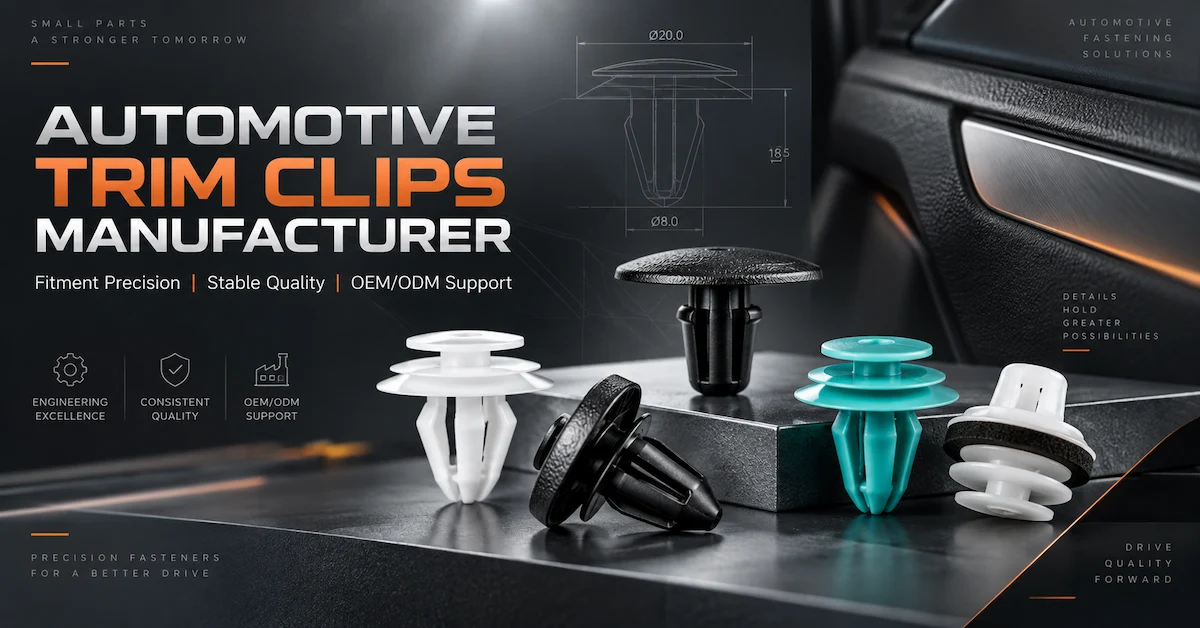
A useful automotive fasteners supplier should do more than send a catalog and quote a price per piece. For distributors and aftermarket buyers handling hundreds or thousands of small fastening parts, the more difficult work is identifying the right clip, keeping SKU information organized, maintaining an appropriate inventory mix, controlling packaging, and ensuring that a repeat order still corresponds to the product previously approved. QEEPEI's current automotive fastener product range is organized around Car Body Clips, Car Clips Kits, Specific Fit Car Clips, and Car Clips Tool, while its website states that the product system covers more than 4,000 models and maintains more than 2,000 SKUs in stock. Those company-level numbers are useful when evaluating range breadth, but availability still needs to be confirmed by SKU and order quantity before purchasing.
For a professional buyer, supplier capability should therefore be evaluated through a complete sourcing chain: product identification → fitment confirmation → specification approval → sample checking → quotation → packaging → shipment → replenishment. If any one of these stages remains unclear, a low unit price can be offset later by incorrect fitment, excess stock, mixed kits, customer returns, or difficult repeat purchasing.
Who Needs This Type of Automotive Fastener Supply Program?
The purchasing requirements of an automotive parts distributor are different from those of an online seller or a repair chain. Distributors normally need broad SKU coverage, clear product identification, stable replenishment, and packaging suitable for warehouse control. Repair suppliers need fast access to commonly used clips and enough fitment information to reduce workshop delays. E-commerce sellers require understandable product photos, application descriptions, component lists, and retail-ready packaging. Private-label brands are more likely to need custom labels, assortment configurations, branded boxes, and sometimes new product development.QEEPEI's wholesale service specifically addresses distributors, online-shop sellers, brand owners, and supermarket buyers, making these buyer groups directly relevant to the site's B2B positioning.
This guide focuses on the plastic clips, retainers, push fasteners, screw-base clips, vehicle-specific clips, and related assortments represented in QEEPEI's product system. It should not be read as a sourcing specification for every automotive fastener category, particularly structural bolts, threaded chassis fasteners, seat-belt anchors, or other safety-critical hardware that requires a different engineering and validation process.
Build Your SKU Plan Around Applications Before Comparing Prices
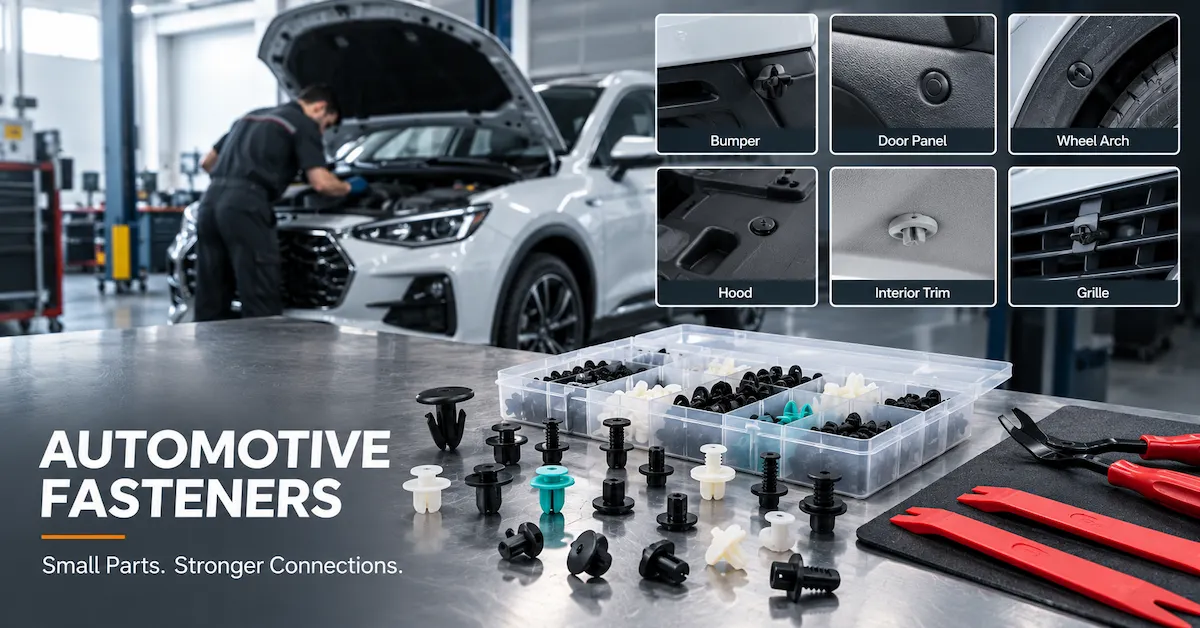
A common sourcing mistake is asking an automotive fasteners supplier for a large general catalog before defining where the products will actually be sold or installed. A stronger approach is to divide your requirement by vehicle area and customer use. Bumper repair may require bumper clips and grille retainers; collision repair can create demand for fender-liner and wheel-arch fasteners; interior work may require door-panel, headliner, dashboard, and navigation-panel clips; routine workshop supply may require mixed assortments and removal tools.Building the SKU plan around real applications makes it easier to distinguish fast-moving items from products that may sit in stock for months.
| Application Area | Typical Product Direction | Information Buyers Should Confirm | Main Purchasing Risk |
|---|---|---|---|
| Bumper and grille repair | Bumper clips, grille clips | Vehicle, mounting location, dimensions, reference number | Visually similar clip with incorrect locking geometry |
| Door and interior trim | Door-panel,dashboard and trim clips | Panel thickness, head style, stem geometry, color | Loose trim, difficult installation or cosmetic mismatch |
| Fender and wheel area | Fender-liner and wheel-arch clips | Hole dimensions, exposure conditions, mounting position | Wrong clip family or insufficient environmental suitability |
| Hood and related trim | Hood or insulation retainers | Exact retained component, dimensions, temperature environment | Treating a trim retainer as another type of hood fastener |
| Workshop assortment | Mixed clip kits and tools | Component list, quantity of each SKU,refill requirements | Large total count but poor useful-SKU coverage |
| Vehicle-specific replacement | Specific-fit clips | Make, model, year, location and OE reference where available | Assuming a brand-level category guarantees exact fitment |
QEEPEI already organizes part of its catalog by mounting area and another part by vehicle brand. These classifications are useful for discovery, but they should not replace final part-level verification.
Define the Fastener Specification Before Requesting a Bulk Quote
Two clips can appear almost identical in a photograph while differing in the dimensions or locking features that determine whether they install correctly. Before comparing quotations, create a controlled specification for every important SKU. QEEPEI's car clip selection guide highlights factors such as hole size, head diameter, panel thickness, material, and locking design, which are more useful for purchasing than relying on appearance alone.
| Specification Item | What the Buyer Should Record | Why It Matters |
|---|---|---|
| Product identity | Supplier model, buyer SKU, drawing or sample reference | Prevents SKU confusion on repeat orders |
| Vehicle information | Make, model, year where relevant | Narrows the fitment range |
| Installation position | Bumper, door,fender, dashboard, trim, hood, etc. | Similar clips may serve different mounting systems |
| OE/reference number | Where available | Provides another identification point |
| Mounting hole | Shape and actual dimensions | Controls insertion and locking engagement |
| Clip dimensions | Head diameter, stem diameter,length and locking geometry | Determines physical compatibility |
| Panel thickness | Actual retained thickness or stack | Helps confirm grip and locking position |
| Material | Polymer family and required grade where specified | Affects mechanical and environmental behavior |
| Color/appearance | Required finish or visible color | Important for interior and exposed applications |
| Packaging | Quantity, label, barcode,kit configuration | Supports warehousing and resale |
| Approval status | Sample/revision/date | Connects the purchase order to the approved version |
A quotation based on this information is easier to compare because suppliers are pricing the same defined requirement rather than interpreting a vague request such as “need black bumper clips.”
Treat Vehicle Fitment as Data, Not as a Marketing Label
Vehicle compatibility is one of the largest sourcing risks in automotive clips. A product being listed under Toyota, BMW, Ford, Nissan, Honda, Volkswagen, or another brand does not mean it fits every vehicle produced by that brand. For professional sourcing, use a chain such as vehicle make → model → year or generation → installation position → OE/reference number → physical dimensions → sample verification. QEEPEI's catalog includes vehicle-specific clip categories, while its fitment-related content emphasizes dimensional matching rather than appearance alone.
This distinction becomes especially important for online sellers and distributors because inaccurate compatibility data can create a problem larger than the value of the clip itself. A wrongly listed fastener can result in customer returns, negative reviews, warehouse confusion, and repeated technical support. When assessing an automotive fasteners supplier, ask what information supports its fitment claim and whether the buyer can obtain a dimension drawing, reference information, sample, or other confirmation before adding a new SKU to inventory.
Specify Material According to the Installation Environment
“Plastic automotive fastener” is not a complete material specification. QEEPEI's technical content discusses PA, PP, and POM as materials used in automotive clips, but the correct choice depends on the geometry and application of an individual product. Its car clips material guide also recommends that buyers define vehicle information, hole dimensions, panel thickness, material requirements, environment, quantity, and packaging when preparing a sourcing requirement.
For interior applications, buyers may need to consider appearance, repeated removal, panel interaction, and cabin temperature. Fasteners around fenders, wheel arches, or exterior trim may face water, dirt, vibration, temperature changes, and outdoor exposure. Under-hood retainers may require a different environmental review. The correct purchasing question is therefore not “Is nylon good?” but “Which material and grade are proposed for this specific geometry and operating condition, and what evidence supports that choice?” Avoid assuming that every QEEPEI clip uses exactly the same polymer formulation simply because several products belong to the same catalog category.
Evaluate Injection Molding and Tooling as Part of Supplier Quality
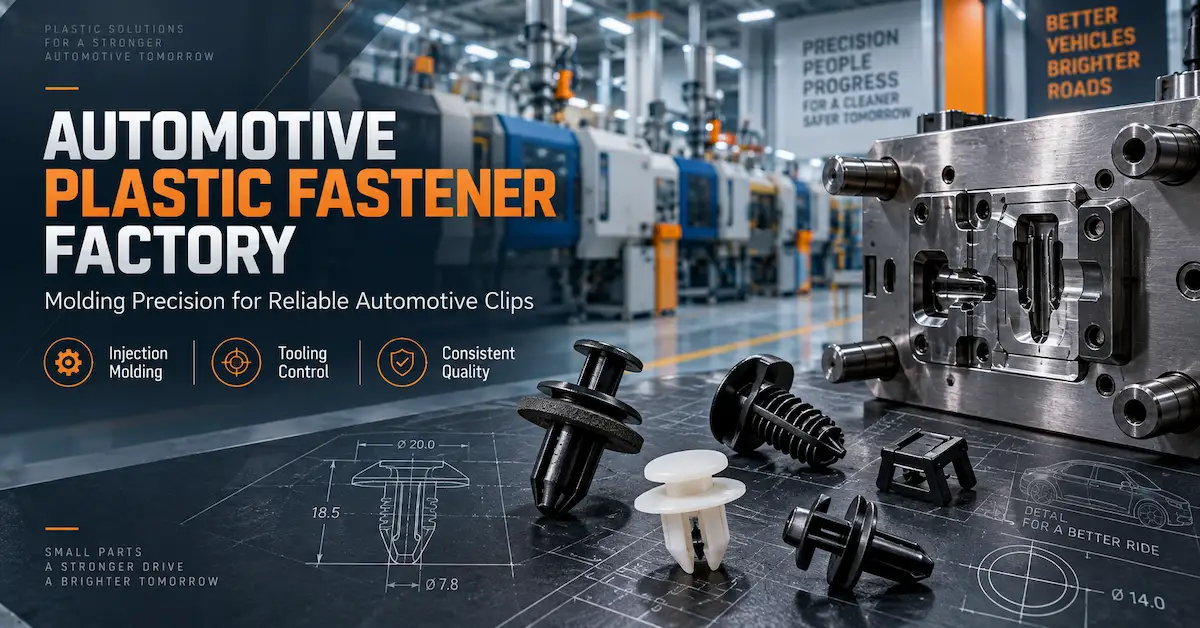
Automotive clips depend heavily on molded geometry. A stem, barb, locking leg, expansion feature, or retaining head may be only a small part of the component, but variation in that feature can change insertion force and fitment. QEEPEI states that it operates its own injection molding equipment and mold workshop, and its injection molded car clips guide explains why mold accuracy, material selection, molding control, and dimensional consistency matter to fitment.
When evaluating manufacturing capability, connect factory information to your actual SKU. Ask which dimensions are considered critical, how molding defects such as flash, incomplete filling or warpage are identified, how tooling revisions are controlled, and what happens when a dimension moves outside the agreed requirement. Factory machinery demonstrates potential capability; the purchasing decision should focus on how that capability is applied to the product you are ordering.
Quality Control Should Be Connected to the Approved Product
A buyer should not evaluate an automotive fasteners supplier only by counting certificate logos. Product quality depends on whether the production batch matches the approved product and the defined application. For important SKUs, determine which dimensions will be checked, what visual defects are unacceptable, whether installation or retention testing is needed, how samples are selected, and how batch information is recorded. If environmental, material, or compliance documentation is required, ask for the actual document and verify its company name, sample description, date, test scope, and relationship to the product being purchased.
This is especially important when a website or quotation contains broad compliance language.A material test report for a submitted clip sample does not automatically establish fitment, mechanical performance, or compliance for every product in a supplier's entire catalog. The safest purchasing approach is to separate company capability documents, material/compliance reports, dimensional inspection, functional testing, and individual product approval instead of treating them as interchangeable evidence.
Inventory Depth Matters Only When It Matches Your Fast-Moving SKUs
QEEPEI's current website states that more than 2,000 SKUs are maintained in standard inventory and promotes fast delivery for stocked products. That is relevant to distributors, but overall inventory size does not answer the most important replenishment question: Are the SKUs you repeatedly purchase actually available when you need them?
Before establishing a supply program, divide products into fast-moving, medium-moving, and project-specific groups. Ask the supplier which selected items are normally stocked, which are produced against orders, and which require special materials, packaging, or manufacturing preparation. For every quotation, distinguish production completion from dispatch and final arrival. A website-level delivery statement should not be treated as an unconditional promise for every quantity, custom package, destination, or SKU combination.
Compare Product Formats Before Building a Large Automotive Fastener Range
QEEPEI gives buyers several ways to source products. A distributor can purchase individual clips, mixed assortment kits, vehicle-oriented clip products, or related removal tools. Each format solves a different commercial problem, so the best option depends on how your customers buy and use the products.
| Supply Format | Best Fit for Buyers | Main Advantage | What Must Be Checked |
|---|---|---|---|
| Individual body clips | Distributors, repair suppliers, refill programs | Precise SKU replenishment | Dimensions, application and pack quantity |
| Mixed car clip kits | Retail, workshops,e-commerce | Multiple clip types in one package | Actual component mix and quantity per type |
| Vehicle-specific clips | Model-focused sellers and repair programs | Narrows product discovery by vehicle | Model, year, position and reference data |
| Clip removal tools | Workshops and kit sellers | Complements installation and removal work | Tool type and intended operation |
| Private-label assortment | Brands and channel-specific sellers | Differentiated packaging and configuration | BOM, artwork, barcodes and replenishment plan |
The QEEPEI product catalog can be used as the starting point for selecting these different product directions rather than treating every fastener as an interchangeable commodity.
Compare Representative Products by Purchasing Purpose
The following published examples show why buyers should compare purchasing purpose instead of comparing only total piece count. Confirm the latest product details directly with QEEPEI before placing an order.
| Product | Published Format | Suitable Purchasing Direction | What Should Be Confirmed |
|---|---|---|---|
| QGC-C066 | Individual tree-shaped nylon rivet product | Specific replacement or SKU-based wholesale | Complete dimensions, hole requirement and actual fitment |
| QGZ-763 | Mixed automotive clip and accessory kit | Workshop, retail or multi-SKU assortment | Exact component list, quantity per clip and tools/accessories |
| QGZ-765 | PA/POM mixed clip kit with tools described in the product information | Assortment and resale applications | Piece-count method, individual clip quantities and application coverage |
A larger kit is not automatically a better kit. A buyer supplying body shops may value bumper, fender and trim fasteners differently from an e-commerce seller targeting DIY users. The useful comparison is how much of the assortment matches actual customer demand and how easily fast-moving items can be replenished.
Calculate Procurement Cost Beyond the Unit Price
The lowest quoted price does not necessarily create the lowest purchasing cost. For automotive fasteners, cost can also be created by incorrect fitment, slow-moving inventory, unclear packaging, mixed components, returns, repeated customer support, emergency replenishment, and time spent identifying unmarked products. When comparing suppliers, place quotations on the same basis: specification, quantity, material, packaging, inspection requirement, sample requirement and delivery terms.
For assortments, calculate the cost of usable SKUs, not just cost per total piece. If a kit contains many clips that rarely match the buyer's target repair market, a low piece price may still produce poor inventory efficiency. For individual clips, consider whether common products can be replenished without buying unrelated models. This approach turns supplier selection from a simple price comparison into a commercial decision about inventory turnover and customer demand.
Separate OEM/ODM Fastener Development From Packaging Customization
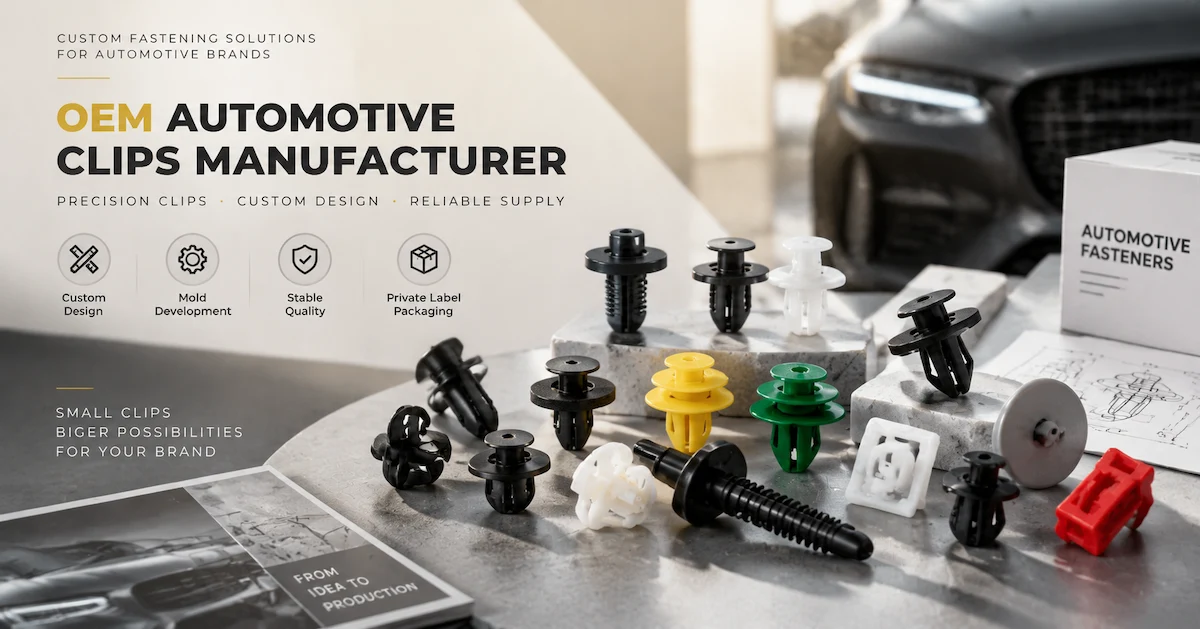
QEEPEI's wholesale program describes OEM/ODM and packaging support, but buyers should define what “custom” actually means for each project. Adding a private label to an existing bag, changing the number of clips in an assortment, designing a retail box, changing a material or color, and developing new clip geometry are different projects with different technical and commercial requirements.
For a packaging project, define the product list, pack quantity, logo, label, barcode, artwork, language, and carton requirements.For a new fastener, prepare an existing sample or drawing, mounting-hole information, panel thickness, application, required material, known failure problems, expected quantity, and approval criteria. If new tooling is involved, also clarify drawing revisions, mold ownership, sample approval, tooling changes, and how the approved configuration will be controlled during later production. A capable automotive fasteners supplier should help separate these requirements rather than treating every request as the same OEM project.
Prepare a Complete RFQ Before Contacting the Supplier
A structured request for quotation reduces back-and-forth communication and makes proposals easier to evaluate. For standard products, provide the desired supplier model or OE/reference number, vehicle information if relevant, installation position, quantity, packaging requirement and destination. When the model is unknown, send clear photographs with measurements rather than only a distant image of the installed component. For assortment kits, provide the desired product types, quantity distribution, tool requirements, packaging, labels and whether individual refills will be needed later. For a custom development project, include drawings or samples, required dimensions, material requirements, operating environment, projected quantity and known application problems.
You can review QEEPEI's product range before preparing the SKU list and submit the completed sourcing requirement through the Contact Us page. A detailed RFQ gives the supplier enough information to distinguish existing-stock products, products requiring confirmation, packaging customization, and genuine new-product development.
Frequently Asked Questions
1. What should I check first when selecting an automotive fasteners supplier?
Start with whether the supplier's actual product range matches your application and customer base. Then evaluate fitment information, specifications, materials, manufacturing control, inventory for relevant SKUs, packaging options, quality records and the process used for repeat orders.
2. Is a large product catalog enough for automotive fastener sourcing?
No.A broad catalog is useful only when buyers can identify the correct products. Part numbers, dimensions, mounting positions, vehicle information, reference numbers and clear product records are what turn a large catalog into a manageable sourcing system.
3. Should I buy universal clip kits or individual automotive clips?
It depends on the customer. Mixed kits can work well for workshops, retail and general maintenance, while individual SKUs are more suitable when a distributor knows which fasteners sell repeatedly. Many buyers use both and maintain refill stock for frequently consumed clips.
4. Can vehicle make alone confirm clip compatibility?
No. Use vehicle make as an initial filter and confirm model, year or generation, mounting position, reference information and dimensions where possible. Sample installation can provide additional confirmation before a large order.
5. What information is most important when matching a plastic clip?
Mounting-hole dimensions, head and stem geometry, panel thickness, locking design, material and actual installation position are important.Vehicle and OE/reference information can help narrow the search but should be considered together with physical dimensions.
6. How should I compare materials such as PA, PP and POM?
Compare the specific grade and application requirement rather than only the polymer name. Consider geometry, required flexibility, dimensional behavior, environmental exposure and validation requirements. Do not assume one material family is automatically superior for every clip design.
7. How should distributors manage automotive fastener inventory?
Classify selected SKUs by demand, maintain clear part identification and fitment data, monitor which kit components are consumed most frequently, and agree on a replenishment process for fast-moving products. Avoid building inventory solely from total catalog size.
8. Can QEEPEI provide private-label automotive fasteners?
QEEPEI states that it supports OEM/ODM and packaging customization for B2B customers.Buyers should define whether the project requires only branding and packaging, a customized kit composition, or actual fastener development, and confirm the applicable commercial conditions for that project.
9. What quality documents should I request before a bulk order?
Request documentation relevant to the actual purchasing requirement. Depending on the project, this may include dimensional inspection, material information, functional checks, sample approval records, batch identification, or relevant test reports. Verify the product and scope rather than relying only on a certificate name.
10. What should I send QEEPEI for an automotive fastener quotation?
Provide the product number or reference number if known, vehicle make/model/year when relevant, installation position, photographs or samples, important dimensions, requested quantity, packaging requirements and destination. For a custom project, add drawings, material requirements, expected volume and the technical reason a standard product is unsuitable.
Conclusion
Choosing an automotive fasteners supplier is ultimately about building a controllable supply system for many small but application-specific parts. B2B buyers should evaluate whether the supplier can help identify products accurately, document critical dimensions and materials, support vehicle fitment, control molding and product quality, maintain relevant inventory, configure packaging, and reproduce an approved SKU during future orders. A large catalog and competitive price are useful, but they create greater value when they are connected to clear product records, useful stock planning and reliable replenishment.
QEEPEI provides automotive body clips, clip kits, vehicle-specific clips and related tools for distributors, repair suppliers, e-commerce sellers and private-label buyers. Start with the QEEPEI automotive fastener catalog, review its wholesale sourcing services, and then contact QEEPEI with your SKU list, vehicle or reference information, dimensions, quantities and packaging requirements so the appropriate existing-product, wholesale or custom-development route can be evaluated.