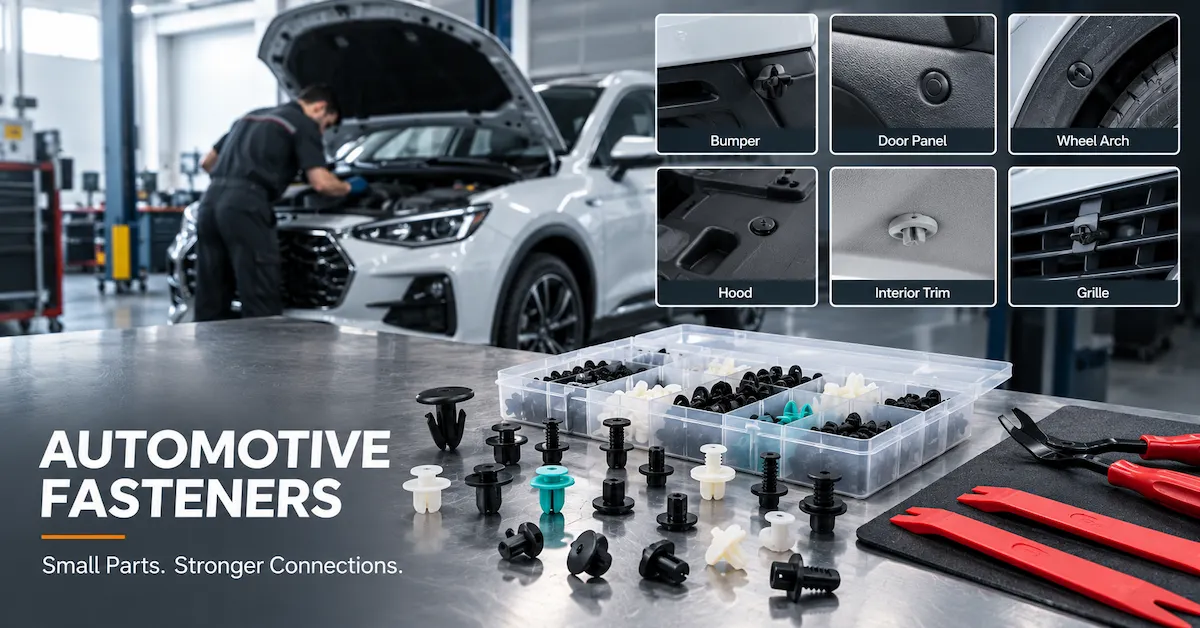

What Should Buyers Expect From an OEM Automotive Clips Manufacturer?
An OEM automotive clips manufacturer helps buyers transform a fastening requirement into a repeatable production solution. Unlike purchasing standard clips from an existing catalog, OEM projects often involve additional steps such as product evaluation, design confirmation, mold development, material selection, sample approval, packaging customization, and production control.
For automotive brands, distributors, and aftermarket suppliers, the purpose of OEM cooperation is usually not only to create a different-looking clip. The real goal is to solve a specific application requirement, improve product differentiation, simplify supply management, or develop a package suitable for a particular sales channel.
Automotive clips may appear small, but their performance depends on precise relationships between the mounting hole, retained panel, locking structure, material characteristics, and production consistency. A qualified OEM partner should therefore help buyers control the entire process from initial concept to repeat orders.
QEEPEI provides automotive clip products including body clips, clip kits, vehicle-specific clips, and related tools through its automotive products page. Buyers looking for OEM cooperation should first determine whether an existing product can meet their requirements or whether a customized solution is actually necessary.
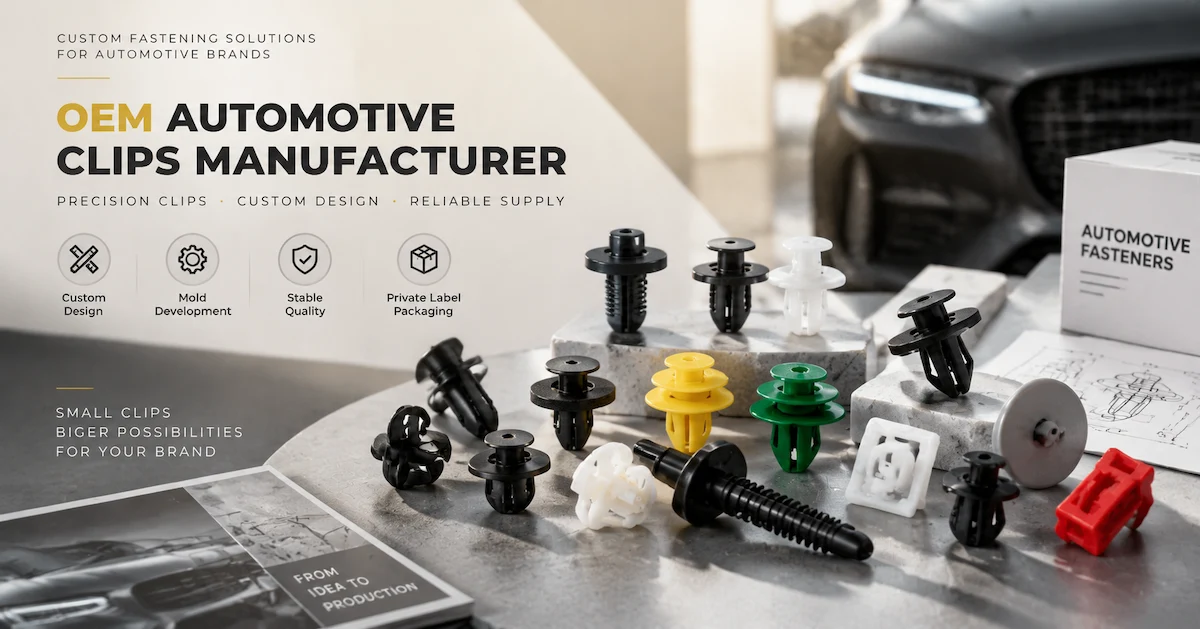
When Should Buyers Choose OEM Automotive Clips Instead of Standard Products?
Not every project requires a new automotive clip design. Standard products are often suitable when the application already matches an available specification and the buyer only needs reliable supply. OEM development becomes more valuable when existing products cannot fully satisfy the customer's requirements.
Typical situations that may require OEM automotive clips include:
| Requirement | Why OEM May Be Needed |
|---|---|
| New vehicle application | Existing clips may not match a new mounting structure |
| Special panel thickness | Standard grip range may not fit the required assembly |
| Unique locking structure | A different retention method may be needed |
| Brand differentiation | Customers may require private-label packaging or exclusive configurations |
| Special material requirement | Application conditions may require a specific material solution |
| Custom assortment kits | Buyers may need a specific combination of clips |
Before starting an OEM project, buyers should clearly define the problem they want to solve. Creating a new mold only makes sense when a standard solution cannot achieve the required result.
QEEPEI's wholesale service supports B2B cooperation including product supply and customization discussions. The exact scope of customization should be confirmed according to the project requirements.
Define the Product Requirement Before Starting OEM Development
A successful OEM project begins with accurate technical information. Many development problems happen because buyers describe the desired product only by appearance, while the manufacturer needs information about function, installation, and production requirements.
A complete OEM automotive clips requirement should include:
| Information | Purpose |
|---|---|
| Application location | Understand where the clip will be installed |
| Retained component | Define what the clip must secure |
| Vehicle information | Support fitment evaluation |
| Existing sample or drawing | Provide a development reference |
| Mounting hole information | Confirm installation interface |
| Panel thickness | Define required grip range |
| Locking requirement | Determine clip structure |
| Material expectation | Support material evaluation |
| Appearance requirement | Define visible finish and color |
| Forecast quantity | Evaluate production feasibility |
| Packaging requirement | Plan final product delivery |
An experienced OEM automotive clips manufacturer should help organize these requirements instead of immediately moving into tooling production.
For example, a buyer requesting “a stronger black plastic clip” provides limited engineering information. A more useful request explains where the clip is installed, what component it retains, why the existing clip is insufficient, what environment it operates in, and what improvement is expected.
OEM Automotive Clips Development Process
A professional OEM development process normally involves several stages. Each stage reduces uncertainty before mass production.
1. Requirement Review
The manufacturer reviews:
- Application information
- Existing samples
- Drawings
- Dimensions
- Material requirements
- Expected quantity
- Packaging needs
The purpose is to determine whether an existing product can be modified or whether a new design is required.
2. Design and Engineering Evaluation
During this stage, the manufacturer evaluates:
- Clip structure
- Locking mechanism
- Mold feasibility
- Material suitability
- Manufacturing difficulty
The design should consider not only whether the clip can be produced but also whether it can be consistently manufactured.
3. Mold Development
For new automotive clips, tooling is a critical part of the project.
Important mold considerations include:
- Part geometry
- Mold structure
- Critical dimensions
- Tool maintenance
- Production repeatability
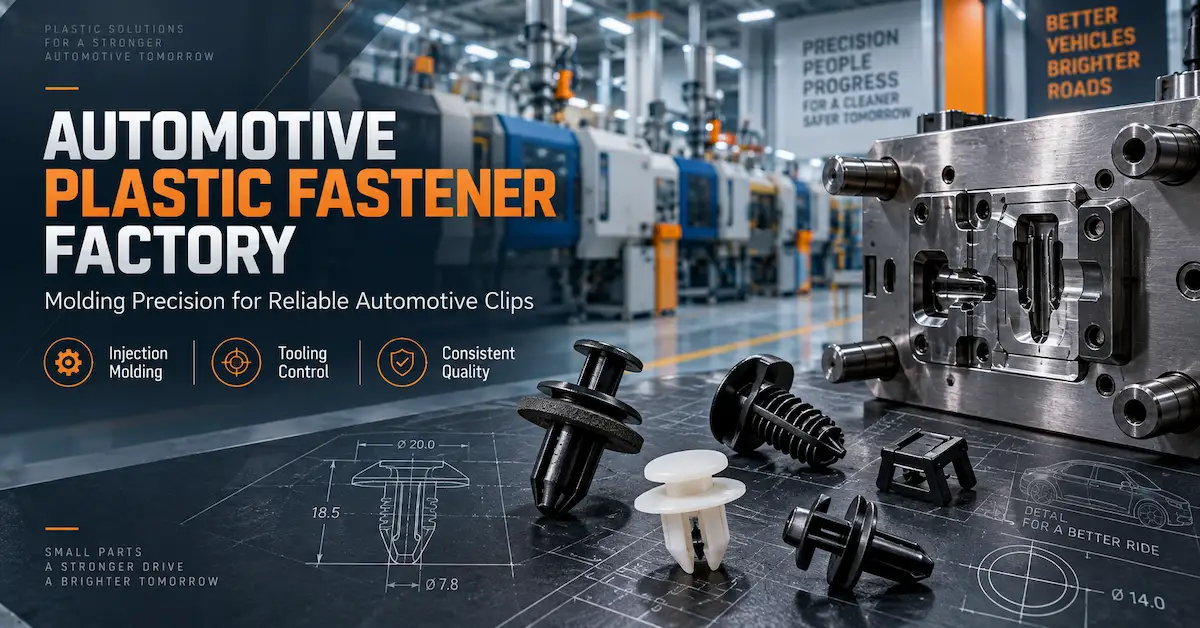
QEEPEI describes injection molding and mold-related capabilities through its About Us page. Buyers should connect these capabilities with the specific OEM project rather than evaluating factory equipment alone.
4. Sample Production and Approval
Sample approval should confirm:
- Appearance
- Dimensions
- Installation behavior
- Fitment
- Material information
- Packaging requirements
The approved sample becomes the reference point for future production.
5. Mass Production
After approval, production should follow the confirmed specification.
Important controls include:
- Material consistency
- Mold condition
- Process stability
- Inspection requirements
- Packaging accuracy
6. Repeat Order Management
A successful OEM relationship depends on maintaining consistency after the first order.
Buyers should keep records of:
- Approved samples
- Drawings
- Product revisions
- Packaging specifications
- Quality requirements
This prevents confusion when future orders are placed.
Material Selection for OEM Automotive Clips
Material selection is one of the important decisions in OEM clip development. Plastic automotive fasteners commonly involve engineering plastics such as PA, PP, and POM, but the correct choice depends on the specific product design and application.
Different applications may require different considerations:
| Application | Material Considerations |
|---|---|
| Interior trim clips | Appearance, installation feel, repeated service |
| Door panel clips | Retention, flexibility, panel compatibility |
| Exterior clips | Environmental exposure and durability requirements |
| Wheel-area clips | Moisture, dirt, vibration conditions |
| Hood-related retainers | Application environment confirmation |
QEEPEI discusses automotive clip material considerations through its material guide.
For OEM projects, buyers should avoid selecting materials only by name. A material recommendation should consider product geometry, manufacturing process, and actual operating conditions.
Injection Molding and Tooling Considerations
An OEM automotive clips manufacturer must manage the relationship between mold design and finished-part performance.
Small features such as:
- Locking legs
- Expansion sections
- Ribs
- Snap structures
- Mounting bases
can directly influence installation results.
QEEPEI's injection molded car clips manufacturing guide explains how mold design, material selection, molding processes, and dimensional control influence automotive clip production.
During supplier evaluation, OEM buyers should ask:
- Which dimensions are critical?
- How are mold changes controlled?
- How are samples approved?
- How are production deviations handled?
- How is the approved design maintained during repeat orders?
A factory's ability to create a mold is important, but the ability to maintain consistent production is equally important.
Quality Control for OEM Automotive Clips
OEM buyers need quality systems that connect directly to the approved product.
Important inspection areas may include:
| Inspection Area | Purpose |
|---|---|
| Dimensional inspection | Confirm critical product measurements |
| Appearance inspection | Identify molding defects and surface issues |
| Material verification | Confirm specified material requirements |
| Fitment evaluation | Check installation compatibility |
| Functional checks | Verify intended locking behavior |
| Packaging inspection | Confirm quantity and identification |
| Batch records | Support traceability |
QEEPEI provides automotive clip quality information through its quality control content.
For OEM projects, quality requirements should be defined before production rather than discussed only after problems occur.
OEM Packaging and Private Label Options
Many automotive brands do not only need a custom product; they also need a complete market-ready solution.
OEM packaging options may include:
- Custom labels
- Barcodes
- Retail boxes
- Customized assortment kits
- Product identification systems
However, packaging customization and product development are different projects.
| Project Type | Main Focus |
|---|---|
| Private label packaging | Brand presentation and identification |
| Custom assortment | Product combination and quantity planning |
| Material modification | Product specification adjustment |
| New clip development | Engineering and tooling process |
QEEPEI's wholesale solutions provide a starting point for discussing customization requirements.
Buyers should clearly define whether they need branding changes or actual product engineering.
Compare Standard Clips and OEM Automotive Clips
| Factor | Standard Automotive Clips | OEM Automotive Clips |
|---|---|---|
| Product availability | Existing products | Developed according to requirement |
| Tooling | Usually completed | May require new tooling |
| Development time | Shorter | Requires engineering process |
| Customization | Limited | Higher customization possibility |
| Initial investment | Lower | Higher development involvement |
| Best for | Regular replacement supply | Special applications and branded solutions |
Standard clips are often the right choice when compatibility already exists. OEM development is more suitable when buyers need differentiation or a specific technical solution.
OEM Cost Factors Buyers Should Understand
The cost of OEM automotive clips depends on more than unit price.
Main factors include:
- Product complexity
- Mold requirements
- Material selection
- Sample development
- Modification requirements
- Packaging customization
- Order quantity
A lower initial quotation may exclude important development steps, while a higher quotation may include engineering support and quality controls.
Buyers should compare complete project scope instead of comparing only the final unit price.
How to Prepare an OEM Request for Quotation
A detailed RFQ helps an OEM automotive clips manufacturer understand the project.
Include:
- Product drawings or samples
- Application details
- Vehicle information
- Mounting requirements
- Material expectations
- Estimated quantity
- Packaging needs
- Quality requirements
- Target market
For existing products, buyers can first review QEEPEI's automotive clip catalog.
For custom development, provide as much technical information as possible through the contact page.
Frequently Asked Questions
1. What does an OEM automotive clips manufacturer do?
An OEM automotive clips manufacturer develops or produces automotive clips according to buyer requirements, including product evaluation, tooling, sample approval, manufacturing, packaging, and repeat supply.
2. Should I choose OEM or standard automotive clips?
Choose standard products when existing specifications meet your needs. OEM development is more suitable when you require unique dimensions, structures, packaging, or application solutions.
3. What information is needed for custom automotive clips?
Provide application details, samples or drawings, mounting information, vehicle requirements, material expectations, quantity forecasts, and packaging requirements.
4. Do OEM automotive clips require new molds?
Not always. Some projects can use existing products or modifications. New tooling depends on whether the required design differs from available solutions.
5. Which materials are used for OEM automotive clips?
Common material families include PA, PP, and POM. The correct material depends on the product design, application environment, and performance requirements.
6. How long does OEM automotive clip development take?
The timeline depends on product complexity, tooling requirements, sample revisions, approval process, and production planning. Specific schedules should be confirmed for each project.
7. Can OEM suppliers customize automotive clip packaging?
Many suppliers support packaging customization such as labels, barcodes, boxes, and assortment configurations. Buyers should confirm the available options before starting the project.
8. How do I evaluate an OEM clip manufacturer?
Review product experience, molding capability, tooling control, quality processes, communication ability, and the ability to maintain approved specifications during repeat production.
9. What quality documents should OEM buyers request?
Request documents relevant to the product requirement, such as material information, inspection records, sample approval records, and applicable test documentation.
10. Can QEEPEI support OEM automotive clip projects?
QEEPEI provides automotive clips, clip kits, wholesale cooperation, and customization support. Buyers can discuss product requirements through the QEEPEI contact page.
Conclusion
Choosing an OEM automotive clips manufacturer is a long-term product development decision rather than a simple purchasing transaction. Successful OEM cooperation requires clear requirements, suitable materials, controlled tooling, stable injection molding, sample approval, quality management, packaging planning, and repeat-order consistency.
For automotive distributors, private-label brands, repair suppliers, and aftermarket companies, a reliable OEM partner can help transform a specific fastening requirement into a controllable production solution. QEEPEI provides automotive clips, clip kits, vehicle-specific fastening products, and B2B customization support. Buyers can explore the QEEPEI product range, review wholesale cooperation options, or contact QEEPEI with samples, drawings, application details, quantities, and packaging requirements for OEM project evaluation.