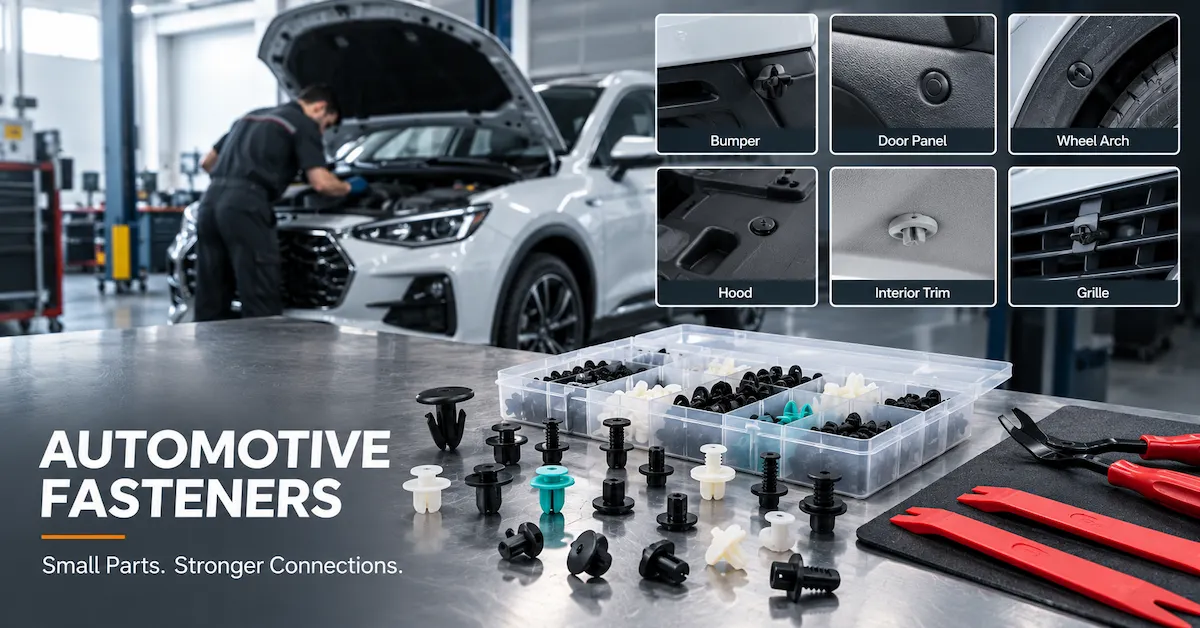

What Should Buyers Audit in an Automotive Plastic Fastener Factory?
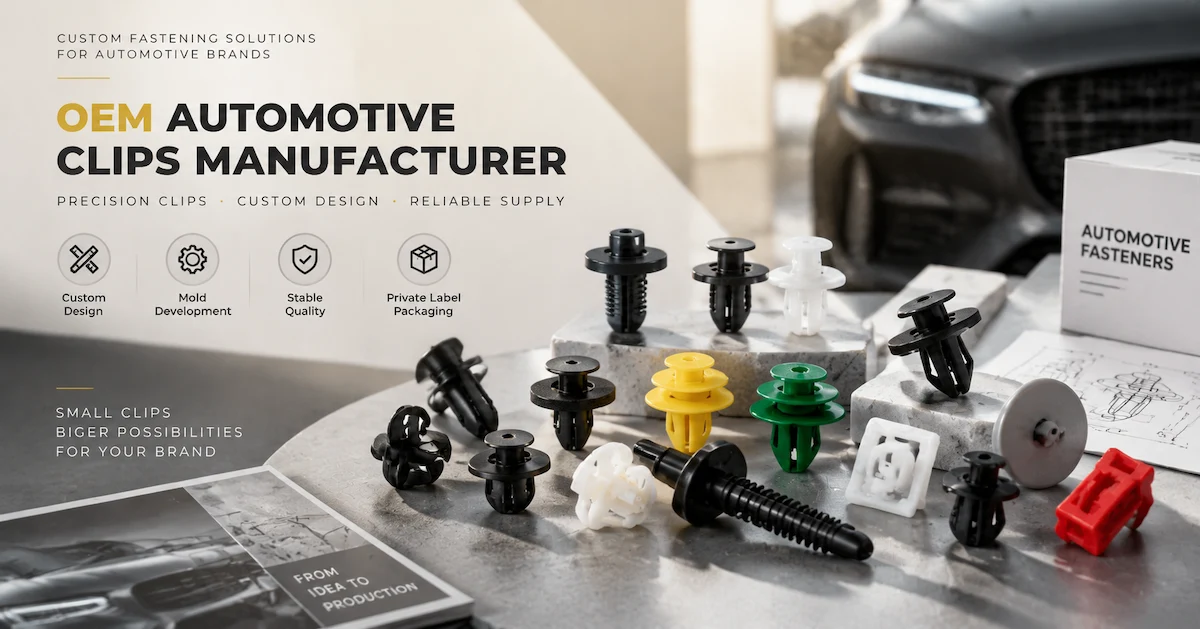
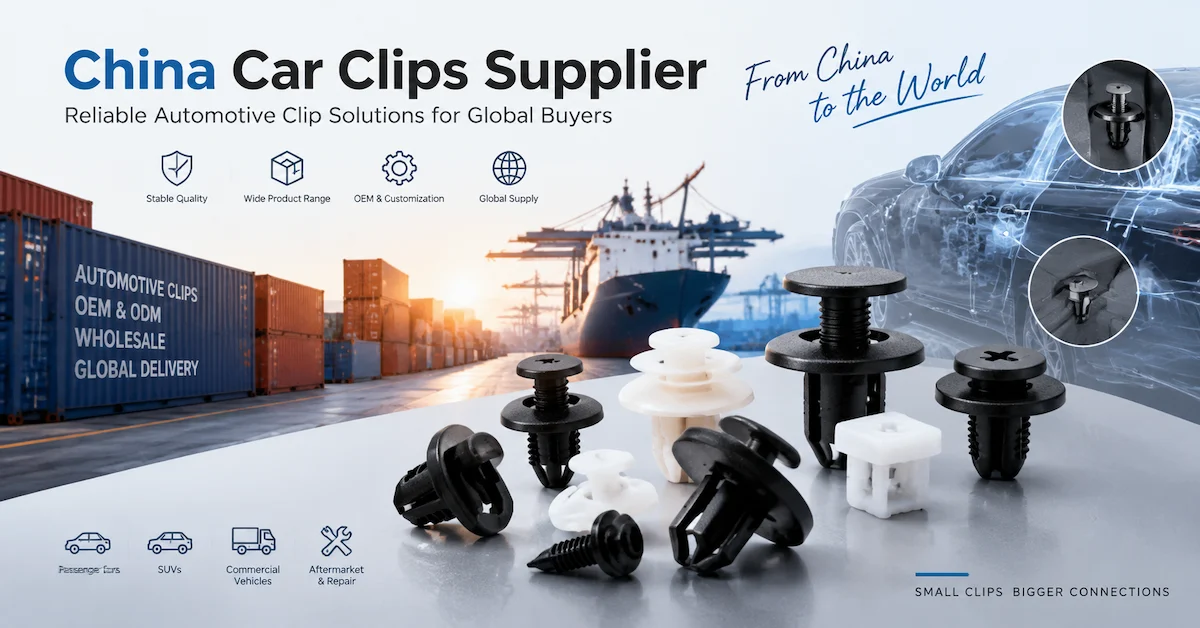
A professional buyer should evaluate an automotive plastic fastener factory by asking whether the factory can repeatedly manufacture the approved clip, not simply whether it can produce something that looks similar. Plastic automotive retainers depend on the relationship between resin, part geometry, mold accuracy, molding conditions, critical dimensions, panel fitment, inspection, packaging, and revision control. A factory may offer hundreds or thousands of clip styles, but catalog breadth has limited value if the buyer cannot identify the correct SKU or reproduce the same requirement on the next order. For distributors and automotive aftermarket buyers, the practical audit sequence is application definition → specification → material → tooling → injection molding → sample approval → production inspection → packaging → batch identification → repeat order. Buyers who are still identifying suitable products can first review QEEPEI's automotive clip product range, while this guide focuses specifically on what to evaluate after a potential factory has been shortlisted.
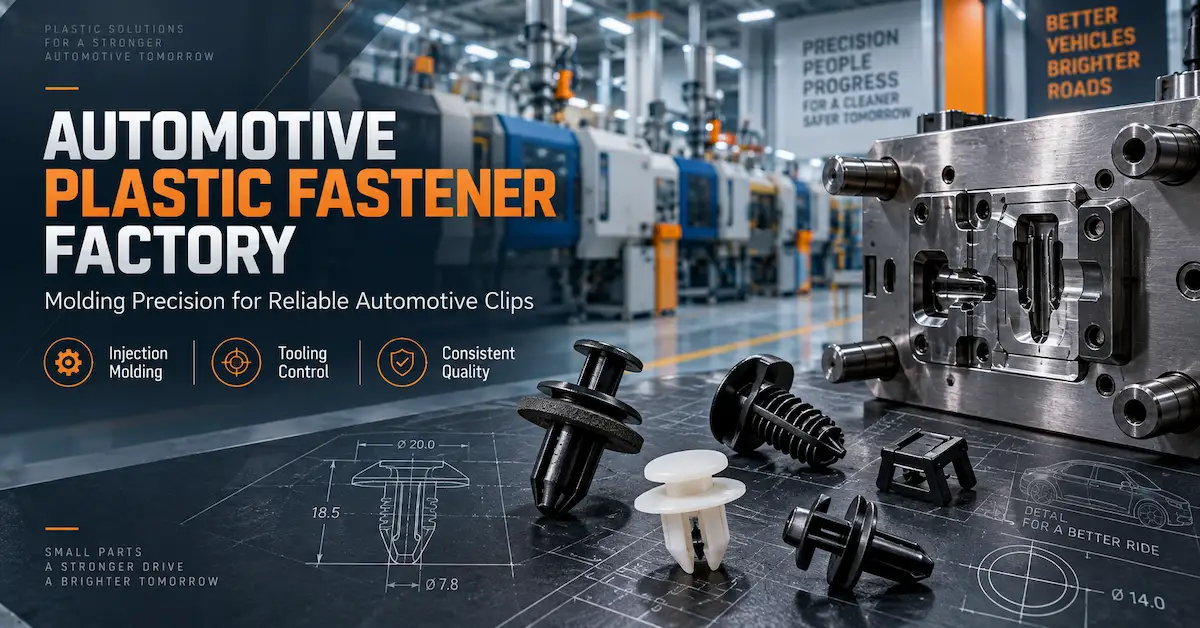
Which Buyers Benefit Most From Factory-Level Evaluation?
Factory-level evaluation is especially important for automotive parts importers, national and regional distributors, collision-repair suppliers, repair-chain purchasing teams, e-commerce brands, and private-label automotive businesses that expect repeated bulk orders. A small repair shop purchasing a few replacement clips may mainly need correct fitment, while a distributor handling dozens or hundreds of SKUs must also control item identification, packaging quantities, labeling, replenishment, and batch consistency. Private-label customers add another layer because an existing clip with customized packaging is fundamentally different from a new molded part requiring drawings, tooling, resin selection, trial samples, and production approval. QEEPEI's wholesale and sourcing services can be used as a starting point when defining the required level of cooperation. This article is focused on plastic clips, retainers, rivets, screw-base fasteners, and related aftermarket fastening products; safety-critical structural bolts, seat-belt anchorage hardware, and other engineered structural joints require a different qualification process.
Start the Factory Audit With the Application, Not the Machine List
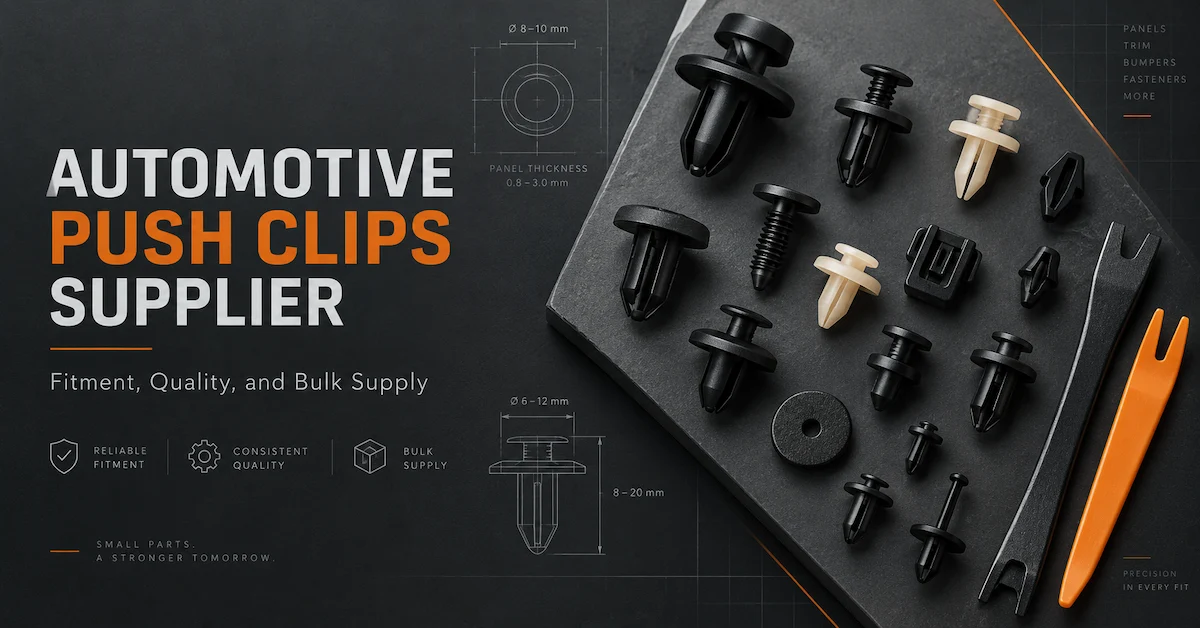
When buyers visit or evaluate an automotive plastic fastener factory, it is tempting to begin with the number of injection molding machines, mold equipment, or production lines. Those details matter, but the better first question is: What exact vehicle component must this fastener retain, and what features determine whether it works? A bumper fastener, door-panel clip, fender-liner retainer, dashboard clip, hood-insulation retainer, grille fastener, and wheel-arch molding clip may all be injection molded, yet they have different interfaces and service conditions. Buyers should define the installation position, retained component, mounting-hole dimensions, panel stack, clip structure, material requirement, and vehicle or reference information before judging whether the factory's equipment and process are suitable. QEEPEI's car clip selection guide provides additional context on hole size, head diameter, panel thickness, and locking structure, which are useful parameters when building this specification.
Build a Controlled Product Specification Before Sample Approval
The most useful factory audit document is often not a certificate or brochure but a controlled specification that both sides can understand. It creates a common reference for tooling, sample approval, inspection, purchasing, and repeat orders.
| Specification Field | What the Buyer Should Define | Why It Matters |
|---|---|---|
| Product identity | Buyer SKU, supplier SKU, drawing or approved sample | Prevents similar clips from being mixed |
| Application | Exact mounting position and retained component | Connects dimensions to real use |
| Vehicle information | Make, model, year/generation where applicable | Supports fitment confirmation |
| Reference number | OE or cross-reference information where available | Adds another identification method |
| Mounting interface | Hole shape and dimensions | Determines insertion and engagement |
| Head geometry | Diameter, shape and visible finish | Affects coverage and appearance |
| Stem/locking geometry | Diameter, legs, barbs, ribs or expansion features | Controls locking behavior |
| Overall dimensions | Relevant lengths and critical dimensions | Supports tooling and inspection |
| Panel condition | Thickness or combined material stack | Helps define suitable grip |
| Material | Polymer family and agreed grade if required | Connects resin to application needs |
| Color | Product-specific color requirement | Important for visible applications |
| Packaging | Pieces per pack, labels, barcodes, box or kit structure | Controls warehouse and resale accuracy |
| Approval reference | Sample date, drawing revision and change status | Supports repeat production |
An automotive plastic fastener factory should be able to work from a defined product record instead of relying indefinitely on photographs and informal descriptions such as “8 mm black clip.”
Audit Raw Material Control Beyond the Word “Plastic”
Material control is one of the clearest differences between simply trading plastic clips and operating a controlled manufacturing process. PA, PP, and POM are among the material families commonly discussed for automotive clips, but the polymer name alone does not determine the finished fastener's performance. Grade, additives, moisture condition, mold design, processing parameters, clip geometry, and service environment all affect the final part. A buyer should therefore ask what resin is specified for the individual SKU, how incoming materials are identified, whether substitutions require approval, and how material information is connected to the production batch. QEEPEI's car clips material guide provides a more detailed comparison of automotive clip materials. The important factory-audit principle is to avoid approving “nylon,” “PP,” or “POM” as a complete specification when the application requires more precise material control.
Check Whether the Mold Controls the Features That Actually Matter
Automotive clips may be small, but many depend on thin locking legs, snap features, expansion structures, ribs, barbs, screw interfaces, and narrow dimensional relationships. Mold condition directly influences these features. An automotive plastic fastener factory should therefore be evaluated on how the mold produces critical geometry rather than simply whether the factory can make its own tooling. Buyers should ask which dimensions are considered critical, how mold revisions are documented, how worn or damaged tooling is identified, and whether the same part is produced through more than one mold or cavity. Where multiple cavities are used, the inspection plan should account for variation that could occur between cavities. QEEPEI's injection molded car clips manufacturing guide explains how mold precision and locking geometry can influence automotive clip fitment. For purchasing purposes, the key question is whether tooling control supports the approved product definition over repeated production runs.
Evaluate Injection Molding by Process Stability, Not by Equipment Appearance
Modern injection molding equipment is useful, but buyers should look beyond machine appearance and ask how the process is controlled. Plastic temperature, mold temperature, injection conditions, holding pressure, cooling, material conditioning, and cycle stability can influence dimensional consistency and visible molding defects. Buyers do not necessarily need every confidential machine setting, but they should understand how the factory establishes an approved process and reacts when production drifts. Common visible issues may include flash, short shots, sink, warpage, deformation, or incomplete locking features, while some dimensional problems are not obvious without measurement. During an automotive plastic fastener factory audit, ask how first pieces are approved, what is checked during the production run, what triggers process adjustment, and how nonconforming pieces are separated. The purpose is not to micromanage the molding machine; it is to determine whether the factory has a repeatable route from approved sample to production batch.
Connect Sample Approval to Mass Production
A common sourcing weakness occurs when a buyer approves an excellent sample but the production order is not clearly tied to that approved version. A stronger system records which drawing, sample, resin, color, tooling condition, packaging requirement, and application information were approved. Before mass production, the factory should be able to identify the current specification and any changes made since sampling. Buyers should also clarify whether approval covers appearance only, dimensional inspection, actual panel fitment, or additional functional requirements. If the clip is tested in a representative mounting interface, record the hole, panel stack, installation position, vehicle information, and test observation rather than simply writing “fit OK.” This creates evidence that purchasing, quality, warehouse, and engineering teams can all understand and makes later repeat orders easier to compare.
Use Critical Dimensions Instead of Inspecting Every Feature Equally
Not every dimension has the same effect on fitment. For many plastic automotive clips, the most important characteristics are those controlling insertion, locking, coverage, orientation, or interaction with the retained panel. An automotive plastic fastener factory should be able to identify critical features for each design and connect them to an inspection method. A head diameter may be important for surface coverage; a stem or expansion dimension may control the mounting hole; locking-leg geometry may influence engagement; overall length may distinguish several visually similar products; and the effective grip condition may determine whether the clip actually holds the intended panel stack. Inspection plans should therefore be product-specific rather than copied mechanically from one clip family to another.
Compare Factory Control Requirements by Product Type
Different fastener structures create different manufacturing and purchasing risks. The table below is a factory-audit framework rather than a universal product specification.
| Product Family | Factory Control Focus | Buyer Validation Focus |
|---|---|---|
| Push clips | Stem, expansion legs, head geometry, molding completeness | Hole size, installation, locking and removal |
| Tree-shaped retainers | Rib geometry, concentricity, material flexibility | Hole interface and usable grip condition |
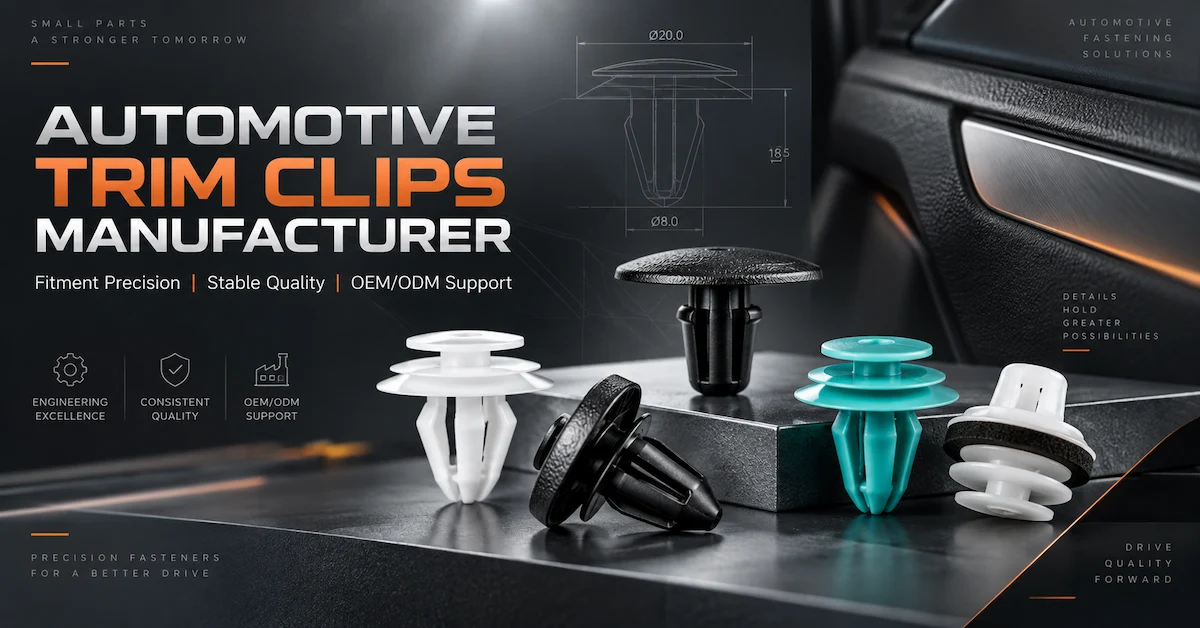
| Trim-panel clips | Locking legs, mating features, visible head or base | Panel fitment, orientation and appearance |
| Screw-base clips/grommets | Screw interface, base geometry, material consistency | Screw compatibility and mounting condition |
| Wheel-arch/molding clips | Molding interface, locking orientation, dimensional accuracy | Actual exterior trim position and environment |
| Mixed clip kits | Individual part accuracy plus counting and packing | BOM, quantity per SKU, identification and refillability |
This comparison also explains why a factory that is strong at producing one simple retainer still needs to demonstrate appropriate process control for a different geometry.
Quality Control Should Follow the Product Through the Factory
Quality control is strongest when it begins before molding and continues through shipment. A buyer evaluating an automotive plastic fastener factory can ask how incoming resin is identified, how tooling and first-piece checks are handled, which dimensions are monitored during production, how appearance defects are controlled, how functional or fitment requirements are verified, and how packaging quantities are checked. Batch or production identification becomes particularly valuable when a distributor later reports an issue because it allows the supplier to trace the affected production rather than treating every shipment as identical. QEEPEI's automotive clip quality-control content can support additional internal-link reading, but for an actual order the inspection method and acceptance requirements should still be defined around the specific SKU.
Do Not Treat Every Certificate as Product Approval
Factory documents can help buyers understand management and compliance systems, but they should not replace product-level verification. When a test report or certificate is relevant to the purchase, confirm the named company, sample identity, test method, date, scope, and relationship to the product being ordered. A raw-material or chemical-compliance document does not automatically prove mounting fit, retention, dimensional accuracy, or service life. Likewise, a company-level quality-system document does not mean every individual clip has passed every possible automotive test. An experienced B2B buyer should separate company qualification, material documentation, product inspection, functional verification, and sample approval so that each piece of evidence is used for the question it actually answers.
Evaluate Production Capacity at SKU Level
General factory capacity can be useful for understanding scale, but purchasing decisions require more detail. Ask whether the selected product is currently available, produced periodically, manufactured only against an order, or requires new tooling. A molded clip that is physically small may still depend on mold availability, resin preparation, machine scheduling, inspection, packaging, and labeling. Custom packaging can create a different lead-time path from a standard bulk pack. An automotive plastic fastener factory should therefore separate stock availability, molding schedule, packaging schedule, and dispatch timing when discussing an order. Buyers should also distinguish manufacturing completion from shipment and shipment from arrival. This prevents broad statements about factory capacity or delivery speed from being converted into an unrealistic promise for every SKU and order condition.
Compare Factory Cost Through the Whole Order, Not Only Piece Price
Piece price is important, but the factory's commercial value also depends on what happens when the product enters the buyer's warehouse and customer's vehicle. Wrong fitment can create returns; inconsistent dimensions can cause workshop complaints; poor SKU identification can cause picking mistakes; incorrect kit counts can produce resale problems; and undocumented changes can make repeat orders difficult to troubleshoot. When comparing quotations from different factories, use the same specification, material requirement, quantity, packaging, inspection criteria, delivery basis, and approval scope. Tooling charges, trial samples, custom labels, assortment packing, and freight should be separated where relevant. The lowest unit price may not remain the lowest total sourcing cost if the buyer must repeatedly sort, remeasure, relabel, or replace products.
Distinguish Standard Production, Packaging Customization, and OEM/ODM Development
“Custom automotive fastener” can describe several very different projects. Using an existing clip with a customer's label or retail box is primarily a packaging project. Changing the quantity of each clip in a kit is an assortment configuration project. Changing the material or geometry can affect the approved product specification. Creating a new clip from a sample or drawing may require engineering review, mold development, trial molding, sample approval, revisions, and controlled mass production. Buyers discussing a project with an automotive plastic fastener factory should identify the required level before requesting pricing. QEEPEI's wholesale page can be used to discuss standard bulk supply and customization, while more complex development should begin with detailed technical information rather than only an expected purchase price.
What Should Buyers Confirm for a New Mold Project?
For new-product development, the starting information should include the retained component, mounting-hole geometry, panel thickness, desired clip structure, existing sample or drawing, material requirement, operating environment, expected quantity, and known problem with the current solution. Buyers should also clarify which party controls drawing revisions, how samples will be approved, what constitutes a tooling modification, and whether subsequent material or geometry changes require renewed approval. Mold ownership, maintenance responsibilities, storage conditions, and future production rights may also matter commercially and should be agreed rather than assumed. A clear development record makes it easier for both sides to distinguish engineering changes from ordinary production adjustments.
Use a Factory Audit Scorecard Before Approving Bulk Supply
A simple scorecard helps different purchasing-team members evaluate the same factory consistently.
| Audit Area | Questions for the Buyer |
|---|---|
| Product definition | Can the factory work from controlled SKUs, drawings or samples? |
| Material | Is the required resin clearly identified and change-controlled? |
| Tooling | Are molds, revisions and critical geometry controlled? |
| Molding | Is there a defined process from first piece to stable production? |
| Dimensional QC | Are application-critical features identified and measured? |
| Functional verification | Can relevant installation or fitment checks be performed? |
| Traceability | Can a later issue be linked to a production batch or record? |
| Packaging | Are SKU, quantity, labels and assortment contents controlled? |
| Change management | Must important changes be communicated and reapproved? |
| Repeat supply | Can the factory reproduce the accepted product on later orders? |
The point is not to give every factory an arbitrary numerical score. The scorecard is most useful for exposing unanswered questions before the purchase order becomes large.
How Should Buyers Prepare an RFQ for an Automotive Plastic Fastener Factory?
A good RFQ gives the factory enough information to determine whether an existing product, modified product, or new development is appropriate. For an existing fastener, provide the supplier model or reference number if known, installation position, vehicle information where relevant, photographs, critical dimensions, quantity, packaging, destination, and any inspection requirement. For an unidentified replacement, add clear front, side, and locking-feature photographs and the mounting-hole information. For a new molded component, send the drawing or physical sample, panel and hole interface, material requirement, expected volume, target application, and known problem that the design is intended to solve. Buyers can first browse QEEPEI's automotive clips and fasteners and then use the Contact Us page to submit a structured project brief.
Frequently Asked Questions
1. What should I check first when selecting an automotive plastic fastener factory?
Start with product definition and application fit. Confirm whether the factory can understand the mounting interface, critical dimensions, clip structure, material, and approval requirements before comparing equipment, capacity, or price.
2. Why is mold accuracy important for plastic automotive fasteners?
The mold forms the locking legs, ribs, stems, heads, expansion structures, and other features that determine how the fastener interacts with the vehicle panel. Variation in those features can affect installation and fitment.
3. Is injection molding equipment enough to prove factory capability?
No. Equipment indicates potential manufacturing capability, but buyers should also evaluate mold control, material management, process stability, inspection, sample approval, packaging, and repeat-order control.
4. Which materials are used for automotive plastic fasteners?
PA, PP, and POM are among the material families used in automotive clip applications, but the appropriate material depends on the specific geometry, grade, environment, and performance requirement. Material should be confirmed by SKU.
5. Should buyers test samples before bulk production?
Yes, particularly when fitment is important or the clip is newly developed. Sample approval should reference the actual product specification and, where possible, a representative mounting interface.
6. How can buyers check whether repeat orders match the approved product?
Keep a controlled record containing the supplier SKU, drawing or dimensional reference, approved sample, material, packaging, application information, and revision status. Reference this record in subsequent purchase orders.
7. What defects should an automotive fastener factory inspect?
The relevant defects depend on the product, but buyers commonly need to control dimensions, flash, incomplete molding, deformation, damaged locking features, appearance, incorrect quantities, and packaging identification.
8. Is private-label packaging the same as OEM/ODM development?
No. Applying a logo or label to an existing product is a different project from changing an assortment, altering the fastener specification, or developing a new molded component and tool.
9. What should I provide for a custom plastic fastener quotation?
Provide drawings or samples, application information, mounting-hole details, panel thickness, required material, expected quantity, packaging requirements, and the problem the new fastener is intended to solve.
10. Where can I discuss a QEEPEI factory or custom fastener project?
Review the company's About Us and product range, then submit the product reference, sample, drawing, application, quantities, and packaging requirements through QEEPEI Contact Us for project-specific evaluation.
Conclusion
Selecting an automotive plastic fastener factory requires more than checking catalog size, machinery, or unit price. For B2B buyers, the stronger evaluation is whether the factory can convert an application into a controlled specification, manage the correct resin and tooling, maintain critical molded geometry, connect sample approval with mass production, inspect the characteristics that affect fitment, control packaging, and reproduce the approved product during repeat orders. These controls are especially important for distributors, repair suppliers, e-commerce sellers, and private-label brands managing many visually similar plastic fasteners across different vehicles and installation positions.
QEEPEI's product system includes automotive body clips, vehicle-specific clips, clip kits, and related fastening solutions for B2B sourcing. Buyers evaluating an automotive plastic fastener factory can explore the QEEPEI product catalog, review its manufacturing-related information, learn more about injection molded car clips, or contact QEEPEI with samples, drawings, dimensions, quantities, and packaging requirements for product matching or custom project evaluation.