
B2B Sales Auto Clip Set: Streamlining Supply Chains for Automotive Distributors
In today’s global automotive aftermarket, speed and reliability define success. Distributors and manufacturers alike rely on efficient fastening systems to support production and repairs. The B2B sales auto clip set model introduces an optimized way for large buyers to manage clip inventories—reducing sourcing costs and ensuring that every delivery meets OEM precision. QEEPEI stands at the center of this transformation, offering standardized clip sets designed for scalability and long-term business collaboration.
Industry Pain Points: Why B2B Buyers Struggle with Clip Procurement
Many distributors still depend on fragmented suppliers and outdated procurement methods. This leads to:
-
Stock inconsistency: Delays due to fluctuating vendor availability.
-
Lack of uniform quality: Incompatible clips across brands.
-
Complex order management: Handling hundreds of SKUs from different sources.
-
High shipping costs: Repeated small-batch orders.
-
Limited technical support: Absence of OEM specifications or testing data.
A McKinsey Automotive Supply Chain Report (2024) found that 40% of B2B distributors could reduce procurement overhead by centralizing fastener sourcing under a single certified supplier.
Technical Principle: The Standardization Logic Behind Clip Sets
The concept of a “clip set” is built on component consolidation and OEM interchangeability.
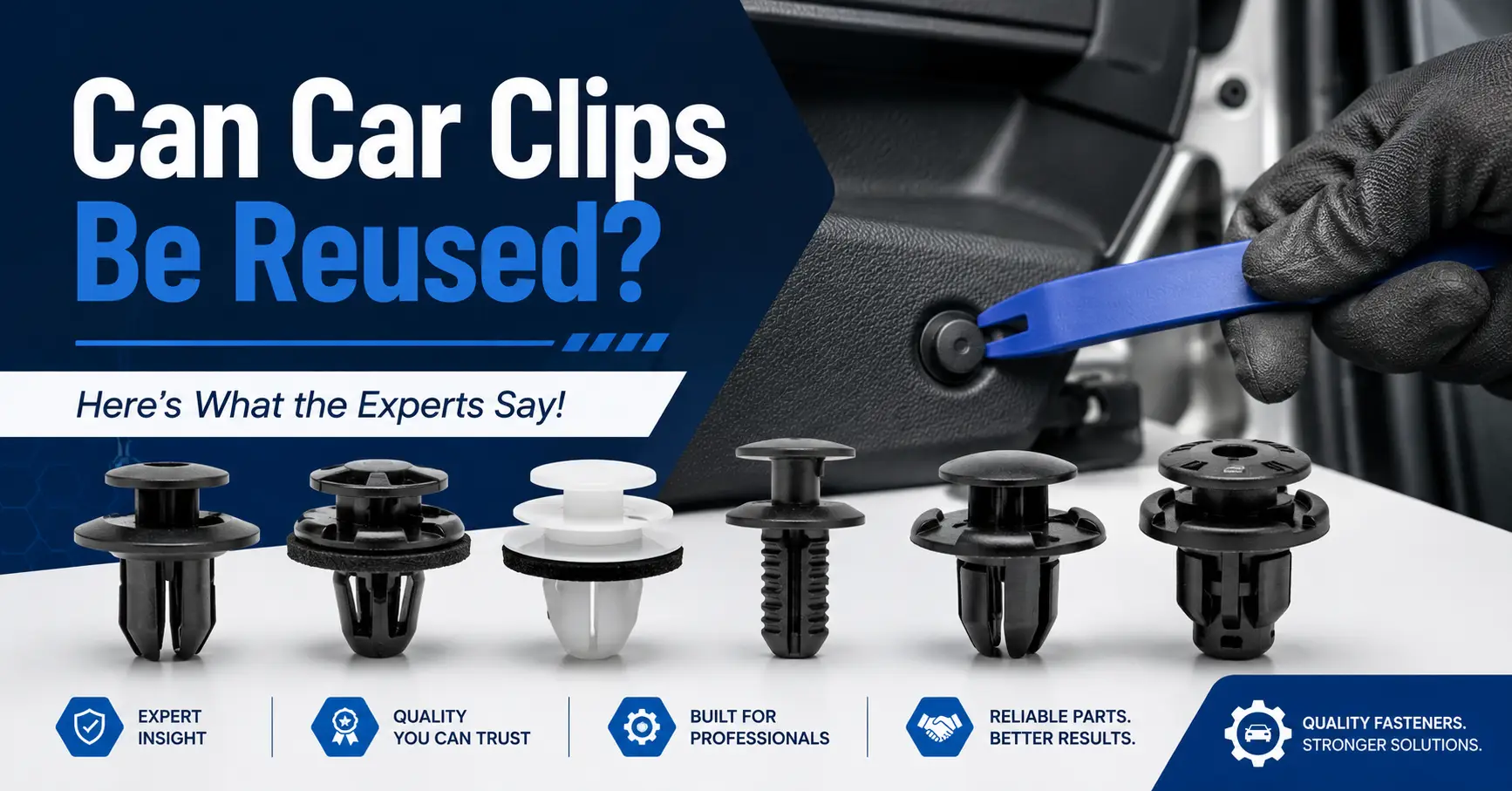
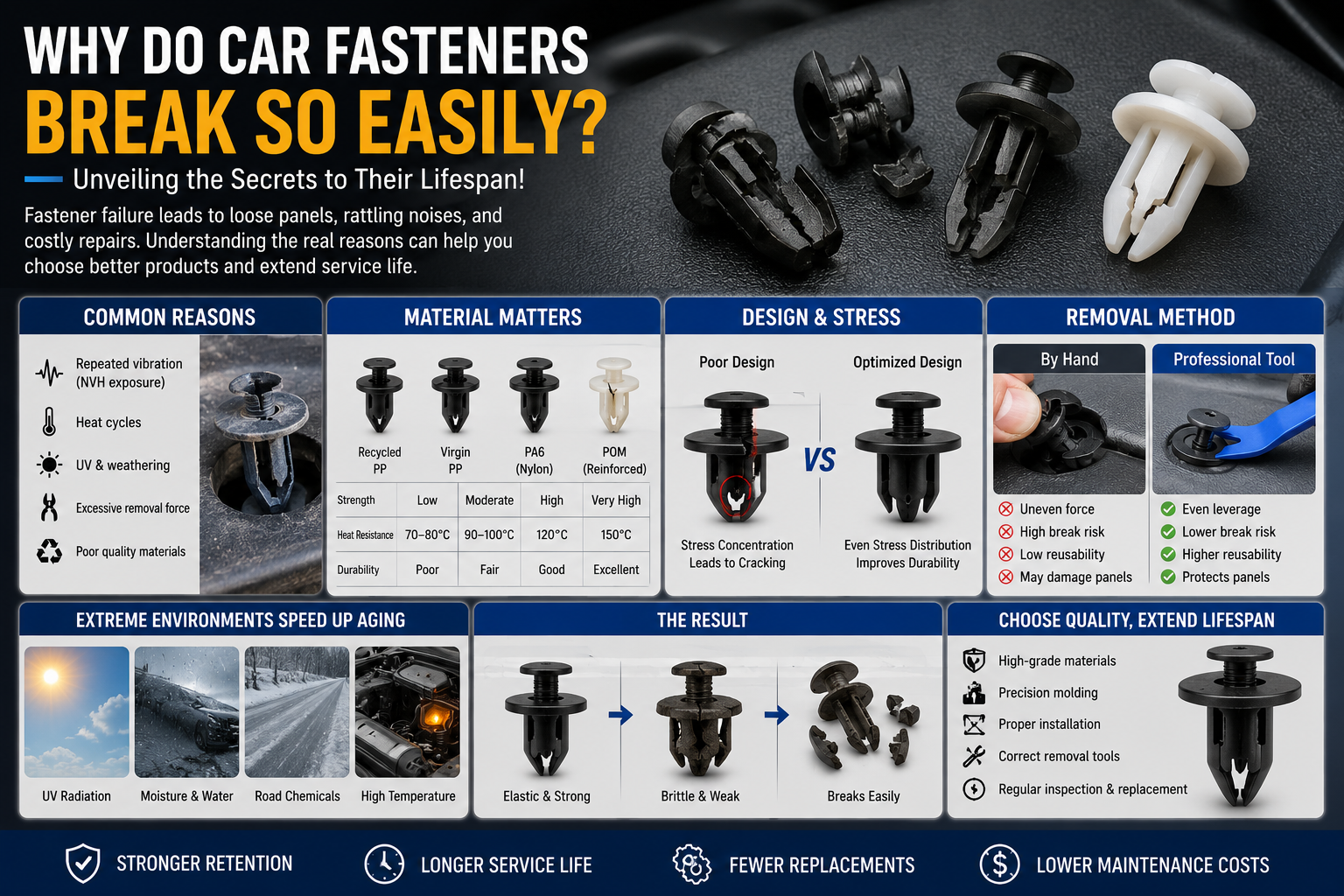
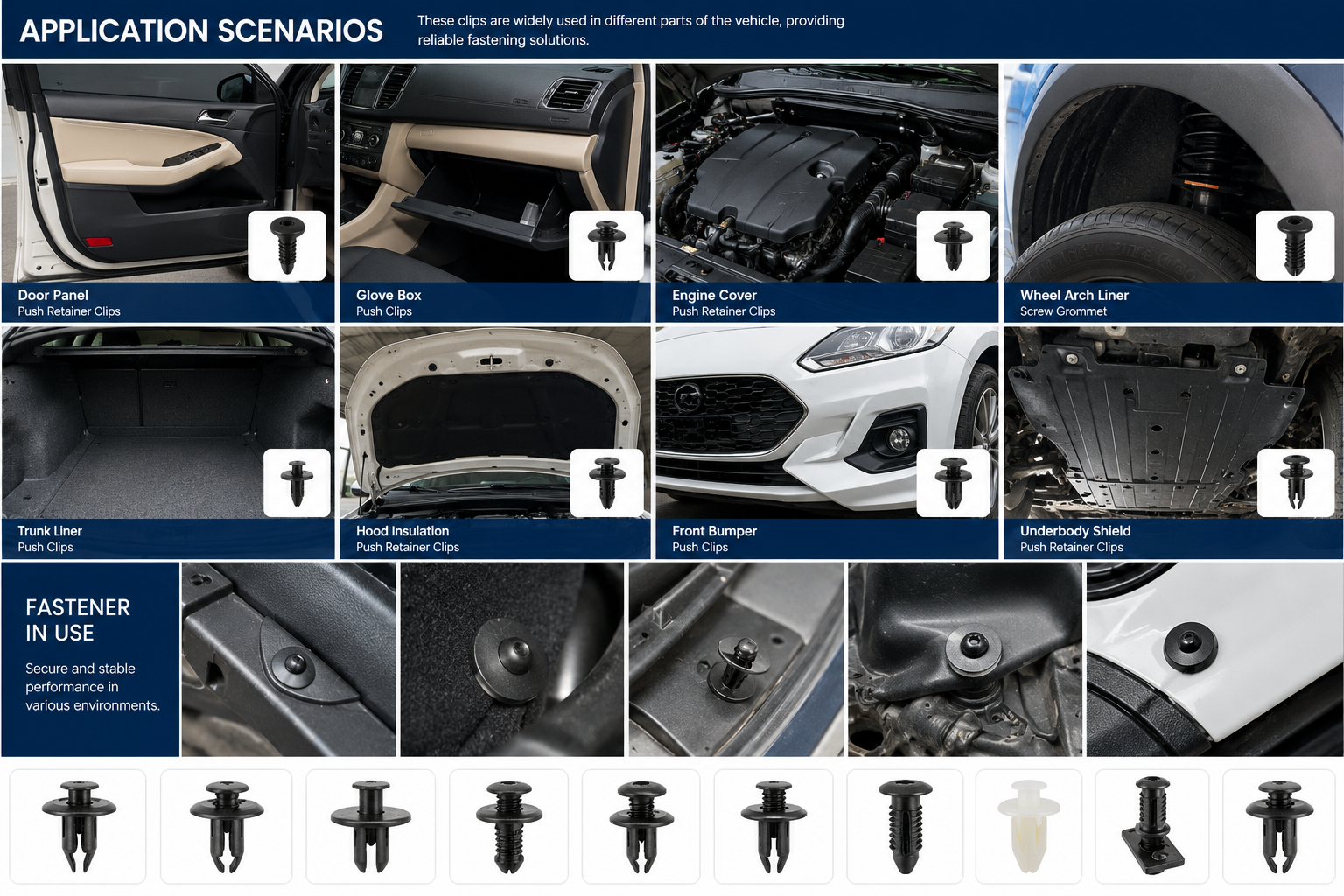
Each kit includes a curated assortment of automotive clips, designed according to SAE J2044 standards for plastic fasteners and retention systems.
| Clip Type | Function | Material | Fitment Range | OEM Tolerance |
|---|---|---|---|---|
| Trim Clip | Interior panel retention | PA6 | Multi-brand | ±0.03 mm |
| Push Rivet | Universal attachment | PP | Door & fender | ±0.05 mm |
| Screw Grommet | Mechanical coupling | POM | Engine bay | ±0.02 mm |
| Retainer Clip | Fixed mount | PA66 + GF | Bumper & skirt | ±0.03 mm |
These sets simplify B2B distribution by offering a predictable range of standardized clips that meet the needs of over 90% of passenger and commercial vehicles.
Comparison: Individual Sourcing vs. B2B Auto Clip Sets
| Parameter | Individual Sourcing | QEEPEI B2B Clip Set Model |
|---|---|---|
| Order Volume | Small, frequent | Bulk consolidated orders |
| Quality Variation | High | OEM-controlled |
| Packaging | Unlabeled | Private label or neutral |
| Cost Efficiency | Low | Up to 30% cost reduction |
| Logistics Management | Decentralized | Centralized with predictive planning |
By shifting to a B2B clip set system, buyers eliminate redundancy, simplify inventory, and gain measurable cost control.
QEEPEI’s Integrated B2B Clip Supply System
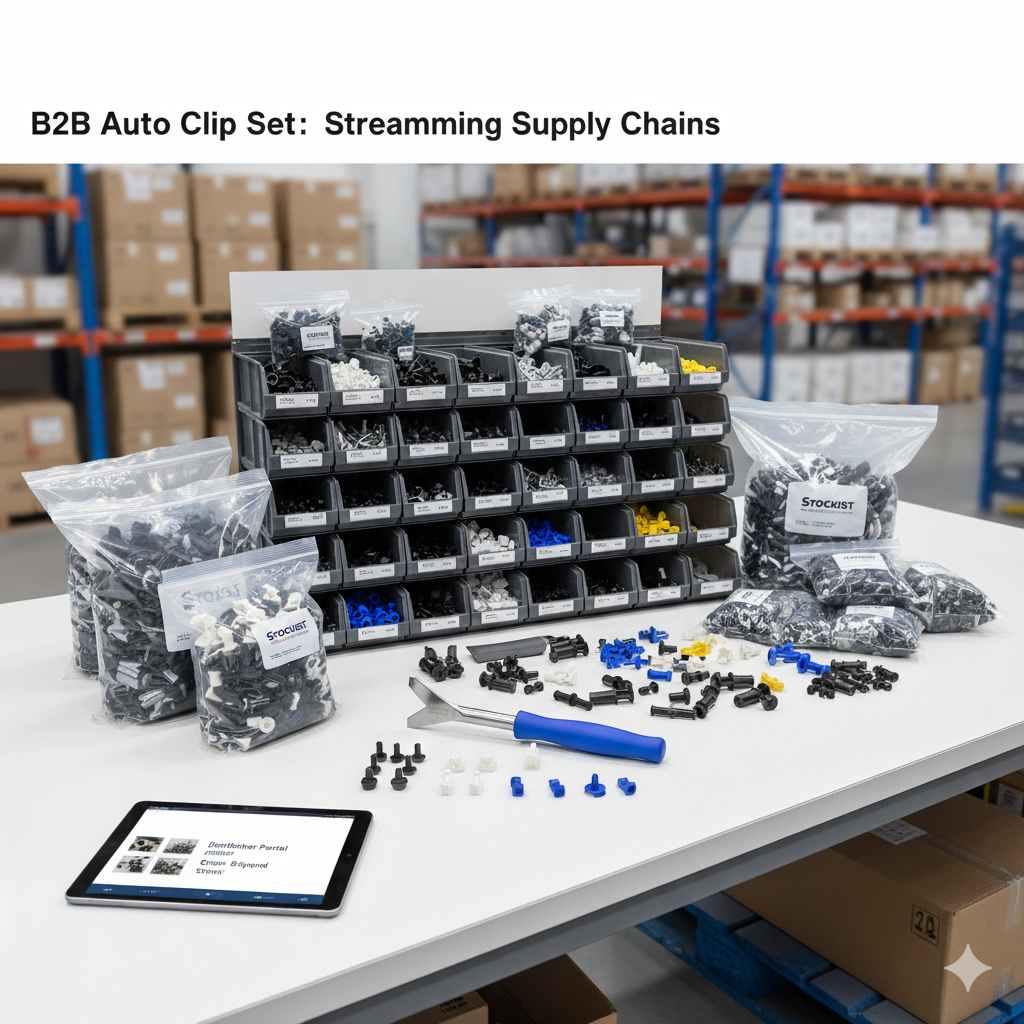
QEEPEI offers a closed-loop supply model covering design, molding, packaging, and export logistics:
-
OEM Database Integration: 2,000+ clip models mapped to major car brands.
-
Bulk Production Capacity: Over 1.2 million clips/month.
-
Material Verification: PA, PP, and POM polymers certified under ISO9001/IATF16949.
-
Customized Packaging: Barcode, SKU, and logo labeling for distributors.
-
Logistics Coordination: Multi-SKU container shipment with digital tracking.
This process ensures high visibility and control for every order cycle—reducing both lead time and waste.
Key Advantages for B2B Buyers
-
Standardized Inventory: Consistent specifications for multi-brand servicing.
-
Cost Predictability: Stable unit prices with long-term contracts.
-
Technical Transparency: Full documentation and QC data included.
-
Private Label Potential: Supports regional branding for distributors.
-
Global Export Compliance: CE, RoHS, and customs documentation provided.
Every B2B partnership with QEEPEI becomes a strategic alliance rather than a one-time transaction.
Real-World Application Scenarios
| Buyer Type | Primary Use | Key Benefit |
|---|---|---|
| Regional Distributors | Supply to workshops | Simplified inventory & logistics |
| OEM Partners | Assembly support | Consistent part compatibility |
| Fleet Maintenance Firms | Preventive service | Ready-to-use clip kits |
| E-commerce Retailers | Online fulfillment | High-volume SKU alignment |
These cases demonstrate how integrated clip sets reduce procurement complexity while sustaining operational speed.
Selection Strategy for B2B Buyers
-
Identify Market Segment: Determine if your clients are OEM workshops or aftermarket garages.
-
Evaluate Usage Frequency: Choose clip sets based on top 50 selling SKUs.
-
Plan Inventory Refill Cycle: Monthly or quarterly replenishment via bulk order.
-
Review Packaging Standards: Align labeling with your local retail system.
-
Confirm Quality Assurance: Ensure each batch includes tensile and thermal test reports.
| Kit Type | Clip Variety | MOQ | Ideal Buyer |
|---|---|---|---|
| Standard Set | 150 types | 5,000 sets | General distributors |
| Professional Set | 250 types | 3,000 sets | OEM and fleet buyers |
| Custom Set | Defined by client | 2,000 sets | Private label programs |
Frequently Asked Questions
Q: Can I request my brand on the packaging?
Yes, QEEPEI provides logo printing and barcode integration for B2B partners.
Q: What are the shipping options for bulk clip sets?
Mixed-SKU container shipments are available, with global tracking and insurance.
Q: How long is the lead time?
Typically 25–35 days, depending on set complexity and volume.
Q: Do you provide testing certificates?
Yes. Each batch includes material reports and SAE conformance documentation.
Conclusion: Scaling Supply Chains Through Smarter B2B Models
The B2B sales auto clip set approach transforms the way distributors manage inventory—reducing complexity while maintaining absolute quality.
With QEEPEI’s OEM-certified systems, large buyers gain a trusted partner for efficient, transparent, and scalable automotive clip supply.
To explore B2B cooperation or request bulk quotations, visit Homepage or contact our team via Contact Us.