
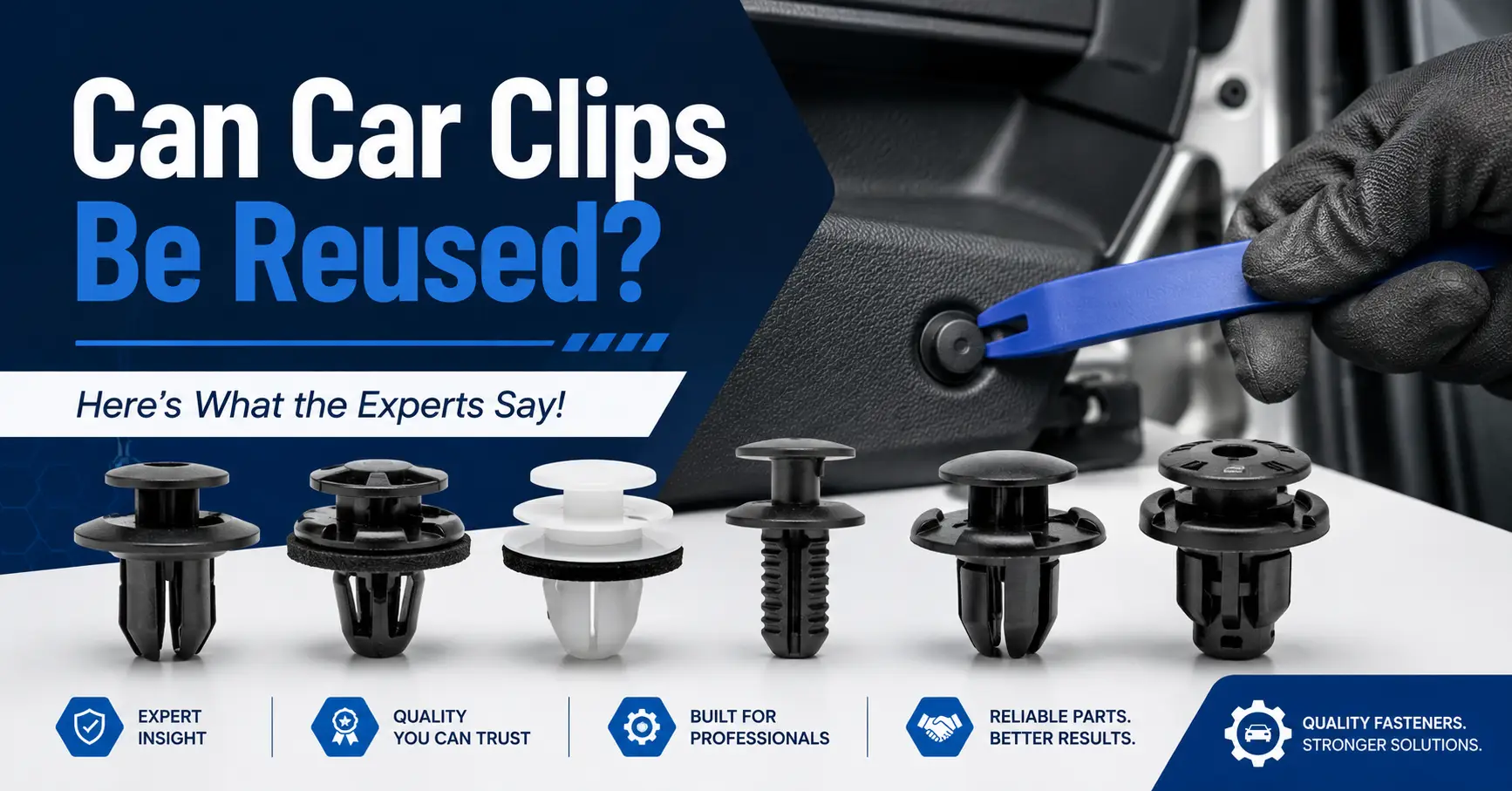
Car clips look small, but they play a big role in keeping bumpers, door panels, fender liners, trim panels, weatherstrips, dashboards, wheel arches, and underbody parts securely attached. For repair shops, auto parts distributors, and DIY maintenance users, one common question comes up again and again: can car clips be reused?
The short answer is: some car clips can be reused if they are removed carefully and remain structurally intact, but many plastic automotive clips should be replaced after removal—especially when they are old, brittle, deformed, or used in high-vibration areas.
For B2B buyers, this is not just a repair question. It affects inventory planning, repair quality, customer satisfaction, return rates, and the type of automotive clips and fasteners you should stock.
Why Car Clips Are Not Always Reusable
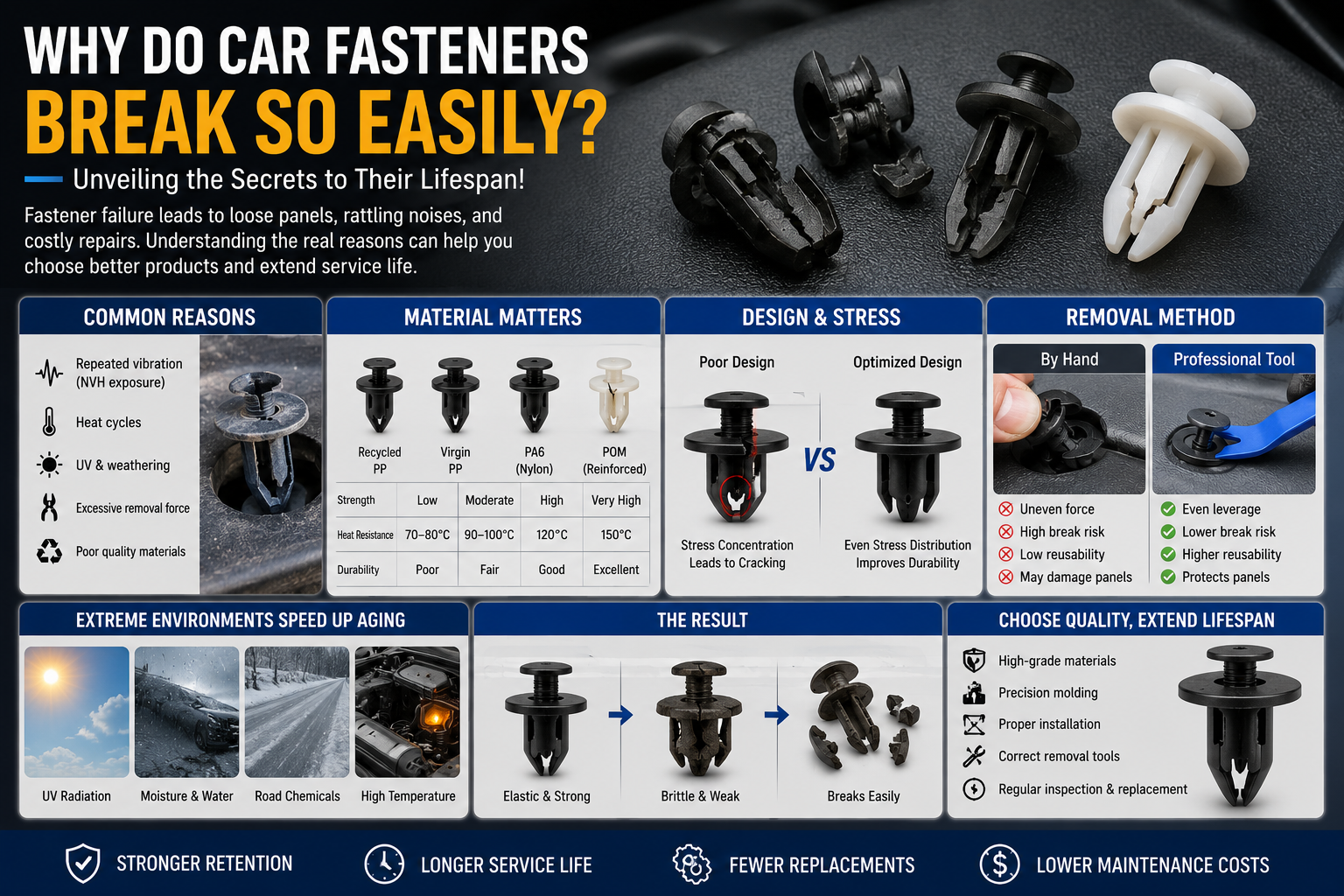
Most car clips are designed to create tension, expansion, or locking force after installation. When a clip is pushed into a hole, its legs expand, bend, or lock behind the panel. This locking force is what keeps the part stable.
However, the same structure that makes a clip hold tightly can also make it difficult to reuse. During removal, the clip may experience:
- Bent or weakened locking legs
- Broken expansion wings
- Cracked heads
- Scratched or stretched stems
- Loss of elasticity
- Material fatigue from heat, cold, or aging
Even if the clip looks acceptable from the outside, its grip strength may already be reduced. A reused clip with weak retention can lead to loose trim, panel vibration, abnormal noise, water leakage, or even part detachment.
That is why professional repair shops often replace plastic car clips during bumper repair, door panel removal, fender liner service, and interior trim work.
When Can Car Clips Be Reused?
Car clips can sometimes be reused when they meet three conditions: they are made from durable material, they were removed with the right tool, and they show no visible damage.
A reusable car clip should have:
| Inspection Point | Reusable Condition |
|---|---|
| Clip head | No cracks, deformation, or missing edge |
| Locking legs | Not broken, bent, or weakened |
| Stem | Not stretched, twisted, or split |
| Material | Still flexible, not brittle |
| Fitment | Can still lock firmly into the hole |
| Application area | Low-stress interior or non-critical trim area |
For example, some interior trim clips may be reused if the vehicle is relatively new and the clip is removed carefully with a proper trim removal tool. But if the clip is used on a bumper, fender liner, wheel arch molding, hood insulation panel, or underbody area, replacement is usually safer.
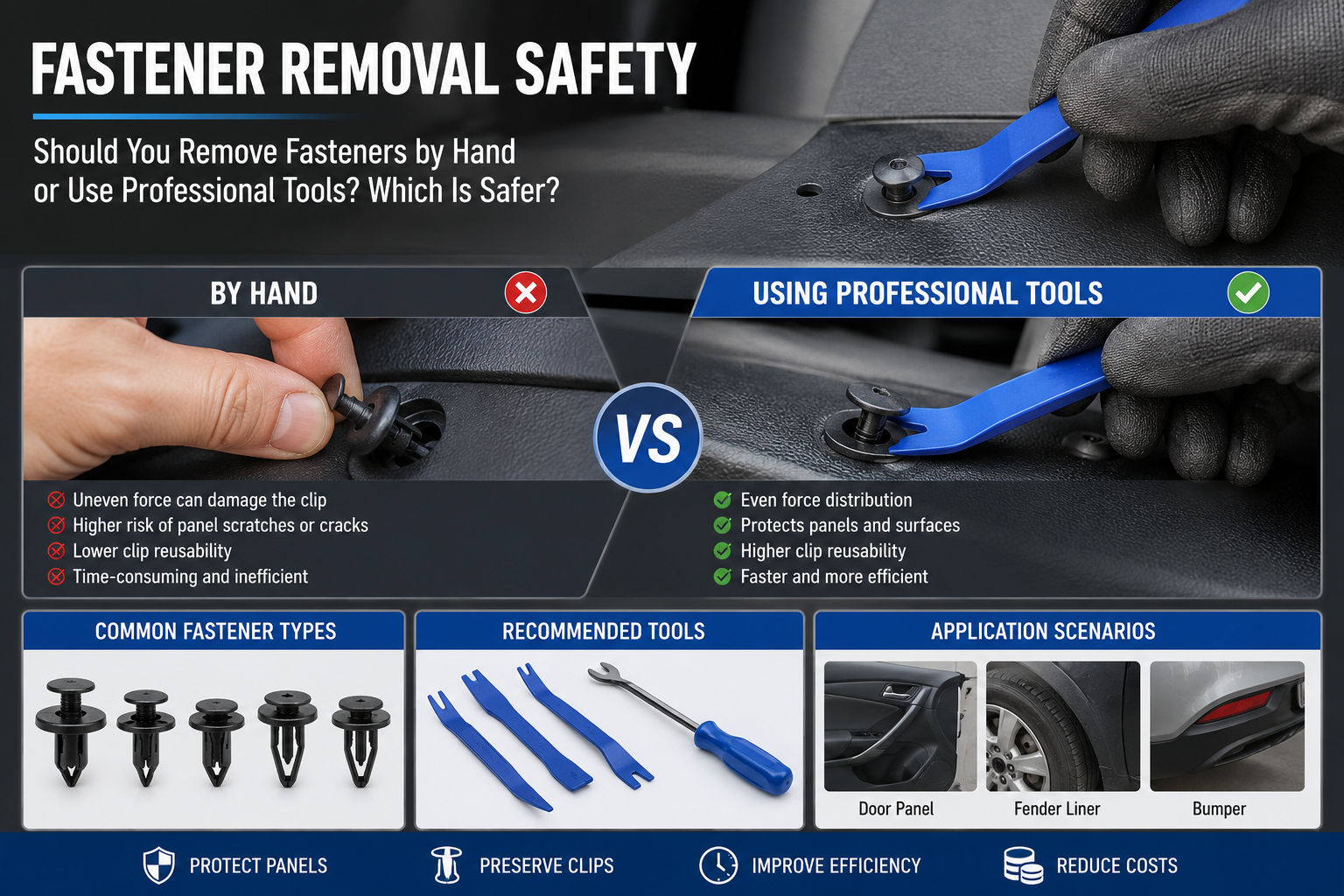
If your team handles frequent trim removal, adding proper car clips tools to your repair workflow can reduce damage during disassembly.
When Should Car Clips Be Replaced?
Car clips should be replaced when they show any sign of structural weakness. This is especially important for professional workshops and distributors who want to avoid customer complaints after repair.
Replace the clip if you notice:
- The clip does not “snap” firmly into place
- The head is cracked or loose
- The legs are bent outward or inward
- The clip feels dry, brittle, or chalky
- The panel still shakes after installation
- The clip was removed from a high-heat or high-vibration area
- The clip has already been reused before
- The vehicle is older and plastic parts have aged
Plastic automotive fasteners are exposed to temperature changes, vibration, moisture, road salt, UV light, and repeated mechanical stress. Over time, even high-quality clips can lose flexibility.
For repair shops, replacing damaged clips is usually cheaper than handling repeat repairs. For distributors, offering complete car clips kits can help customers replace clips immediately instead of trying to reuse worn parts.
Application Areas Where Replacement Is Recommended
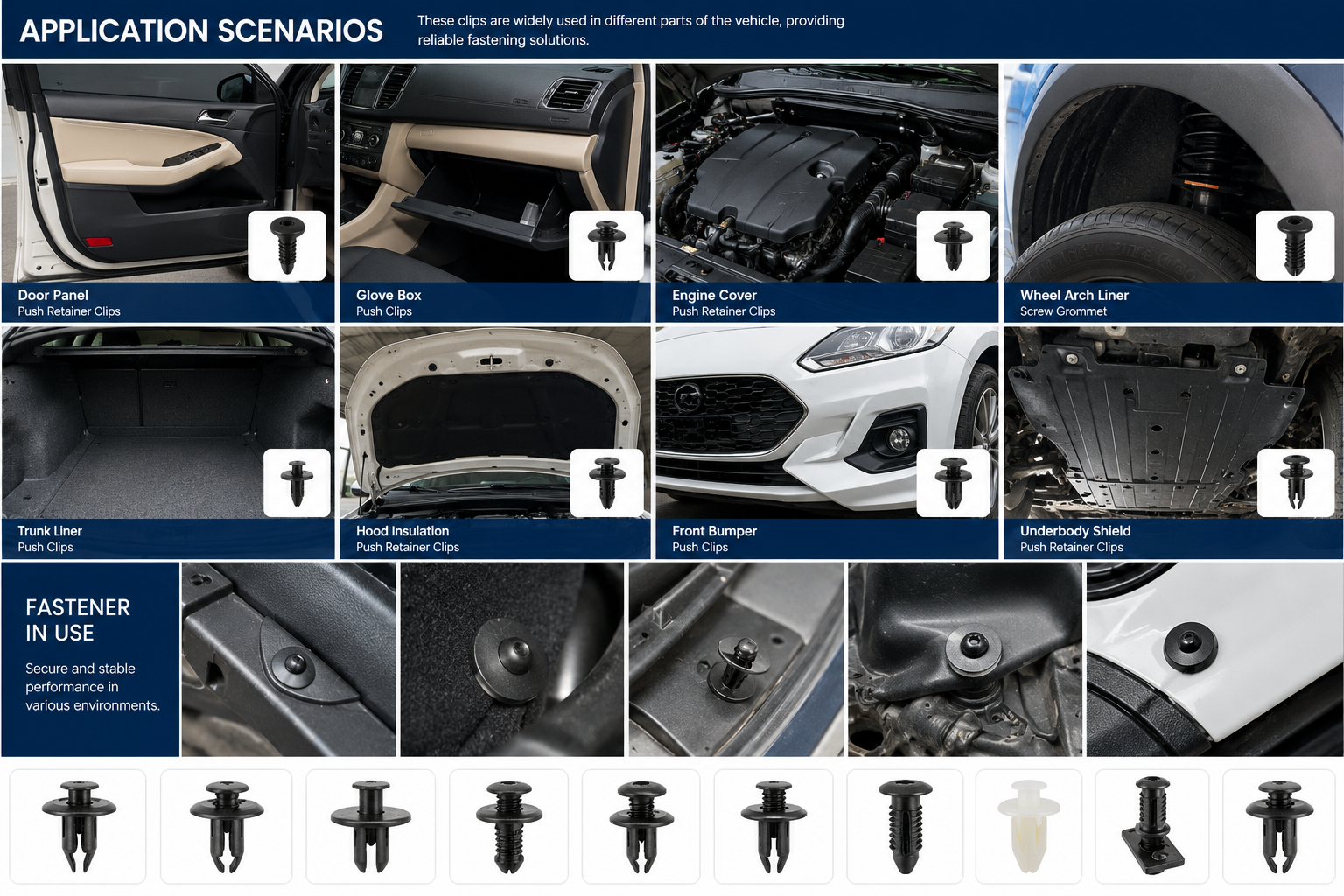
Different areas of the vehicle place different stress on automotive clips. Some clips hold light interior trim, while others must resist vibration, impact, moisture, and temperature changes.
| Vehicle Area | Reuse Risk | Recommendation |
| Door interior panel | Medium | Reuse only if clip is undamaged |
| Dashboard trim | Low to medium | Inspect carefully before reuse |
| Bumper | High | Replace after removal |
| Fender liner | High | Replace if removed during repair |
| Wheel arch molding | High | Replace for secure fitment |
| Hood insulation | Medium to high | Replace if exposed to heat aging |
| Weatherstrip / seal strip | Medium | Replace if sealing is affected |
| Underbody panels | High | Replacement recommended |
| Headliner / ceiling trim | Medium | Reuse only if clip still locks firmly |
| Car light fixture area | Medium | Replace if fitment is loose |
For business buyers, this table can also help with SKU planning. High-replacement areas such as bumper clips, fender clips, wheel arch clips, and inner lining clips should usually be stocked in larger quantities.
Why Material Quality Affects Reusability
The material of a car clip directly affects whether it can survive removal and reinstallation. Low-grade or recycled plastic may become brittle faster, especially under heat and vibration. Better material selection improves flexibility, impact resistance, and long-term durability.
Common materials include:
| Material | Typical Advantage | Common Use |
| PA Nylon | Strong, flexible, wear-resistant | Bumper clips, trim clips, push retainers |
| PP | Lightweight and cost-effective | Interior and light-duty clips |
| POM | Good dimensional stability | Precision fasteners and locking parts |
| Mixed PA/POM | Balanced strength and stability | Assortment kits and repair sets |
For professional buyers, the key question is not only “can this clip be reused?” but also “will this clip keep its holding force after installation?” This is where material quality, mold precision, and dimensional control become important.
QEEPEI focuses on automotive clips, plastic fasteners, and vehicle-specific clip solutions. You can explore different clip categories on the QEEPEI Products page based on vehicle position, model fitment, or repair application.
Why Reusing Bad Clips Causes Bigger Problems
Reusing a damaged clip may seem like a small cost-saving decision, but it can create bigger problems later.
A weak clip may cause:
- Interior rattling noise
- Loose bumper corners
- Detached fender liners
- Poor weatherstrip sealing
- Misaligned trim panels
- Customer complaints after repair
- Higher return rates for repair kits
- Extra labor for repeat installation
For repair chains and distributors, this becomes a business issue. A few low-cost clips can affect repair quality, customer satisfaction, and brand trust.
That is why many professional buyers prefer stocking complete car clip assortments instead of relying on reused parts. A well-planned kit allows technicians to replace damaged clips immediately and keep repairs consistent.
How B2B Buyers Should Stock Car Clips
If you are an auto parts distributor, online seller, supermarket buyer, or repair chain operator, car clip reuse behavior should influence your inventory strategy.
Instead of stocking only random universal clips, consider a structured product mix:
| Buyer Type | Recommended Stock |
| Auto parts distributors | Bumper clips, fender clips, door panel clips, universal retainers |
| Repair shops | Mixed car clip kits and trim removal tools |
| Online sellers | Retail-ready car clip assortment kits |
| OEM/ODM brands | Custom clips, private label kits, branded packaging |
| Supermarket buyers | Standardized retail packs with barcode labels |
| Vehicle-specific sellers | Toyota, Honda, Ford, VW/Audi, Nissan, BMW clips |
For distributors and online sellers, specific fit car clips can reduce compatibility guesswork. For retail channels, private label packaging and clear fitment guidance can improve customer trust.
QEEPEI’s Solution for Reliable Clip Replacement
QEEPEI provides automotive fastening solutions for distributors, repair shops, online sellers, automotive brand owners, and supermarket buyers. Instead of only offering single clips, QEEPEI supports buyers with a wider supply chain solution, including product selection, vehicle fitment, bulk supply, kit development, and packaging support.
For buyers who need stable supply, QEEPEI offers:
- Wide automotive clip categories
- Car body clips, clip kits, specific fit clips, and clip tools
- OEM/ODM support for custom clip development
- Packaging options for bulk, retail, and private label sales
- Product matching for different vehicle applications
- Support for distributors, repair chains, online sellers, and brand owners
If you want to understand QEEPEI’s manufacturing and service background, visit the About Us page. For product sourcing or bulk quotation, you can reach the team through the Contact Us page.
Expert Recommendation: Reuse Only After Inspection
So, can car clips be reused?
Yes—but only when they are still flexible, undamaged, and able to lock firmly. In professional repair and B2B supply, replacement is often the better option when clips are old, brittle, deformed, or used in high-stress areas.
The safest rule is simple:
Reuse only when the clip passes inspection. Replace whenever fitment, strength, or sealing may be affected.
For small repairs, this prevents loose panels. For repair shops, it reduces repeat work. For distributors and sellers, it supports better product quality and fewer customer complaints.
FAQ
1. Can plastic car clips be reused after removal?
Yes, some plastic car clips can be reused if they are removed carefully and show no damage. However, clips with cracked heads, bent legs, or weak locking force should be replaced.
2. Should bumper clips be reused?
Usually not. Bumper clips face vibration, impact, weather, and repeated stress. Replacement is recommended after removal, especially for professional repair work.
3. Why do car clips break during removal?
Car clips may break because of aging, low-quality material, improper removal tools, cold temperature, or excessive pulling force.
4. Are nylon car clips better than regular plastic clips?
PA nylon clips usually offer better flexibility, wear resistance, and strength than lower-grade plastic. Material choice depends on the application area and load requirement.
5. What clips should repair shops stock most often?
Repair shops should stock bumper clips, fender liner clips, door panel clips, trim retainers, wheel arch clips, weatherstrip clips, and mixed car clip kits.
6. Can one universal clip fit all vehicles?
No. Universal clips can cover some common applications, but many vehicles require specific hole size, head diameter, stem length, and locking design.
7. How can distributors reduce car clip return rates?
They can reduce returns by offering clearer fitment data, vehicle-specific clip categories, better packaging labels, and complete assortment kits.
8. Are car clip kits better than single clips?
For repair shops and online sellers, kits are often more practical because they include multiple sizes and types for different repair needs.
9. When should I choose specific fit car clips?
Choose specific fit clips when the customer needs replacement clips for a particular brand or model, such as Toyota, Honda, Ford, VW/Audi, Nissan, or BMW.
10. Where can I source automotive clips in bulk?
You can browse QEEPEI’s automotive clip product categories or contact the team through Contact Us for bulk orders, OEM/ODM projects, and packaging customization.
Conclusion
Car clips can sometimes be reused, but replacement is often the safer and more professional choice. A clip may look small, but its performance affects panel stability, repair quality, noise control, sealing, and customer satisfaction.
For B2B buyers, the real value is not only in choosing a low-cost clip, but in building a reliable automotive fastener supply system. With the right material, correct fitment, suitable packaging, and stable inventory support, distributors and repair businesses can reduce risk and improve long-term customer trust.
Explore QEEPEI’s full range of car clips, automotive fasteners, car clip kits, and specific fit clip solutions to support your next sourcing plan.