
Customization Car Door Trim Clip: Tailored Fastening for Every Vehicle Design
Automotive interiors are evolving faster than ever — thinner panels, complex geometries, and lightweight materials now define modern vehicle design.
For OEMs and suppliers, customized car door trim clips have become essential to ensure every panel fits precisely while maintaining long-term structural stability.
That’s why manufacturers like QEEPEI invest in engineered clip customization that integrates seamlessly into each vehicle’s assembly process.
Design Pain Points in Standard Door Trim Clips
Automakers and suppliers encounter several recurring issues when using generic clips:
-
Poor alignment between trim panels and inner steel frames.
-
Inconsistent pull-out strength due to mixed materials or inadequate geometry.
-
Rattling noises from panel looseness after temperature or humidity changes.
-
Limited compatibility when one design must fit multiple car models.
-
Time-intensive rework during manual assembly line adjustment.
These problems drive the shift toward clip customization — where each design matches the unique thickness, shape, and pressure load of specific car door assemblies.
How Custom Clips Enhance Door Trim Integration
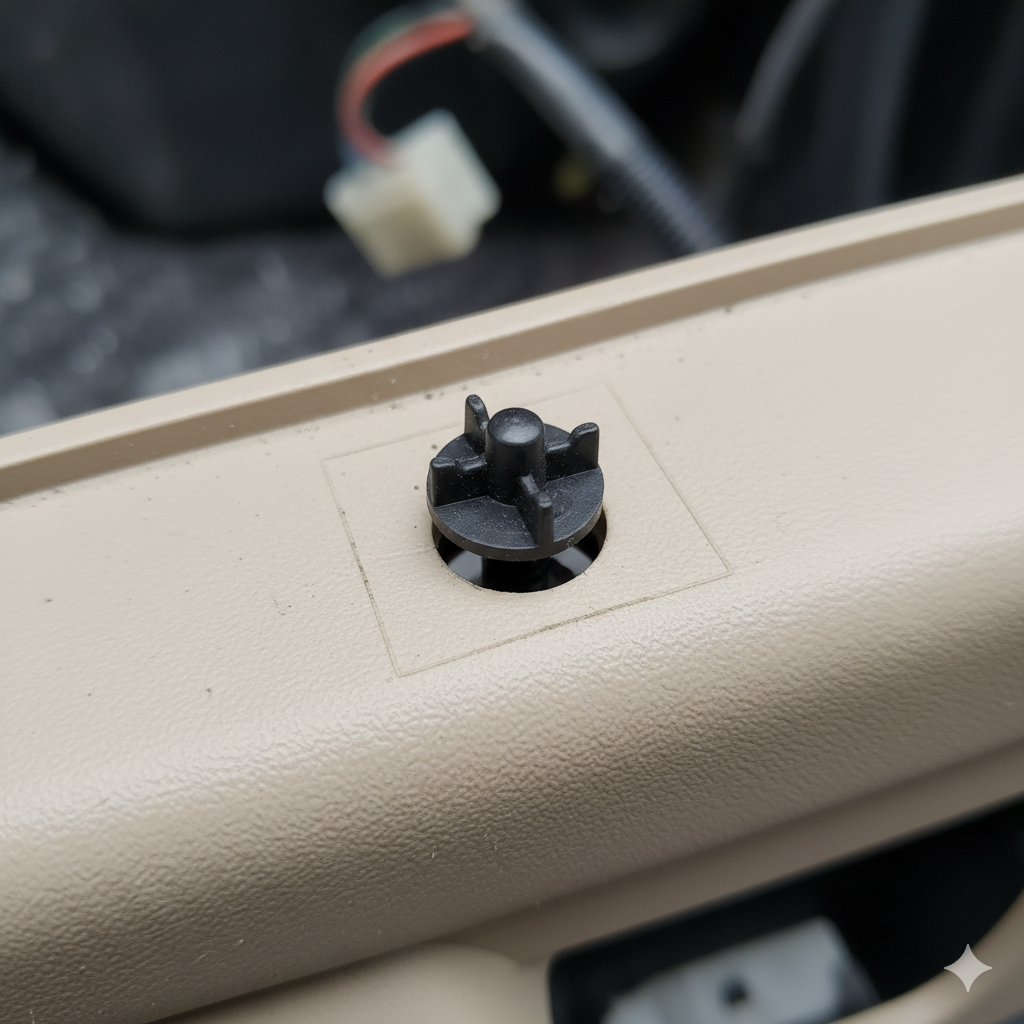
A door trim clip is not just a small plastic piece — it is a structural connector that balances compression and flexibility.
Customized clips optimize this balance through targeted design variables:
| Design Parameter | Function | Customization Impact |
|---|---|---|
| Head Diameter | Panel compression control | Adjusts trim tension and prevents deformation |
| Anchor Length | Lock depth into frame hole | Matches steel panel thickness for tight fit |
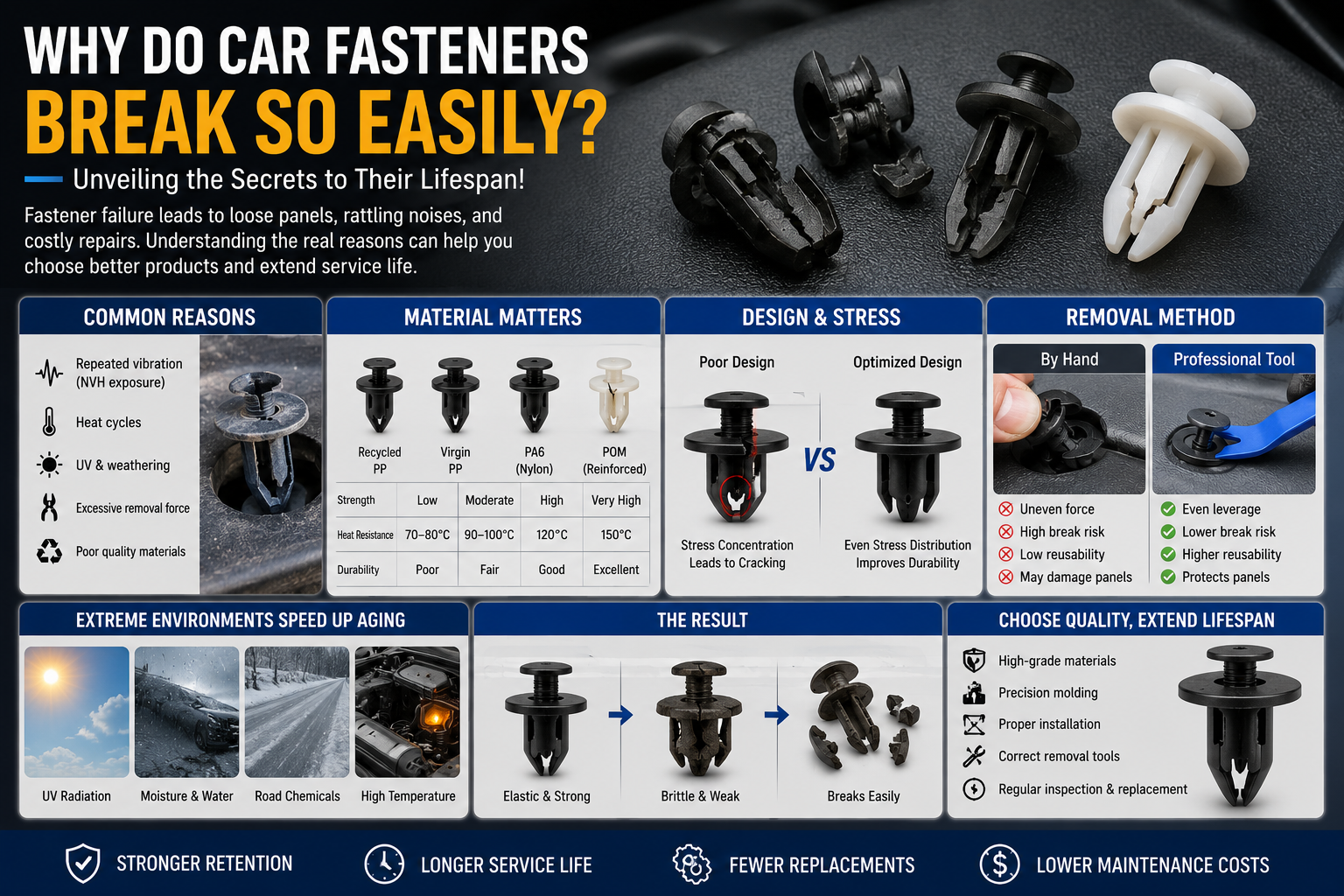
| Material Composition | Elastic performance | Adapts to different temperature zones |
| Flange Shape | Ease of installation | Reduces assembly force and noise |
| Coating & Color | Visual or anti-scratch needs | Matches interior aesthetic and surface friction |
Each adjustment ensures precise interaction between trim and metal, reducing stress points and preventing long-term wear.
Standard vs. Customized Door Trim Clips
| Feature | Standard Clip | Customized Clip |
|---|---|---|
| Fitment Accuracy | ±0.10 mm | ±0.03 mm |
| Pull-Out Strength | Generic testing | Model-specific validation |
| Material Type | Single polymer | Optimized blend (PA6, POM, PP) |
| Noise Damping | Minimal | Integrated cushion layer |
| Assembly Speed | Standard force | Reduced by 20–30% |
Customization allows automakers to save installation time and reduce vibration failures — a key advantage in premium interior production.
QEEPEI’s Tailored Solutions for OEM Partners
QEEPEI delivers a comprehensive clip customization process from concept to production:
-
3D CAD Simulation: Virtual geometry testing based on client door frame data.
-
Prototype Sampling: CNC-cut pilot molds within 10 working days.
-
Performance Validation: Thermal aging, tensile, and noise resistance tests.
-
Mold Optimization: Iterative tool tuning for repeat accuracy.
-
Mass Production: Automated injection molding with quality traceability codes.
This workflow ensures design precision while meeting regional OEM standards such as ISO9001 and IATF16949.
Key Advantages of Custom Door Trim Clips
-
Vehicle-Specific Fitment: Each clip is adapted to the brand’s door geometry.
-
Material Flexibility: Nylon, POM, and PP available for specific environments.
-
Reduced NVH (Noise, Vibration, Harshness): Integrated rubber dampers reduce cabin noise.
-
Improved Assembly Efficiency: Quick-fit structures reduce manual labor effort.
-
Aesthetic Alignment: Color-matched finishes for exposed interior sections.
These features help OEMs meet both mechanical performance and visual quality requirements.
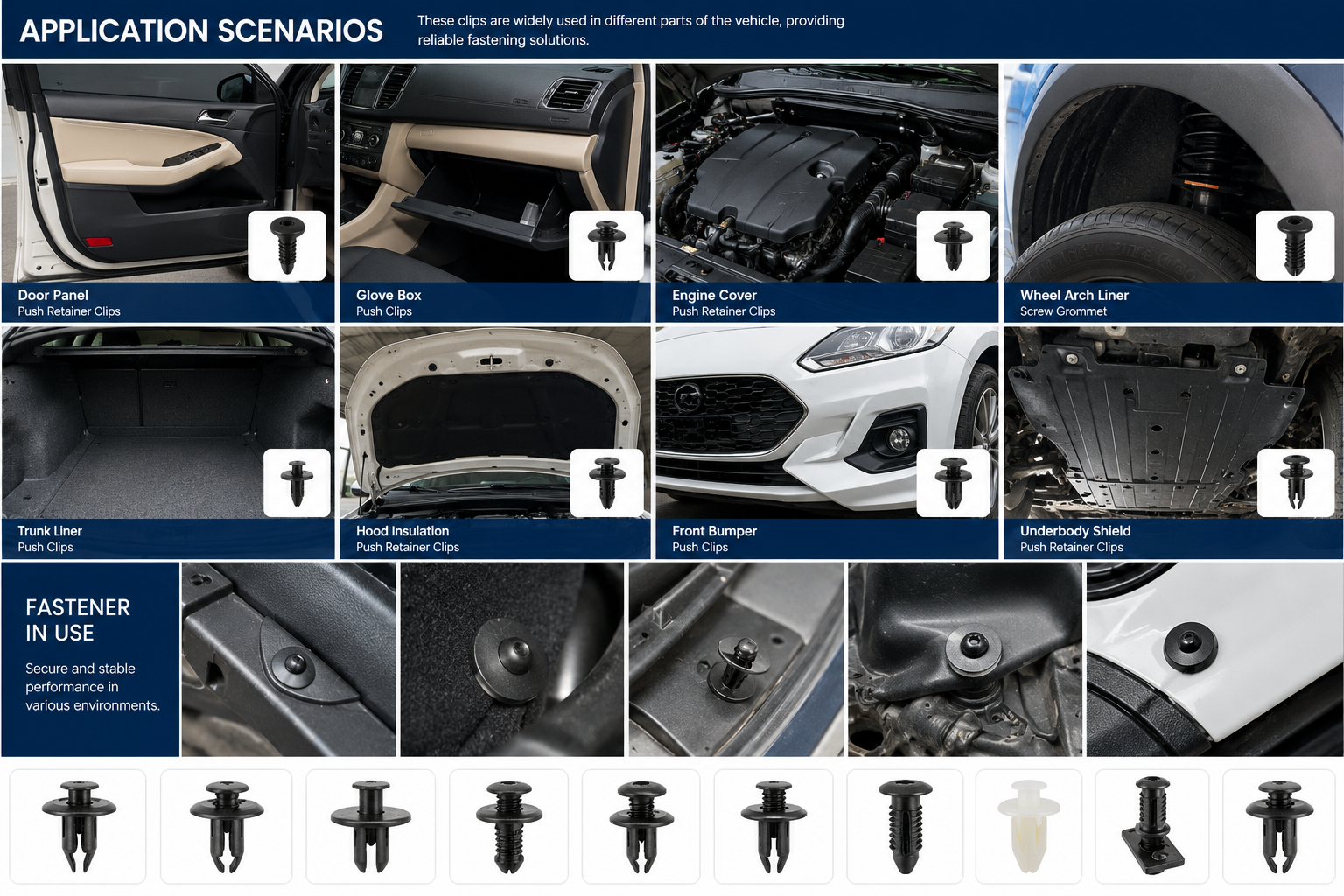
Real-World Application Scenarios
| Application Area | Common Vehicle Type | Recommended Clip | Key Benefit |
|---|---|---|---|
| Front Door Panel | Sedans (Toyota, Honda) | Soft-lock POM clip | Reduced noise |
| Rear Door Trim | SUVs (Volkswagen, Ford) | Deep-lock PA66 clip | Enhanced grip |
| Luxury Models | BMW, Lexus | Coated decorative clip | Scratch-free finish |
| Commercial Vehicles | Pickup and vans | Reinforced nylon clip | Long-term durability |
| EV Models | Tesla, BYD | Lightweight PA6-GF blend | Heat and vibration resistance |
Such diversity in materials and geometry highlights why customization is now the industry standard.
Selection Guide: Choosing the Right Trim Clip Configuration
-
Measure Door Frame Thickness: Ensure anchor length matches tolerance range.
-
Assess Environmental Conditions: Hot climates require UV-stable PA66.
-
Define Interior Finish: Select coatings or textures that prevent friction.
-
Confirm Installation Angle: Horizontal or vertical alignment affects retention force.
-
Prioritize NVH Performance: For luxury interiors, request double-layered or cushioned designs.
Common Industry Questions with Practical Insights
Q: How do customized clips improve noise reduction compared to generic designs?
Because customized clips are tuned for each vehicle’s material stiffness, they distribute pressure evenly—eliminating the micro-gaps that cause vibration sounds.
Q: What is the minimum order for a new custom design?
QEEPEI’s pilot production begins at 10,000 pcs per model, ideal for OEM testing or regional assembly lines.
Q: Can customized clips support hybrid or electric vehicle applications?
Yes. QEEPEI’s materials are rated for high heat insulation, suitable for EV cabins and battery enclosures.
Q: How long does it take to develop a new custom clip?
The entire process — from 3D modeling to mass production — typically takes 30–45 days, depending on mold complexity.
Building Better Interiors Starts with the Right Clip
Precision, performance, and comfort all depend on fastening that fits perfectly.
With QEEPEI’s customized car door trim clips, automotive brands achieve a perfect balance between assembly efficiency and interior excellence.
Explore our full range of solutions at Homepage or reach our team via Contact Us to start your next customization project.