
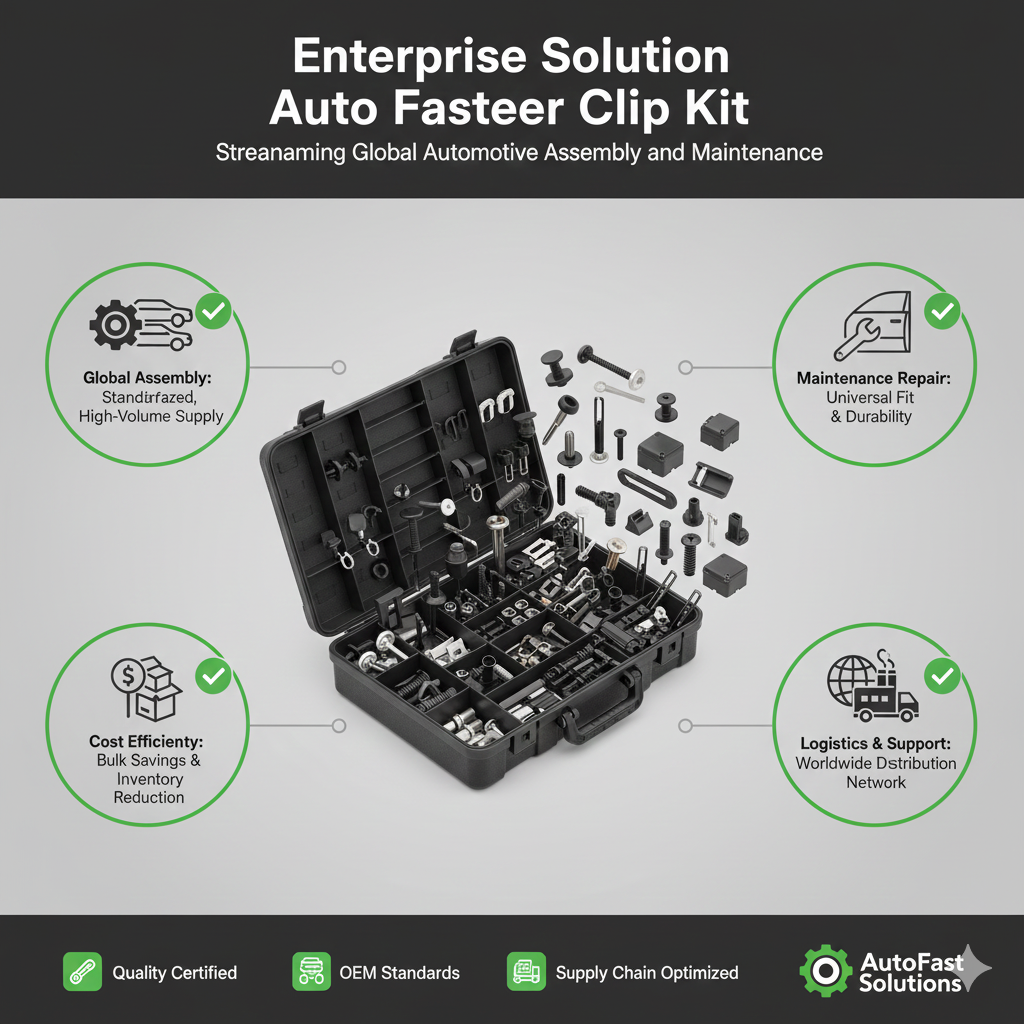
Enterprise Solution Auto Fastener Clip Kit: Streamlining Global Automotive Assembly and Maintenance
In modern automotive manufacturing, the margin for error has disappeared. A reliable enterprise solution auto fastener clip kit gives manufacturers a unified standard for retention strength, compatibility, and packaging across multiple vehicle models. From high-volume OEM production lines to regional after-sales networks, QEEPEI delivers fastening systems designed for scalability, traceability, and long-term reliability.
The Enterprise Challenge: Fragmented Supply and Rising Maintenance Costs
Many global automotive enterprises still manage multiple suppliers for simple fasteners—each with different dimensions, materials, and packaging.
This fragmentation creates recurring problems:
-
Non-interchangeable parts across assembly lines.
-
Increased logistics cost from low SKU standardization.
-
Delayed production caused by clip mismatch.
-
Complex warranty claims for inconsistent components.
According to Automotive Supply Chain Analytics 2025, unstandardized fasteners account for up to 12 % of total assembly downtime in global OEM operations.
How Fastener Clip Kits Solve Systemic Assembly Inefficiencies
An enterprise-grade fastener system unifies design parameters and quality control across the entire value chain.
Key engineering logics include:
-
Geometry Unification – identical clip specifications for door panels, bumpers, and sealing systems.
-
Material Integration – nylon-based compounds resistant to impact and high temperature.
-
Load Consistency – calibrated retention strength between 100–130 N.
-
Dimensional Coding – color and QR labeling for automated recognition.
This structural harmony minimizes variance and enables both robotic assembly and manual service replacement with identical precision.
Traditional Procurement vs. Enterprise Fastener Solutions
| Attribute | Conventional Procurement | QEEPEI Enterprise Solution |
|---|---|---|
| Suppliers | Multiple | Single integrated source |
| Packaging | Mixed bulk cartons | Modular kits by vehicle section |
| Quality Control | Random inspection | Full digital traceability |
| Fitment Accuracy | ±0.10 mm | ±0.03 mm tolerance |
| Lead Time | Unpredictable | Forecast-based production scheduling |
By consolidating sourcing into a unified fastener kit, enterprises cut average procurement complexity by 40 % while improving plant-level interchangeability.
Manufacturing and Material Discipline
QEEPEI applies an industrial-grade process for every enterprise solution auto fastener clip kit:
-
Precision Injection Molding: maintains dimensional uniformity at micron levels.
-
Moisture-Balanced Resin Conditioning: prevents micro-cracking.
-
Tensile Testing: validates load stability under thermal cycling.
-
Automated Sorting: ensures correct part grouping by geometry.
-
Barcode Serialization: provides production-to-installation traceability.
These steps allow global partners to maintain consistent assembly performance, even across different facilities or markets.
Advantages for Automotive Enterprises
-
Operational Standardization – unified clips across platforms minimize assembly errors.
-
Cost Predictability – reduced inventory variation and logistics overhead.
-
Enhanced Serviceability – identical kits for OEM and aftermarket repair.
-
Global Traceability – serialized packaging simplifies warranty audits.
-
Scalable Supply – adaptable to both prototype runs and mass production.
Through this enterprise approach, QEEPEI converts a traditionally low-value component into a core element of operational efficiency.
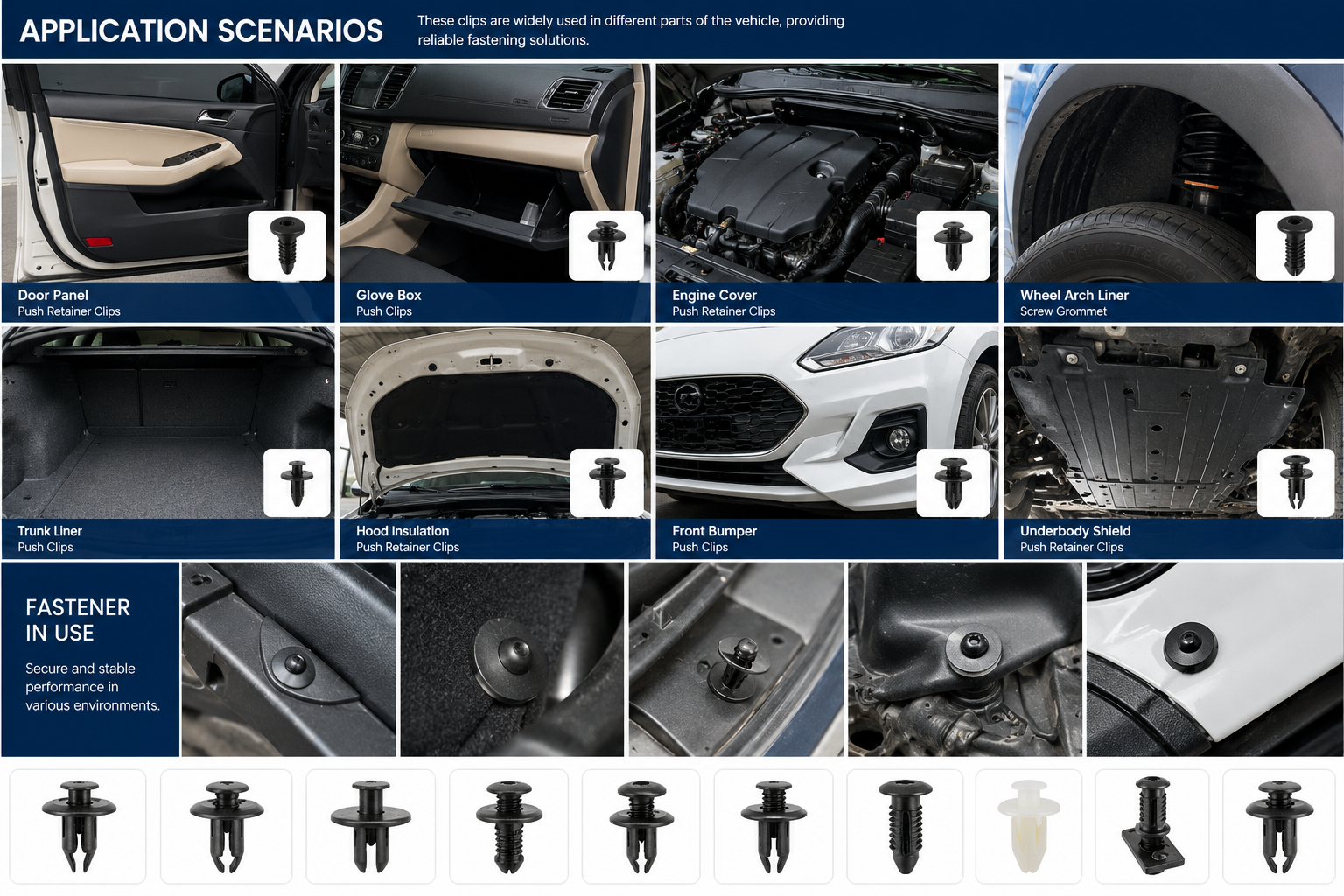
Application Scenarios in the Automotive Ecosystem
| Use Case | Description | Impact |
|---|---|---|
| OEM Production | Unified clips for global model platforms | Faster changeovers |
| Dealer Maintenance | Pre-packed repair kits for specific car series | Reduced service time |
| Fleet Management | Standardized parts for multi-brand fleets | Simplified procurement |
| E-Commerce Distribution | Barcode-ready inventory for online fulfillment | Improved logistics accuracy |
This modular architecture allows enterprises to deploy one fastener standard across manufacturing, distribution, and maintenance.
Selecting the Ideal Enterprise Fastener Kit
When choosing a fastener solution for corporate or OEM integration:
-
Define Assembly Scope: interior, body, or sealing clips.
-
Set Mechanical Requirements: tensile, shear, and torsion targets.
-
Validate Environmental Endurance: UV and chemical exposure.
-
Confirm Labeling Format: part number, QR, and visual code alignment.
-
Request Data Pack: include test reports and 3D CAD compatibility.
Properly specified kits eliminate design ambiguity between suppliers and assembly lines.
FAQ
Q: Can QEEPEI design enterprise kits for multiple OEM brands?
A: Yes. We integrate cross-platform clip compatibility and customized labeling per client specification.
Q: What certifications support these kits?
A: ISO 9001, IATF 16949, and RoHS compliance for all molded components.
Q: Do you offer on-site packaging solutions?
A: For large orders, we provide in-plant packaging stations with automated weighing and labeling systems.
Conclusion: Standardization as a Competitive Advantage
In a supply chain where seconds matter, precision and predictability define success. An enterprise solution auto fastener clip kit unites mechanical reliability with digital oversight, enabling manufacturers to scale production with confidence. With deep expertise and an integrated production model, QEEPEI helps enterprises achieve seamless assembly, cost control, and global part consistency.
To explore customized enterprise fastening systems, visit QEEPEI Homepage or contact our solutions team via Contact Us.