
Global Sourcing Auto Fastener Kit: Building a Reliable Supply Network for Modern Automotive Production
As automotive manufacturing globalizes, sourcing efficiency has become a decisive competitive factor. A standardized global sourcing auto fastener kit bridges the gap between engineering precision and supply chain agility, ensuring every vehicle assembled—whether in Asia, Europe, or Latin America—meets consistent fastening standards. QEEPEI enables that consistency through data-driven manufacturing and global logistics alignment.
The Pain of Disconnected Fastener Supply Chains
Fasteners are often treated as low-priority parts, yet poor sourcing decisions can disrupt entire production cycles:
-
Mismatched clip dimensions lead to rework or scrap.
-
Shipping delays halt assembly lines.
-
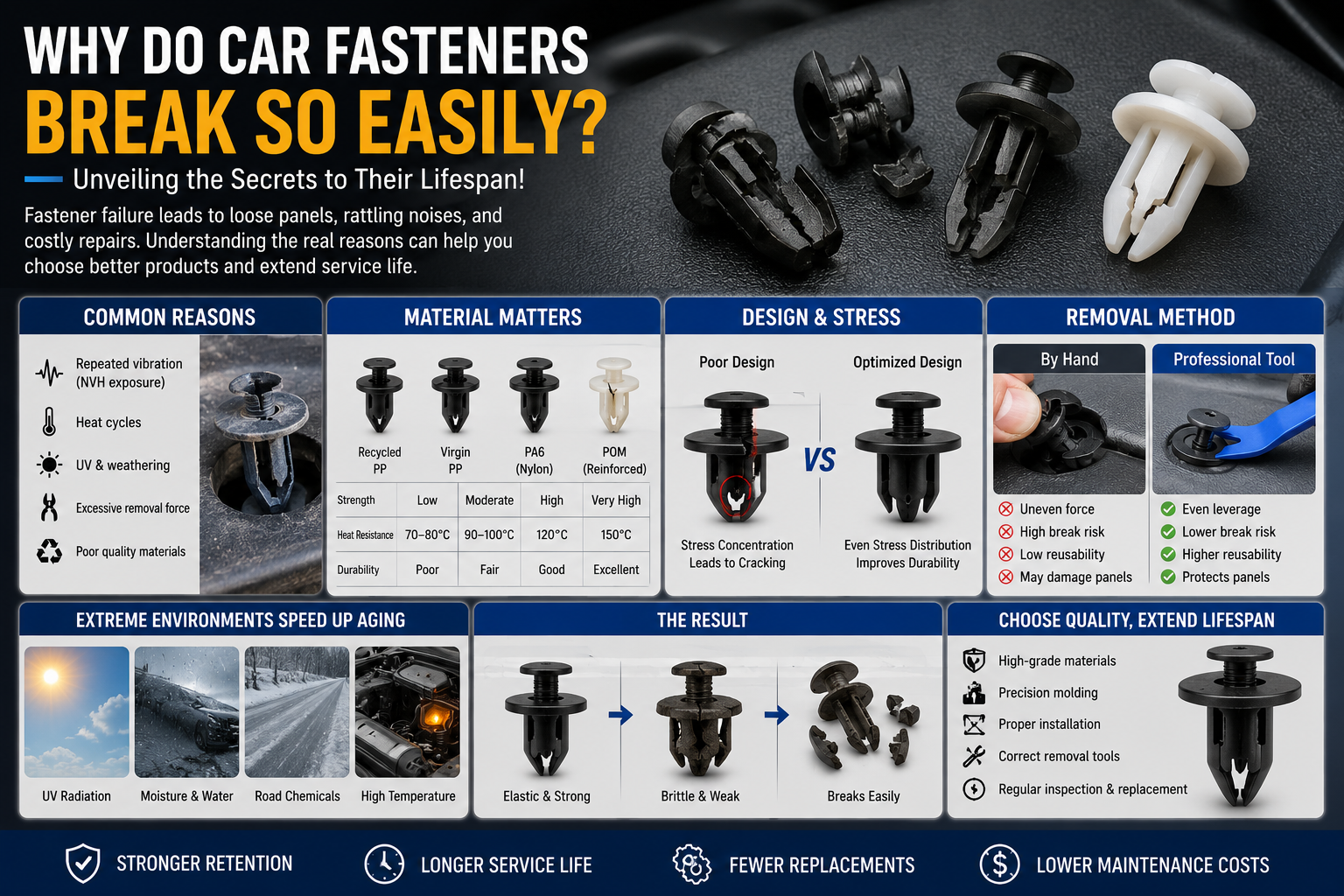
Inconsistent materials cause stress fractures and recalls.
-
Distributors lack visibility into part origin and certification.
According to Automotive Sourcing Index 2025, logistics inefficiency in fastener procurement costs the global industry over USD 1.4 billion annually.
Understanding the Foundation of Reliable Fastening Systems
A successful global sourcing strategy begins with standardization:
-
Dimensional Interchangeability: Maintaining consistent geometry across regions.
-
Material Governance: Using certified Nylon 66 and POM blends for global compliance.
-
Load Uniformity: Tension-tested clips ensure identical retention across batches.
-
Packaging and Data Integrity: Labeling aligned with digital part-tracking systems.
By applying these principles, manufacturers ensure uniform installation torque, even under varying humidity and temperature conditions worldwide.
Regional Sourcing vs. Global Integration: A Comparison
| Criteria | Regional Sourcing | Global Integrated Sourcing (QEEPEI) |
|---|---|---|
| Cost Efficiency | Medium | High – consolidated logistics |
| Part Consistency | Variable | Standardized across all factories |
| Data Traceability | Limited | QR-coded, batch-level tracking |
| Certification | Regional norms | Global ISO/IATF compliance |
| Delivery Lead Time | Unpredictable | Forecast-based fulfillment |
Centralizing fastener supply under one global framework reduces the risk of part duplication and regional nonconformity.
How QEEPEI Aligns Production with Global Sourcing Standards
QEEPEI’s manufacturing and logistics network follows a precise process designed for large-scale sourcing stability:
-
Centralized Material Procurement – Resin batches certified for tensile and thermal uniformity.
-
Automated Mold Calibration – Maintains ±0.03 mm precision.
-
Cross-Region Quality Protocols – Shared inspection data across factories.
-
Geo-Distributed Warehousing – Inventory nodes in Asia, EU, and South America.
-
Smart Label Integration – QR and RFID linking batch data to ERP systems.
This level of digital synchronization ensures real-time visibility and consistent performance across all shipments of the global sourcing auto fastener kit.
Why Global Enterprises Choose Integrated Fastener Kits
-
Operational Consistency: Identical clip geometry across multiple production lines.
-
Regulatory Compliance: All materials meet ISO 9001, RoHS, and REACH.
-
Forecast-Based Manufacturing: Data-driven supply adjustment minimizes overstock.
-
Unified Packaging: Kits optimized for pallet and container dimensions.
-
Aftermarket Synergy: OEM and service kits share identical parts for continuity.
Through such alignment, enterprises move from reactive purchasing to predictive logistics—cutting downtime and improving financial predictability.
Use Cases Across the Automotive Ecosystem
| Segment | Application | Result |
|---|---|---|
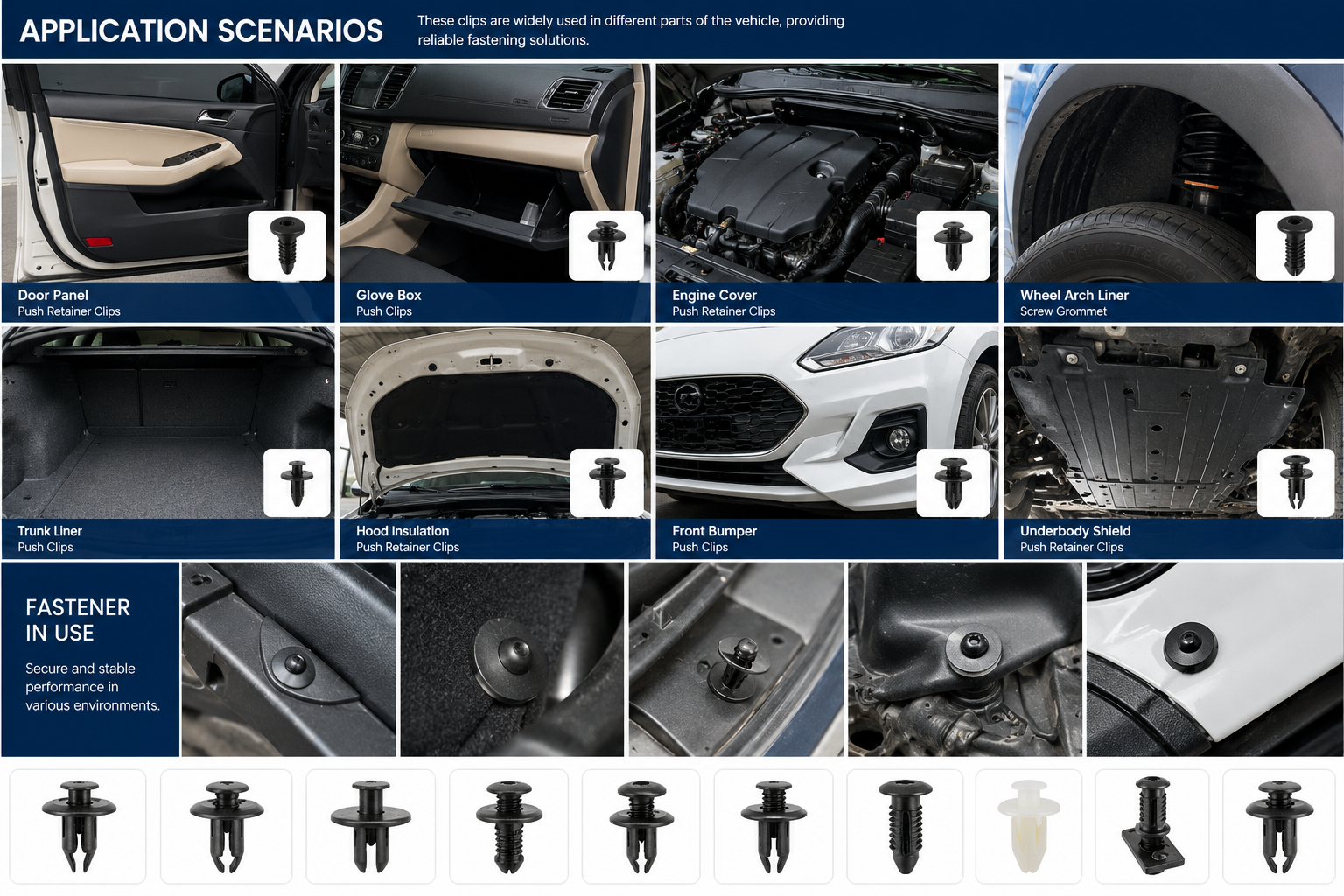
| OEM Assembly Plants | Standardized fastening kits for body, trim, and sealing | Reduced rework and downtime |
| Tier-1 Suppliers | Component sub-assembly | Improved part interchangeability |
| Global Distributors | Warehouse and retail packaging | Easier inventory control |
| E-commerce Platforms | B2B online supply | Consistent product data and labeling |
These applications show how standardized fastener kits reinforce efficiency not only in production but across the full value chain.
Choosing a Sourcing Partner That Scales Globally
To select the right partner for fastener sourcing:
-
Verify Global Certification – IATF 16949 and ISO 9001 as a baseline.
-
Check Supply Footprint – Multi-region manufacturing for continuity.
-
Confirm Data Transparency – Trackable lot codes and online QC records.
-
Assess Engineering Support – Ability to customize clips per vehicle model.
-
Review Logistics Alignment – Warehouse proximity to key export ports.
These criteria ensure reliability under both high-volume OEM and aftermarket conditions.
FAQ
Q: How does QEEPEI ensure part consistency across continents?
A: All facilities share unified molds, calibrated injection parameters, and central QC data.
Q: Are your fastener kits suitable for both passenger and commercial vehicles?
A: Yes, our product library covers light-duty, heavy-duty, and EV-specific applications.
Q: Can you provide private-label global packaging?
A: Absolutely. QEEPEI offers multilingual labeling and brand-customized packaging.
Conclusion: From Regional Procurement to Global Control
Sourcing automotive clips across multiple regions once meant complexity and uncertainty. Today, an integrated global sourcing auto fastener kit model replaces fragmentation with efficiency, traceability, and standardization. With scalable production and digitalized logistics, QEEPEI helps automotive enterprises build resilient supply networks ready for global growth.
For sourcing consultation or partnership inquiries, visit QEEPEI Homepage or connect through Contact Us.