
Automotive Hood Clips Exporter: Precision Fastening That Protects Performance
The vehicle hood—often overlooked—is a critical structural component. It must stay perfectly aligned, resist vibration, and provide easy access for maintenance. The clips securing it must perform flawlessly in every condition. As a professional automotive hood clips exporter, QEEPEI delivers fastening systems that ensure both mechanical integrity and production efficiency for global automotive manufacturers.
Common Pain Points in Hood Assembly
Hood fastening presents unique engineering challenges because the component is both functional and safety-related. Poor-quality clips can cause:
-
Panel misalignment leading to air noise and aerodynamic drag.
-
Vibration fatigue damaging metal and paint contact points.
-
Difficult service access in maintenance or repair.
-
Loose fittings after long-term heat exposure.
For OEMs and aftermarket suppliers, such issues can increase production costs and harm brand reputation.
The Mechanical Principles Behind Hood Clip Performance
Effective hood clips rely on three main engineering dynamics:
-
Tensile Retention – maintains a secure connection under vibration.
-
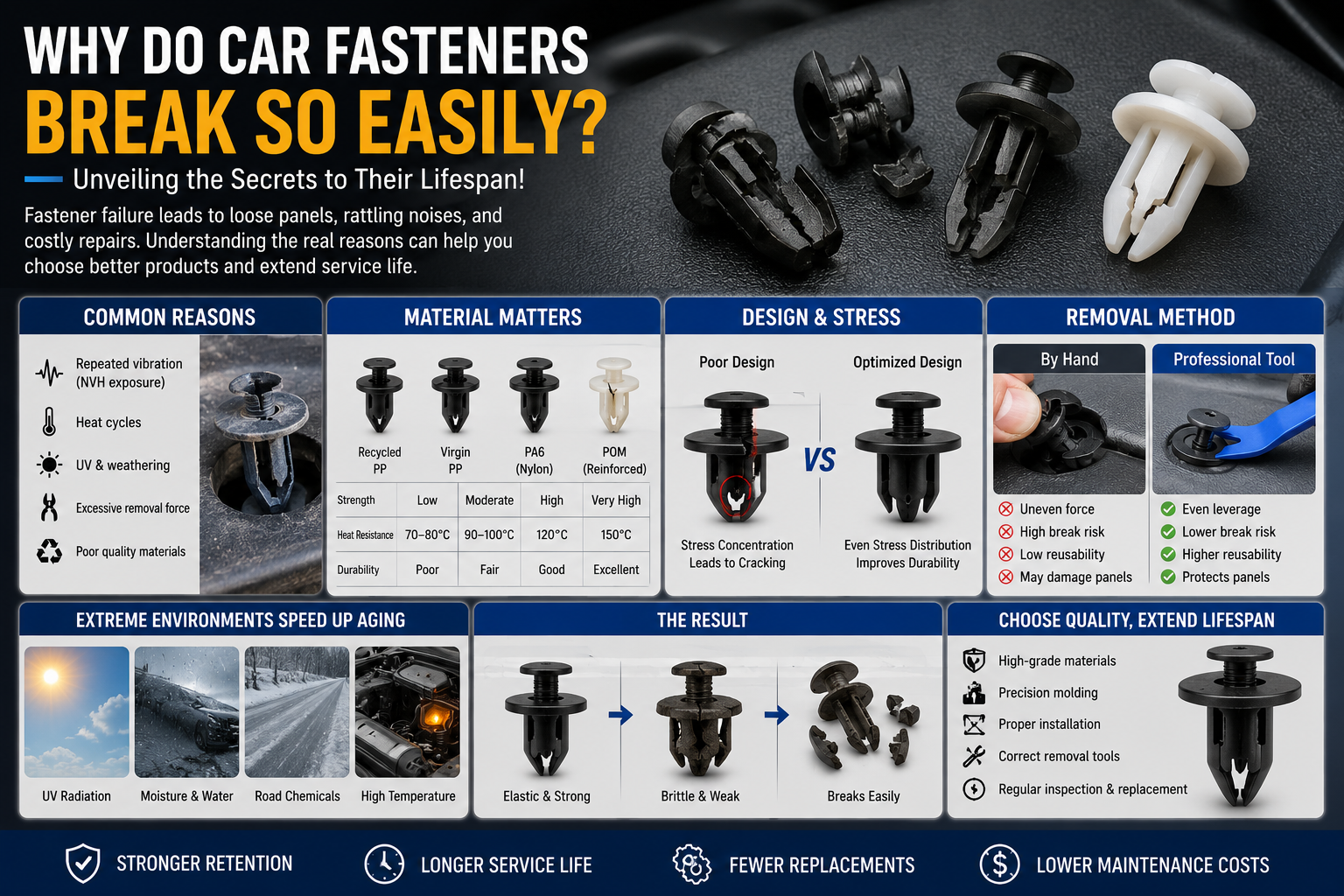
Thermal Stability – prevents deformation under engine heat.
-
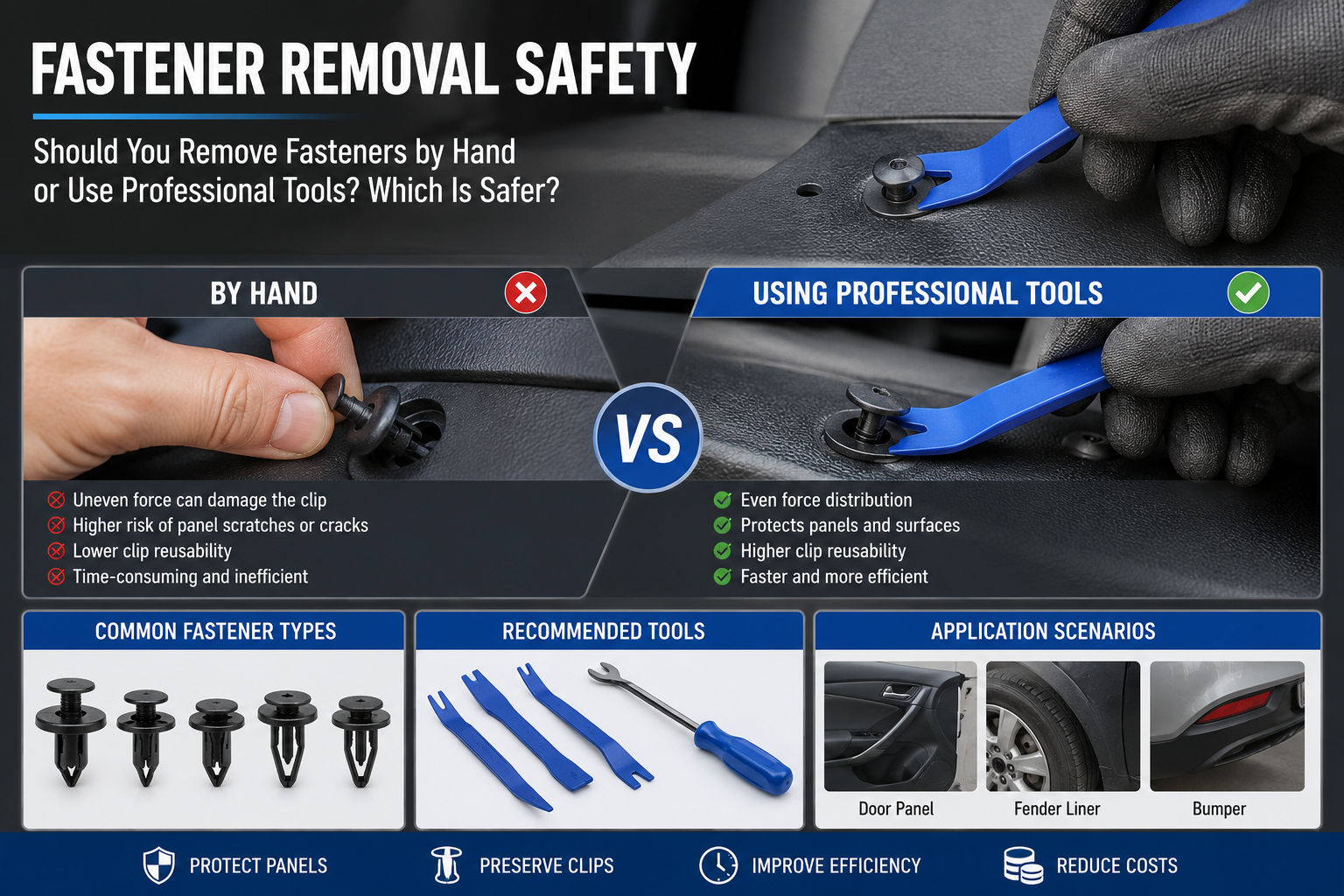
Ease of Release – allows tool-free removal for service work.
| Parameter | Engineering Target | Result |
|---|---|---|
| Retention Strength | 25–40 N | Prevents detachment under vibration |
| Operating Temperature | -30°C to +130°C | Maintains dimensional stability |
| Elastic Recovery | ≥90% | Ensures multiple installation cycles |
| Material Density | 1.1–1.3 g/cm³ | Balances weight and stiffness |
This balance of mechanical strength and flexibility ensures long-term safety and ease of maintenance.
Material Comparison: Balancing Heat Resistance and Flexibility
| Material | Key Benefit | Limitation | Recommended Use |
|---|---|---|---|
| PA6 (Nylon) | Excellent tensile and heat resistance | Costlier | OEM engine bay components |
| POM (Acetal) | Dimensional stability and wear resistance | Less UV durable | Interior or protected areas |
| PP (Polypropylene) | Lightweight and affordable | Limited rigidity | General aftermarket use |
For high-temperature zones, QEEPEI often uses reinforced nylon with glass fiber, maintaining clip tension near the engine where heat exceeds 100°C.
QEEPEI’s Engineering Solutions for OEM-Grade Production
QEEPEI integrates precision injection molding and multi-point inspection to ensure every clip meets global standards:
-
±0.02 mm tolerance control for exact fit.
-
Automatic stress testing under simulated vibration.
-
Custom CAD tooling for vehicle-specific clips.
-
Surface finishing preventing abrasion against metal parts.
These production systems enable high-speed assembly compatibility and ensure durability even in extreme engine bay environments.
Core Advantages for Buyers and Manufacturers
| Advantage | Technical Description | Buyer Value |
|---|---|---|
| Vibration Resistance | Elastic retention geometry | Prevents fatigue cracks and noise |
| Thermal Stability | Reinforced polymers resist heat aging | Maintains fit under engine conditions |
| Easy Maintenance | Quick-release clip design | Simplifies servicing operations |
| Customization Support | OEM-specific molds | Perfect alignment and reduced assembly errors |
| Global Export Network | 3,000+ SKUs, 24-hour dispatch | Consistent supply for distributors |
These features make QEEPEI’s hood clips a trusted choice for OEM assembly lines and international distributors.
Real-World Applications and Common Use Cases
-
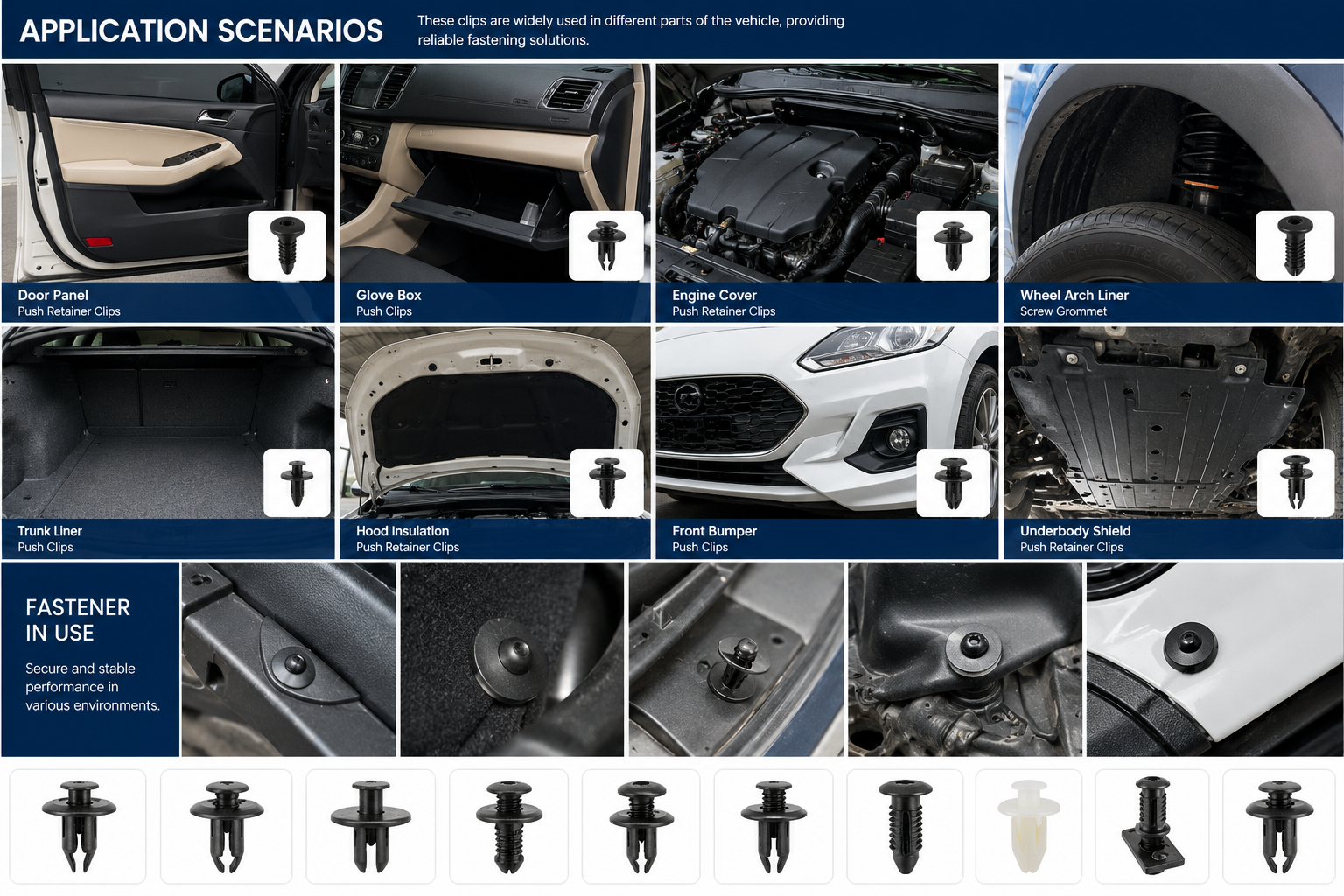
Passenger vehicles — securing engine hoods and sound insulation pads.
-
SUVs and pickup trucks — vibration-resistant clips for off-road stability.
-
Commercial fleets — quick-access designs for frequent service maintenance.
-
Aftermarket supply — universal clips compatible with multiple car brands.
Each variant is tested for tensile strength, thermal durability, and installation speed, ensuring real-world reliability.
Selecting Hood Clips Based on Application
The best clip design depends on vehicle type and operating environment:
-
For city vehicles, use standard nylon clips with good flexibility and low noise.
-
For off-road or high-vibration models, choose reinforced PA6 clips with stronger hold.
-
For electric vehicles, use lightweight PP or hybrid polymer clips to reduce mass.
-
For maintenance workshops, stock universal quick-release clips for efficient repair.
Matching clip characteristics to the use scenario helps extend lifespan and simplify maintenance.
Frequently Asked Questions
Q1: Can hood clips handle high engine bay temperatures?
Yes, QEEPEI’s nylon and glass-fiber-reinforced clips maintain shape up to 130°C.
Q2: Are these clips compatible with multiple car models?
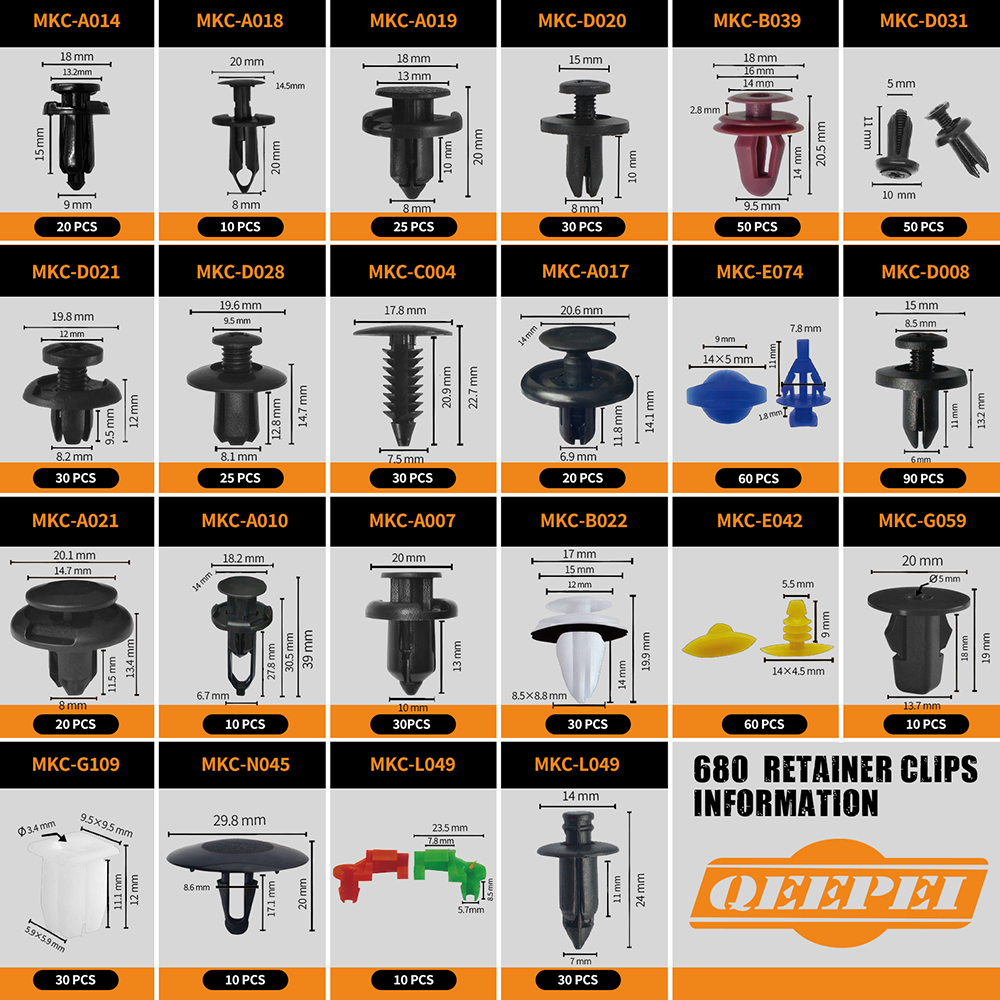
Universal and model-specific versions are available based on hole size and mounting type.
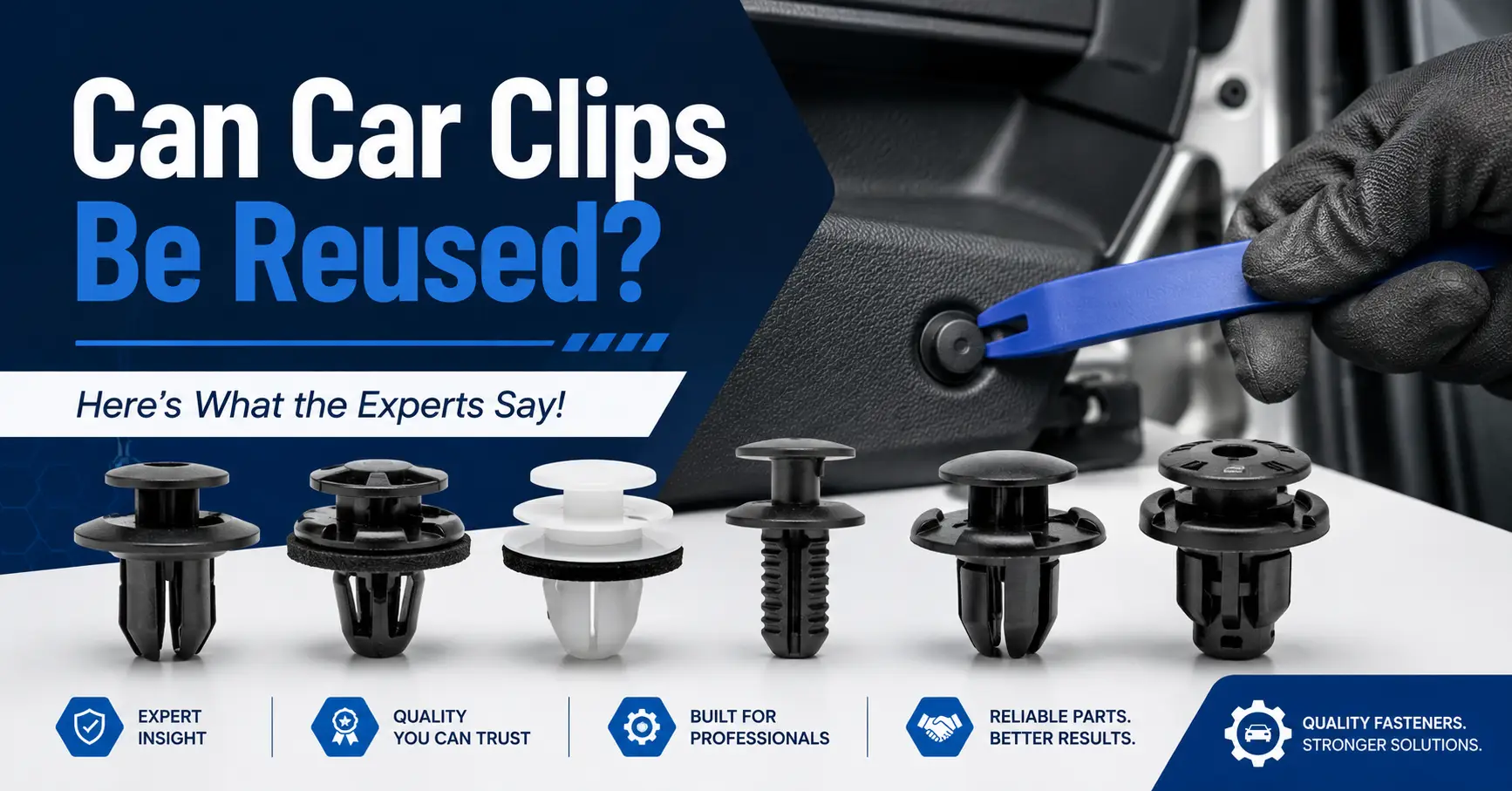
Q3: Can the clips be reused during service?
Yes, most models allow multiple installations without losing grip.
Q4: What’s the minimum order quantity for export?
MOQ varies by model; standard products available from 10,000 pieces.
Secure Performance Starts with Reliable Fastening
A strong hood clip ensures not only appearance but also safety and serviceability.
By combining material science, design precision, and manufacturing consistency, QEEPEI supports automakers and distributors with fasteners that deliver lasting performance under demanding conditions.
Explore the complete range of fastening solutions on the Homepage.
For export inquiries or OEM customization, contact us here.