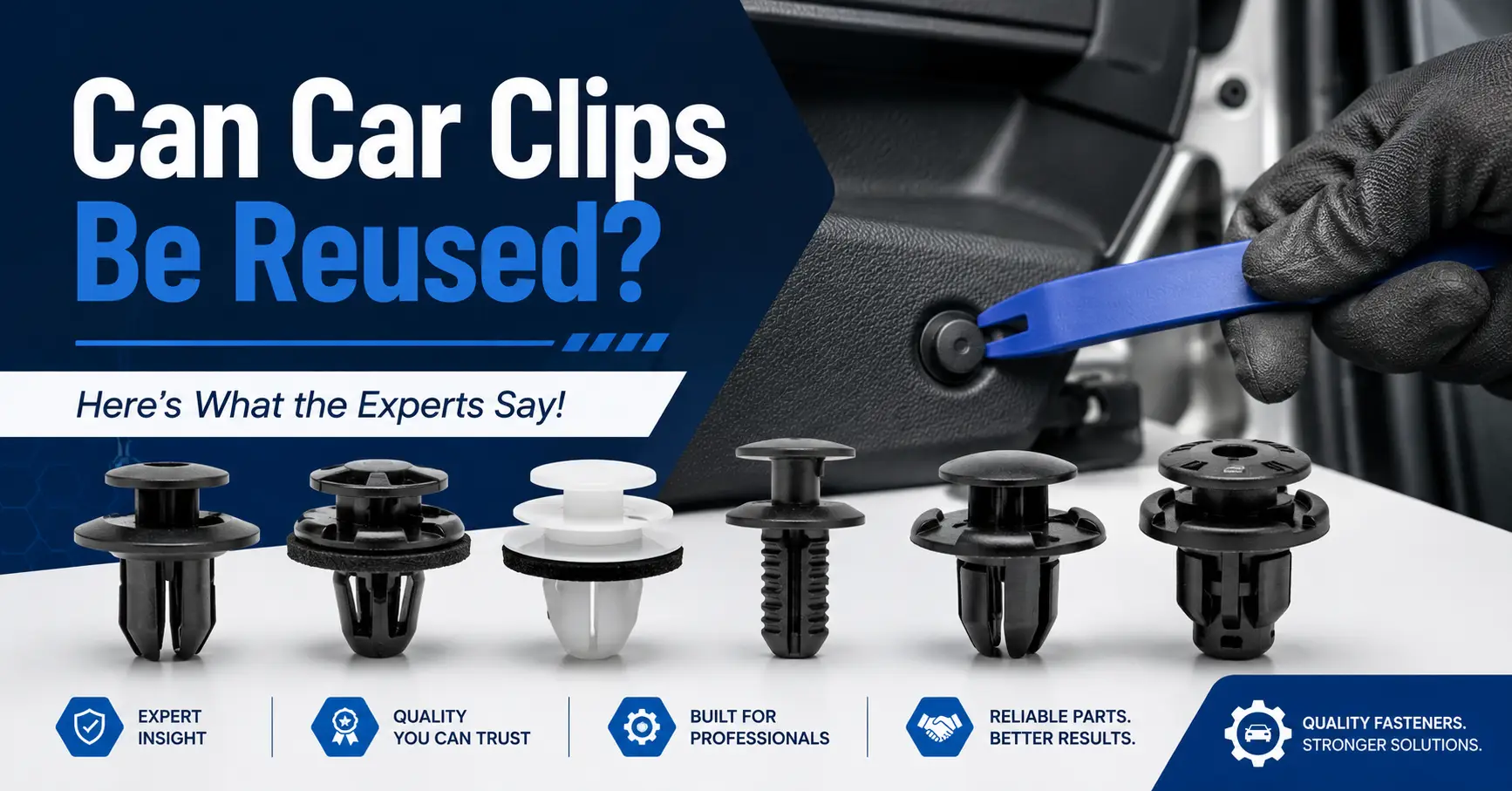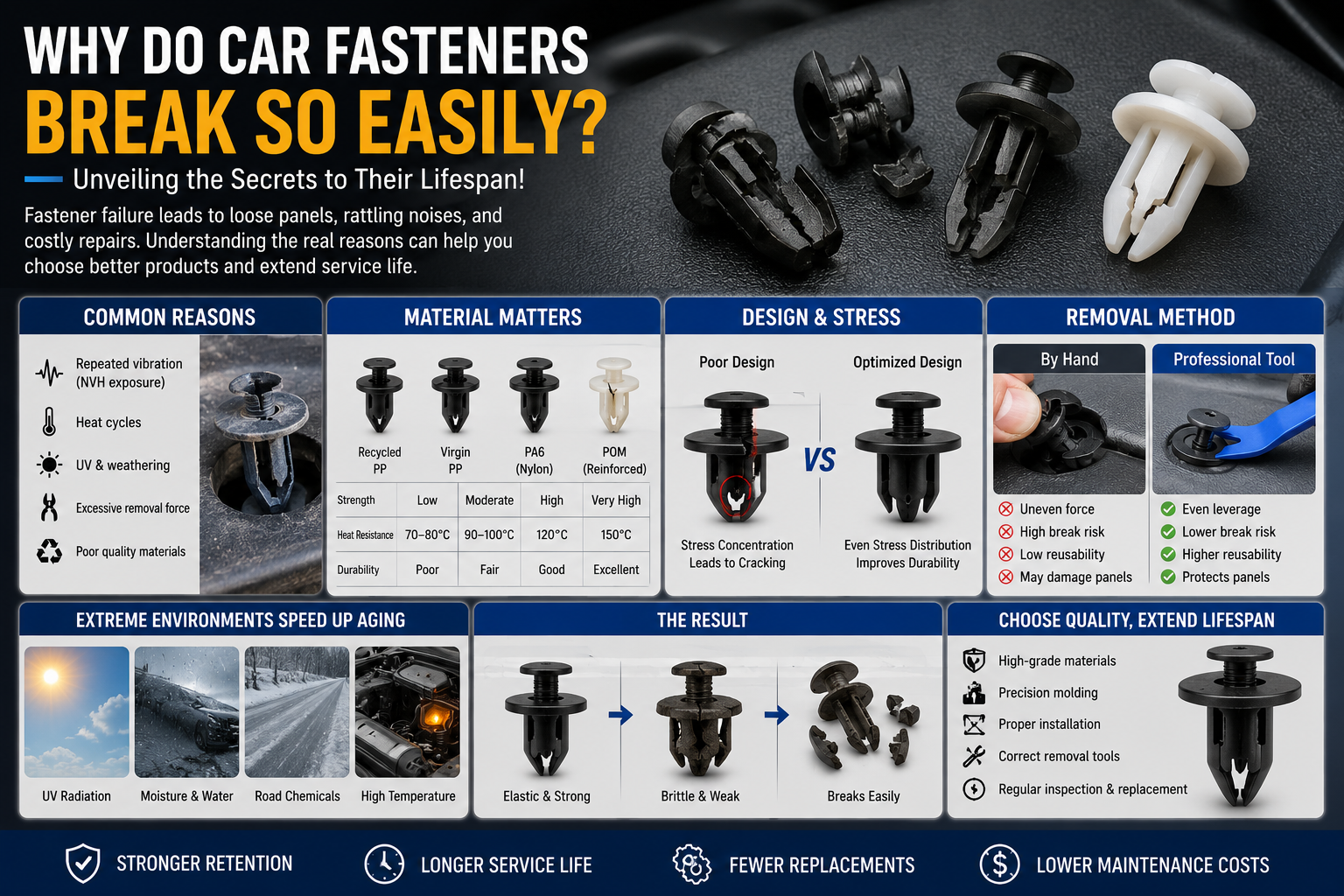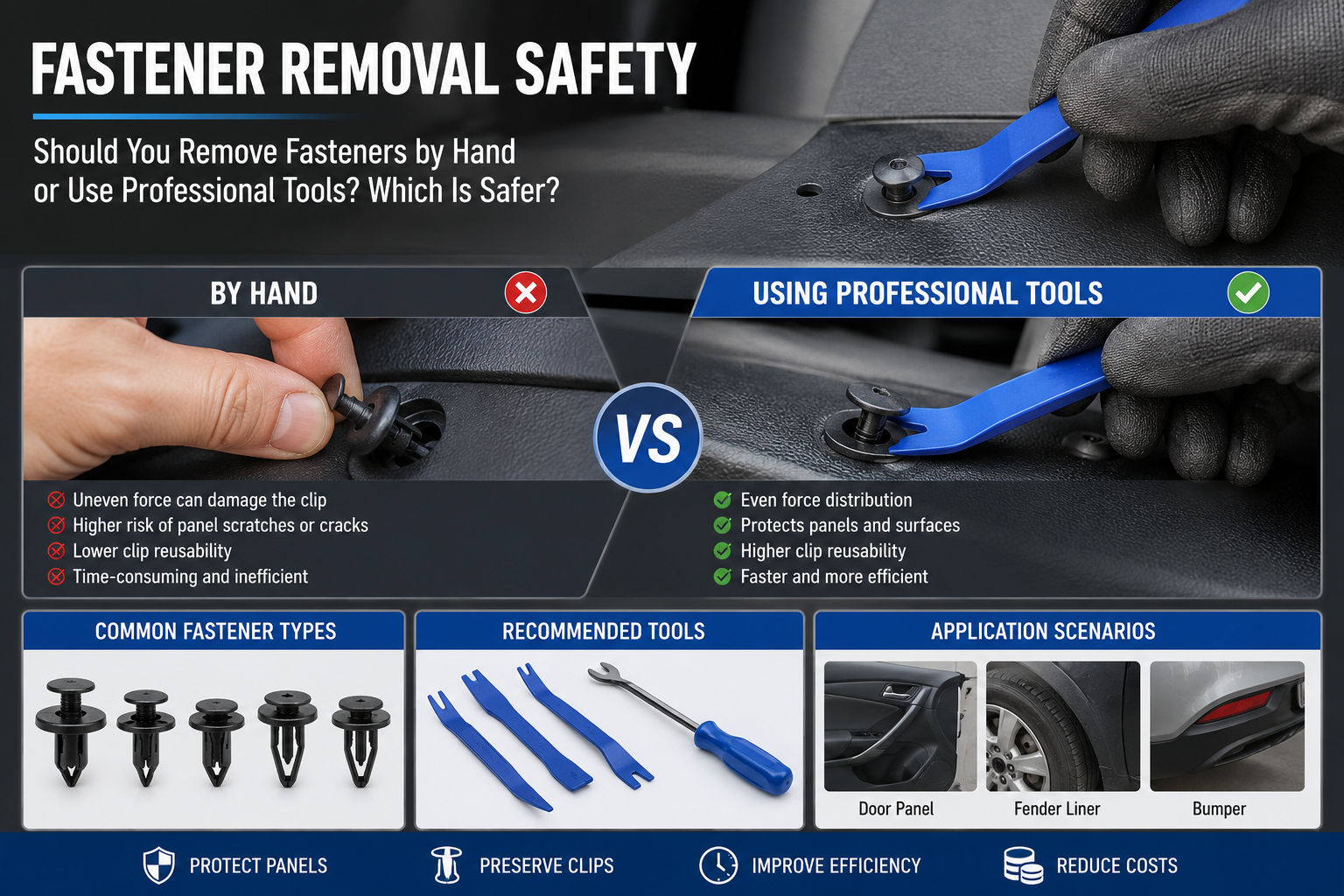

A clip that seems identical in size can perform completely differently once installed. Some hold firmly for years. Others loosen within months. Some crack during removal. Others survive multiple cycles.
Selecting the wrong clip is rarely about price — it is usually about misunderstanding application requirements.
This car clips selection guide explains how load, material, tolerance, and environment determine fastening performance. As an experienced Automotive Clips manufacturer, we have seen most failures originate from improper selection rather than poor manufacturing.
Correct selection prevents vibration, panel deformation, and repeated replacement.
Why Clip Selection Fails in Real Applications
Most fastening failures come from four overlooked variables:
- Hole diameter mismatch
- Wrong material type
- Incorrect retention force level
- Environmental misjudgment
Car clips are engineered for specific load ranges. Using interior trim clips in bumper zones or high-temperature areas often results in premature loosening.
A structured car clips selection guide avoids these mistakes.
Understanding Structural Load Requirements
Different vehicle zones experience different stress patterns:
| Application Area | Typical Load | Vibration Level | Temperature Range |
|---|---|---|---|
| Interior trim | Low–Medium | High | -20°C to 80°C |
| Bumper / fender | Medium | Medium | -30°C to 120°C |
| Engine bay cover | Medium–High | High | -40°C to 140°C |
| Underbody panel | High | High | -40°C to 150°C |
Selecting clip type without understanding these parameters leads to structural mismatch.
A professional Automotive Clips manufacturer matches retention force to application stress.
Material Selection: Plastic vs Reinforced Options
Material choice significantly affects long-term performance.
Common options:
- PA6 – flexible, cost-efficient
- PA66 – higher heat resistance
- PA66 GF – reinforced for higher load zones
- POM – good dimensional stability
Plastic materials absorb vibration better than metal fasteners, especially in trim systems.
However, in high-load or thermal cycling environments, reinforced options are necessary.
Material selection is central to any serious car clips selection guide.
Tolerance and Hole Fit: The Hidden Variable
Retention stability depends on interference fit.
Typical standards:
- Clip shaft tolerance: ±0.02–0.03 mm
- Panel hole tolerance: ±0.1 mm
If the hole expands during removal, even a new clip may loosen.
Before ordering in bulk, measure:
- Hole diameter
- Panel thickness
- Required extraction force
Dimensional verification prevents future warranty claims.
Installation Conditions Matter More Than Expected
Improper installation reduces retention strength.
Avoid:
- Hammering push clips
- Twisting during insertion
- Installing at an angle
Proper vertical alignment preserves barb geometry.
A reliable Automotive Clips manufacturer designs for elastic recovery, but installation technique determines real-world durability.
Recommended Selection Workflow
A practical car clips selection guide should follow this workflow:
- Identify installation location
- Measure hole diameter and panel thickness
- Determine load and vibration level
- Confirm environmental exposure
- Choose material and reinforcement
- Verify retention force
This structured process reduces error rate significantly.
Why Work with an Experienced Supplier
Beyond geometry, production discipline affects quality.
At QEEPEI, we maintain:
- Controlled moisture below 0.2%
- Mold precision within ±0.03 mm
- Batch retention testing
- Consistent material sourcing
Learn more about our production capabilities here:
https://www.cnclip.com/about-us
Explore our full product range:
https://www.cnclip.com/products
Reliable supply prevents dimensional variation across batches.
Application-Based Selection Examples
| Scenario | Recommended Clip |
|---|---|
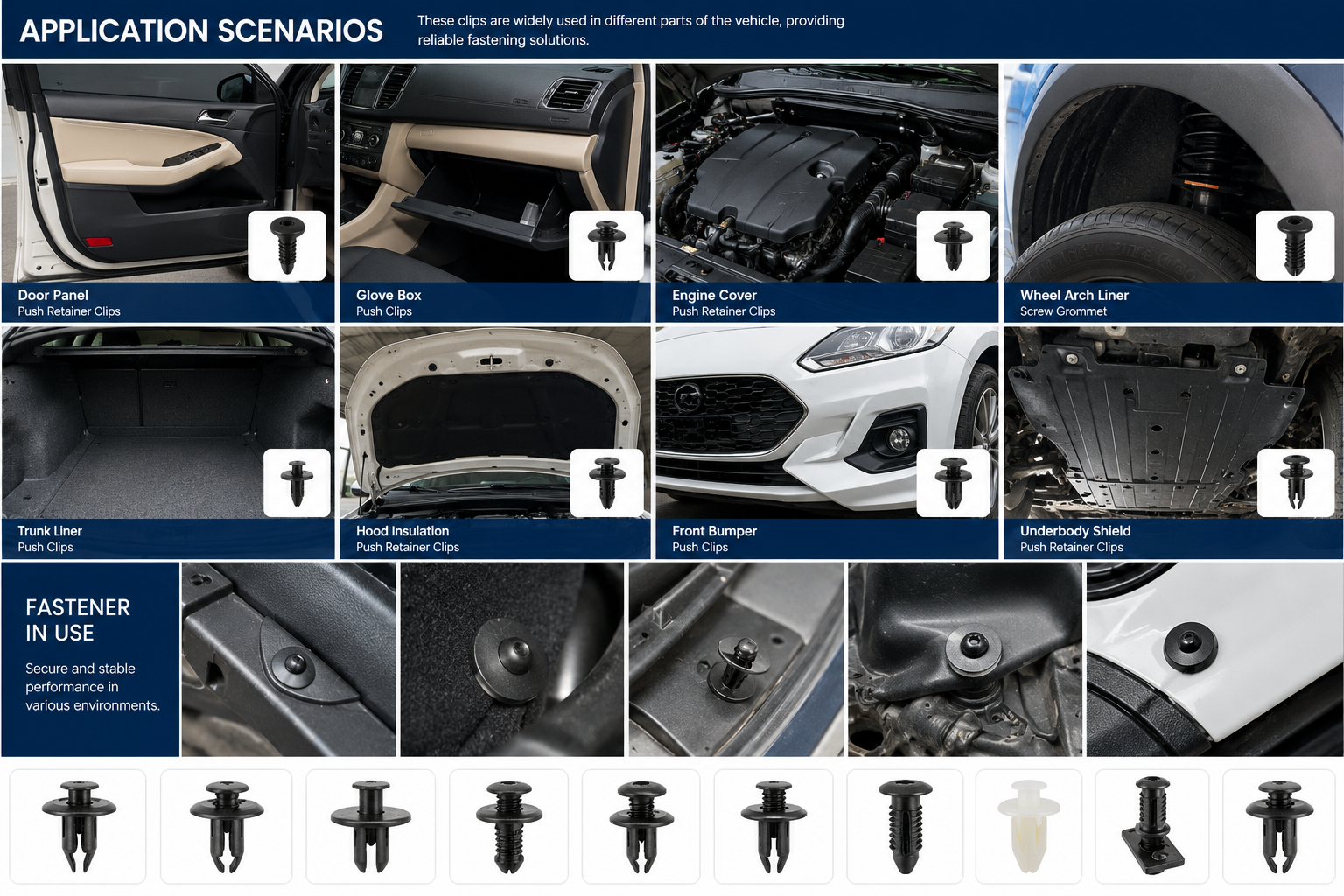
| Door panel trim | Standard PA66 push clip |
| Fender liner | Reinforced expansion rivet |
| Engine splash shield | PA66 GF reinforced |
| Wiring harness | Flexible nylon retainer |
Matching structure to environment improves lifespan and reduces noise.
FAQ
Q1: Can one clip type fit all applications?
No. Each zone has different load and temperature demands.
Q2: How do I know required retention force?
It depends on panel weight and vibration level. Contact supplier for testing data.
Q3: Is reinforced always better?
Not necessarily. Over-rigid clips may stress lightweight panels.
For more technical insights, visit our FAQ section:
https://www.cnclip.com/blog
Conclusion
Correct clip selection is a technical decision that balances load, material properties, dimensional tolerance, and environmental conditions. A structured car clips selection guide minimizes installation failure and long-term loosening.
An experienced Automotive Clips manufacturer evaluates application stress before recommending solutions.
If you need engineering consultation or bulk supply, contact us:
https://www.cnclip.com/contact-us