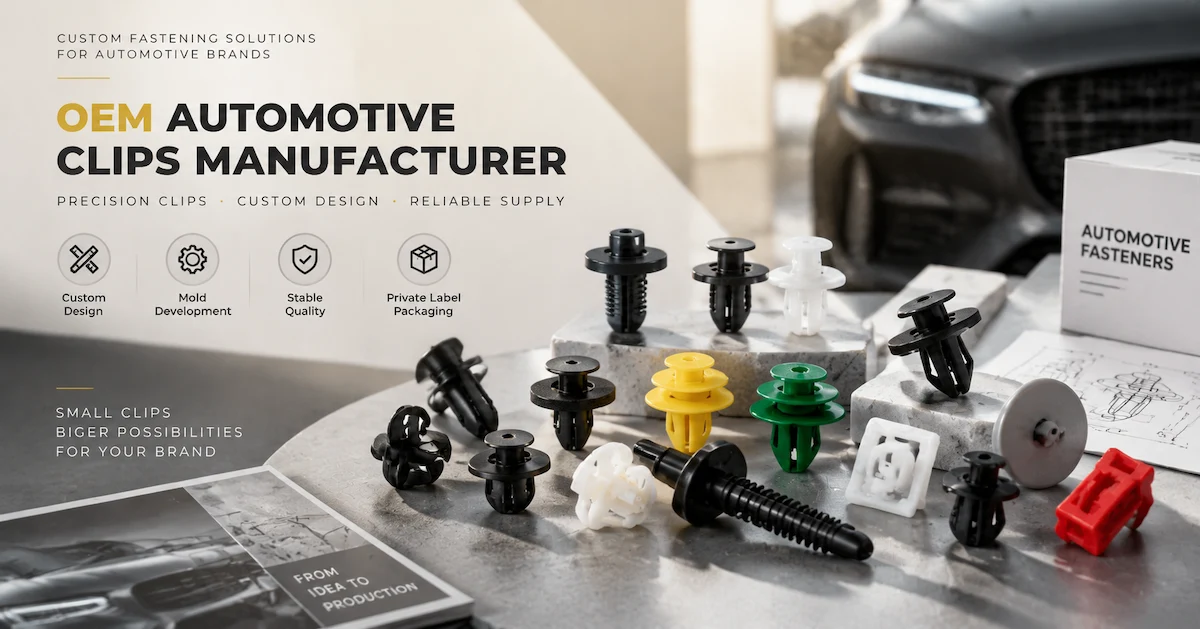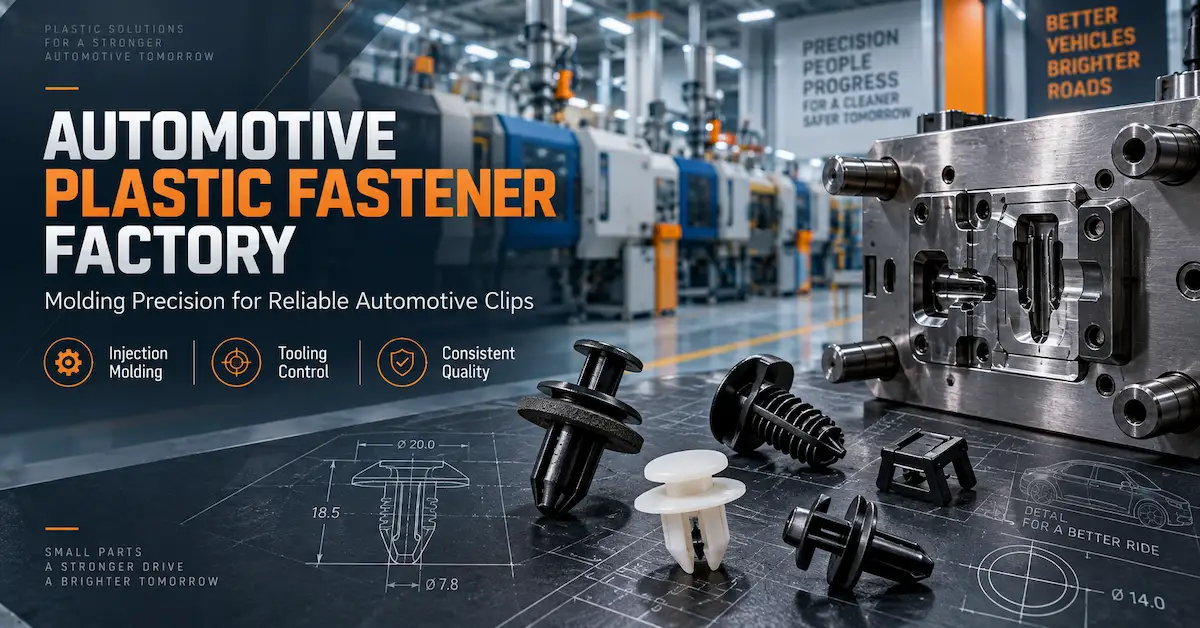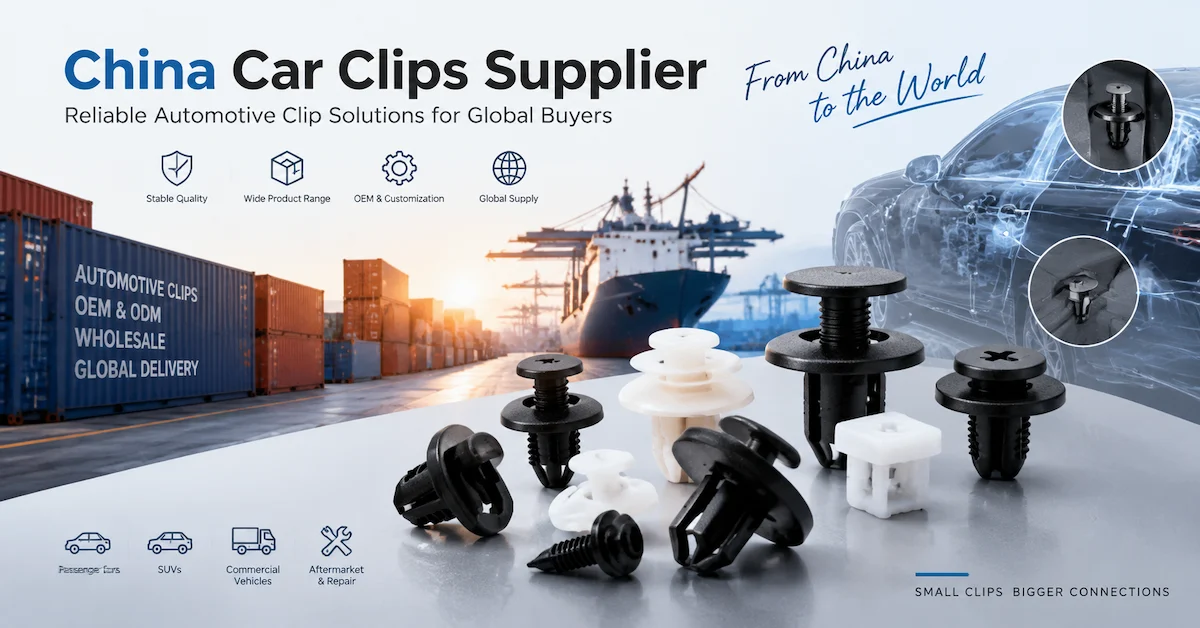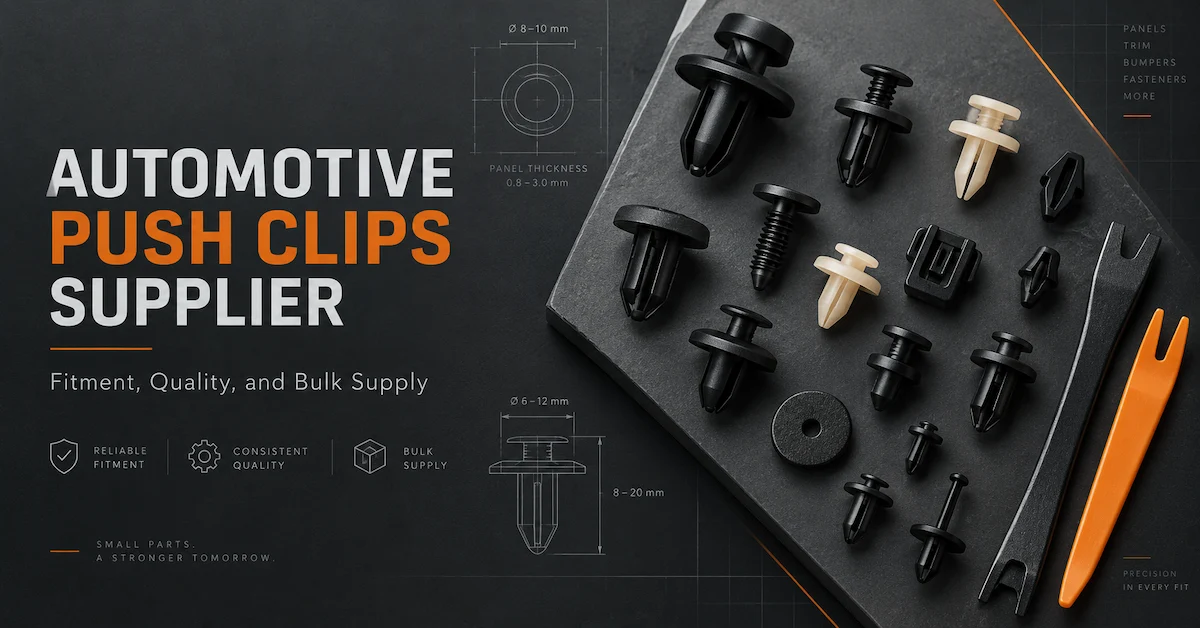

Injection molding plays an important role in producing modern automotive fasteners. For businesses sourcing injection molded car clips, product quality depends not only on plastic materials but also on mold design, manufacturing accuracy, and production control.
Automotive clips may appear simple, but their performance relies on extremely precise dimensions. A small difference in hole size, clip stem diameter, locking structure, or panel thickness range can affect installation quality and vehicle fitment.
For automotive distributors, OEM buyers, repair suppliers, and aftermarket companies, choosing a supplier with strong injection molding capability helps reduce wrong-fit products, customer complaints, and quality issues.
QEEPEI provides automotive fastening solutions including car clips, plastic fasteners, clip kits, and specific fit clips for global B2B buyers.
Why Injection Molded Car Clips Require High Precision
Most automotive clips are manufactured through injection molding because this process allows large-scale production with consistent shapes and dimensions.
However, automotive applications require much higher precision than ordinary plastic products.
A small molding error can cause:
- Loose panel installation
- Weak locking performance
- Difficult assembly
- Broken clips during installation
- Increased repair costs
- Higher product return rates
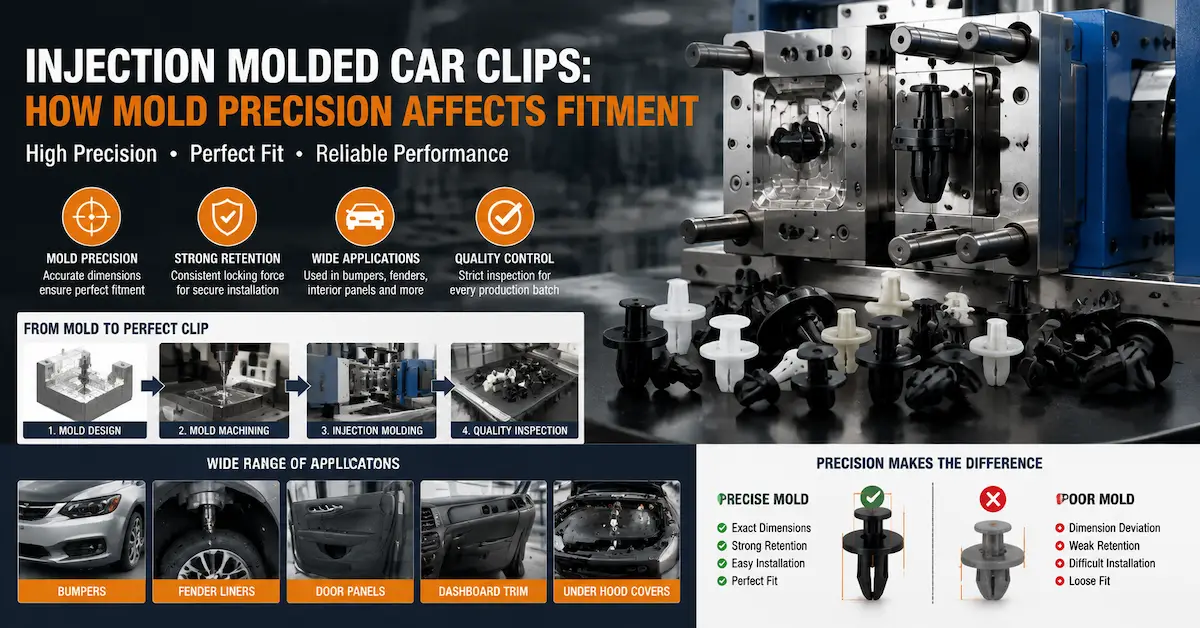
For example, a bumper clip with an incorrect stem diameter may not lock securely, while a door panel clip with poor dimensional accuracy may create vibration noise after installation.
This is why mold precision is one of the most important factors affecting automotive clip performance.
How Mold Precision Affects Automotive Clip Fitment
The mold determines the final shape, size, and structural accuracy of injection molded car clips.
Several mold-related factors directly affect fitment.
Dimensional Accuracy
Automotive clips must meet specific dimensional requirements, including:
- Head diameter
- Stem diameter
- Clip length
- Locking leg size
- Hole compatibility
If dimensions vary between production batches, distributors and repair shops may experience inconsistent installation results.
High-precision molds help maintain stable measurements and improve product reliability.
Locking Structure Performance
The locking mechanism is one of the most important parts of an automotive clip.
Different clip designs use:
- Expansion legs
- Snap structures
- Retaining arms
- Flexible locking tabs
Poor mold precision can affect these structures, causing:
- Weak retention force
- Difficult installation
- Broken locking legs
- Loose vehicle panels
A well-designed mold ensures that each clip performs consistently.
Surface Quality and Appearance
Automotive clips are often visible during installation or removal. Surface defects may indicate poor molding control.
Common molding defects include:
| Defect | Possible Impact |
|---|---|
| Flash | Affects installation accuracy |
| Sink marks | Reduces structural strength |
| Warping | Causes fitment problems |
| Short shots | Creates incomplete clips |
| Surface defects | Affects appearance |
Professional injection molding processes help reduce these problems.
Injection Molding Process for Automotive Clips
Producing reliable automotive clips requires control throughout the manufacturing process.
A typical production process includes:
| Production Stage | Key Control Point |
|---|---|
| Mold design | Structural accuracy |
| Material selection | Performance requirements |
| Injection molding | Temperature and pressure control |
| Cooling process | Dimensional stability |
| Quality inspection | Size and function testing |
| Packaging | Quantity and identification |
Each stage affects the final performance of the clip.
Material Selection for Injection Molded Car Clips
Mold precision is important, but material selection also determines durability.
Common materials include:
| Material | Characteristics | Applications |
|---|---|---|
| PA Nylon | Strong, flexible, wear-resistant | High-performance clips |
| PP | Lightweight and economical | General trim clips |
| POM | Excellent dimensional stability | Precision fasteners |
| Reinforced plastic | Higher strength | Heavy-duty applications |
Different applications require different material properties.
For example:
- Bumper clips need impact resistance;
- Interior clips need flexibility;
- Engine compartment clips need temperature resistance;
- Exterior clips need weather durability.
A professional automotive clips supplier should recommend suitable materials based on application requirements.
Common Fitment Problems Caused by Poor Manufacturing
When injection molded car clips are not produced accurately, buyers may face several problems.
Incorrect Hole Fit
The clip may not properly match the vehicle mounting hole.
Possible results:
- Loose installation
- Clip rotation
- Panel movement
Incorrect Panel Thickness Range
Each clip is designed for a specific material thickness range.
If the clip is too short or too long:
- It may not lock properly;
- It may damage the panel;
- It may fail under vibration.
Inconsistent Production Batches
For distributors, repeat orders must maintain the same quality.
Poor production control may result in:
- Different dimensions between batches;
- Different locking force;
- Customer complaints.
Why OEM Buyers Need Injection Molding Capability
For OEM buyers and private label brands, manufacturing capability is an important supplier selection factor.
A capable supplier should support:
- Custom clip designs
- Mold development
- Sample production
- Material selection
- Color customization
- Mass production
- Quality inspection
- Custom packaging
OEM projects require more than supplying standard products. They require engineering support and production consistency.
QEEPEI supports automotive buyers with automotive clips and fastening solutions, including customized solutions for different applications.
How to Evaluate an Injection Molded Car Clips Supplier
When selecting a supplier, buyers should evaluate more than price.
Important factors include:
| Evaluation Factor | Why It Matters |
|---|---|
| Mold capability | Determines product accuracy |
| Injection molding experience | Ensures production stability |
| Material control | Improves durability |
| Quality inspection | Reduces defects |
| Product range | Supports different applications |
| OEM ability | Enables customization |
| Inventory support | Improves supply reliability |
| Packaging options | Supports different markets |
A reliable supplier should provide technical information and help buyers choose suitable fastening solutions.
Applications of Injection Molded Car Clips
Injection molded car clips are used in many automotive areas.
| Application | Common Clip Types |
|---|---|
| Bumper systems | Push clips, retainers |
| Fender liners | Plastic rivets, retainers |
| Door panels | Interior clips |
| Wheel arches | Exterior clips |
| Dashboard panels | Trim fasteners |
| Hood insulation | Heat-resistant clips |
| Underbody covers | Heavy-duty fasteners |
A wide application range makes automotive clips an important category for distributors and aftermarket suppliers.
Why Choose QEEPEI for Injection Molded Car Clips?
QEEPEI focuses on automotive clips, plastic automotive fasteners, car clip kits, specific fit clips, and fastening solutions.
For global B2B buyers, QEEPEI provides:
- Wide automotive clip categories
- Injection molded plastic fastening solutions
- Stable production capability
- OEM/ODM support
- Packaging customization
- Fitment assistance
- Wholesale supply solutions
To learn more about QEEPEI’s company capability, visit the About Us page.
For bulk orders, customized projects, or supplier cooperation, contact QEEPEI through the Contact Us page.
FAQ
What are injection molded car clips?
Injection molded car clips are automotive fasteners produced through injection molding processes to secure vehicle panels, trims, and components.
Why does mold precision affect car clip fitment?
Mold precision determines clip dimensions, locking structure accuracy, and installation performance.
What problems can poor-quality molds cause?
Poor molds may cause flash, deformation, incorrect dimensions, weak locking force, and poor vehicle fitment.
Which materials are used for injection molded car clips?
Common materials include PA Nylon, PP, POM, and reinforced plastics.
Are injection molded car clips customizable?
Yes. Suppliers can customize size, structure, color, material, and packaging.
Why should OEM buyers choose a manufacturer with mold capability?
Mold capability allows better control over product accuracy, customization, and production consistency.
How do automotive clips affect repair quality?
Incorrect clips can cause loose panels, noise problems, installation failures, and customer complaints.
What should distributors check before buying molded clips?
They should evaluate mold quality, material control, fitment support, production capacity, and quality inspection.
Can injection molded clips be produced in bulk?
Yes. Injection molding is suitable for high-volume automotive clip production with consistent quality.
Where can I source injection molded car clips?
You can explore QEEPEI automotive clip solutions through the Products page.
Conclusion
Injection molded car clips require precise molds, stable materials, and strict production control to achieve reliable fitment. For automotive distributors, OEM buyers, and repair suppliers, choosing the right supplier helps reduce installation problems, improve product quality, and build long-term customer trust.
A professional injection molded car clips supplier should provide not only products but also manufacturing expertise, quality control, customization support, and stable supply capability.
QEEPEI provides automotive clips, plastic fasteners, clip kits, and OEM/ODM fastening solutions for global automotive markets.
Explore QEEPEI’s complete automotive fastening product range to build a stronger supply chain.