
ODM Car Clips: Customized Fastening Solutions for Modern Automotive Innovation
In a rapidly evolving automotive landscape, customization is no longer a premium—it’s a necessity. The ODM car clips market is transforming traditional fastening systems into engineered solutions that adapt to specific vehicle architectures. Whether for electric vehicle (EV) battery covers, lightweight body trims, or aerodynamic exterior panels, customized clips ensure precision, durability, and manufacturability at scale.
QEEPEI stands at the center of this transformation, combining engineering expertise, data-driven production, and flexible ODM services that meet the unique specifications of automakers and global distributors.
Persistent Pain Points in Automotive Clip Development
Despite modern automation, many suppliers struggle to meet evolving assembly demands:
-
Limited design flexibility for model-specific geometries.
-
Material fatigue from repeated installation or extreme climates.
-
Dimensional inconsistency due to outdated tooling calibration.
-
Poor coordination between design teams and mass production.
For automotive brands, these problems can result in higher assembly rework, slower launch timelines, and reduced vehicle quality ratings.
The Engineering Principles Behind ODM Clip Reliability
ODM development focuses on harmonizing mechanical, chemical, and design properties for each vehicle environment.
-
Dimensional Precision: Mold accuracy within ±0.03 mm ensures robotic insertion reliability.
-
Polymer Reinforcement: Glass-fiber or mineral-filled resins improve stiffness by 20–30%.
-
Thermal Endurance: Stable performance from –40°C to +130°C, verified through thermal cycling.
-
Elastic Recovery: Retains 90% holding force after 5,000 installation cycles.
-
Noise Damping: Optimized geometry reduces vibration resonance by up to 15%.
By integrating simulation software (Moldflow & Abaqus), QEEPEI validates material behavior before tooling investment, minimizing production risk.
Generic Supplier vs. ODM Manufacturing Partner
| Criteria | Generic Supplier | ODM Car Clips (QEEPEI) |
|---|---|---|
| Design Process | Based on generic CAD model | Tailored CAD per vehicle component |
| Mold Tolerance | ±0.10 mm | ±0.03 mm (5-axis CNC mold) |
| Material Options | Limited PA6, POM | PA66, POM, PPS, PC+ABS, PP-GF |
| Tensile Strength | 120–150 N | 180–250 N (verified by ASTM D638) |
| Heat Resistance | ≤100°C | 130°C continuous / 150°C short peak |
| Quality Control | Visual sampling | Full 3D optical + dimensional mapping |
| Lifecycle Test | None | 10,000 clip cycles + 500 h salt spray |
| Packaging | Bulk bags | Barcode carton with QR traceability |
This data underscores why QEEPEI’s ODM approach consistently exceeds automotive-grade expectations.
QEEPEI’s ODM Workflow: From Concept to Production
-
Requirement Analysis: Evaluate assembly conditions, panel type, and stress load.
-
Design Simulation: 3D modeling with finite element stress testing.
-
Prototype Development: Rapid tooling using high-precision aluminum molds.
-
Performance Validation: Conduct pull-out, shear, vibration, and heat aging tests.
-
Mass Production: Automated injection lines with IoT monitoring.
-
Global Distribution: JIT logistics from bonded warehouses in Asia and Europe.
This modular workflow enables consistent quality from concept validation to large-scale deployment.
Advantages of QEEPEI ODM Car Clips
-
Tailored Geometry: Fitment designed for specific car models or trim lines.
-
Enhanced Assembly Efficiency: Reduces installation force variance by 25%.
-
Material Versatility: Compatible with multi-material vehicle bodies (steel, aluminum, carbon fiber).
-
Sustainability: Fully recyclable polymers meet REACH & RoHS compliance.
-
Supply Scalability: Rapid transition from low-volume prototyping to mass production.
ODM isn’t just about design—it’s about lifecycle optimization across global manufacturing ecosystems.
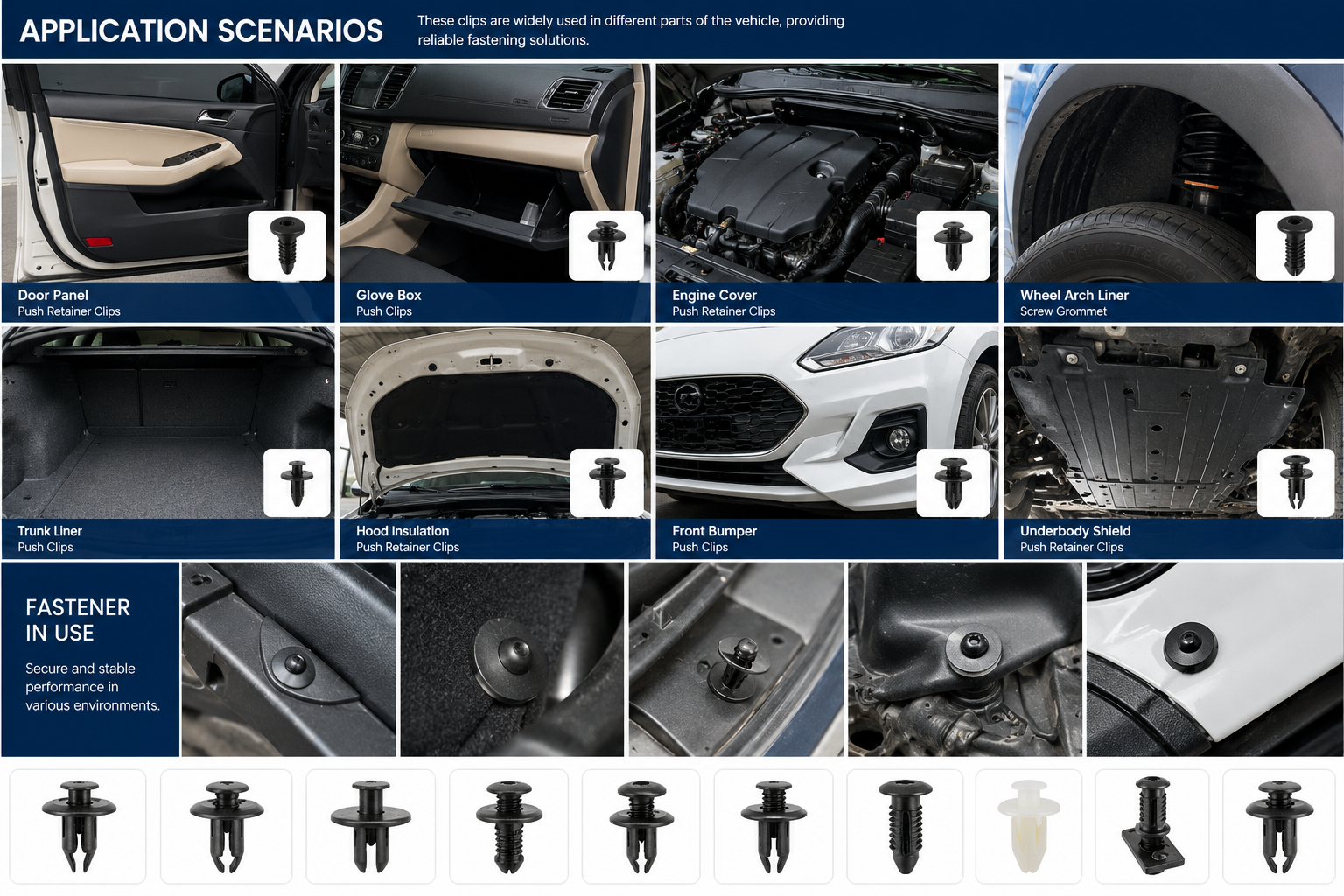
Applications Across Vehicle Platforms
| Vehicle Section | ODM Clip Function | Recommended Material | Strength (N) | Heat Resistance (°C) | Lifetime Cycles |
|---|---|---|---|---|---|
| Door Trim Panel | Retainer for decorative molding | PA66 + GF10 | 200 | 130 | 8,000 |
| Engine Bay | Harness & cable management | POM reinforced | 230 | 150 | 10,000 |
| Roof Liner | Insulation clip | Modified nylon | 160 | 100 | 6,000 |
| Bumper Assembly | Impact zone fixation | PA66 + GF30 | 250 | 140 | 9,000 |
| EV Battery Housing | Anti-vibration mount | PPS composite | 260 | 150 | 12,000 |
Each parameter represents QEEPEI’s engineering standard validated through internal testing and customer benchmarking.
Selection Guide for ODM Collaboration
-
Define Functional Objectives: Load requirement, temperature exposure, and removal frequency.
-
Material Selection: Match polymer structure to vehicle component (nylon for metal panels, POM for plastics).
-
Geometric Validation: Ensure clip diameter, barb depth, and flange width are tuned for robotic installation.
-
Testing Plan: Include pull-out, fatigue, and environmental resistance validation.
-
Scalability Assessment: Verify production line flexibility for design revisions.
Partnering with an experienced ODM supplier ensures faster time-to-market and consistent global quality alignment.
FAQ
Q: Can QEEPEI co-develop clips for new EV or hybrid vehicle platforms?
A: Yes. Our R&D team collaborates with EV manufacturers to design heat-stable and low-weight fastening systems.
Q: What is the minimum order quantity for ODM projects?
A: For new mold development, MOQ typically starts at 50,000 units, with scalable production up to 2 million annually.
Q: How do you validate long-term durability?
A: Through tensile, torsion, UV exposure, and environmental cycling tests according to ISO 16750 and SAE J400 standards.
Conclusion: Engineering the Future of Vehicle Connectivity
The ODM car clips industry defines how future vehicles will connect, adapt, and endure. Through advanced tooling, certified materials, and a customer-driven development process, QEEPEI ensures every clip aligns with both technical and commercial objectives.
From EV assembly to high-volume passenger cars, ODM fastening solutions are redefining reliability—one precision-molded part at a time.
Explore partnership opportunities via QEEPEI Homepage or connect directly through Contact Us.