
Fasteners rarely fail loudly. They loosen quietly. Crack silently. Corrode slowly. And when they finally give way, the cost is never just the buckle itself—it is the panel, the trim, the vibration complaint, or the returned shipment.
Plastic buckles vs metal buckles is not a cosmetic debate. It is a material engineering decision.
As an experienced Automotive Clips manufacturer, we often see fastening problems traced back to wrong material selection rather than structural design. Choosing correctly at the beginning prevents repeated rework later.
The Core Pain Point: Same Shape, Different Behavior
Two buckles may look identical in geometry. Yet their performance diverges dramatically depending on material.
Plastic buckles vs metal buckles differ in:
- Elastic recovery
- Corrosion resistance
- Weight
- Fatigue tolerance
- Electrical conductivity
- Thermal expansion
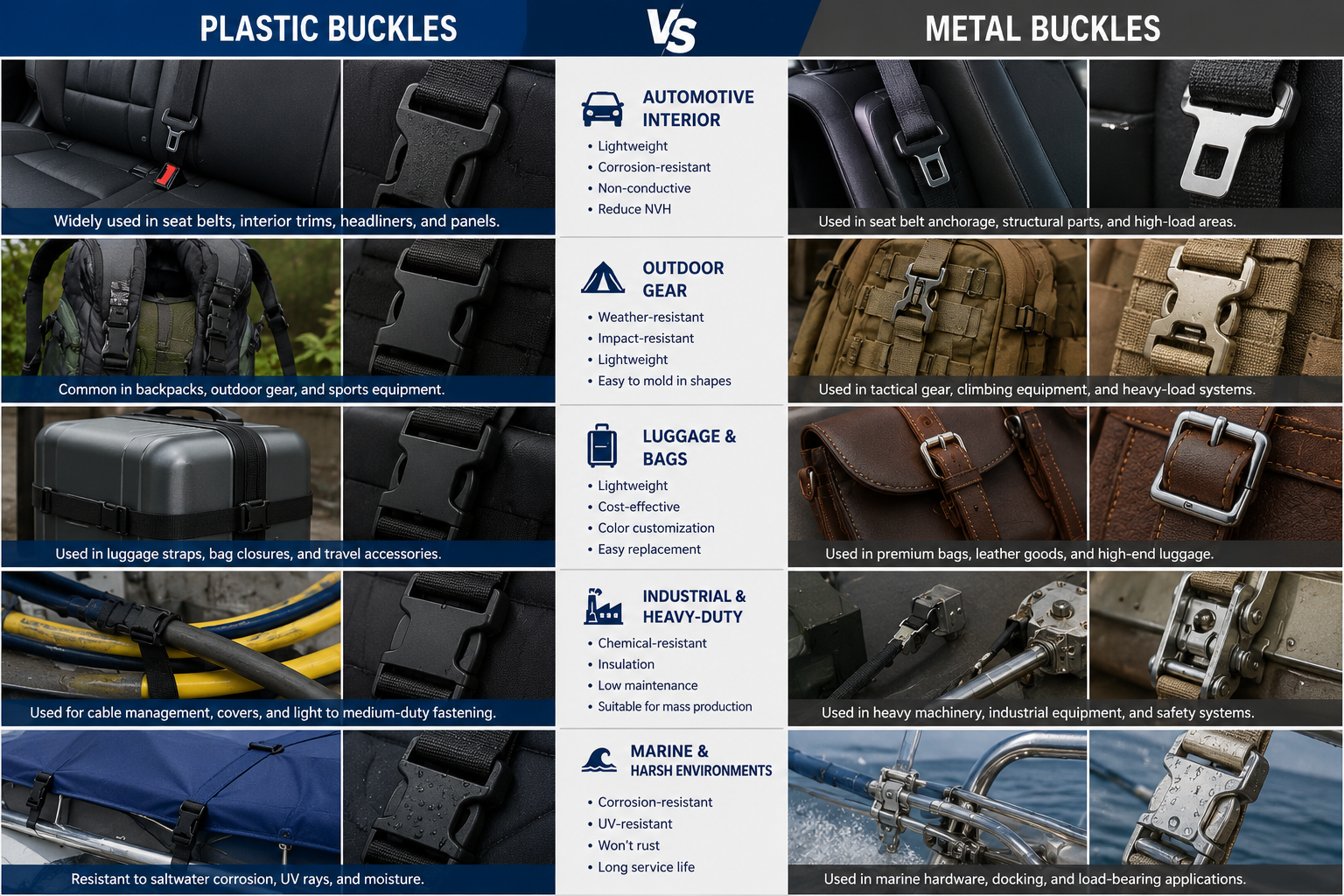
A metal buckle may withstand higher static load. A plastic buckle may outperform in vibration-heavy, corrosion-prone environments.
Material defines behavior.
Material Mechanics: Why Performance Diverges
Understanding polymer vs metal physics clarifies the difference.
Plastic Buckles (Common Materials)
- PA6
- PA66
- PA66 GF reinforced
- POM
Characteristics:
- Tensile strength: 65–140 MPa
- Density: ~1.1–1.4 g/cm³
- Excellent corrosion resistance
- Controlled elastic deformation
- Lightweight
Metal Buckles (Common Materials)
- Carbon steel
- Stainless steel
- Zinc-plated steel
Characteristics:
- Tensile strength: 300–1000+ MPa
- Density: ~7.8 g/cm³
- High load capacity
- Susceptible to corrosion without coating
- Higher rigidity
Plastic buckles vs metal buckles is essentially elasticity vs rigidity.
Structural Load Comparison
| Factor | Plastic Buckles | Metal Buckles |
|---|---|---|
| Static Load Capacity | Medium | High |
| Vibration Absorption | Excellent | Low |
| Corrosion Resistance | High | Depends on coating |
| Weight | Very Light | Heavy |
| Installation Flexibility | High | Moderate |
| Thermal Conductivity | Low | High |
Plastic absorbs vibration. Metal transfers it.
In automotive trim systems, vibration damping often matters more than peak load strength.
When Plastic Buckles Outperform
Plastic buckles are preferred when:
- Weight reduction is critical
- Vibration absorption needed
- Corrosion environment present
- Frequent removal required
- Electrical insulation required
Modern nylon fasteners used by a qualified Automotive Clips manufacturer are engineered with stabilizers and reinforcement to handle demanding environments.
When Metal Buckles Are Necessary
Metal buckles are preferred when:
- Structural load exceeds 300 N consistently
- Extreme heat environment (>150°C)
- High shear stress zones
- Mechanical locking needed without elasticity
Metal offers rigidity. But rigidity can create stress concentration in flexible panels.
Real Case: Corrosion-Induced Failure in Coastal Market
A distributor supplying coastal regions used zinc-coated metal buckles for exterior panels.
After 18 months:
- Coating degradation
- Corrosion spread
- Loosening complaints increased
Solution:
- Switched to PA66 GF reinforced plastic buckles
- Eliminated corrosion issue
- Reduced weight by 40%
Plastic buckles vs metal buckles decision significantly reduced return rate.
Manufacturing Perspective: Precision Matters More Than Material Alone
Material choice is only one factor. Dimensional control ensures performance.
At QEEPEI, we maintain:
- Mold tolerance ±0.02–0.03 mm
- Moisture control <0.2%
- Reinforcement ratio consistency
- Batch tensile validation
Learn more about our capabilities on our About Us page:
https://www.cnclip.com/about-us
Explore full product range here:
https://www.cnclip.com/products
Reliable production discipline strengthens both plastic and metal solutions.
Application-Based Selection Guide
| Application | Recommended Material |
|---|---|
| Interior trim | Plastic (PA66) |
| Bumper mounting | Plastic GF reinforced |
| Engine bay light cover | Metal or reinforced plastic |
| Underbody structural bracket | Metal |
| Wiring harness fastening | Plastic |
Selection should match environment—not assumption.
FAQ
Q1: Are plastic buckles weaker than metal buckles?
Not necessarily. Reinforced nylon can handle moderate structural load while providing vibration absorption.
Q2: Do metal buckles always last longer?
In corrosion environments, untreated metal may fail earlier than plastic.
Q3: Which is better for automotive trim?
Plastic buckles vs metal buckles—plastic is typically preferred for trim systems due to elasticity and lightweight benefits.
For more technical insights, visit our FAQ page:
https://www.cnclip.com/blog
Conclusion
Plastic buckles vs metal buckles is a strategic engineering choice, not a preference issue. The right material depends on load, environment, vibration profile, and service cycle.
A professional Automotive Clips manufacturer evaluates material science, dimensional precision, and application scenario before recommending fastening solutions.
Choosing correctly once prevents dozens of problems later.
Contact us for technical support:
https://www.cnclip.com/contact-us