
Processing Plant Car Retainer Clips: Industrial Precision in Automotive Fastening
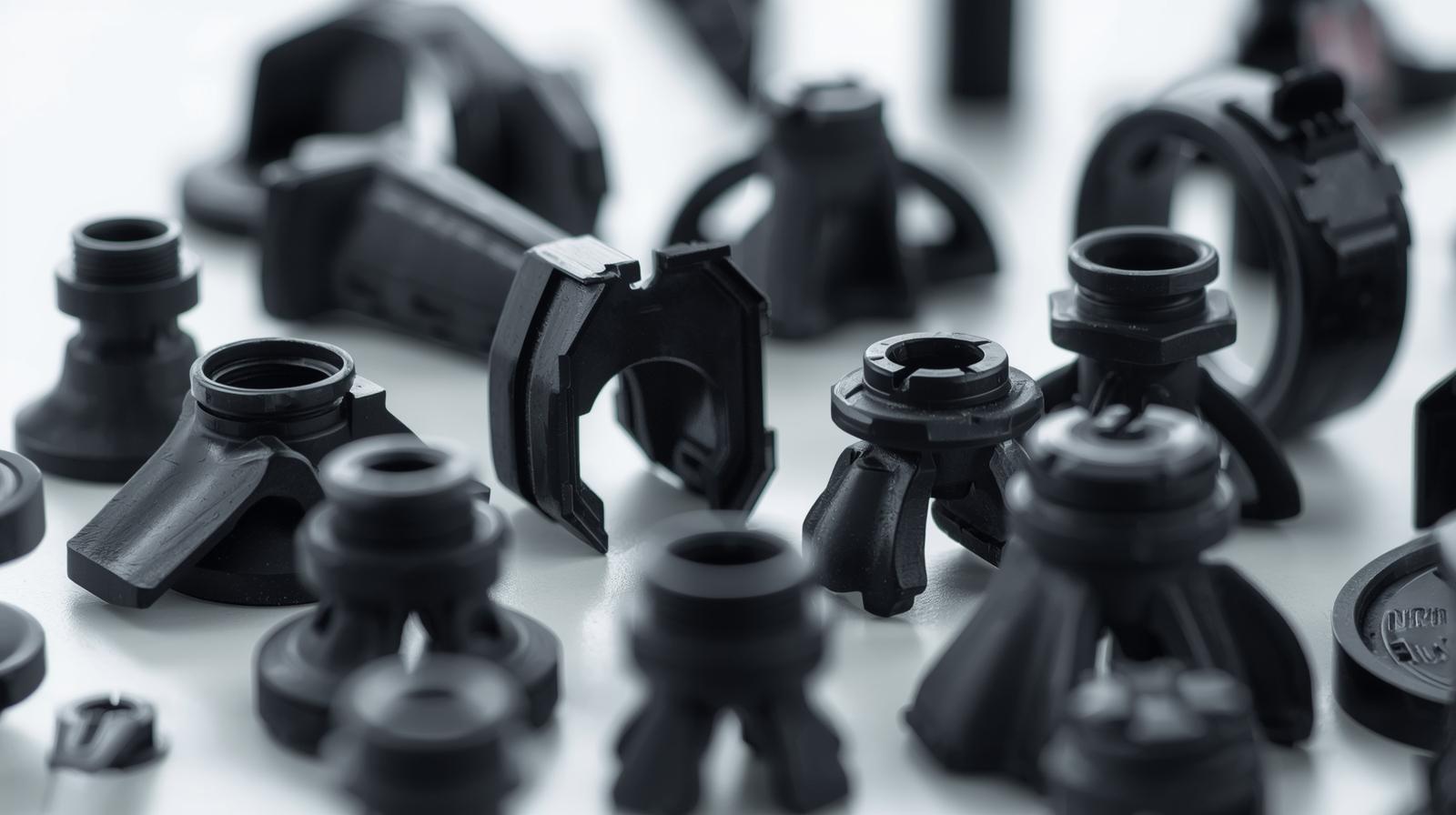
In modern automotive manufacturing, every component—no matter how small—defines the vehicle’s overall integrity. Among these, processing plant car retainer clips stand out as silent structural anchors, maintaining alignment, vibration resistance, and aesthetic precision.
Unlike generic injection-molded parts, these clips undergo a meticulously engineered production cycle involving multi-stage tooling, resin conditioning, and automated quality control. QEEPEI, a leader in industrial fastener processing, integrates robotics and AI-driven inspection systems to ensure every clip matches OEM expectations with near-zero deviation.
Common Pain Points in Automotive Clip Production
Automotive suppliers face persistent challenges when scaling production for fastening components:
-
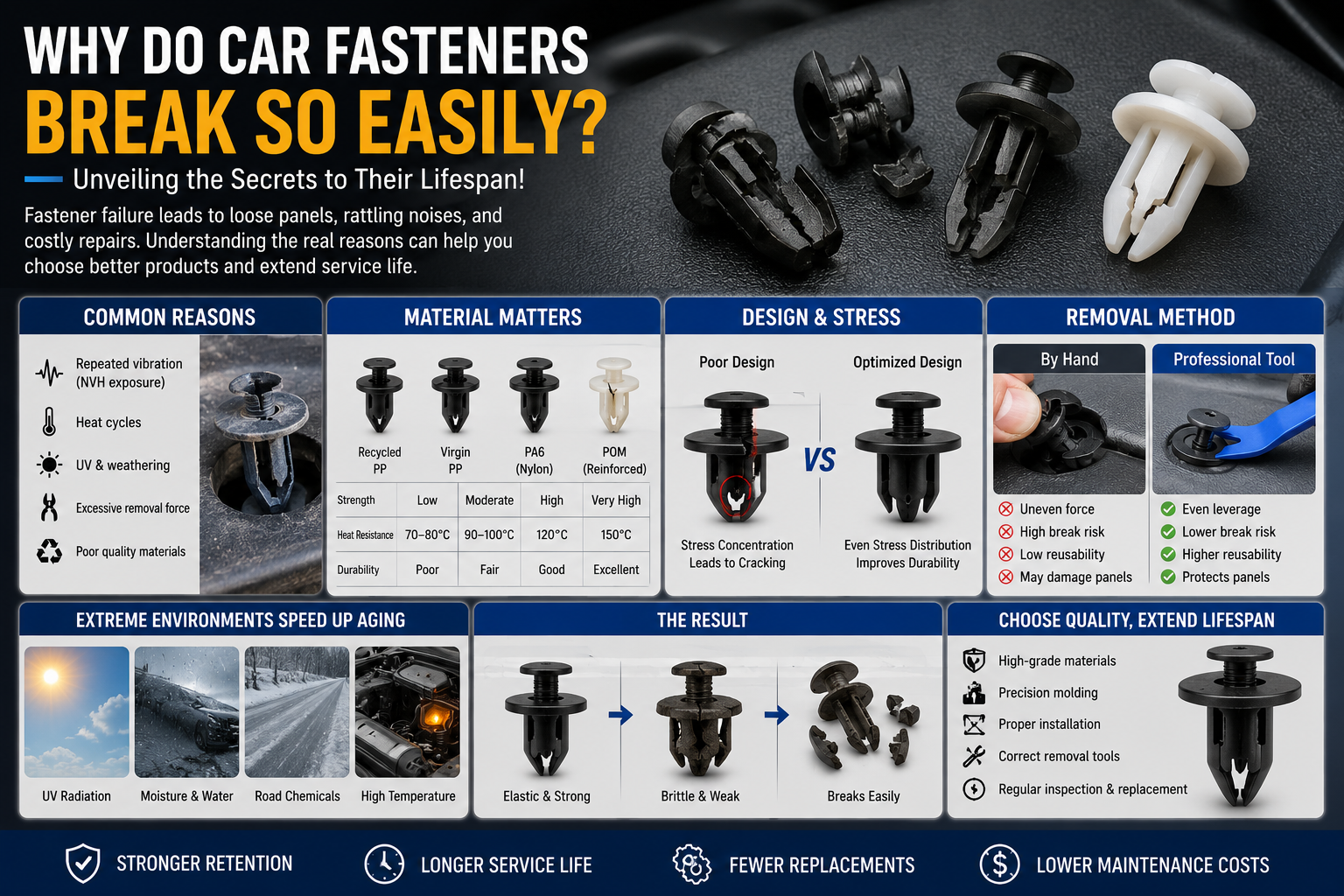
Dimensional instability due to temperature fluctuations during molding.
-
Uneven polymer flow creating weak stress points.
-
Low repeatability in multi-cavity mold systems.
-
Inadequate tensile and impact resistance leading to clip fracture during assembly.
-
Poor traceability across production batches.
Such issues directly affect assembly precision and vehicle NVH (Noise, Vibration, Harshness) performance—critical for both OEM and aftermarket applications.
The Engineering Logic Behind High-Precision Clip Manufacturing
Processing plant car retainer clips rely on precision-controlled production environments.
-
Material Drying and Conditioning: PA66 and POM are moisture-sensitive; pre-drying ensures molecular stability.
-
Multi-Zone Temperature Control: Prevents internal stress and warpage.
-
Cavity Pressure Monitoring: Sensors regulate fill speed and packing pressure for uniform geometry.
-
Post-Molding Annealing: Stabilizes internal structure to maintain long-term dimensional accuracy.
-
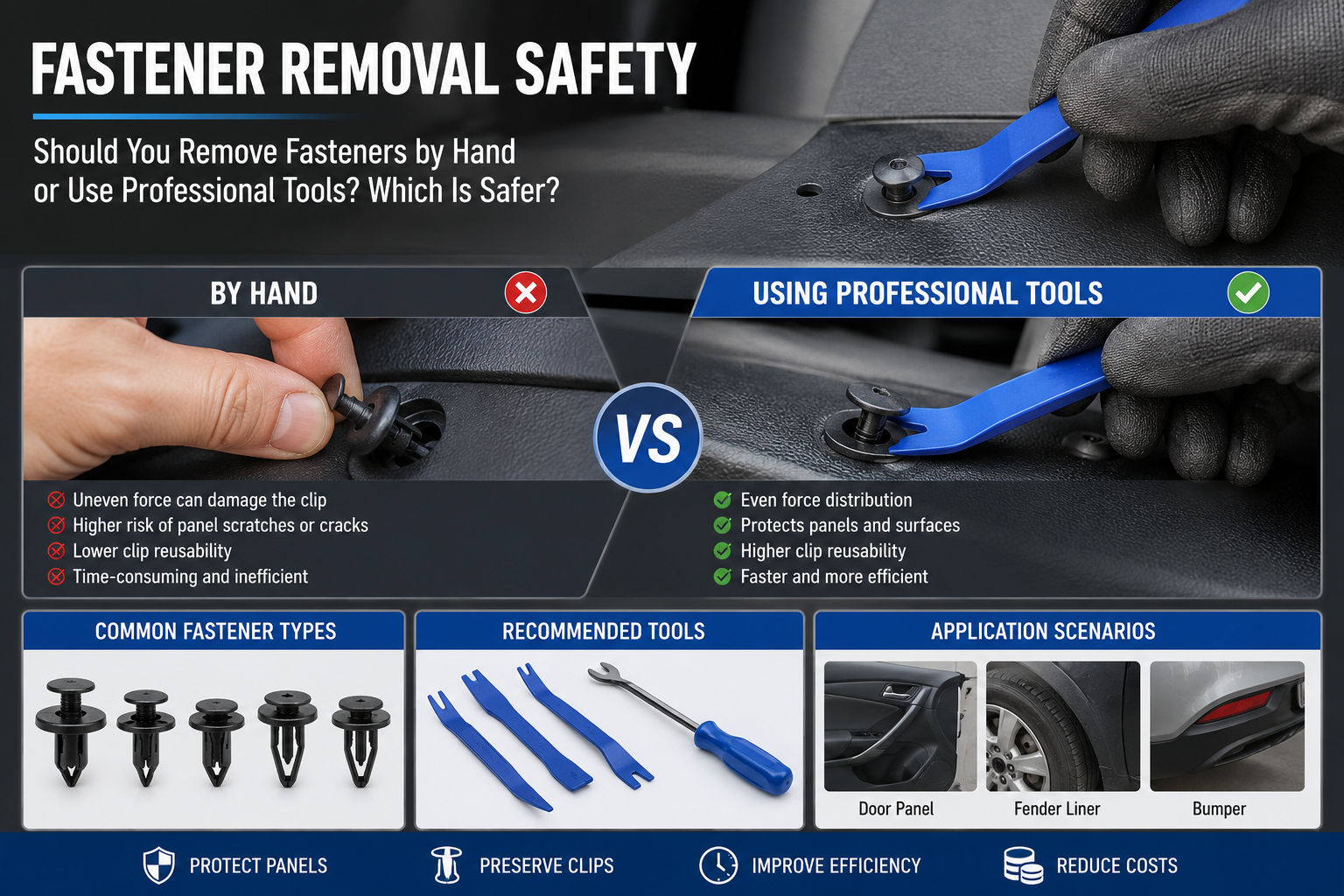
Automated Deburring and Finishing: Guarantees smooth clip edges to prevent vehicle panel scratches.
These stages transform basic polymer feedstock into structural-grade automotive components.
Generic Manufacturing vs. Advanced Processing Plants
| Production Parameter | Generic Workshop | Processing Plant Car Retainer Clips (QEEPEI) |
|---|---|---|
| Mold Tolerance | ±0.08 mm | ±0.02 mm CNC-calibrated |
| Cavity Count | 1–4 cavities | 8–16 optimized balance flow |
| Material Type | Standard PA6 | PA66 + 10–30% GF (OEM grade) |
| Production Rate | 25 pcs/min | 60 pcs/min automated system |
| Quality Check | Manual visual | Optical + tensile + torque testing |
| Batch Traceability | No system | ERP QR code tracking |
| Waste Ratio | 4–6% | <1% closed-loop recycling |
| Energy Efficiency | Conventional heating | Servo-electric molding (25% less energy) |
This industrial evolution ensures both environmental responsibility and mechanical superiority.
QEEPEI’s Industrial Processing Framework
QEEPEI operates integrated facilities built for precision, repeatability, and scalability.
-
Fully Automated Injection Cells: Human-free molding stations for continuous operation.
-
Digital Mold Lifecycle Management: Real-time wear detection for preventive maintenance.
-
In-Line AI Inspection: Each part imaged and measured for geometry and density.
-
Automated Packaging: Barcode sorting ensures logistics traceability.
-
Energy Recovery Systems: Reuses thermal energy, cutting power usage by 18%.
Such digital processing infrastructure turns high-volume manufacturing into a science of precision.
Performance Advantages of Industrially Processed Clips
-
Superior Retention Strength: Holds over 200 N without deformation.
-
Dimensional Integrity: Maintains ±0.02 mm variance across 10,000 parts.
-
Thermal Stability: Operational range from –40°C to +150°C.
-
Fatigue Resistance: Withstands 8,000 cycles of installation/removal.
-
Supply Consistency: Multi-site production ensures uninterrupted OEM delivery.
These features make QEEPEI’s clips a preferred choice for global automotive brands.
Applications Across Vehicle Systems
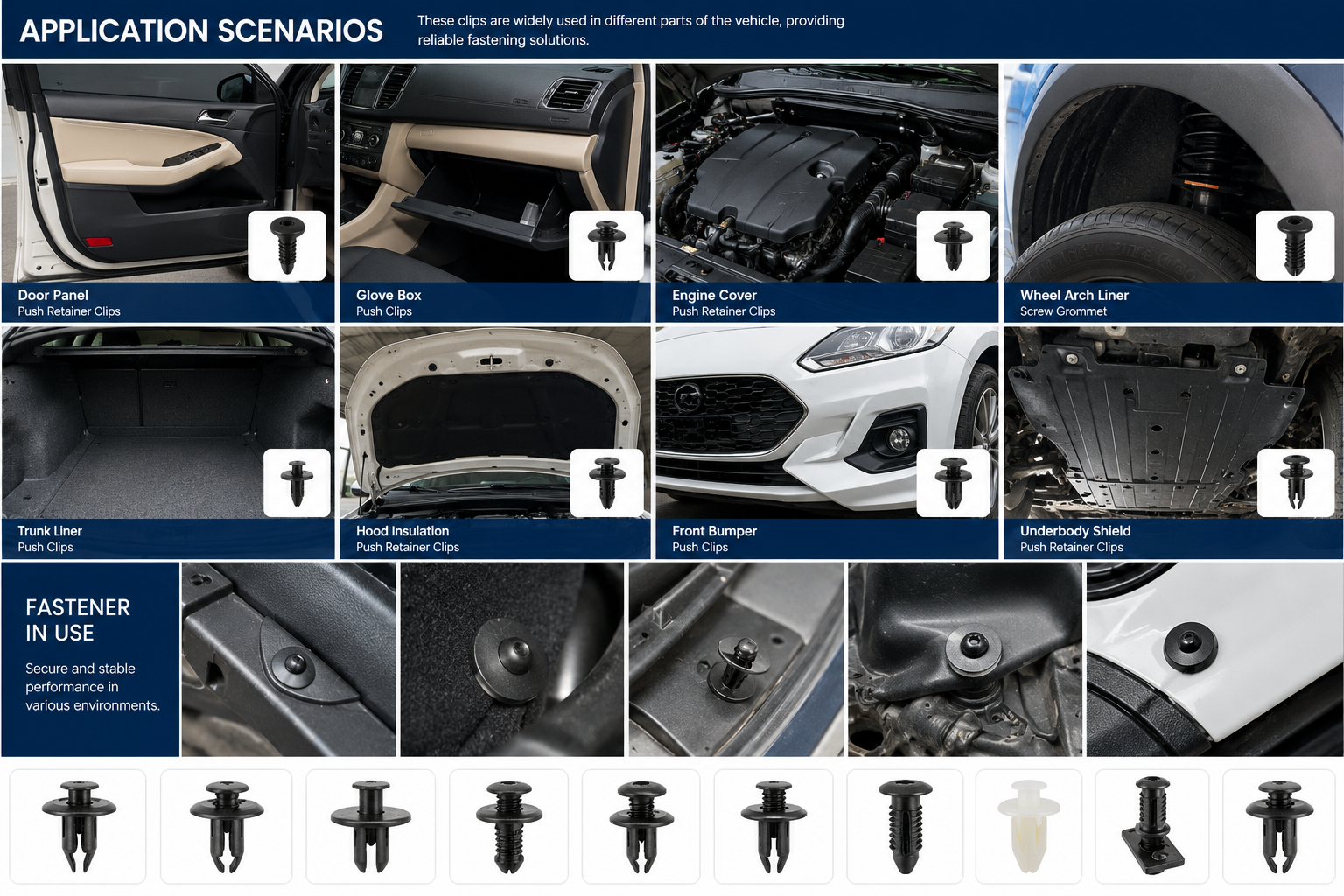
| Vehicle Section | Function | Recommended Clip Type | Material | Tested Load (N) | Service Temp (°C) |
|---|---|---|---|---|---|
| Door Panel | Trim alignment | Push retainer | PA66 + GF15 | 180 | –30 to 120 |
| Engine Bay | Wire harness fixing | Lock rivet | POM reinforced | 240 | –40 to 130 |
| Fender Mount | Panel fastening | Snap clip | Nylon 6/6 | 210 | –20 to 110 |
| Roof Liner | Interior stability | Expansion clip | Modified PP | 160 | –10 to 90 |
| Underbody Shield | Vibration isolation | Rubber-metal hybrid clip | PA66 + elastomer | 280 | –40 to 150 |
Each specification demonstrates industrial precision combined with material science.
Selection Guidance for Engineers and Procurement Teams
-
Assess Vehicle Environment: Exposure to temperature, UV, and moisture.
-
Match Clip Geometry: Align barb angle, shaft diameter, and flange size with panel design.
-
Evaluate Installation Method: Determine compatibility with manual, pneumatic, or robotic systems.
-
Verify Compliance: Ensure supplier certifications include IATF 16949, ISO 9001, and RoHS.
-
Prioritize Batch Consistency: Insist on QR-coded traceability and SPC reporting.
This approach ensures technical alignment between product design and production logistics.
FAQ
Q: How does QEEPEI maintain consistent clip dimensions in mass production?
A: By employing in-mold sensors and closed-loop control systems that auto-adjust pressure and temperature in real time.
Q: Are recycled polymers used in processing plant clips?
A: Only secondary internal regrinds are reused, maintaining resin purity and mechanical properties.
Q: Can QEEPEI customize clips for EV or composite body panels?
A: Yes. QEEPEI’s ODM division develops resin blends and tooling designs specific to EV platforms and lightweight materials.
Conclusion: From Polymer to Precision
The production of processing plant car retainer clips exemplifies how industrial engineering transforms simple materials into structural solutions. With advanced automation, global supply reliability, and certified quality systems, QEEPEI ensures each clip not only meets but defines automotive fastening standards.
For OEM partnerships or industrial cooperation, visit QEEPEI Homepage or connect directly via Contact Us.