
 Bumper Clip for Car Distributor: Stabilizing Supply, Margins, and Mechanical Performance
In automotive distribution, bumper clips may look like low-value consumables. They are not. For a serious bumper clip for car distributor, these components represent a high-volume, high-turnover product category that directly affects workshop satisfaction, fleet maintenance efficiency, and aftermarket reputation.
Every bumper clip must withstand vibration, temperature variation, and minor impact loads. If it fails prematurely, the distributor—not the factory—often absorbs the reputational cost. That is why sourcing discipline matters as much as pricing strategy.
Where Distributors Face Operational Friction
Distributors operating in multi-brand environments encounter recurring issues:
-
SKU fragmentation across Toyota, Nissan, Ford, VW platforms
-
Inconsistent clip geometry causing return rates above 5–8%
-
Supply instability during peak repair seasons
-
Excess inventory tied to slow-moving vehicle models
-
Margin compression due to unreliable supplier pricing
These challenges are commercial as much as technical. Poor sourcing strategy erodes both warehouse efficiency and customer loyalty.
Mechanical Performance Benchmarks for Bumper Clips
Before a distributor evaluates cost, they must understand performance metrics. A reliable bumper clip should meet the following standards:
-
Pull-Out Strength: 220–260 N for reinforced bumper mounting points
-
Insertion Force: 35–50 N (balanced for manual or pneumatic installation)
-
Impact Absorption: 15–20% energy dispersion during low-speed collision
-
Thermal Resistance: –40°C to +130°C sustained
-
Salt Spray Endurance: ≥500 hours without material degradation
Distributors who verify these numbers reduce downstream claims and maintain consistent reorder cycles.
Price-Driven Trading vs Structured Distribution Strategy
| Criteria | Low-Cost Trading Source | Professional Bumper Clip for Car Distributor Model |
|---|---|---|
| Material Grade | Standard PA6 | PA66 + GF10 OEM-grade |
| Dimensional Tolerance | ±0.10 mm | ±0.03 mm controlled molding |
| Return Rate | 6–10% | <2% verified batch control |
| Heat Resistance | ≤100°C | 130°C sustained |
| Packaging | Bulk plastic bags | Barcode carton + palletized export |
| Lead Time | 30–40 days unstable | 14–21 days bonded logistics |
| Margin Stability | Volatile | Long-term contract pricing |
The structured model produces stability—not just shipments.
How QEEPEI Supports Professional Distributors
A dependable distributor requires a dependable manufacturing backbone. QEEPEI provides that foundation through:
-
16-cavity high-precision molds (±0.02–0.03 mm accuracy)
-
AI optical inspection covering 100% production
-
Automated tensile and fatigue testing
-
Climate-controlled warehousing to prevent moisture distortion
-
Flexible MOQ and mixed-container export capability
By partnering with QEEPEI, distributors gain predictable quality and repeatable supply cycles.
Commercial Advantages for Distribution Networks
-
Lower Return Rates: Dimensional consistency reduces claims by up to 20%
-
Inventory Optimization: Stable SKUs across multiple car models
-
Higher Customer Retention: Workshops trust consistent fitment
-
Improved Cash Flow: Reliable lead times reduce overstock buffering
-
Private Label Options: Brand-building opportunities with serialized packaging
In distribution, reliability compounds into profit.
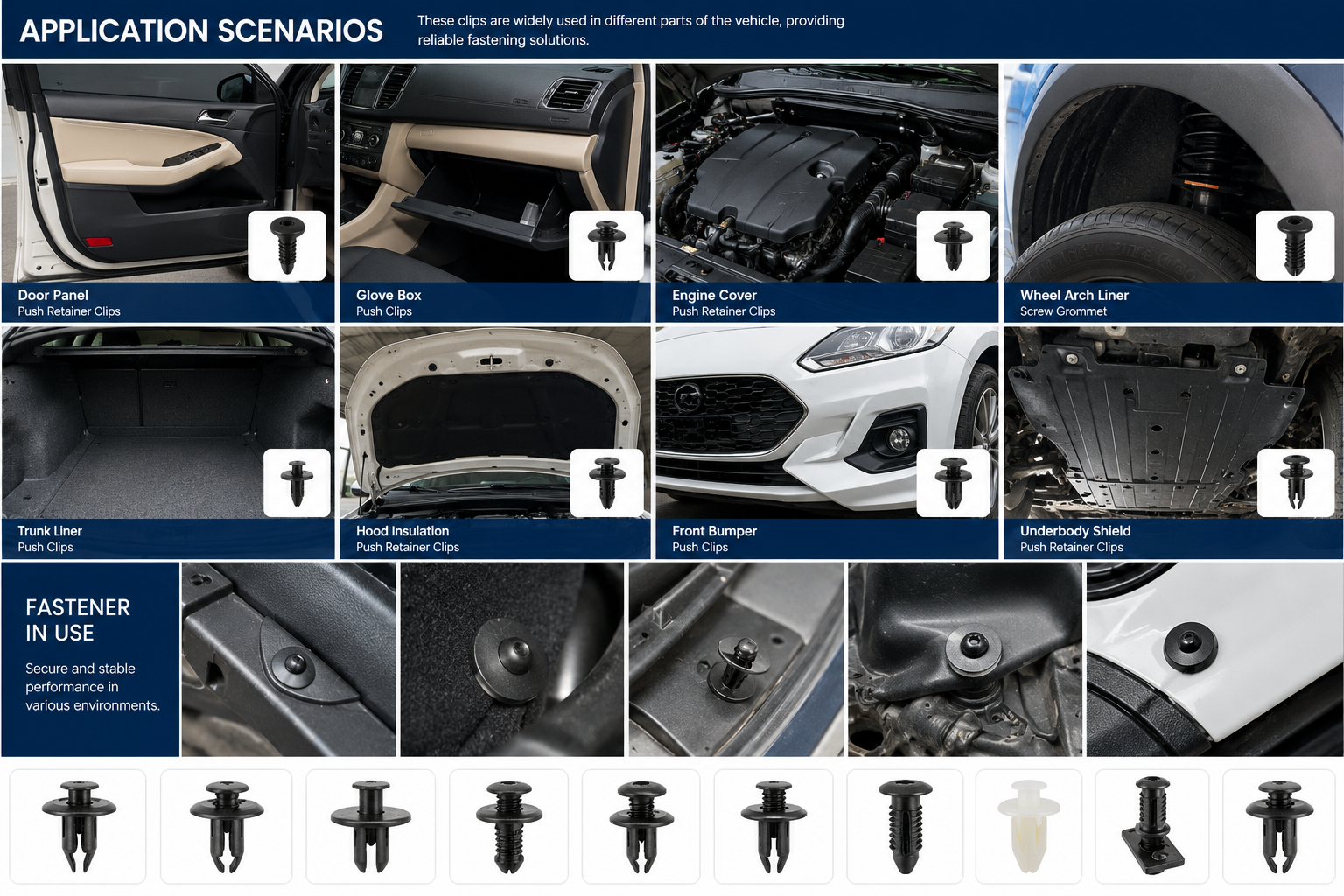
Application Across Market Segments
| Market Segment | Typical Vehicle Type | Clip Diameter | Retention Strength (N) | Usage Frequency |
|---|---|---|---|---|
| Body Repair Shops | Passenger sedans | 8 mm | 230 | High turnover |
| Fleet Maintenance | SUVs & vans | 9–10 mm | 250 | Medium turnover |
| Insurance Repair Networks | Multi-brand | 6–10 mm mix | 220–260 | Seasonal peaks |
| Aftermarket Retail | Compact vehicles | 6–8 mm | 200 | Moderate |
This diversity highlights why distributors must carry standardized, high-performance clips rather than inconsistent alternatives.
Procurement Checklist for Distributors
-
Validate tensile and insertion force reports
-
Confirm IATF 16949 and REACH documentation
-
Inspect packaging compression rating (>12 kN recommended)
-
Request pre-shipment random sample verification
-
Negotiate fixed-term pricing to reduce volatility
Structured procurement reduces uncertainty across the supply chain.
FAQ
Q: What is the ideal inventory turnover rate for bumper clips?
A: Most distributors target 8–12 rotations per year depending on regional repair demand.
Q: How can distributors reduce return rates?
A: Partner with manufacturers that guarantee ±0.03 mm dimensional tolerance and full-batch inspection.
Q: Does QEEPEI support mixed-SKU container exports?
A: Yes. Serialized carton labeling simplifies warehouse management for distributors.
Conclusion: Distribution Built on Precision, Not Guesswork
A serious bumper clip for car distributor does not gamble on fasteners. Precision manufacturing, compliance documentation, and predictable logistics define long-term profitability.
By aligning with QEEPEI, distributors gain mechanical reliability, commercial stability, and global supply assurance—transforming a small component into a dependable revenue engine.
For distribution partnerships or bulk inquiries, visit:
https://www.cnclip.com/
or contact directly at:
https://www.cnclip.com/contact-us