
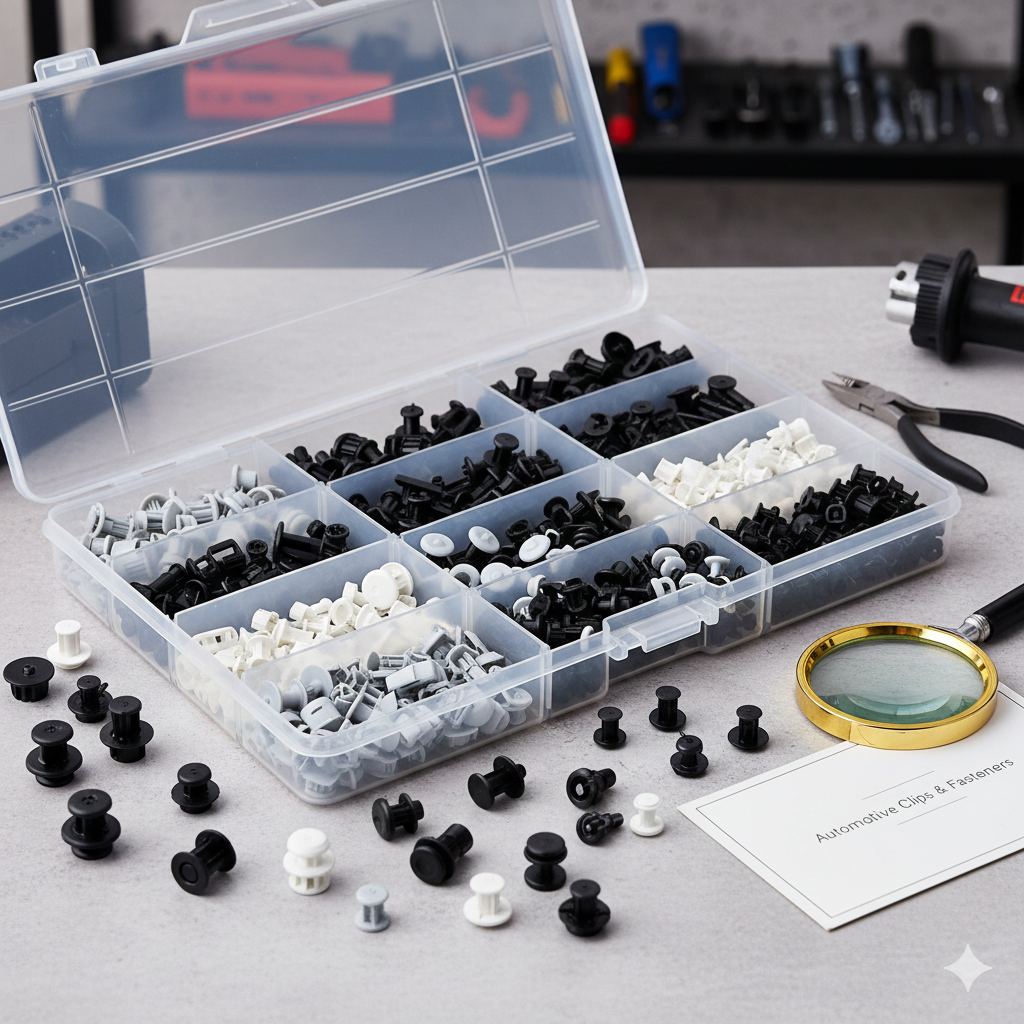
Car Door Panel Clips Supplier: Engineering Secure, Silent, and Seamless Automotive Interiors
Inside every vehicle, the quality of a door panel’s fit defines first impressions. Poorly secured panels rattle, vibrate, and compromise acoustic comfort. A trusted car door panel clips supplier ensures that fastening systems perform under mechanical stress, temperature variation, and repeated use—without deformation or noise generation.
QEEPEI specializes in developing and manufacturing high-performance clips engineered for tight tolerances, soundproofing integration, and easy robotic or manual installation. These components quietly uphold the refinement standards of modern automotive interiors.
Persistent Industry Pain Points
Even global automakers face recurring fastening challenges:
-
Inconsistent retention strength leading to panel looseness.
-
Clip breakage during high-speed assembly or cold-weather installation.
-
Poor alignment tolerance causing visible gaps.
-
Interior squeak and rattle (S&R) due to insufficient vibration damping.
-
High part rejection rates from batch variation in molding.
For B2B buyers, these translate into costly rework, warranty claims, and damaged brand perception.
The Technical Foundation of Reliable Door Panel Fastening
The performance of a door panel clip depends on three interlinked engineering principles:
-
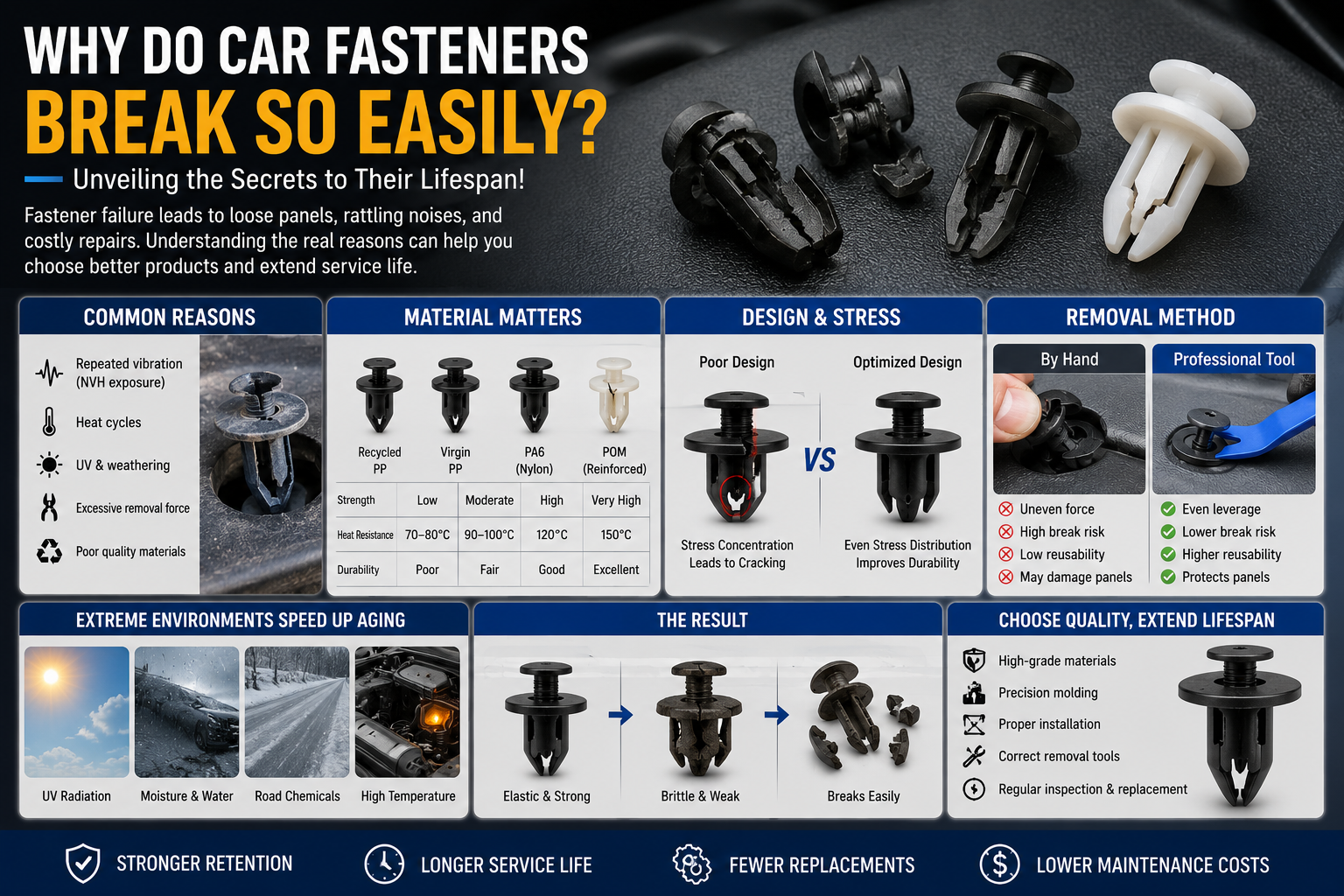
Elastic Retention Geometry – Multi-barbed or wedge-style clip shafts distribute stress evenly along insertion depth, preventing local breakage.
-
Material Modulus Optimization – PA66 + 10–30% glass fiber composites balance flexibility with impact resistance.
-
Thermal and Aging Stability – Stabilized polymers retain 90% retention force after 5,000 thermal cycles (–30°C to +120°C).
These variables determine whether clips maintain fit precision throughout the vehicle’s lifespan.
Local Vendors vs. OEM-Grade Suppliers
| Criteria | Local/Generic Supplier | QEEPEI – Car Door Panel Clips Supplier |
|---|---|---|
| Material Composition | Standard PA6 | Certified PA66 + GF (OEM blend) |
| Dimensional Tolerance | ±0.10 mm | ±0.03 mm CNC-controlled |
| Acoustic Damping | None | Integrated EVA or TPE layer |
| Pull-Out Strength | 120 N | 200–240 N (ASTM D638 tested) |
| UV Resistance | 300 h | 1,000 h accelerated aging |
| Recyclability | Partial | 100% RoHS & REACH compliant |
| Quality Traceability | Manual log | ERP-based QR tracking |
Industrial consistency transforms an ordinary clip into a precision interior component.
QEEPEI’s Manufacturing Process Control
QEEPEI integrates automotive-grade process control systems that guarantee every batch performs identically:
-
Multi-Zone Mold Temperature Regulation – Prevents uneven crystallization and shrinkage.
-
In-Mold Pressure Sensors – Continuously monitor cavity filling for uniform density.
-
Optical Inspection Units – Detect micro-deformation invisible to human eyes.
-
Robotic Packaging and Labeling – Reduces handling defects and ensures traceability.
Every production stage aligns with IATF 16949 standards for global OEM supply chains.
Key Advantages for Automotive Manufacturers
-
Dimensional Stability: Precision fit under continuous thermal expansion and contraction.
-
Noise Reduction: Built-in damping interfaces lower NVH scores by up to 20%.
-
Reduced Assembly Time: Low insertion force and automatic alignment features streamline robotic assembly.
-
High Durability: Proven to survive 10,000 installation-removal cycles.
-
Sustainability: Recyclable composites minimize environmental impact.
Through this, QEEPEI achieves the balance between mechanical performance and comfort refinement.
Applications Across Vehicle Platforms
| Vehicle Type | Clip Design | Material | Retention Strength (N) | Tested Temperature (°C) | Application Notes |
|---|---|---|---|---|---|
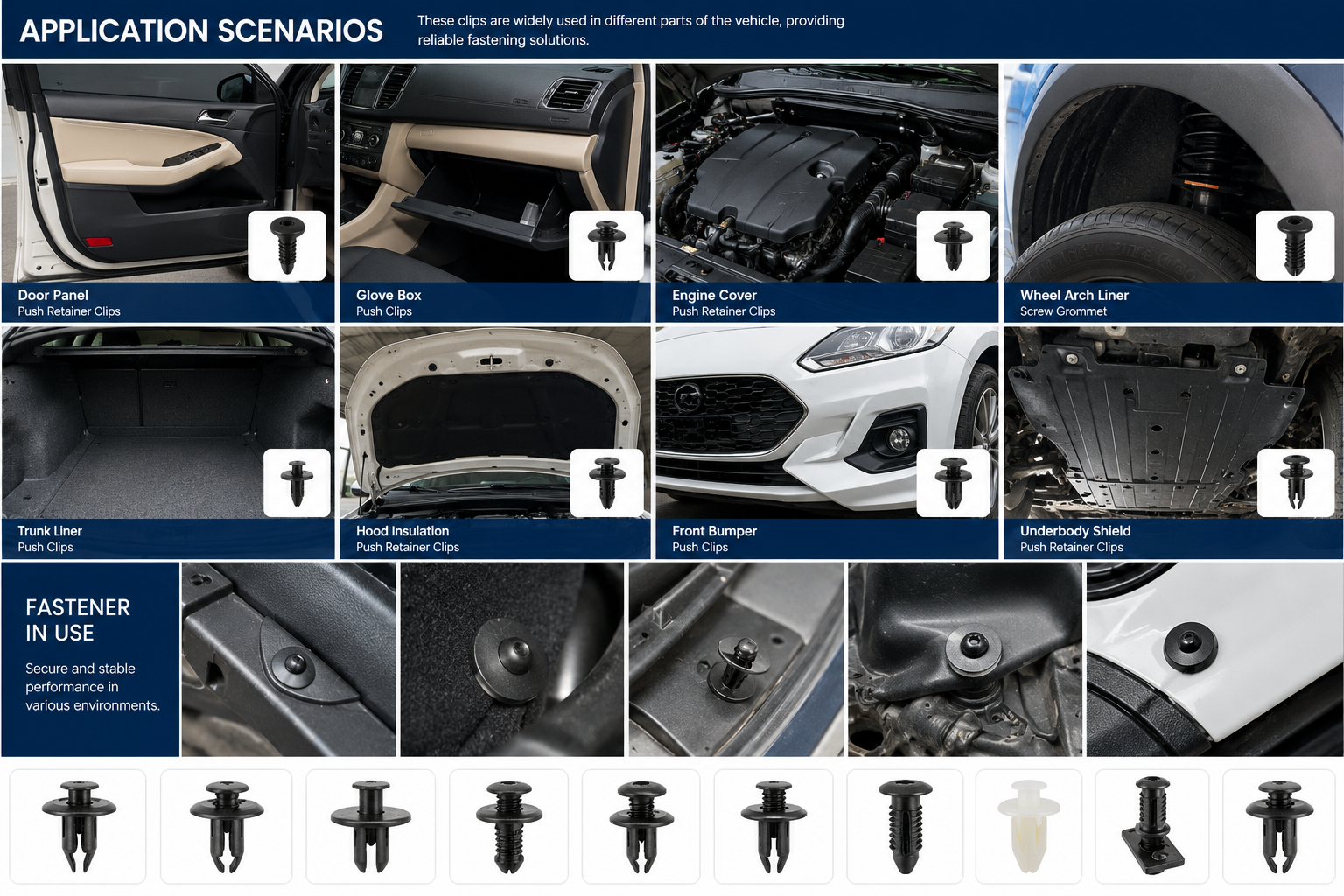
| Compact Cars | Wedge barbed clip | PA66 + GF15 | 190 | –30 to 120 | Ideal for thin trim panels |
| SUVs | Reinforced push clip | POM + elastomer seal | 230 | –40 to 130 | Enhanced for vibration control |
| Sedans | Acoustic retainer | PA66 + TPE | 210 | –25 to 110 | Improved noise isolation |
| EV Platforms | Hybrid clip (metal insert) | Nylon composite | 250 | –40 to 140 | Thermal resistance for battery areas |
This modularity allows direct adaptation to multi-segment manufacturing programs.
Selection and Procurement Guidelines
-
Define Assembly Tolerance: Establish acceptable gap and insertion variance.
-
Test for Removal Resistance: Ensure force consistency across production batches.
-
Select Polymer Blend: Match flexibility and tensile load requirements.
-
Confirm Compliance: Demand full IATF, ISO, and material certificates.
-
Verify Packaging Integrity: Anti-static and moisture-proof standards for export.
An informed specification sheet reduces long-term service risks in both OEM and aftermarket supply chains.
FAQ
Q: What testing standards does QEEPEI use for clip performance?
A: ASTM D638 (tensile), ISO 16750 (environmental), and SAE J400 (aging) are applied across all product series.
Q: Can QEEPEI customize clips for different door thicknesses or materials?
A: Yes. Custom mold design and geometry modification are standard services in QEEPEI’s ODM process.
Q: What is the standard lead time for OEM shipments?
A: Typically 4–6 weeks, supported by JIT delivery from regional warehouses in China and Europe.
Conclusion: Quiet Precision That Shapes Automotive Interiors
The refinement of modern vehicles depends not only on visible aesthetics but also on the engineering behind every connection. A professional car door panel clips supplier like QEEPEI ensures structural integrity, acoustic harmony, and production stability.
With intelligent molding, certified materials, and end-to-end traceability, QEEPEI helps automakers secure every detail—one clip at a time.
For OEM or distributor inquiries, visit QEEPEI Homepage or reach us directly via Contact Us.