
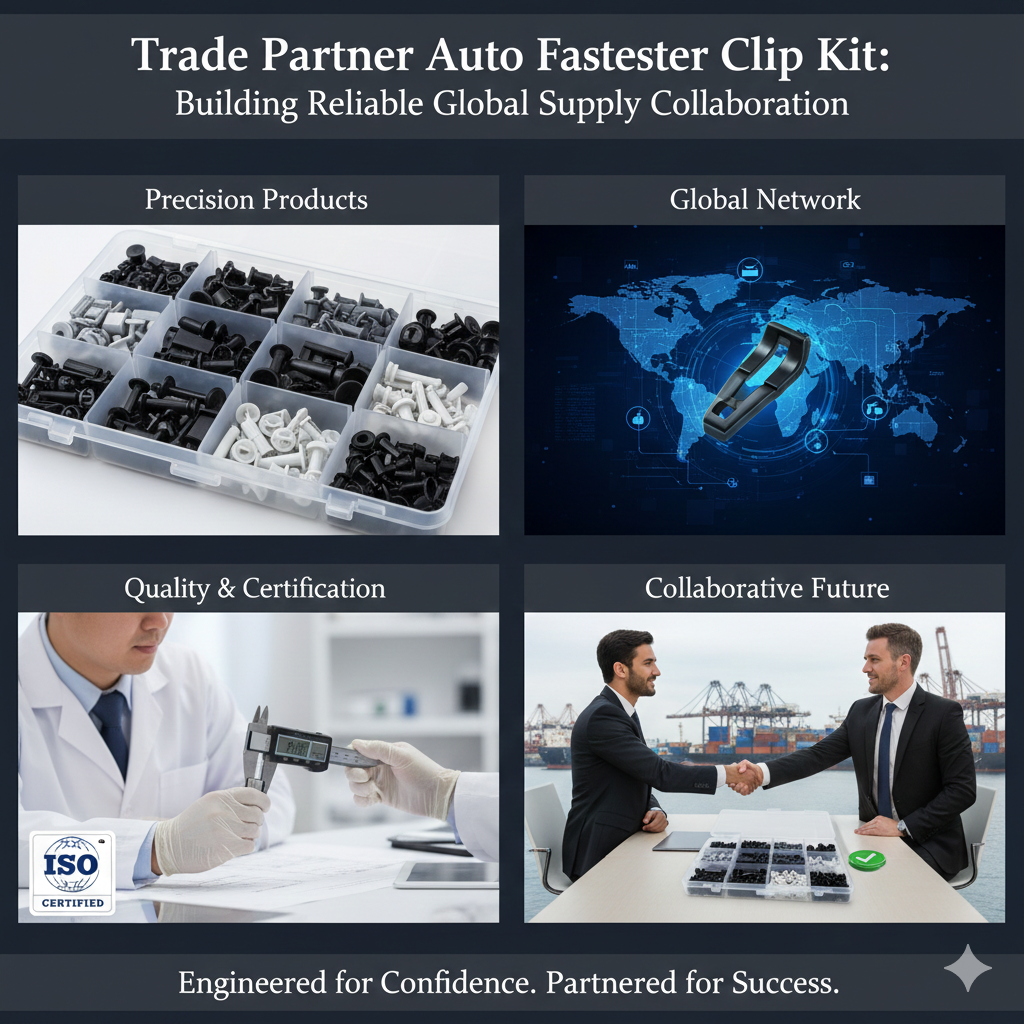
Trade Partner Auto Fastener Clip Kit: Building Reliable Global Supply Collaboration
In today’s automotive supply landscape, trade partnerships thrive on precision, predictability, and product integrity. Whether supplying to OEM workshops or independent garages, every trade partner relies on one constant—a dependable fastener clip system. The auto fastener clip kit by QEEPEI bridges global demand and localized distribution, empowering partners to deliver OEM-level performance with consistent logistics support.
Pain Points in Global Trade Collaboration
Many importers and distributors face hidden inefficiencies that hurt profitability:
-
Unstandardized fasteners: Variations in material strength cause misalignment in panels.
-
Supply fragmentation: Multiple small vendors increase procurement risk.
-
Packaging inconsistency: Mixed or unlabeled kits complicate warehouse management.
-
Shipment delays: Poor container coordination disrupts restocking schedules.
-
After-sales gap: Limited technical documentation reduces reseller confidence.
According to McKinsey’s Automotive Supply Optimization Report (2024), distributors who streamlined their fastener supply through OEM-aligned partners reduced downtime costs by 22% on average.
Principle: The Engineering Logic of Clip Kits
Every auto fastener clip kit follows a core principle — modular compatibility across brands and applications.
The SAE J1239 and ISO 9001/IATF 16949 standards define durability thresholds, tensile resistance, and material stress ratios for plastic automotive fasteners.
| Clip Category | Function | Material | Fitment Range | Resistance Level |
|---|---|---|---|---|
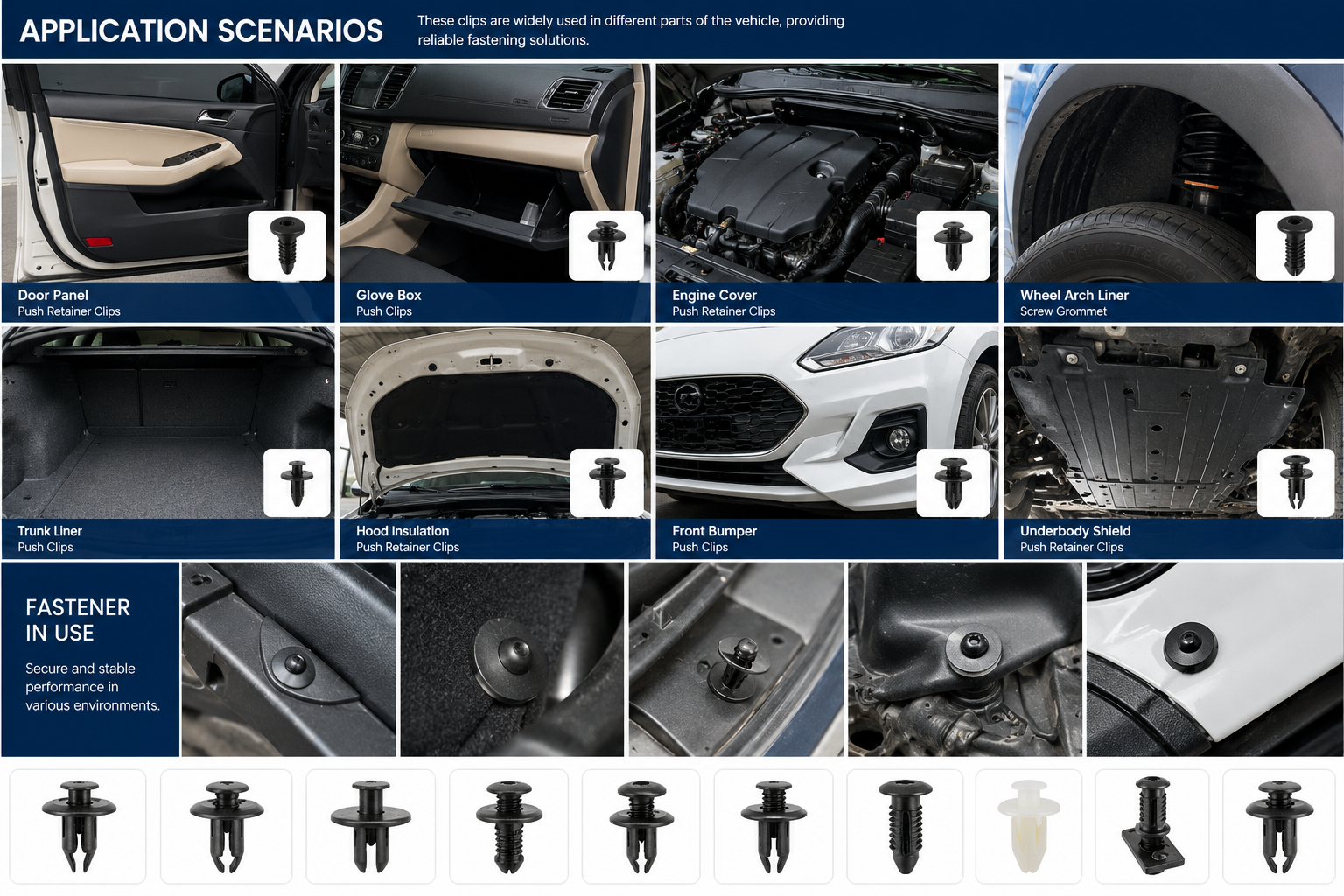
| Push Retainers | Panel securing | PA6 | 90% of sedan & SUV models | Medium |
| Trim Rivets | Interior & door trims | PP | Multi-brand | Low/Medium |
| Fender Clips | Exterior & bumper mounts | PA66 + GF | High | |
| Screw Grommets | Engine & chassis zones | POM | High |
This modular design allows trade partners to serve multiple vehicle segments without maintaining separate SKU inventories.
Comparison: Independent Procurement vs. Partnered OEM Clip Supply
| Criteria | Independent Sourcing | QEEPEI Trade Partner System |
|---|---|---|
| Supplier Management | 5–10 vendors | Single integrated OEM supplier |
| Quality Consistency | Variable | Certified OEM-level |
| Documentation | Rare | Full QC + test data |
| Delivery Timelines | Unpredictable | 25–35 days fixed schedule |
| Long-Term Scalability | Limited | Global container consolidation |
Trade partnerships under a unified OEM supply model bring predictability—critical for long-term importer-distributor cooperation.
QEEPEI’s Integrated Trade Partner Framework
QEEPEI operates under a global trade-ready system that simplifies large-volume fastener exports:
-
Consolidated SKU Catalog: Over 2,000 fastener models covering 80% of international brands.
-
Automated Injection Production: Robotic molding ensures ±0.03 mm tolerance.
-
Batch-Level Traceability: QR-coded labeling for every clip type.
-
Private Label Packaging: Available for regional resellers and distributors.
-
Optimized Export Logistics: Sea, air, and mixed container shipping flexibility.
This ecosystem minimizes the communication gap between factories and trade partners, creating a streamlined flow from order to port delivery.
Competitive Advantages for Trade Partners
-
Predictable Lead Time: Consistent 25–35 day production cycle.
-
OEM Material Verification: All clips tested for tensile strength and heat resistance.
-
Brand Customization: Label, carton, and blister packaging tailored to each distributor.
-
Regional Exclusivity: Partnership territories protect long-term trade stability.
-
After-Sales Support: Dedicated engineer consultation for bulk buyers.
By combining scale, quality, and flexibility, QEEPEI becomes not just a supplier—but a strategic manufacturing partner for global fastener distributors.
Real-World Scenarios
| Buyer Type | Application | Benefit |
|---|---|---|
| Importers | Regional distribution | Predictable replenishment cycles |
| Wholesalers | Multi-brand clip resale | Simplified inventory control |
| OEM Networks | Assembly line support | Certified parts consistency |
| Retail Chains | Market resale | High-quality packaging & shelf appeal |
Trade partners gain not only a physical product but a repeatable system—designed to maintain continuity and trust across global channels.
Trade Partner Selection Guide
-
Define Market Focus: Passenger, SUV, or commercial segments.
-
Evaluate Kit Size: Choose between 150, 250, or 300-piece assortments.
-
Confirm OEM Coverage: Match clips to top-selling models in your territory.
-
Plan Volume Forecasting: Align shipment schedules with sales cycles.
-
Set Packaging Standards: Decide between private label or QEEPEI-branded kits.
| Kit Model | Coverage | MOQ | Target Buyer |
|---|---|---|---|
| Standard Kit | 150 models | 3,000 sets | Regional wholesalers |
| Premium Kit | 250 models | 2,000 sets | Global importers |
| OEM Pro Kit | 300+ models | 1,500 sets | Assembly partners |
Frequently Asked Questions
Q: Can we mix different kits within one shipment?
Yes, multi-kit consolidation is supported with full SKU traceability.
Q: What certifications do QEEPEI clips meet?
All products meet ISO 9001, SAE J1239, and IATF 16949 standards.
Q: How do you ensure packaging durability during sea transport?
Each carton is drop-tested under ASTM D5276 for export safety.
Q: Can QEEPEI assist with local market labeling requirements?
Absolutely—regional compliance labeling is available upon request.
Conclusion: Building Stronger Trade Networks Through Quality and Trust
A true trade partner doesn’t just supply parts—they strengthen supply chains.
Through QEEPEI’s OEM-certified clip kits, distributors gain access to a system engineered for reliability, transparency, and growth—ensuring every shipment meets the same quality as the last.
For partnership inquiries or OEM clip kit quotations, visit Homepage or reach our export team through Contact Us.