
What Should an Automotive Trim Clips Manufacturer Provide?
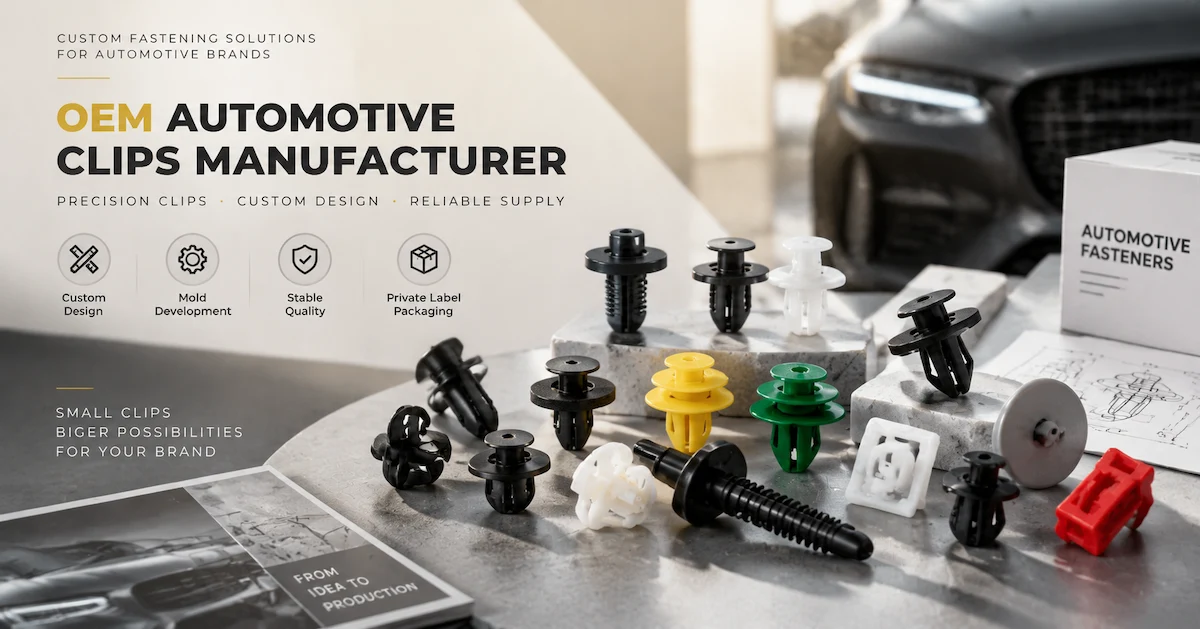
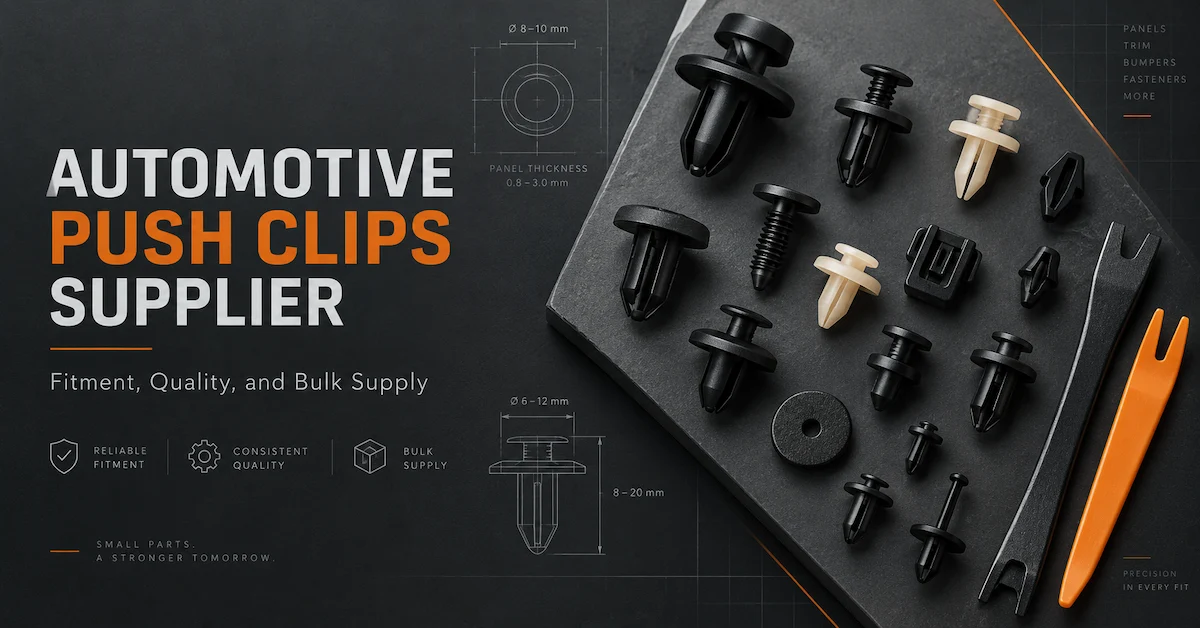
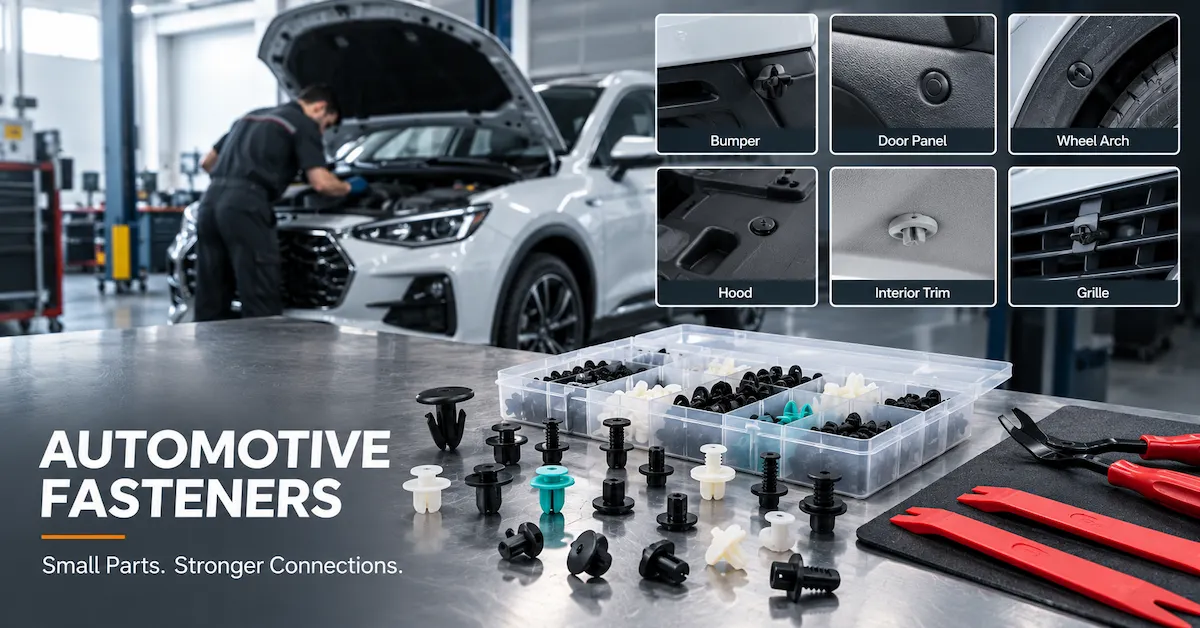
An automotive trim clips manufacturer should help a B2B buyer turn an installation requirement into a repeatable product specification rather than simply offering a large collection of clips that look similar. Automotive trim retainers can be used around door panels, dashboards, navigation panels, headliners, exterior moldings, wheel arches, grilles, and other interior or exterior trim areas, but products used in these locations can differ in mounting-hole size, head geometry, stem design, locking features, panel thickness, material, color, and removal method. QEEPEI organizes its automotive clip product range by body application, clip kits, vehicle-specific clips, and related tools, giving distributors and repair suppliers several ways to locate candidate products. The purchasing goal, however, should be to move beyond a visual match and establish enough technical and fitment information to approve the correct SKU for bulk and repeat orders.
Which Buyers Need Automotive Trim Clips in Bulk?
Automotive trim clips are particularly relevant to aftermarket parts distributors, collision-repair suppliers, body-shop supply companies, vehicle interior repair businesses, automotive accessory installers, online sellers, retail automotive brands, and private-label parts companies. A distributor normally needs clearly identified SKUs and predictable replenishment, while a body-shop supplier may prioritize bumper, grille, wheel-arch, door-panel, and interior trim retainers that are frequently replaced during dismantling and repair. E-commerce buyers need accurate product images, dimensions, fitment descriptions, and understandable pack contents because an unclear listing can generate avoidable returns. Private-label brands may also require customized packaging, barcodes, assortment combinations, and consistent product identification. QEEPEI's wholesale service is structured around B2B customers including distributors, online sellers, brand owners, and retail buyers, making trim-clip sourcing part of a broader inventory and channel-management decision rather than a one-time component purchase.
Know When a Trim Clip Is the Right Product Category
Not every small automotive fastener should be treated as a trim clip. Trim clips generally help locate or retain interior and exterior decorative panels, liners, moldings, covers, or related components, but the actual function must be confirmed for each product. A door-panel retainer should not automatically be substituted for a dashboard clip simply because its head looks similar, and a wheel-arch molding clip should not be assumed to perform the same function as a fender-liner fastener. Likewise, hood insulation retainers are different from hood latching components, and seat or interior clips should not be confused with safety-belt anchors or structural seat fasteners. When discussing requirements with an automotive trim clips manufacturer, describe the retained component and exact mounting position instead of using only a generic term such as “plastic car clip.” This distinction reduces the risk of approving a visually similar part for a function it was not intended to perform.
Start the Specification With the Installation Area
Application location is one of the fastest ways to narrow a large clip catalog, but location should be treated as the beginning of selection rather than final proof of fitment. For door trims, buyers should consider the panel construction, mounting hole, clip seat, visible surface, and removal process. Dashboard and navigation-panel clips may require close attention to geometry and positioning because poor engagement can contribute to loose trim or difficult reassembly. Headliner clips may require a particular head shape, color, or coverage area. Exterior molding and wheel-arch retainers may face different exposure conditions from protected interior trim. QEEPEI's product catalog separates applications such as door interior clips, ceiling clips, dashboard/navigation clips, grille clips, wheel-arch molding clips, and other body clips, allowing buyers to build a sourcing list around actual vehicle areas before moving to detailed specification approval.
Build a Controlled Trim Clip Specification Before Quotation
One of the most important jobs for an automotive trim clips manufacturer is translating a sample, drawing, reference number, or application request into information that can be reproduced later. A buyer should not rely only on photographs because small dimensional differences can change installation behavior. QEEPEI's car clip selection guide discusses dimensional and application factors that should be considered when identifying automotive clips. A practical RFQ specification can use the following structure.
| Specification Area | Information to Define or Confirm | Why It Matters |
|---|---|---|
| Product identification | Supplier model, buyer SKU, drawing or approved sample | Connects purchasing records to the correct product |
| Installation area | Door panel, dashboard, headliner, grille, molding, wheel arch, etc. | Prevents confusion between similar clip families |
| Vehicle information | Make, model, year or generation when applicable | Helps narrow fitment |
| Reference information | OE or cross-reference number where available | Adds another identification point |
| Mounting hole | Shape and dimensions | Influences insertion and locking |
| Clip geometry | Head size, stem diameter, overall length, locking-leg design | Determines mechanical compatibility |
| Panel thickness | Thickness or material stack being retained | Helps define usable grip range |
| Material | Required polymer family and grade when specified | Affects behavior in the application |
| Appearance | Color, visible head style, finish | Important for exposed trim |
| Packaging | Pieces per bag, label, barcode, retail box or assortment | Supports warehouse and resale requirements |
| Approval reference | Approved sample, date and revision | Reduces repeat-order variation |
Why Head Size, Stem Size, and Grip Are Not Interchangeable Measurements
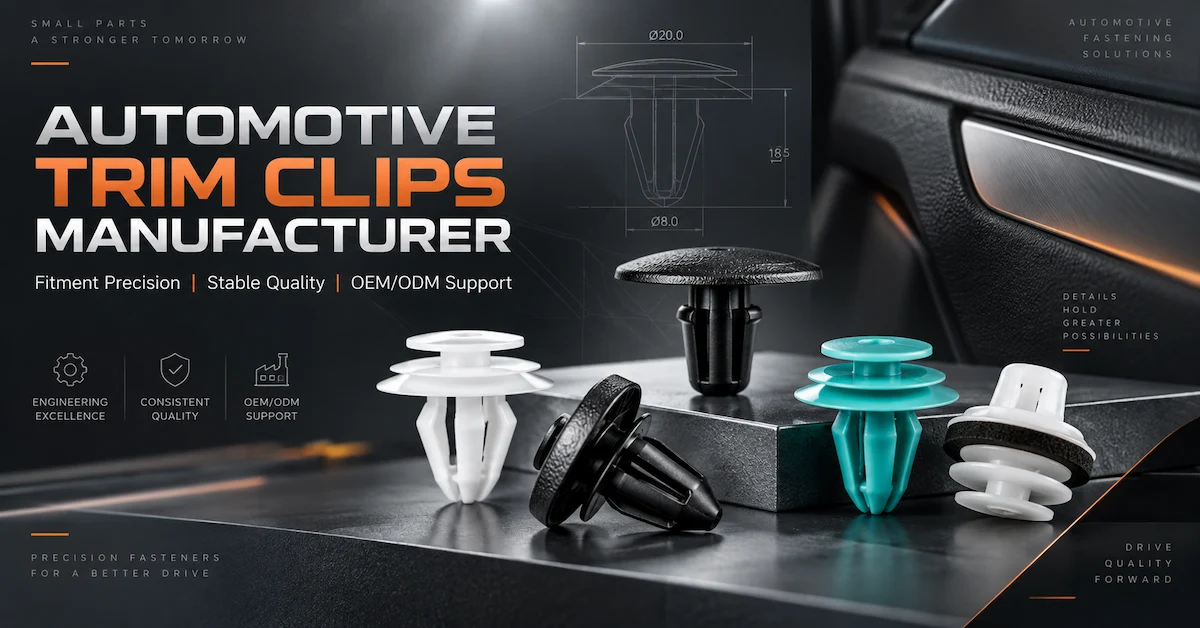
Buyers frequently receive clip dimensions described by a single number, but one “diameter” does not completely define an automotive trim retainer. A clip may have a head diameter, stem diameter, locking-leg width, mounting-hole requirement, and overall length that are all different. The panel stack or grip condition also matters because a clip that inserts into the correct hole may still fail to clamp the trim correctly if the locking position does not correspond to the retained thickness. When sending an existing sample to an automotive trim clips manufacturer, identify which measurement refers to which feature and use drawings or annotated photographs where possible. If the original clip is damaged, do not assume its deformed dimensions represent the intended specification; compare it with the mounting interface and, where available, additional undamaged samples or reliable reference information.
Select Materials According to the Actual Trim Application
QEEPEI's automotive clip content discusses PA, PP, and POM among material families used for automotive fastening products. These polymer names are useful starting points, but they do not by themselves define product performance. A polymer grade, geometry, molding condition, and application environment work together to determine how a finished clip behaves. An interior door-panel clip may require a useful balance between installation behavior, holding function, and service removal, while an exterior molding fastener may require consideration of weather exposure, moisture, dirt, vibration, and temperature changes. A headliner clip may place more emphasis on appearance and compatibility with the retained material. Buyers can review QEEPEI's car clips material guide when preparing material questions, but final requirements should still be confirmed for the specific SKU rather than assuming every clip in one category uses the same resin formulation or performance rating.
Evaluate Injection Molding Through Critical Clip Geometry
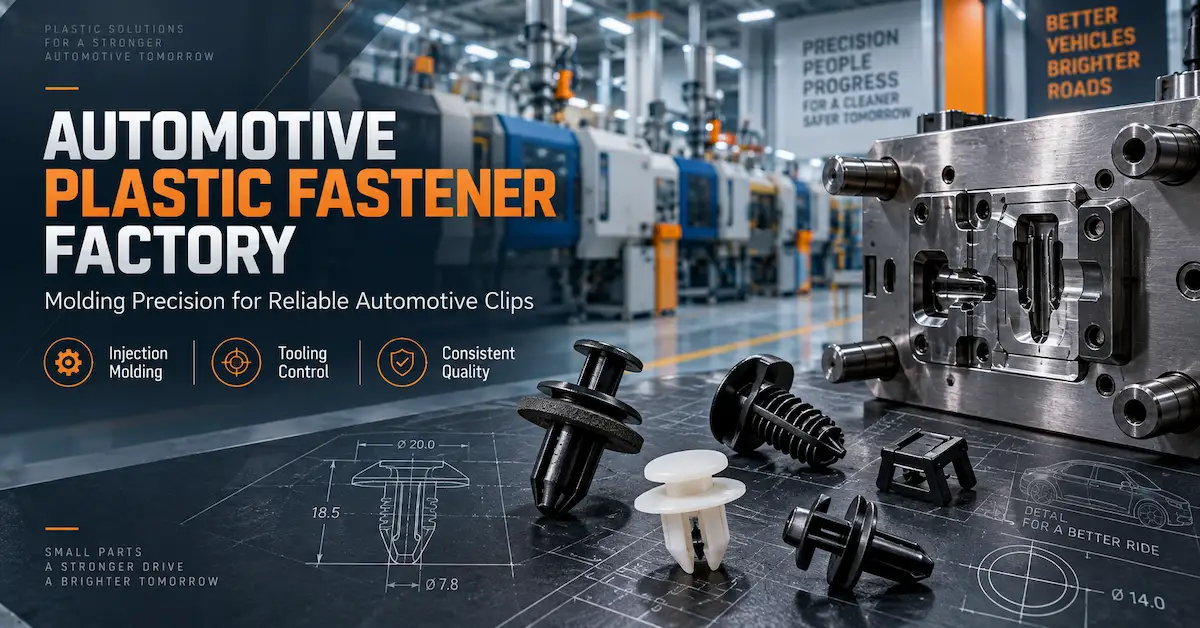
Trim clips are small injection-molded components, yet their locking features can be highly sensitive to geometry. Locking legs, barbs, expansion sections, heads, stems, and locating features must interact correctly with the mating panel and hole. QEEPEI describes injection molding and mold-development capabilities on its About Us page, while its injection molded car clips guide explains the relationship between molds, material control, molding processes, dimensional accuracy, and finished fasteners. When evaluating a factory, buyers should therefore ask how critical dimensions are identified, how flash, incomplete filling, deformation, and other molding defects are checked, how mold revisions are controlled, and how an approved part is linked to later production. A machine list shows available equipment; a stronger supplier evaluation asks how that equipment and tooling control are applied to the specific trim clip being purchased.
Quality Control Should Reproduce the Approved Fit, Not Just the Appearance
An automotive trim clip can look acceptable while still differing in a dimension or locking feature that affects assembly. Product approval should therefore combine visual inspection with application-relevant checks. Depending on the product and requirement, this may include dimensions, molding condition, color, installation behavior, retention, fitment against the intended panel, packaging count, labeling, and batch identification. QEEPEI's automotive clips quality-control guide provides additional context on quality checks for automotive clips. For B2B purchasing, the most useful approach is to agree on what will be inspected, how samples are selected, what specification or reference sample applies, and how deviations are handled. If a compliance or test document is requested, verify the named company, tested sample, date, test scope, and relationship to the ordered SKU rather than assuming a document shown at company level automatically applies to every trim clip in the catalog.
Treat Vehicle Fitment as a Chain of Evidence
Vehicle compatibility can become a major source of returns when buyers rely only on statements such as “for BMW,” “for Toyota,” or “universal.” QEEPEI offers vehicle-specific clip categories in addition to application-based categories, but a professional buyer should continue the fitment process beyond the vehicle brand. A stronger identification chain is make → model → year or generation → mounting position → reference number → physical dimensions → sample or installation confirmation. Each element reduces uncertainty. A brand-level category is useful for product discovery; it is not the same as proof that one clip fits every model or every position produced under that brand. This approach is especially important for distributors and e-commerce sellers because inaccurate compatibility information can create returns, customer complaints, and difficult inventory corrections long after the original purchase order has been completed.
Compare Automotive Trim Clip Families by Their Purchasing Requirements
An automotive trim clips manufacturer may produce many forms of retainers, but buyers gain more value by comparing them according to application and approval requirements rather than simply comparing shape or price.
| Trim Clip Family | Typical Application Direction | Important Selection Factors | Common Sourcing Risk |
|---|---|---|---|
| Door panel clips | Interior door trim and panel attachment | Clip seat, hole size, panel thickness, head/locking geometry | Visual match but incorrect panel engagement |
| Dashboard/navigation clips | Dashboard, center trim and navigation-related panels | Position, geometry, mating feature and installation direction | Loose trim or difficult reassembly |
| Headliner/ceiling clips | Roof liner and associated interior trim | Head coverage, color, retained thickness and appearance | Correct hole fit but unsuitable visible finish |
| Grille clips | Front grille and related exterior trim | Locking orientation, hole/slot dimensions and trim position | Confusing grille attachment with another bumper fastener |
| Wheel-arch molding clips | Exterior wheel-arch moldings and trim | Molding slot, clip geometry and environmental exposure | Substitution with fender-liner clip |
| Seal-strip retainers | Weatherstrip and related body trim | Seal profile, mounting interface and clip engagement | Assuming the clip itself provides the sealing function |
This table is a sourcing framework rather than a universal specification. Final dimensions, material and fitment should be confirmed against the individual product and vehicle application.
Sample Approval Should Be More Than “It Fits”
Before a bulk purchase, the buyer and manufacturer should agree on what an approved sample represents. A useful sample approval record can include supplier model number, drawing or measurement sheet, material information, color, application, reference number, packaging specification, date, and any application test notes. If the clip is installed in a real panel or vehicle, record the mounting position and vehicle details rather than simply writing “tested OK.” When a future order is placed, the purchasing team can then reference the approved configuration instead of starting again from photographs. This is particularly useful for automotive trim clips because a distributor may handle many visually similar black plastic retainers, and small product differences can be difficult for warehouse staff to identify without controlled SKU information.
Plan Wholesale Inventory Around Fast-Moving Applications
A broad catalog can help buyers source multiple vehicle applications from one supplier, but catalog size alone does not determine inventory efficiency. Distributors should identify fast-moving trim clips by customer type, vehicle mix, repair frequency, and sales history. Door-panel or bumper-related products may behave differently from less frequently replaced interior clips, while a body-shop supplier may consume different fasteners from a retail DIY seller.When working with an automotive trim clips manufacturer, divide the sourcing plan into regularly stocked SKUs, less frequent replenishment SKUs, and project-specific parts. Confirm availability and delivery conditions at SKU level instead of treating an overall inventory claim as a guarantee for every part. This also makes it easier to build refill programs for customers that initially purchase mixed clip assortments.
Choose Between Individual Clips, Assortments, and Vehicle-Specific Supply
QEEPEI's automotive clip range includes individual clip categories, clip kits, vehicle-specific clips, and tools. Individual SKUs are suitable when distributors already know which trim clips sell consistently and want precise replenishment. Mixed assortments can be useful for workshops or retail environments where technicians need access to several common styles, but the total number of pieces should not be the only buying criterion. The buyer should review exactly which clip types are included, how many pieces of each are provided, whether tools are counted in the total, and whether frequently consumed clips can later be replenished separately. Vehicle-specific assortments may narrow product selection, but they still require confirmation of the vehicle coverage and individual components rather than assuming the vehicle-brand name alone guarantees every intended repair application.
Private-Label Packaging and New Clip Development Are Different Projects
OEM/ODM discussions become clearer when buyers divide customization into separate levels. Applying a customer's logo, barcode, label, or retail box to an existing clip is primarily a packaging project. Changing the quantities and clip mix inside an assortment is a configuration project. Adjusting color or material can affect the product specification and may require additional approval. Developing a new locking geometry or creating tooling for a new clip is a product-development project. QEEPEI's wholesale service describes customization support for B2B customers, but buyers should define the requested scope before asking for a quotation. For new-product development, provide the original component or drawing, mounting-hole data, retained panel information, material requirements, vehicle/application details, expected order quantities, and the problem the new part is intended to solve. Clarifying this scope helps avoid comparing a simple private-label quotation with a genuine molding-development project as though they were equivalent.
Calculate the Cost of a Usable Trim Clip, Not Only the Unit Price
The lowest purchase price does not necessarily produce the lowest cost for a distributor. Incorrect fitment can lead to returns and customer support; incomplete labels can create warehouse picking errors; inconsistent pack quantities can complicate resale; slow-moving assortments can tie up capital; and an undocumented product change can make repeat orders difficult to compare. When reviewing quotations from an automotive trim clips manufacturer, compare suppliers using the same approved specification, material, pack quantity, inspection requirement, order quantity, and delivery terms. For clip assortments, examine how many components are commercially useful to your customer base instead of calculating value only from total piece count. For individual SKUs, consider whether the part can be clearly identified and replenished later. In B2B sourcing, a controlled SKU with dependable documentation may create more value than a cheaper part that repeatedly requires re-identification.
Control Packaging as Part of Product Quality
Packaging is not only a marketing consideration for small automotive fasteners; it also affects inventory identification and order accuracy. A distributor may require simple bulk bags with clear SKU labels, while an e-commerce seller may need barcode labels and retail-ready packs. Private-label brands may require branded bags, boxes, multilingual text, or customized assortment trays. Whatever the format, the packaging specification should identify product number, quantity, and any information needed for warehouse and customer use. For assortment kits, a component list can be especially valuable because buyers need to know what is actually inside the box. When packaging changes between orders, the change should be reviewed just as carefully as other commercial requirements so that the warehouse, online listing, and physical product remain aligned.
What Should Buyers Send With an RFQ?
A detailed request for quotation gives the manufacturer a better chance of finding the correct existing clip or determining whether development is required. If the product is already known, send the supplier model number, reference number, required quantity, packaging and destination. If it is unknown, provide clear front, side, and locking-feature photographs; measurements; installation location; vehicle make, model and year where relevant; reference information; required quantity; and an undamaged sample when possible. For a new clip project, add mounting-hole drawings, panel thickness, application environment, material requirements, known problems with the existing part, forecast quantity, and required approval process. Buyers can first review QEEPEI's products and then submit a defined sourcing request through the Contact Us page instead of sending only “Please quote your best price for trim clips.”
Frequently Asked Questions
1. What is an automotive trim clip?
An automotive trim clip is a small fastening component used to locate or retain particular interior or exterior panels, moldings, liners, covers, or related trim parts. Designs vary substantially, so the term describes a broad application family rather than one universal clip shape.
2. How should I choose an automotive trim clips manufacturer?
Evaluate the manufacturer's product range, fitment support, dimensional information, material control, mold and production capability, sample-approval process, quality checks, packaging support, and ability to reproduce an approved SKU for future orders. A large catalog is useful, but product identification and repeatability are equally important.
3. Can I identify a trim clip only from a photograph?
A photograph can help narrow possible products but should not be the only approval method. Confirm relevant dimensions, locking geometry, mounting hole, panel thickness, vehicle/application information, and reference number where available.
4. Are door panel clips and dashboard clips interchangeable?
Not necessarily. They may use different mounting structures, panel interfaces, dimensions, and locking features. Confirm the specific mounting position and product geometry before substituting one type for another.
5. Which material is best for automotive trim clips?
There is no single material that is automatically best for every trim clip. The correct choice depends on product geometry, installation behavior, environmental exposure, appearance requirements, and application-specific validation. Confirm the material used for the individual SKU.
6. What information should a trim clip drawing include?
Useful information may include head dimensions, stem dimensions, overall length, locking geometry, mounting-hole requirement, applicable panel thickness or grip condition, material, color, drawing revision, and any other product-specific critical dimensions.
7. Should I order individual trim clips or assortment kits?
Individual clips are useful when you already know the fast-moving SKUs and need reliable replenishment. Assortment kits are convenient for workshops, retail, and mixed repair needs, but buyers should check the component list, quantity of each type, fitment relevance, and refill options.
8. Can QEEPEI support private-label automotive trim clips?
QEEPEI describes B2B customization and packaging support through its wholesale program. Buyers should define whether they need labels, barcodes, retail boxes, customized kit composition, product modifications, or new development because these represent different project scopes.
9. How can buyers reduce risk on repeat orders?
Keep an approved sample or controlled specification linked to the SKU, material, dimensions, application, packaging, and revision. Reference that information in later purchase orders and require relevant changes to be reviewed before production.
10. What should I send QEEPEI to request a trim clip quotation?
Provide the QEEPEI model or reference number if known, or send clear photos and measurements together with the installation position, vehicle information, required quantity, packaging requirements, and destination. For custom development, also provide drawings or samples, mounting details, material requirements, and expected order volume through the QEEPEI contact page.
Conclusion
Choosing an automotive trim clips manufacturer is ultimately a fitment, manufacturing, inventory, and repeatability decision rather than a simple search for similar-looking plastic clips. Professional buyers should identify the exact trim application, define mounting-hole and clip geometry, confirm material and environmental requirements, establish sample-approval and quality-control criteria, manage vehicle compatibility carefully, and connect every repeat purchase to an approved product specification. For distributors, repair suppliers, online sellers, and private-label automotive brands, this approach can reduce incorrect SKU selection, simplify warehouse management, and make future replenishment more controllable. QEEPEI offers automotive body clips, vehicle-specific clips, clip kits, tools, wholesale support, and customization services; buyers can review the QEEPEI product range, learn more about the company's manufacturing background, or contact QEEPEI with application details, samples, dimensions, quantities, and packaging requirements for product matching or project evaluation.