
Car Fender Clips Manufacturer: Structural Fastening Solutions for Modern Automotive Assembly
In every vehicle, fenders protect the bodywork and define its exterior alignment. Behind their sleek appearance lies a hidden network of fastening systems that maintain structure and prevent vibration. As a dedicated car fender clips manufacturer, QEEPEI focuses on providing fastening components that combine structural integrity, corrosion resistance, and easy assembly for both OEM and aftermarket needs.
Understanding the Hidden Challenge in Fender Assembly
Fender areas experience constant stress from vibration, temperature changes, and external forces. Poor-quality clips can cause:
-
Misalignment between body panels and fenders.
-
Paint damage or corrosion due to metal-on-metal contact.
-
Noise and rattling under vibration.
-
Increased assembly time and maintenance costs.
These issues impact both vehicle aesthetics and performance, creating warranty and durability challenges for automakers.
The Engineering Principles Behind Fender Clip Design
Effective fastening relies on controlled tension, elastic recovery, and material compatibility.
A fender clip must hold tightly enough to secure panels, but also allow for small deformations during thermal expansion.
| Design Parameter | Engineering Focus | Result |
|---|---|---|
| Retention Force | 20–40N range | Prevents detachment under vibration |
| Elastic Modulus | Moderate stiffness | Allows tolerance for temperature expansion |
| Surface Treatment | Anti-UV & anti-corrosion | Extends lifespan in outdoor exposure |
| Locking Geometry | Dual-wing or push-pin type | Ensures stable multi-surface grip |
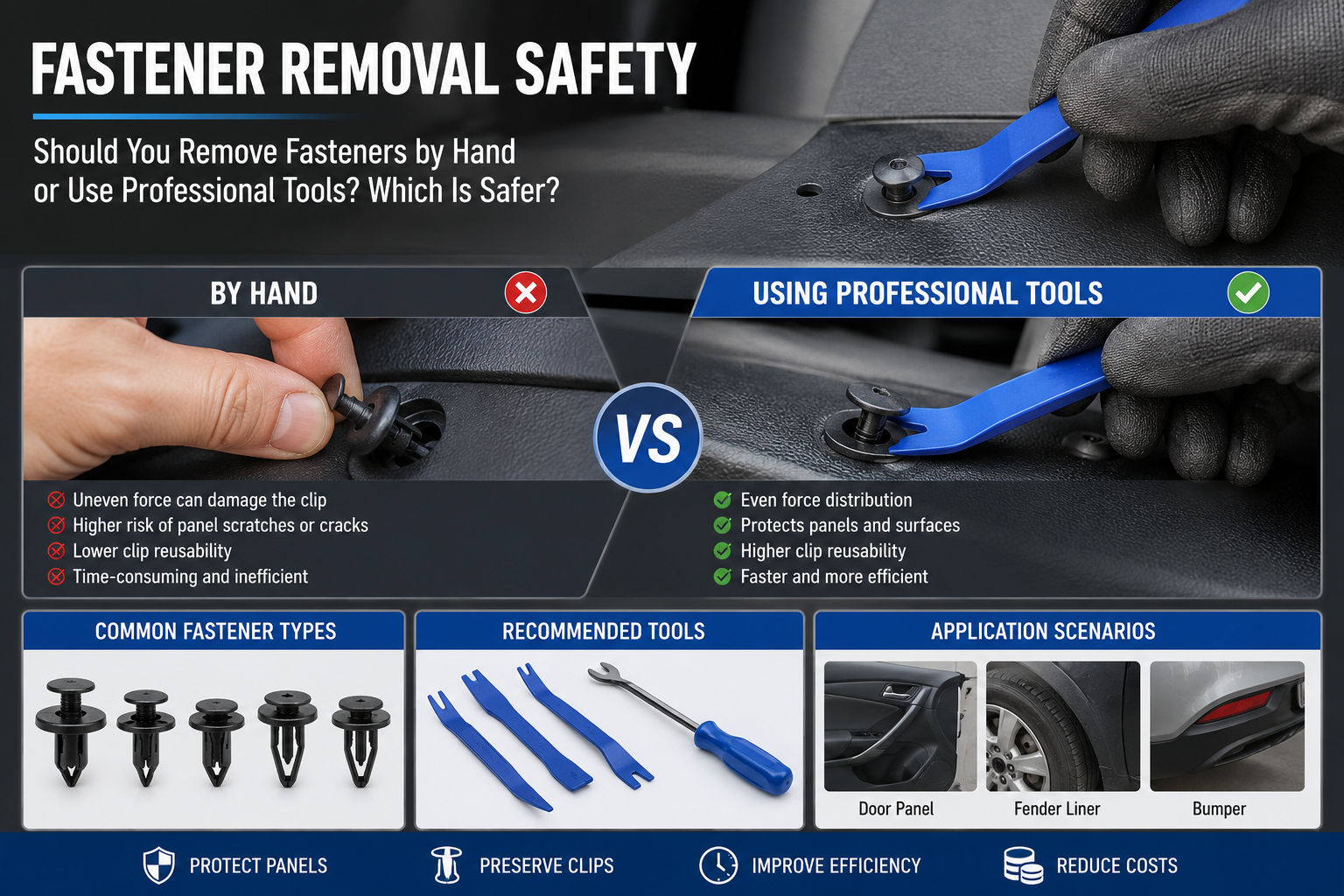
This mechanical balance ensures both long-term hold and ease of disassembly when repair is needed.
Material Comparison: Finding the Ideal Balance
Different materials offer different mechanical properties. Selecting the right compound determines the product’s performance and cost.
| Material | Advantages | Limitations | Typical Use Case |
|---|---|---|---|
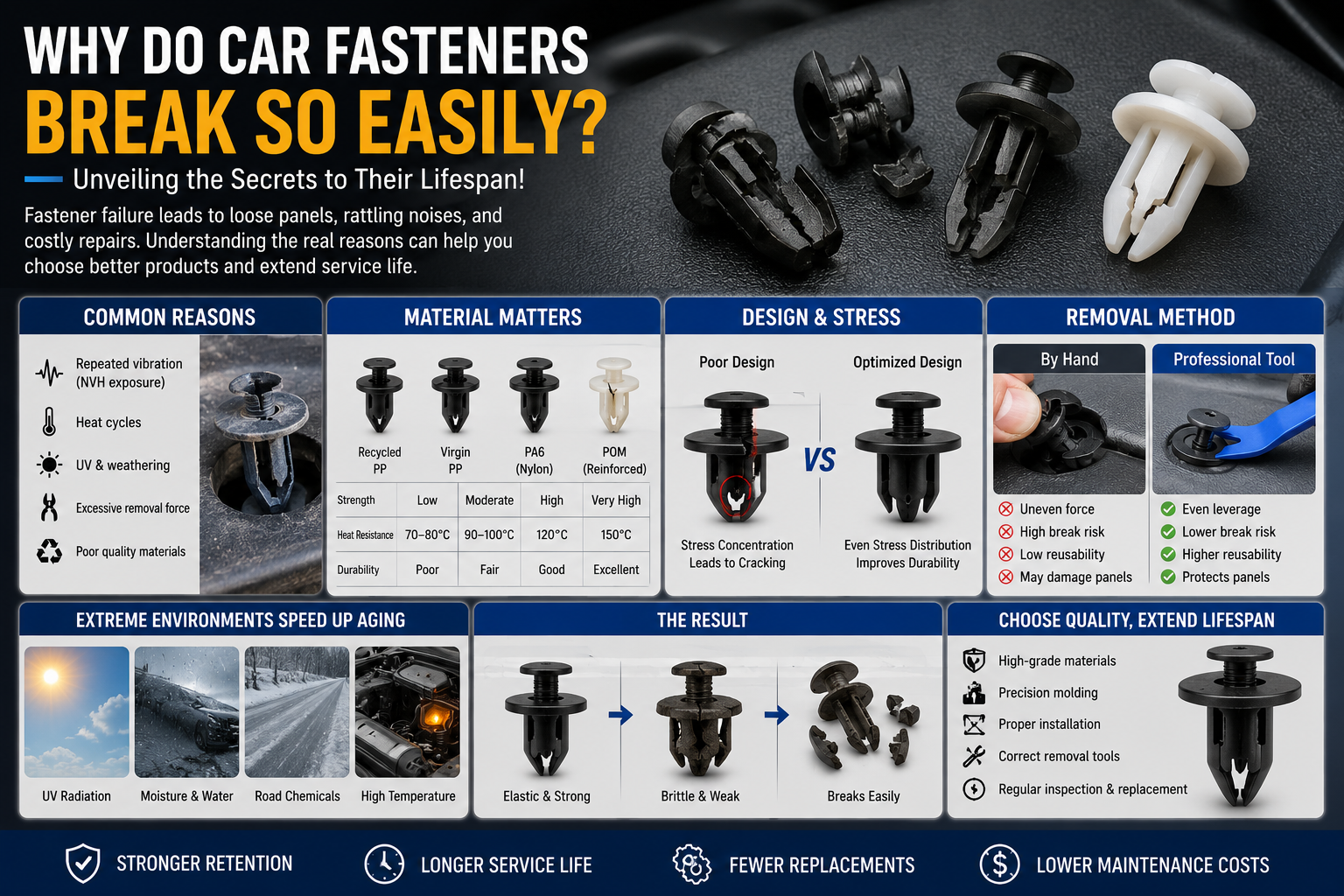
| PA6 (Nylon) | High strength, heat resistance | Costlier | OEM-grade fenders |
| PP (Polypropylene) | Cost-effective, flexible | Lower tensile strength | Aftermarket applications |
| POM (Acetal) | Excellent dimensional stability | Less UV resistant | Interior or protected panels |
By combining these polymers with reinforcing agents such as glass fiber or UV stabilizers, manufacturers like QEEPEI achieve durability without sacrificing flexibility.
Engineering Solutions for Modern Manufacturing Lines
QEEPEI applies precision injection molding with automated inspection to ensure repeatable accuracy.
-
Tolerance Control: ±0.02 mm for consistent fitment.
-
High-cycle Mold Design: Supports large-volume OEM production.
-
Anti-static packaging: Prevents contamination before assembly.
-
Custom geometry: Developed from CAD or 3D models within 10 days.
This approach enables clients to integrate custom clips into robotic assembly systems without retooling entire production lines.
Key Advantages for Global Buyers
| Feature | Technical Benefit | Procurement Value |
|---|---|---|
| Certified Quality | ISO/TS16949, RoHS, REACH compliant | Meets global OEM standards |
| Material Reliability | UV- and corrosion-resistant compounds | Extended product lifespan |
| Precision Fit | High repeatability across batches | Reduces assembly variance |
| Flexible Supply Chain | 3,000+ SKUs, 24-hour dispatch | Fast fulfillment for distributors |
| Sustainable Production | Low-waste injection systems | Supports ESG compliance |
These strengths make QEEPEI an ideal long-term partner for both OEM procurement and aftermarket resellers.
Real-World Applications and Industry Scenarios
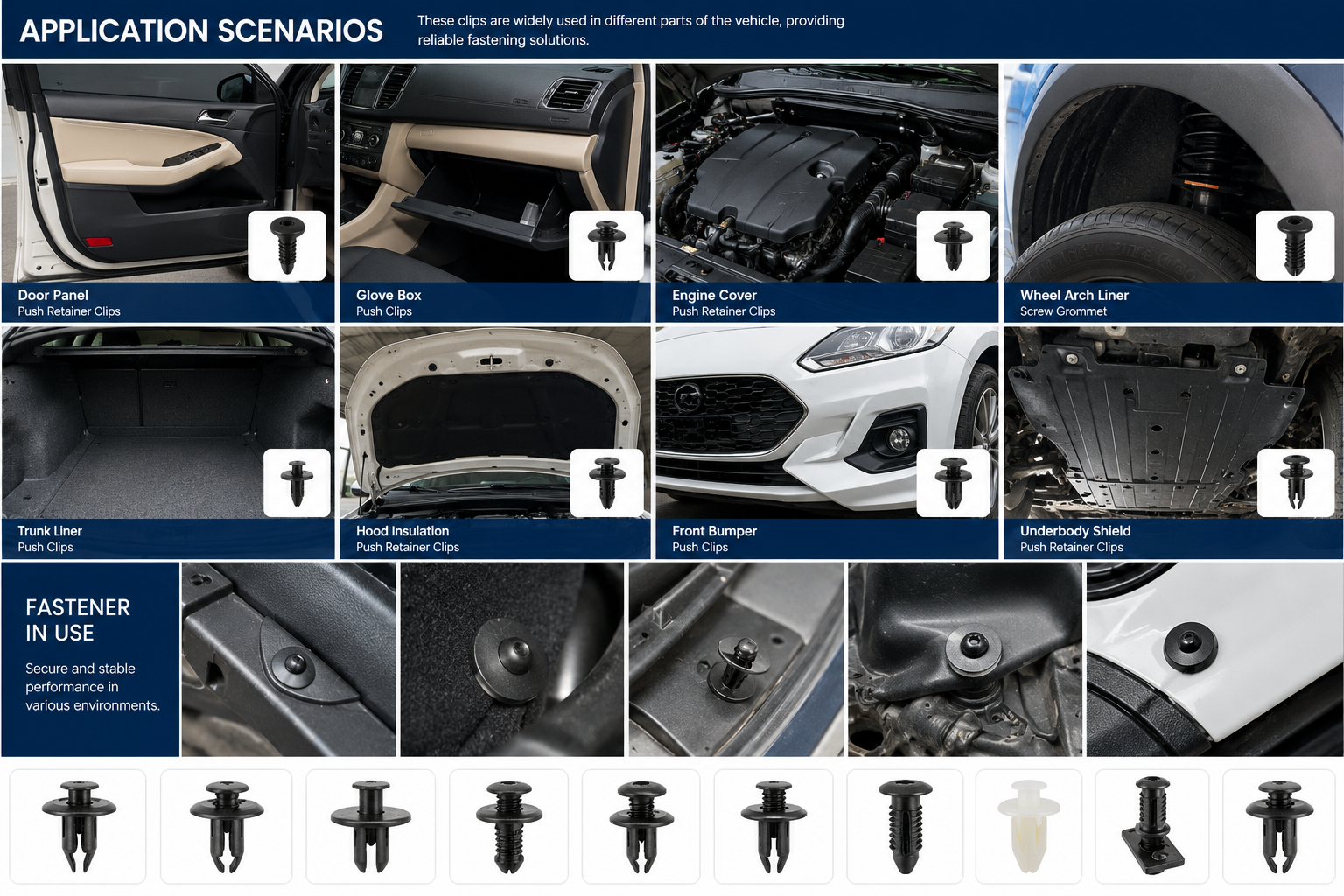
Fender clips are used across different environments and vehicle classes:
-
Passenger cars — maintaining visual alignment of body panels.
-
SUVs and trucks — reinforced clips for higher torque and road vibration.
-
Electric vehicles — lightweight clips to optimize energy efficiency.
-
Aftermarket repair centers — universal models ensuring quick replacement.
With global climate differences, QEEPEI tailors clip material formulations to local humidity and temperature conditions.
Selecting the Right Fender Clips for Different Applications
Not all vehicles require the same fastening strength or flexibility. The best choice depends on how the vehicle is used and maintained:
-
Daily-use passenger cars — choose lightweight nylon clips for better fit and reduced vibration noise.
-
SUVs and off-road vehicles — prefer reinforced PA6 clips that resist impact and heavy vibration.
-
Fleet and service vehicles — use reusable fasteners to simplify inspection and reduce downtime.
-
Electric and lightweight vehicles — select low-mass polymer clips to reduce overall vehicle weight.
-
Repair workshops — stock universal fender clips compatible with multiple models for quick replacements.
Selecting clips by application ensures the right balance between durability, ease of assembly, and maintenance efficiency.
Frequently Asked Questions
Q1: Are fender clips interchangeable between models?
Not always. OEM clips are model-specific, while universal clips suit general repair or aftermarket use.
Q2: What’s the lifespan of plastic fender clips?
Typically 5–8 years under standard conditions; UV- and heat-resistant variants last longer.
Q3: Can you provide custom molds for specific car models?
Yes, QEEPEI offers rapid tooling and OEM mold design within 10 days.
Q4: Do you offer small-quantity orders for testing?
Yes, MOQ is flexible for prototype validation and pilot runs.
Engineering Fasteners That Define Automotive Durability
In vehicle design, every fastening component contributes to quality and longevity.
Through engineering innovation, rigorous material selection, and scalable production, QEEPEI delivers fender clips that ensure both structural integrity and production efficiency.
Explore more fastening solutions on the Homepage.
For OEM customization or wholesale inquiries, contact us here.