
What Are the Common Clip Sizes for Popular Car Models?
Wrong size is the most common reason a clip fails.
Installers often assume clips are interchangeable across brands. But even a 0.3 mm diameter difference can lead to looseness, cracking, or panel noise. In aftermarket supply chains, size confusion also creates unnecessary inventory pressure.
At QEEPEI, we frequently assist distributors who struggle with model-specific fitment issues. As an experienced Automotive Clips manufacturer, we maintain dimensional databases to prevent misapplication across vehicle platforms.
Clip selection begins with measurement accuracy.
Understanding Critical Dimensions Before Model Matching
Before listing model sizes, engineers must understand which dimensions matter:
-
Hole diameter
-
Stem diameter
-
Head diameter
-
Grip range (panel thickness compatibility)
-
Retention force
A clip with 8.0 mm stem inserted into an 8.2 mm hole may reduce retention strength by up to 15%. According to SAE fastening performance discussions (https://www.sae.org), tolerance stacking significantly affects long-term vibration stability.
Dimensional precision is engineering, not approximation.
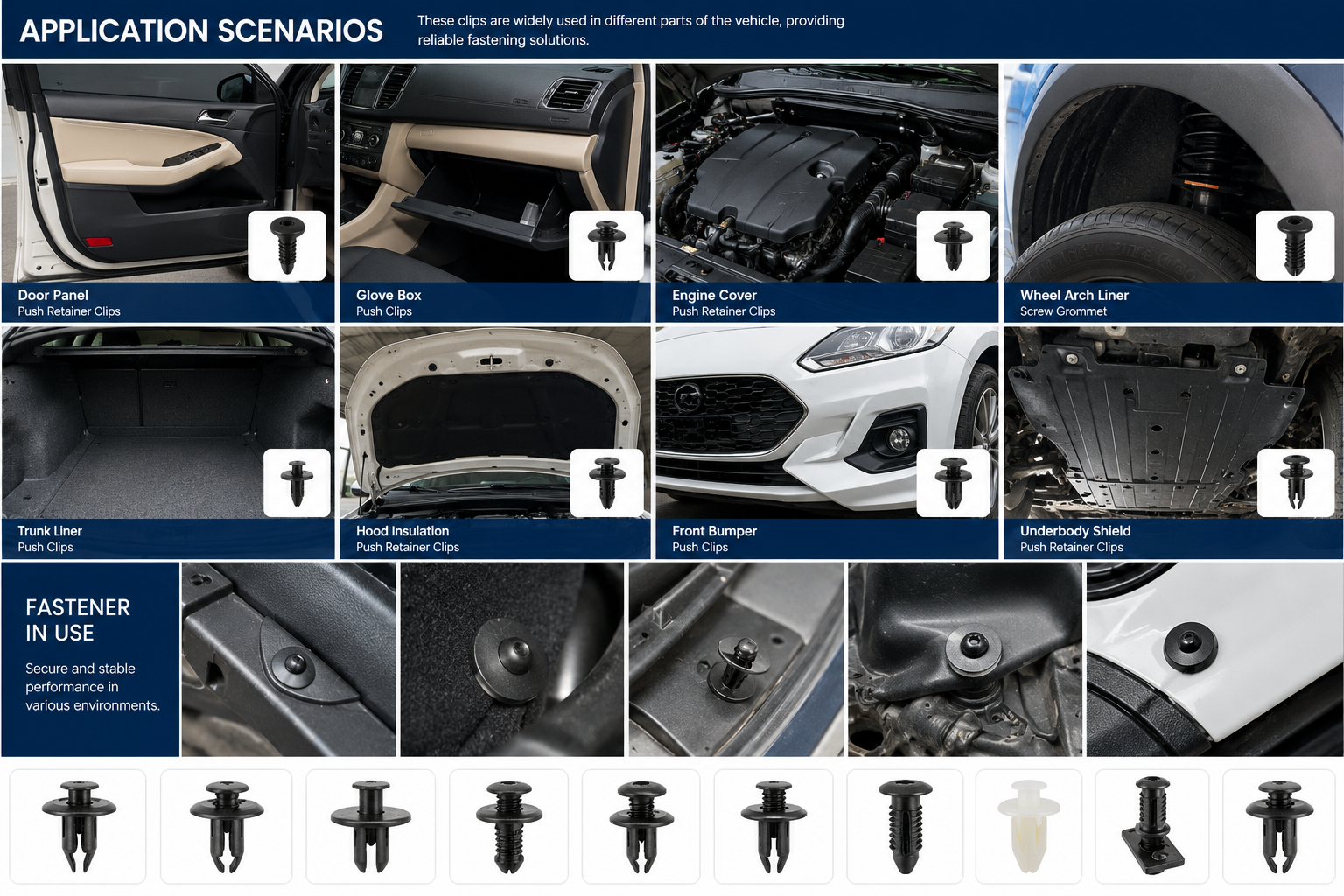
Common Clip Sizes by Popular Vehicle Brands
Below is a reference table compiled from aftermarket and OEM replacement data. Actual variation may exist by production year.
| Brand | Typical Hole Diameter | Stem Diameter | Head Diameter | Common Application |
|---|---|---|---|---|
| Toyota | 7.8–8.2 mm | 7.9–8.0 mm | 18–20 mm | Door panels, bumper |
| Nissan | 8.0–8.5 mm | 8.1–8.3 mm | 18–22 mm | Fender liner |
| Honda | 6.8–7.5 mm | 7.0–7.2 mm | 16–18 mm | Interior trim |
| Ford | 8.0–9.0 mm | 8.2–8.8 mm | 20–25 mm | Underbody shield |
| BMW | 7.5–8.0 mm | 7.6–7.9 mm | 18–21 mm | Engine bay covers |
Tolerance control typically remains within ±0.05–0.1 mm for stable retention.
As a technical Automotive Clips manufacturer, we ensure mold cavity accuracy within ±0.02–0.03 mm to maintain consistent fitment.
Material Considerations by Application Zone
Size alone is insufficient. Material must match installation environment.
| Zone | Recommended Material | Temperature Range |
|---|---|---|
| Interior trim | PA6 | –30°C to 100°C |
| Bumper area | PA66 GF10 | –40°C to 120°C |
| Engine compartment | PA66 GF30 | –40°C to 140°C |
| Underbody | Impact-modified nylon | –40°C to 110°C |
Glass fiber reinforcement increases stiffness by up to 35–45%, but excessive rigidity may reduce snap elasticity.
Material-size compatibility determines long-term stability.
Why Precision Manufacturing Determines Size Reliability
Size consistency depends on process control.
At QEEPEI, we apply:
-
Moisture-controlled resin drying (<0.2%)
-
Automated injection monitoring
-
100% cavity dimensional inspection
-
Pull-out force testing (180–260 N standard range)
-
IATF 16949 compliance
(https://www.iatfglobaloversight.org)
As a global Automotive Clips manufacturer, our role extends beyond production—we ensure dimensional repeatability across batches and shipments.
This reduces distributor returns and warranty claims.
Real Case: Cross-Model Size Substitution Failure
A European importer attempted to unify Toyota and Nissan bumper clips into one SKU.
Problem observed:
-
Toyota fit acceptable
-
Nissan retention force dropped from 240 N to 190 N
-
Increased panel vibration complaints
Root cause:
-
0.4 mm hole diameter variation
-
Insufficient expansion tolerance
Solution:
-
Split SKU inventory
-
Adjusted stem expansion angle
Outcome:
-
Complaint rate reduced by 60%
-
Inventory accuracy improved
Model-specific sizing matters.
Size Planning for Inventory Optimization
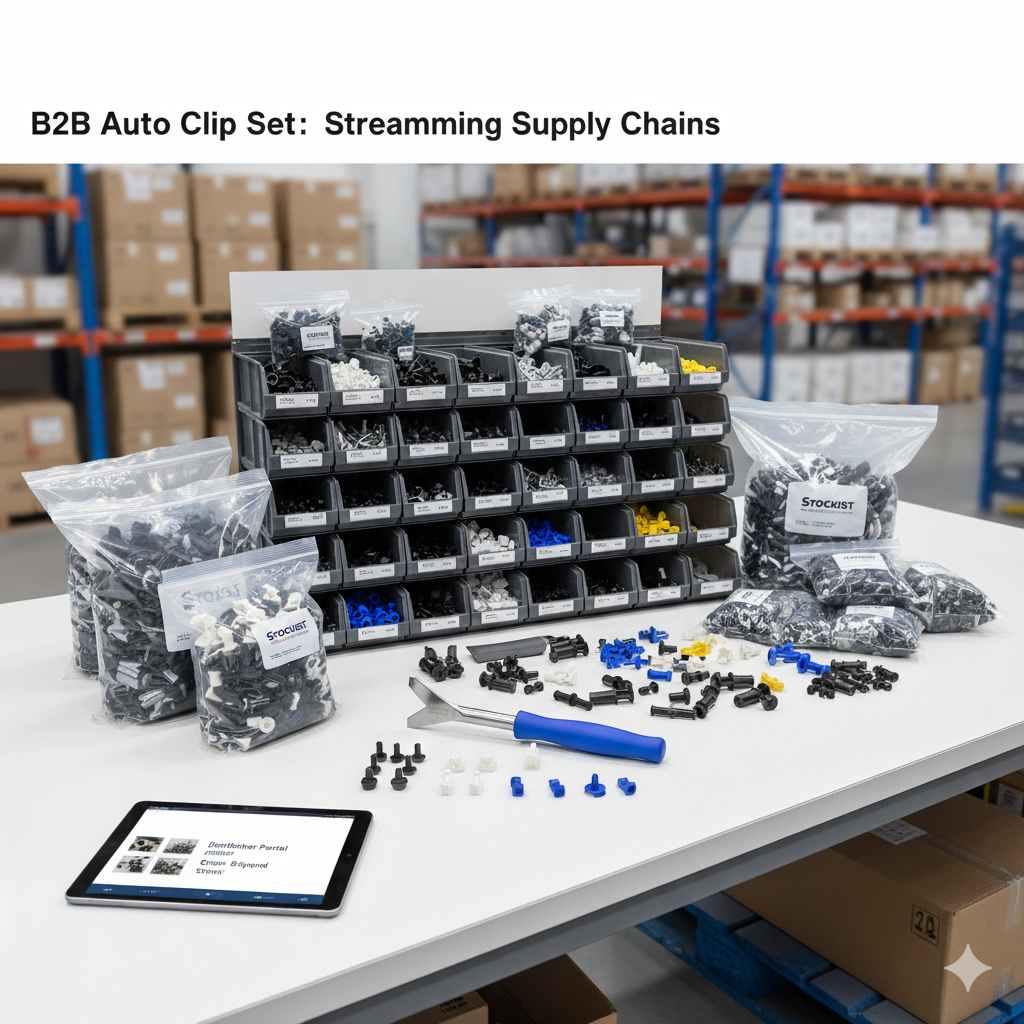
For distributors managing multiple brands, recommended stock strategy includes:
-
6 mm series (Honda-type interior)
-
8 mm series (Toyota/Nissan bumper)
-
9 mm heavy-duty series (Ford underbody)
-
Mixed 100–500 piece kits per category
This approach balances coverage and turnover efficiency.
FAQ
Q: Are Toyota and Nissan clips interchangeable?
A: Not always. Minor diameter differences affect retention stability.
Q: How do I measure hole size correctly?
A: Use calibrated digital calipers with ±0.02 mm accuracy.
Q: Should I prioritize head diameter or stem diameter?
A: Stem diameter controls retention. Head diameter controls coverage and aesthetics.
Conclusion
Understanding clip sizes across popular models prevents installation errors, noise issues, and premature failure.
An experienced Automotive Clips manufacturer ensures dimensional precision, material compatibility, and consistent supply reliability.
At QEEPEI, we combine engineering databases, certified manufacturing, and fitment validation to support distributors and OEM buyers worldwide.
Explore our full clip catalog here:
https://www.cnclip.com/
For technical consultation or bulk inquiries:
https://www.cnclip.com/contact-us/