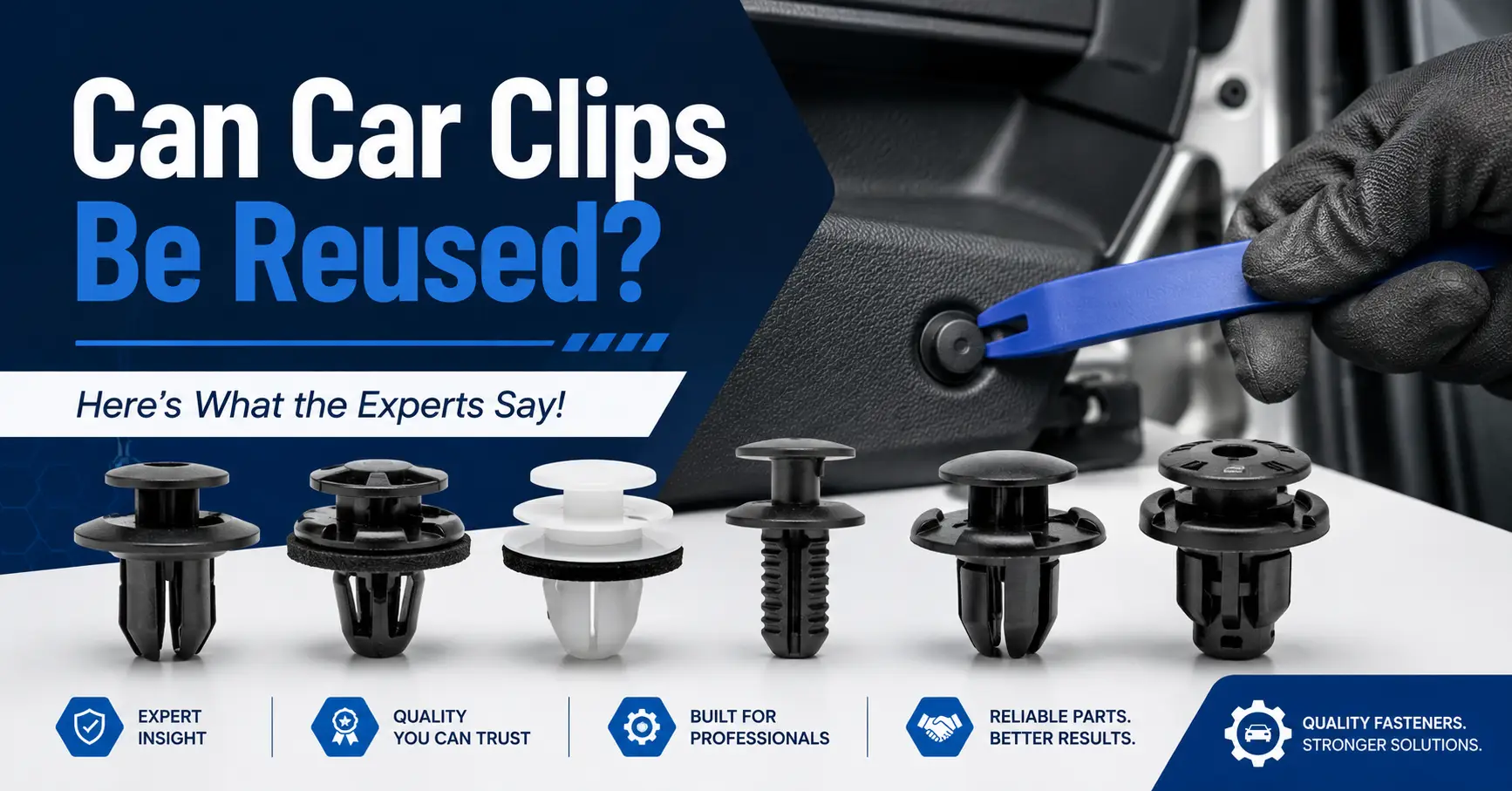

Maker Car Body Clips: Defining Precision, Fit, and Durability in Modern Auto Assembly
Automotive assembly is not just about engines and electronics—it’s about how thousands of components stay securely joined. The maker car body clips segment holds that invisible responsibility. These small, molded parts determine how tightly panels align, how quietly interiors ride, and how easily maintenance occurs.
Behind every seamless exterior lies a fastening network designed to endure vibration, temperature, and time. QEEPEI engineers and manufactures body clips that maintain exact tolerances, ensuring every attachment point performs flawlessly, from first installation to final inspection.
Pain Points in Modern Vehicle Assembly
Even with advanced automation, manufacturers face recurring fastening challenges:
-
Clips that deform under repeated assembly cycles.
-
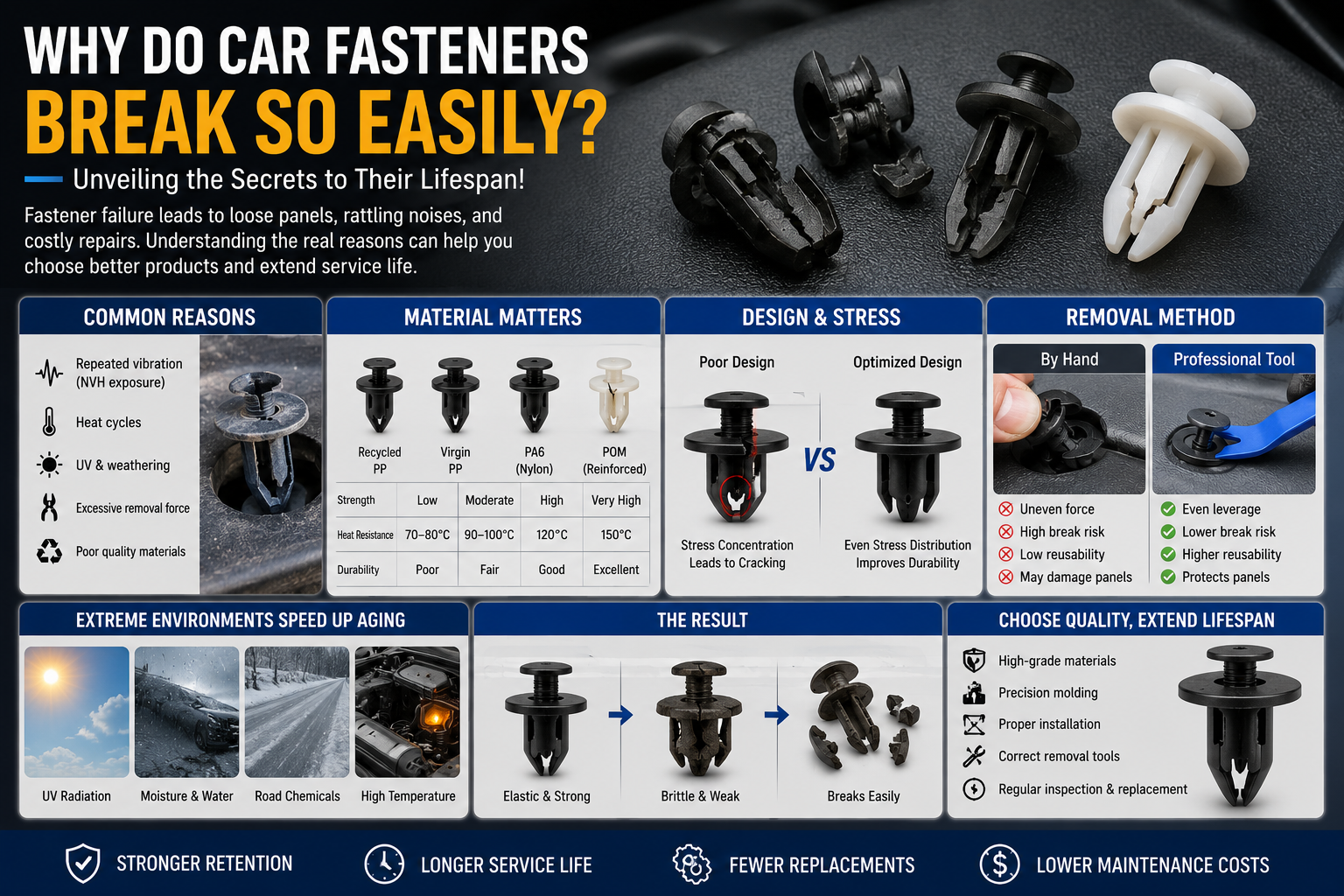
Material fatigue leading to loosened panels or interior noise.
-
Inconsistent insertion forces disrupting robotic precision.
-
Limited material compatibility for hybrid or aluminum bodies.
These seemingly small issues create costly ripple effects—assembly rework, delayed shipments, and compromised NVH (noise, vibration, harshness) performance.
Understanding the Functionality Behind Automotive Body Clips
A reliable clip performs under stress, heat, and torque without deformation.
-
Elastic Retention: Ensures secure hold without over-compressing panels.
-
Tensile Strength: Maintains fastening under dynamic load and vibration.
-
Thermal Stability: Prevents warping in extreme heat zones like engine bays.
-
Dimensional Fidelity: Guarantees consistent geometry for robotic insertion.
Each QEEPEI design undergoes finite element testing, simulating impact, vibration, and climate exposure to guarantee lifecycle performance.
Generic Clip Vendors vs. Professional Makers
| Specification | Generic Vendor | Maker Car Body Clips (QEEPEI) |
|---|---|---|
| Material Source | Unverified nylon | Certified PA66 / POM from BASF / DuPont |
| Mold Tolerance | ±0.1 mm | ±0.03 mm with digital calibration |
| Strength Testing | Sample pull test | Full-cycle fatigue and heat aging |
| Traceability | None | QR-coded production lot tracking |
| Logistics | Local batch | Global JIT supply network |
A professional maker car body clips partner ensures repeatability that meets the demands of modern OEM lines.
QEEPEI’s Manufacturing and Quality Control Framework
QEEPEI integrates precision tooling, automation, and global logistics to deliver predictable quality at scale:
-
Advanced Mold Fabrication: CNC tooling maintains uniform shrinkage ratio.
-
High-Tonnage Injection Lines: Servo control ensures consistent cavity fill.
-
Optical Defect Scanning: Detects surface variance under 0.02 mm.
-
Batch-Level Traceability: ERP system links every box to raw material lot.
-
Climate Simulation Testing: Confirms structural integrity under ±80°C shifts.
This process ensures every batch is identical, whether produced in January or July.
Advantages of Partnering with a Reliable Maker
-
Assembly Efficiency: Stable insertion forces improve robotic cycle times.
-
Enhanced Fit and Finish: Perfect alignment eliminates visible gaps.
-
Lightweight Durability: Polymer blends reduce vehicle mass without loss of strength.
-
Global Support: Warehouses in Asia and Europe for seamless replenishment.
-
ESG-Compliant Materials: Fully recyclable polymers aligned with sustainability goals.
In an era where vehicles are built faster and lighter, QEEPEI delivers fastening that matches the pace of innovation.
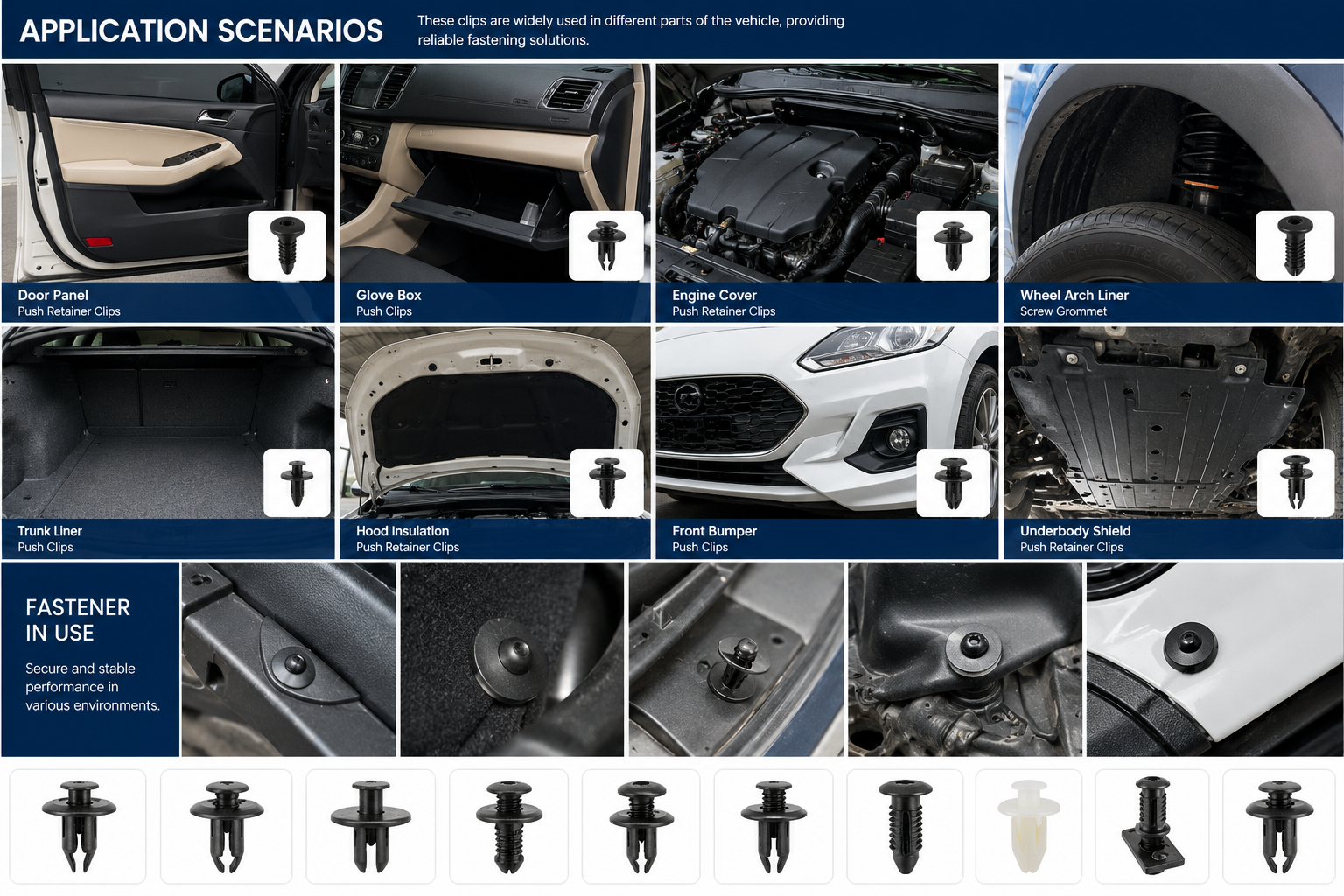
Applications Across Vehicle Platforms
| Vehicle Section | Clip Type | Primary Function | QEEPEI Material Grade |
|---|---|---|---|
| Door Panels | Trim clip | Holds decorative panels | PA66 + 10% GF |
| Fender & Bumper | Retainer clip | Absorbs impact vibration | POM reinforced |
| Roof & Ceiling | Snap clip | Secures liner and insulation | Modified nylon |
| Engine Bay | Push rivet | Cable routing | Heat-resistant PA |
Every application proves how small details build large-scale reliability.
Guidelines for Choosing the Right Car Body Clip
-
Identify Assembly Environment: Heat, humidity, and chemical exposure.
-
Match Material to Substrate: Nylon for steel, POM for plastic-to-plastic joints.
-
Check Dimensional Tolerance: ±0.03 mm ensures cross-model compatibility.
-
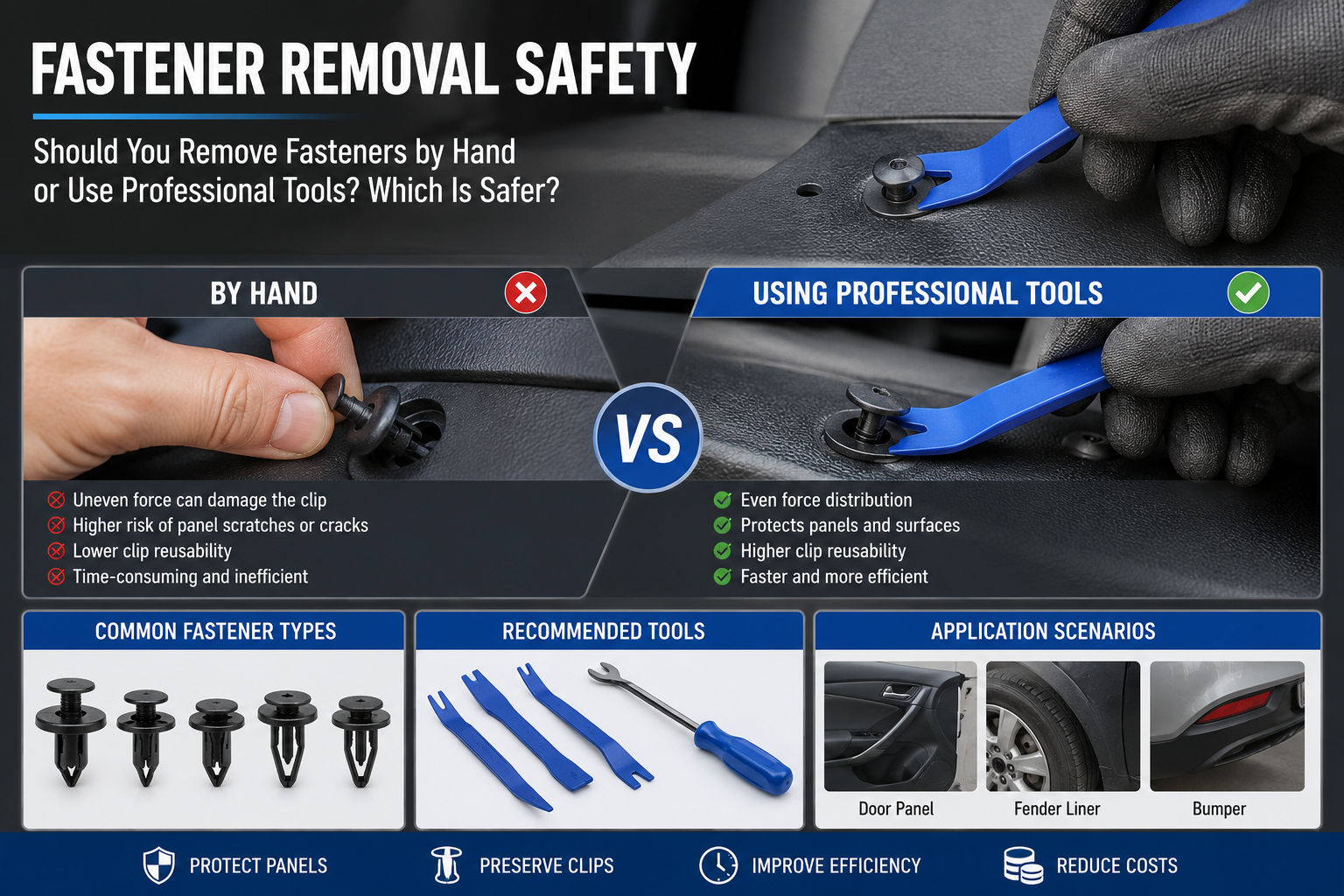
Evaluate Clip Geometry: Balanced retention and easy removal during service.
-
Verify OEM Compliance: IATF 16949 and RoHS-certified supply.
Procurement accuracy begins with clear technical alignment between buyer and maker.
FAQ
Q: Can QEEPEI provide customized clips for specific car models?
A: Yes, our engineering team designs mold geometry tailored for OEM fitment programs.
Q: How do QEEPEI clips perform in high-vibration areas like underbody panels?
A: Each design is validated with long-duration vibration and tensile fatigue tests.
Q: Do you offer recyclable or eco-friendly materials?
A: Absolutely. Our PA and POM formulations support circular manufacturing goals.
Conclusion: Small Components, Lasting Reliability
A car’s visual harmony and mechanical stability depend on unseen precision—the clip network that holds it all together. A maker car body clips partner like QEEPEI bridges material science, manufacturing discipline, and logistics reliability to deliver fastening systems that outlast expectations.
For collaboration and technical consultation, visit QEEPEI Homepage or connect via Contact Us.