
OBM Car Trim Clips: Empowering Automotive Brands with In-House Manufacturing Strength
In today’s automotive industry, brands are shifting from outsourced production toward self-controlled manufacturing systems.
OBM — Original Brand Manufacturing — represents not only a supply model but a strategic transformation.
When it comes to car trim clips, OBM means precision control, faster innovation, and visible brand identity in every fastening detail.
For manufacturers seeking both independence and consistency, QEEPEI’s OBM solution bridges technical excellence with brand power.
The Hidden Pain Points Behind Outsourced Clip Production
Many automotive companies still rely on fragmented OEM or ODM production chains — a model that carries hidden inefficiencies:
-
Weak brand presence: Generic fasteners dilute product identity and recognition.
-
Delayed production cycles: Communication gaps between design, molding, and testing.
-
Quality drift: Varying standards between subcontracted factories.
-
Dependence on intermediaries: Slower response to design or supply changes.
-
Limited customization: Restricted ability to match trim design with brand aesthetics.
These issues accumulate quietly but affect every stage — from assembly precision to post-sale maintenance.
The OBM Principle: Design Ownership Meets Manufacturing Control
OBM car trim clips merge engineering capability with brand ownership.
Unlike traditional OEM outsourcing, OBM gives automotive companies full access to the design-to-delivery pipeline.
| Stage | OEM Model | OBM Model | Key Advantage |
|---|---|---|---|
| Design Authority | Supplier-driven | Brand-driven | Full product ownership |
| Mold Development | Shared tooling | Exclusive tooling | Confidential precision |
| Material Selection | Supplier decision | Brand-controlled | Performance assurance |
| Testing & QA | Factory standard | Brand-defined | Custom benchmarks |
| Brand Visibility | Neutral | Branded part identity | Market differentiation |
Through this framework, OBM helps automakers unify brand identity with engineering execution.
QEEPEI’s OBM Manufacturing System
QEEPEI operates as both an engineering partner and a production base for OBM car clip programs.
Its integrated system covers the entire product lifecycle:
-
Concept Co-Design: Joint development of clip geometry for specific vehicle models.
-
Mold Fabrication: CNC precision tooling under ISO9001 & IATF16949 supervision.
-
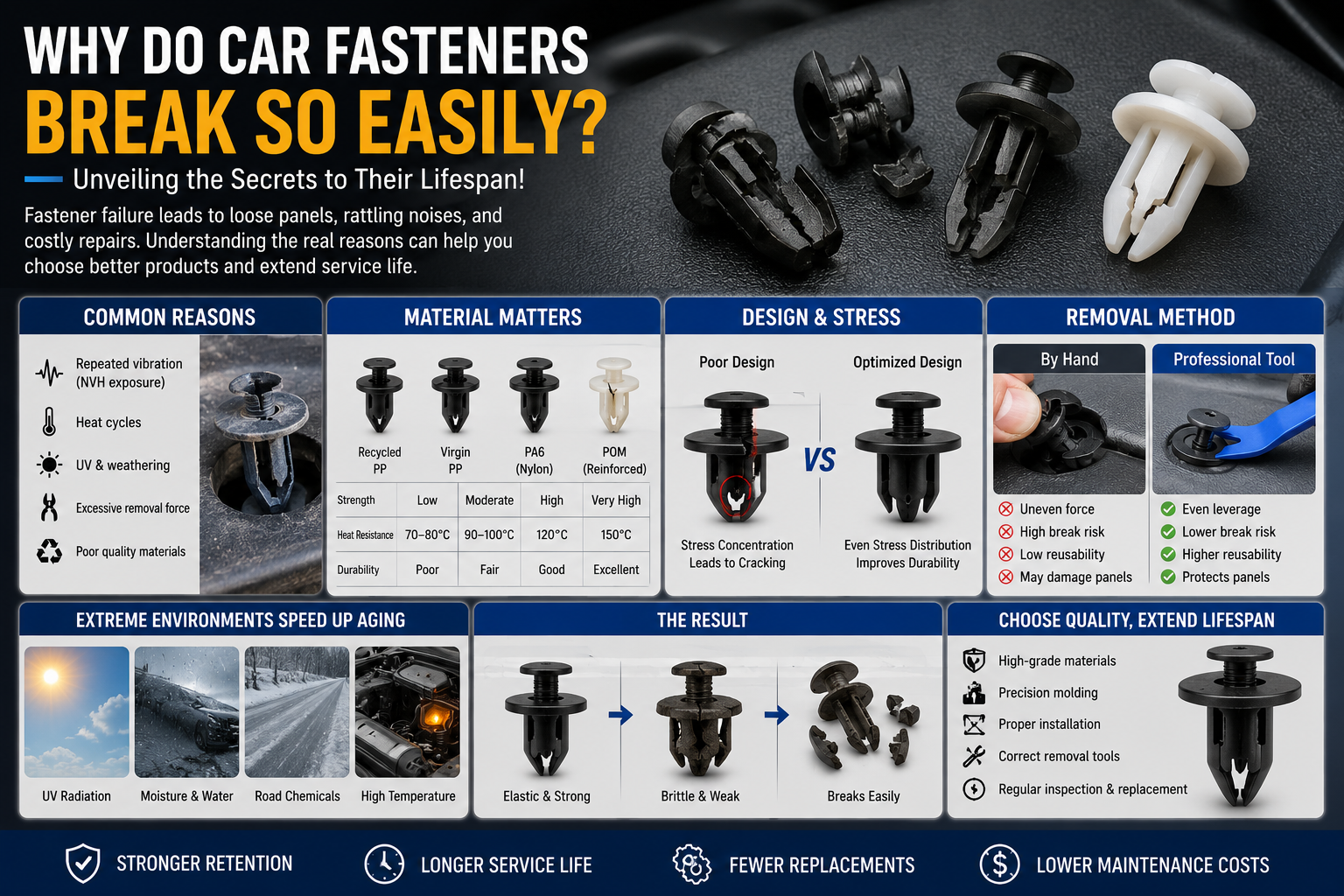
Material Engineering: PA6, POM, and reinforced composites adapted to thermal environments.
-
Quality Validation: Fatigue, vibration, and UV resistance testing per vehicle type.
-
Brand Marking: Laser engraving or embossed logo for brand traceability.
-
Global Fulfillment: Direct export with regional packaging and labeling systems.
This structure allows brands to achieve full production autonomy while maintaining supplier-level efficiency.
Strategic Advantages of OBM Trim Clips
-
Total Brand Control: From design to packaging, every part reflects the brand’s identity.
-
Faster Market Response: Direct feedback from assembly lines to design units.
-
Reduced Supply Risk: Elimination of intermediaries and duplicated logistics.
-
Enhanced Durability: Materials and tolerances set by internal engineering teams.
-
Higher Profit Margins: Brand-owned manufacturing reduces outsourcing overhead.
OBM isn’t just about independence — it’s about building a self-sustaining manufacturing ecosystem.
Real-World Applications: From Assembly Line to Market
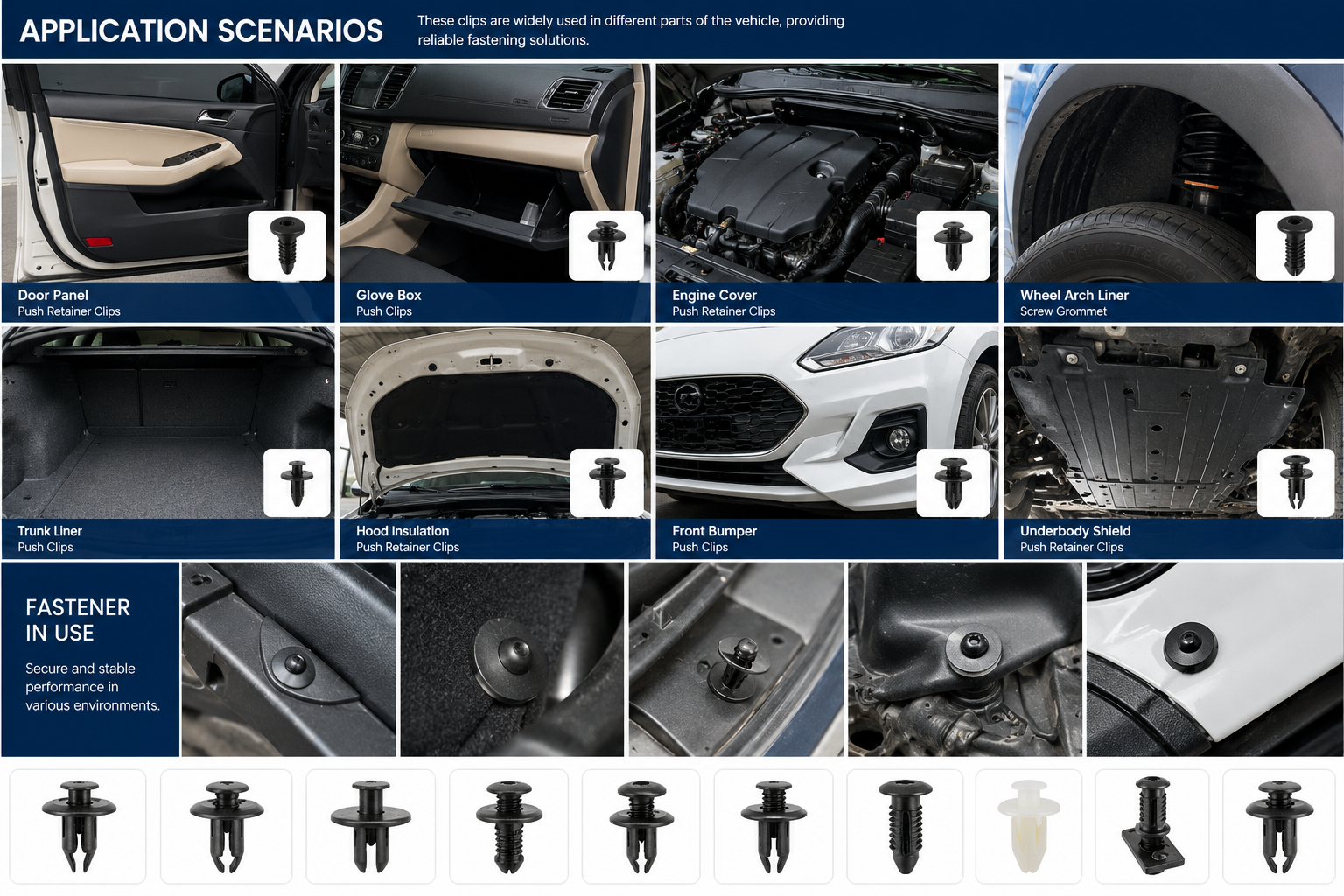
| Vehicle Type | Trim Area | Clip Type | Core Feature |
|---|---|---|---|
| Sedans | Door & interior panels | Soft-lock POM clips | Noise-free fit |
| SUVs | Fender & bumper joints | Reinforced PA6 clips | Impact resistance |
| Commercial vehicles | Dashboard & console | PP-TPE hybrid clips | Lightweight structure |
| Luxury cars | Roof lining & pillar trims | Coated decorative clips | Scratch protection |
| EV models | Underbody & battery cover | Flame-retardant nylon clips | Heat stability |
This broad adaptability allows OBM manufacturers to serve both premium and mass-market automotive lines with unified quality control.
Choosing the Right OBM Strategy for Your Brand
-
Evaluate Internal Capabilities: Identify which clip categories can be internalized first.
-
Define Material Standards: Match polymers with the vehicle’s environmental profile.
-
Invest in Tooling IP: Secure molds and design rights for long-term stability.
-
Optimize Logistics: Use direct export models to reduce freight redundancy.
-
Integrate Brand Communication: Ensure packaging and markings reflect consistent visual identity.
Transitioning to OBM doesn’t happen overnight — but with a trusted partner, it becomes a competitive leap rather than a structural risk.
Industry Q&A: Real Challenges from Automotive Teams
Q: How can OBM improve quality consistency in multi-model production?
By standardizing material sourcing and geometry across internal facilities, OBM eliminates tolerance deviations common in outsourced systems.
Q: Is OBM suitable for small automotive brands?
Yes — QEEPEI supports scalable OBM programs starting from limited SKUs, allowing smaller brands to grow manufacturing capability over time.
Q: How does OBM affect intellectual property management?
All molds, designs, and technical documents remain under brand ownership, ensuring data confidentiality and long-term control.
Q: What is the investment threshold for OBM transition?
Typically, initial investment includes mold development and testing infrastructure; ROI improves as volume stabilizes.
Manufacturing Autonomy Is Brand Strength
The evolution toward OBM car trim clip production is not just a technical shift — it’s a declaration of brand maturity.
With QEEPEI as your engineering partner, your clips no longer carry someone else’s identity — they carry your own.
Explore how OBM manufacturing can redefine your brand’s control and credibility at our Homepage or get in touch via Contact Us to begin your transformation journey.