
ODM Car Clips: Customized Fastening Solutions for Modern Automotive Design
Automotive design is evolving toward lighter materials, modular construction, and higher assembly precision.
This evolution demands fastening systems that are not only standardized but adaptable.
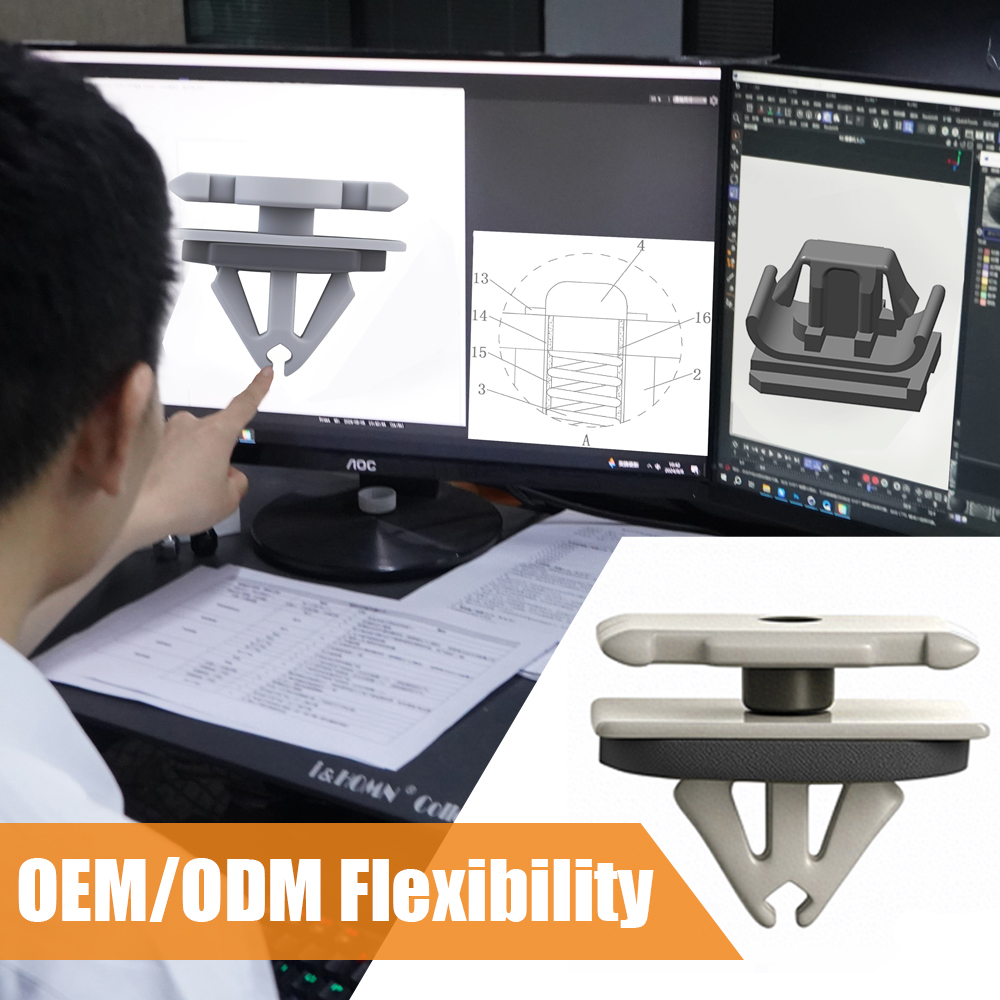
As a professional ODM car clips manufacturer, QEEPEI delivers fully customized fasteners that match OEM specifications—balancing design flexibility, mechanical strength, and manufacturing efficiency.
Rethinking Automotive Fastening Through Custom Design
Generic clips often fail to meet the structural or dimensional demands of new vehicle models.
ODM solutions bridge this gap by combining engineering expertise with flexibility:
-
Custom geometries to match unique panel designs.
-
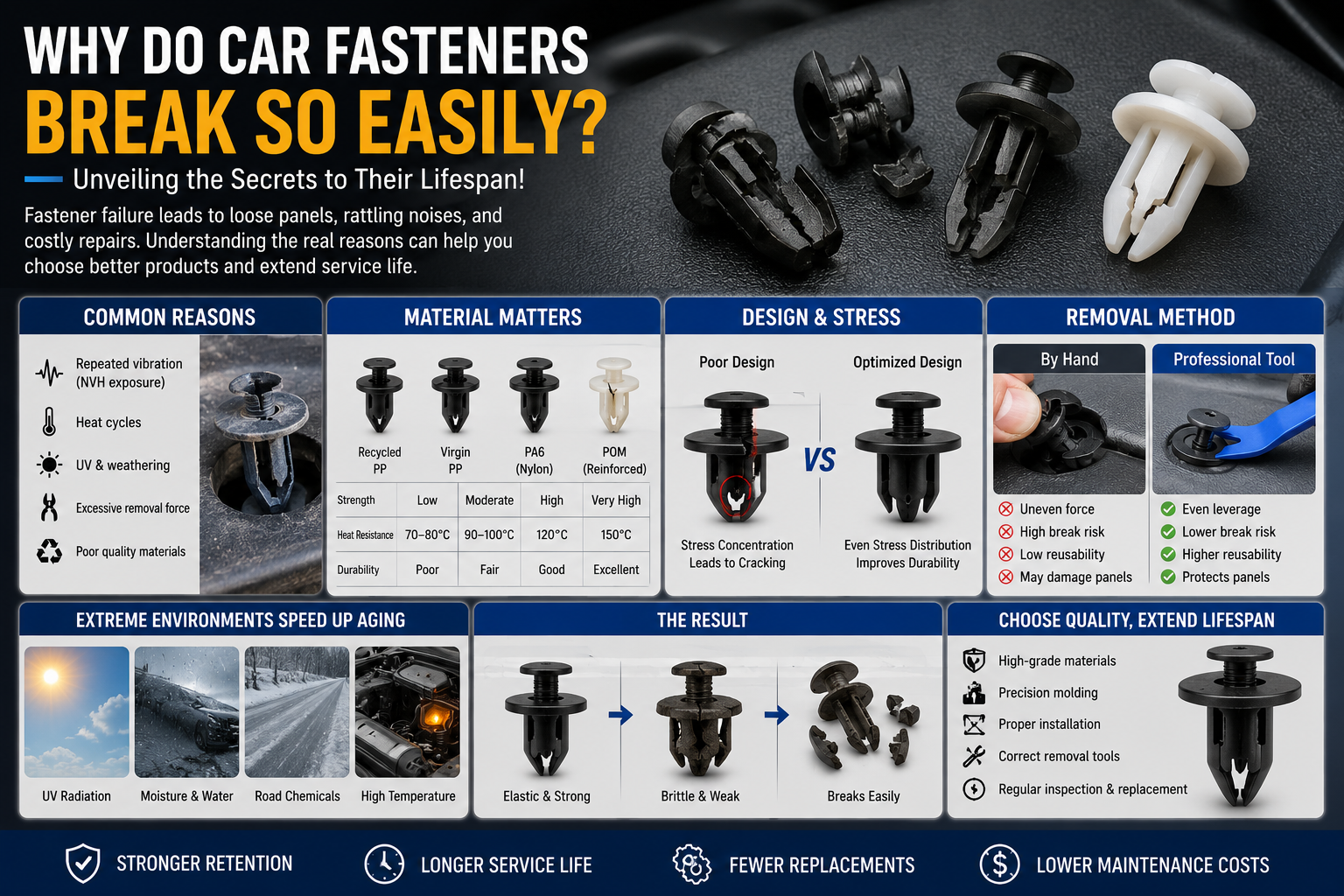
Material selection based on temperature, vibration, and chemical exposure.
-
OEM compatibility ensuring perfect alignment with existing tooling.
-
Color and texture customization for visible interior and exterior parts.
QEEPEI’s ODM service helps automakers shorten development cycles while maintaining global quality consistency.
Engineering Foundations Behind Every Custom Clip
ODM fasteners are not just visual modifications—they’re engineered systems designed for precise mechanical function.
| Design Factor | Technical Role | ODM Implementation |
|---|---|---|
| Elastic Retention Arms | Control grip force on panels | Variable wall thickness per model |
| Locking Tabs Geometry | Ensure click-fit stability | CAD-tuned tolerances ±0.02 mm |
| Material Blend Ratio | Balance stiffness and recovery | PA6 + POM hybrid or PP for flexibility |
| UV and Heat Resistance | Outdoor durability | Integrated UV stabilizer additive |
This data-driven engineering ensures each ODM clip fits and performs flawlessly—without unnecessary over-design or weight.
The Material Advantage: Engineering for Durability and Lightweight
| Material | Core Strength | Heat Resistance | Ideal Application |
|---|---|---|---|
| PA6 + GF | High tensile strength | Excellent | Exterior body panels, bumpers |
| POM (Acetal) | Low friction, wear-resistant | Good | Dashboard and interior trims |
| PP (Polypropylene) | Flexible, low-cost | Fair | Door linings, insulation panels |
| ABS | Paintable surface | Moderate | Visible clips and decorative parts |
QEEPEI’s ODM service allows flexible material selection based on cost targets, performance requirements, and installation conditions—helping clients achieve an ideal balance between functionality and manufacturability.
Why ODM Solutions Outperform Standard Components
| ODM Feature | Engineering Benefit | Customer Value |
|---|---|---|
| Model-Specific Mold Design | Matches panel geometry exactly | No need for modification during assembly |
| Hybrid Material Composition | Combines flexibility and strength | Extends clip lifespan |
| Color-Coded Fitment System | Easy identification on production line | Reduces assembly error |
| Optimized Locking Force | Stable connection under vibration | Enhances vehicle NVH quality |
| Scalable Production | Multi-cavity injection molding | Supports mass OEM orders |
ODM customization empowers vehicle manufacturers to achieve both engineering precision and production scalability.
Real-World Integration Across Vehicle Platforms
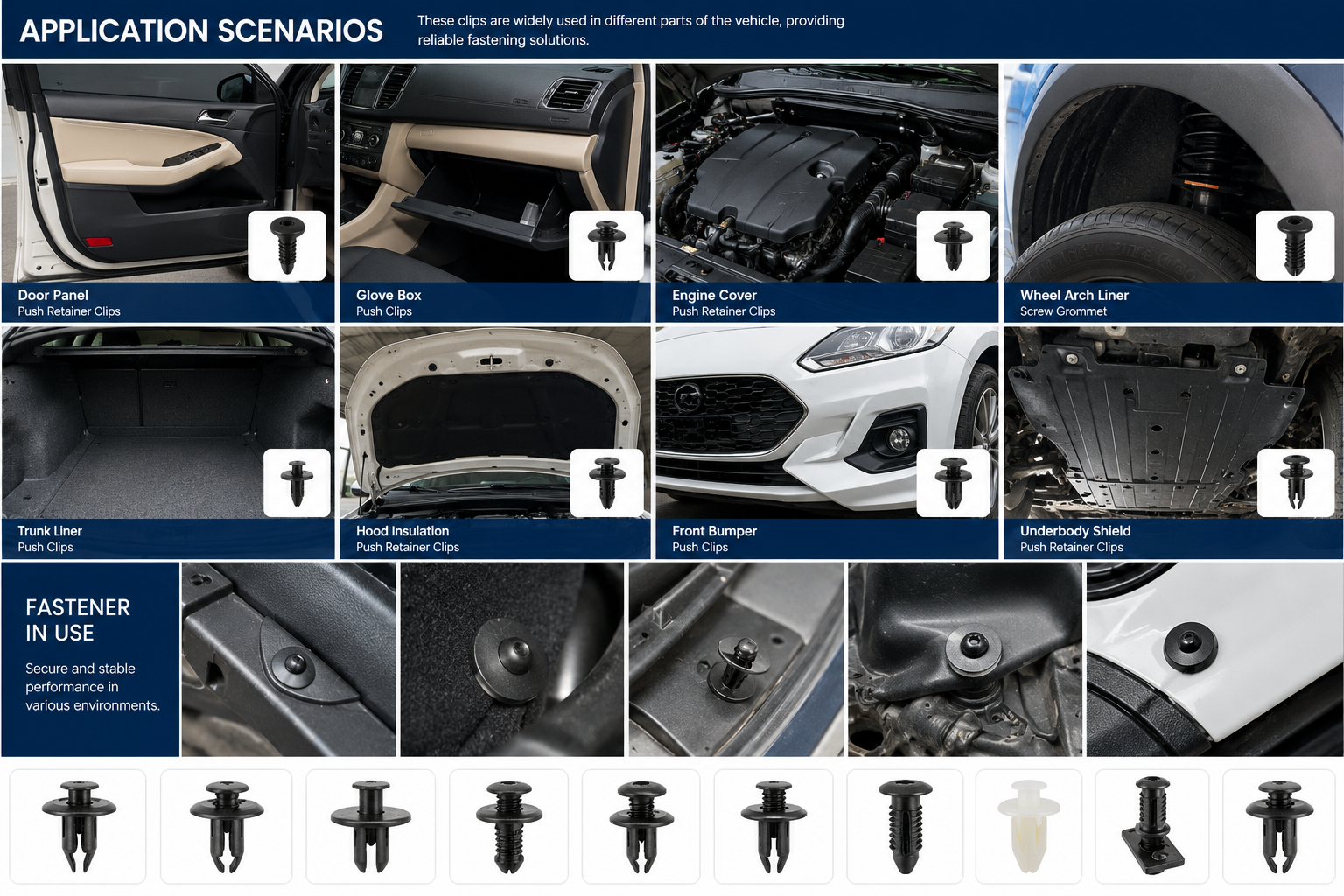
QEEPEI’s ODM clips are used across a wide spectrum of automotive applications:
-
Exterior trims and fenders — high-stress zones requiring strong retention.
-
Dashboard and consoles — noise-free locking systems for refined interiors.
-
Roof and underbody panels — thermal-resistant materials for outdoor exposure.
-
EV battery covers and modules — lightweight, insulated clips for electric vehicles.
ODM flexibility allows QEEPEI to tailor each solution to the assembly line’s requirements—ensuring fast installation and low defect rates.
Technical Matching Guide: Choosing ODM Car Clips by Vehicle Type
Different vehicle brands adopt distinct structural standards, material compositions, and assembly tolerances. When selecting ODM car clips, engineers must evaluate not just dimensions, but also elasticity, load distribution, and long-term durability under each brand’s specific body configuration.
| Vehicle Brand | Structural Characteristics | Clip Design Focus | Recommended Material | Key Technical Notes |
|---|---|---|---|---|
| BMW Cars | Complex multi-layer panel joints, high precision gaps | Dual-lock geometry for tight tolerance assembly | PA6 + GF | Requires <±0.02 mm mold precision and vibration damping for low NVH interiors |
| Honda Cars | Lightweight body structures emphasizing flexibility | High elastic clips for quick disassembly and reuse | POM or PP | Ensure elastic recovery rate >90% for repetitive maintenance |
| Nissan Cars | Emphasis on corrosion resistance and thermal balance | UV-resistant clips for exterior panels | PP + UV stabilizer | Designed for consistent retention strength under tropical climates |
| Volkswagen Cars | Rigid body panels with high-density paint coating | Surface-safe clips preventing paint cracking | POM + anti-friction coating | Prioritize smooth insertion force below 20 N to avoid surface tension |
| Ford Vehicles | Reinforced bumpers and thicker trim layers | Heavy-duty clips with multi-rib structure | PA6 reinforced | Must sustain >35 N tensile force for impact zones |
| Toyota Cars | Modular assembly design with high repeatability | Universal-fit clips adaptable across models | PP or ABS | Suitable for high-volume assembly lines with reusability ≥10 cycles |
Engineering Guidance:
-
Always align clip retention strength with panel thickness and material density.
-
For luxury or EV models, prioritize low-noise damping designs to meet NVH requirements.
-
When exporting ODM clips, consider environmental adaptation — especially UV and temperature variance between markets.
-
Use CAD-based verification to match OEM tolerance standards before mass production.
With this systematic approach, QEEPEI’s ODM solutions ensure compatibility across multiple global automotive platforms—balancing performance, manufacturability, and cost efficiency.
Frequently Asked Questions
Q1: How does QEEPEI support new car model development?
We offer joint engineering programs, working with OEM teams to design clips directly from CAD files.
Q2: What’s the typical ODM project timeline?
From concept to production, most projects take 10–15 working days, including prototype validation.
Q3: Are ODM clips suitable for both interior and exterior use?
Yes, material selection and surface finish are adjusted for UV exposure, heat, and aesthetics.
Q4: Can I request branding or logo engraving on parts?
Yes, QEEPEI offers private labeling, logo engraving, and color matching upon request.
Building Tailored Fastening Systems for the Future
ODM car clips are not just components—they are precision-engineered interfaces between design and performance.
By combining advanced molding, materials science, and collaborative customization, QEEPEI helps automakers create fastening systems that enhance reliability, reduce noise, and simplify assembly.
Explore our ODM solutions and product range on the Homepage.
For ODM partnerships or technical consultation, contact us here.