
OEM Auto Fasteners: Driving Assembly Precision and Structural Stability
In modern vehicle manufacturing, fastening technology plays a silent but decisive role. Every joint, panel, and component depends on fasteners engineered to exact tolerances. As a trusted producer of OEM auto fasteners, QEEPEI delivers fastening systems that enhance assembly precision, reduce NVH (Noise, Vibration, Harshness), and ensure long-term reliability across vehicle models.
Structural Pain Points in OEM Vehicle Assembly
Automotive OEMs face growing challenges as vehicles evolve toward lighter, more complex structures:
-
Panel misalignment during high-speed assembly lines due to clip deformation.
-
Vibration and squeaks from inconsistent fastener tension.
-
Thermal fatigue caused by extreme temperature variation under the hood.
-
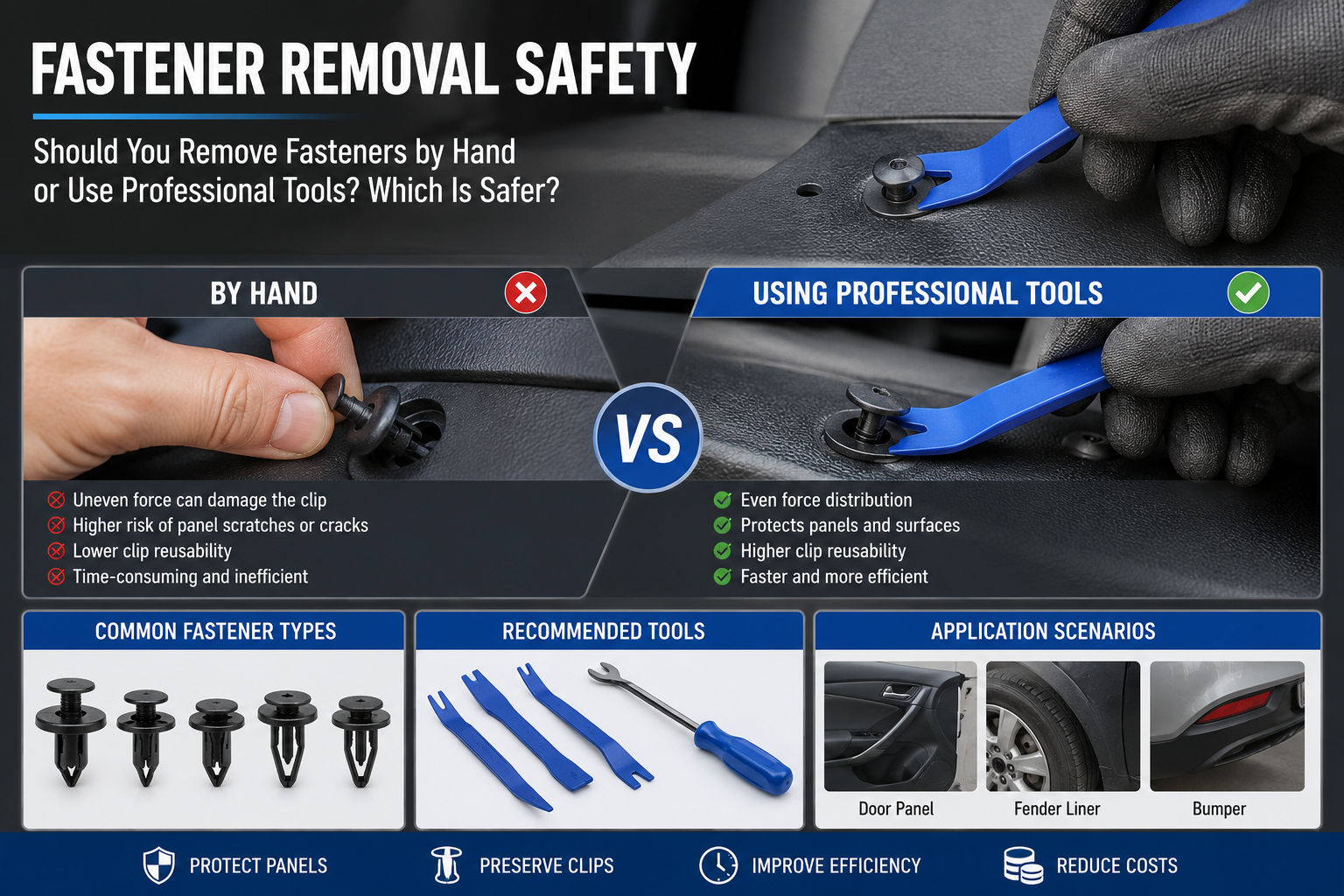
Disassembly difficulty during maintenance or repairs.
Each problem directly impacts assembly efficiency, product quality, and warranty performance—making the precision of fasteners a core engineering concern.
Engineering Principles Behind Reliable Fastening
OEM auto fasteners must balance mechanical locking strength, elastic recovery, and environmental resistance.
Their performance depends on how accurately they distribute load and maintain alignment under dynamic conditions.
| Engineering Parameter | Function | Performance Target |
|---|---|---|
| Retention Force | Secure mechanical locking | 30–40 N |
| Flexural Strength | Resist bending stress | >800 MPa |
| Heat Resistance | Maintain elasticity | Up to 120°C |
| Dimensional Tolerance | Ensure repeatable fit | ±0.02 mm |
These characteristics ensure that every fastener integrates seamlessly into robotic assembly lines, maintaining consistent performance even after thousands of production cycles.
The Core of Fastener Longevity
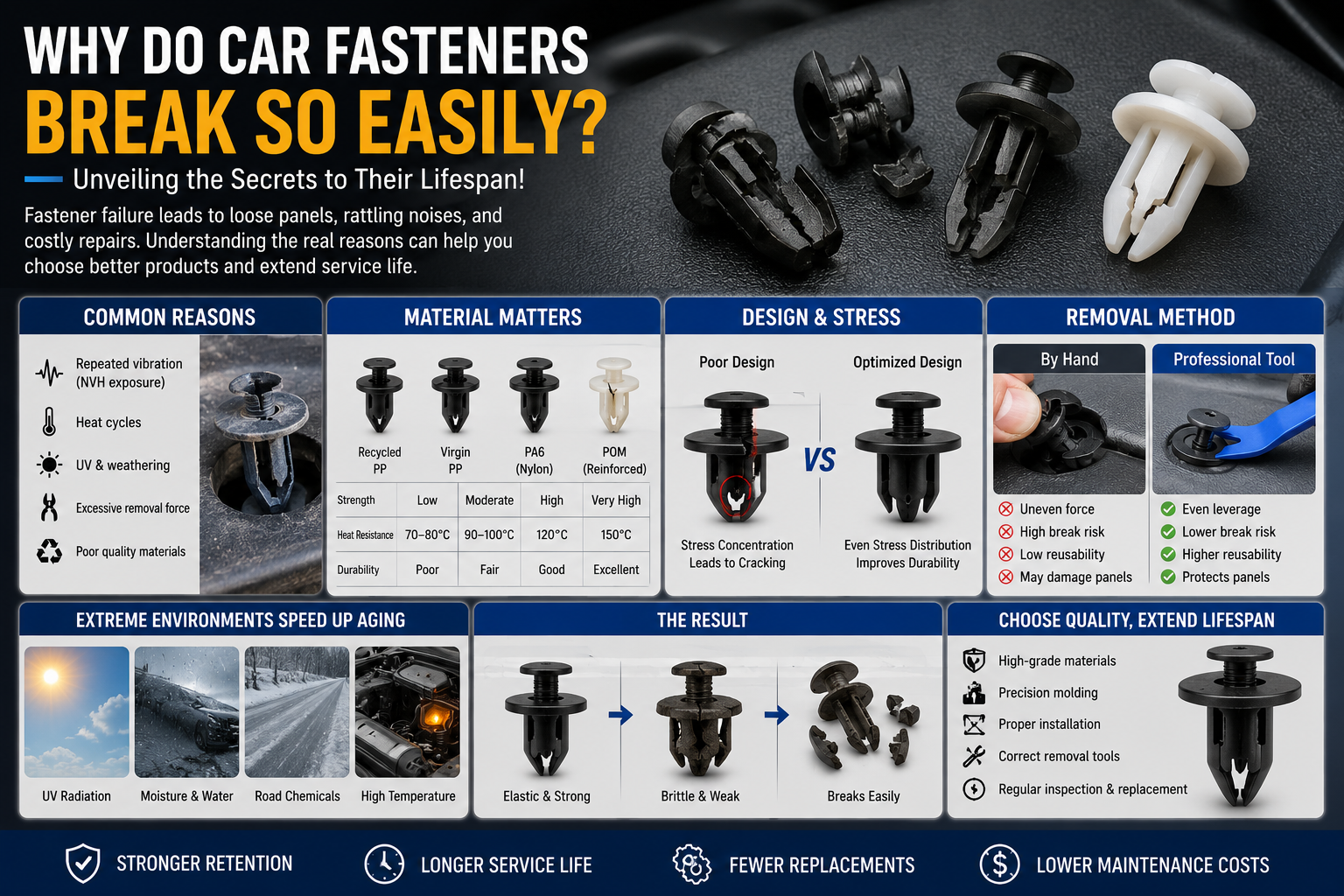
| Material | Strength | Heat Resistance | Recommended Application |
|---|---|---|---|
| PA6 + GF (Glass Fiber Nylon) | Excellent | High | Engine bay, fenders, and bumper frames |
| POM (Acetal) | Medium | Moderate | Interior trim and dashboards |
| PP (Polypropylene) | Good | Fair | Door panels, insulation boards |
| PC/ABS Blends | Balanced | Excellent | Structural joints and visible parts |
Material engineering is at the core of QEEPEI’s OEM solutions—ensuring fasteners deliver long-term stability in both mechanical and environmental performance.
From Design to Delivery: How OEM Fasteners Are Engineered
At QEEPEI, fasteners are not off-the-shelf parts—they are precision components developed through integrated R&D and testing:
-
3D modeling and mold simulation for stress distribution.
-
Automated injection molding to eliminate dimensional deviation.
-
Vibration testing to simulate vehicle motion cycles.
-
Thermal aging verification under 120°C continuous exposure.
Each fastener design goes through multiple prototype iterations to meet OEM specifications for fitment, noise control, and thermal resistance.
Competitive Advantages for OEM Partners
| Feature | Technical Value | Business Impact |
|---|---|---|
| OEM Fit Guarantee | Exact match with car model design | Simplifies global assembly |
| Zero-Tolerance Manufacturing | ±0.02 mm precision | Minimizes rework and defects |
| Material Certification | RoHS & ISO compliance | Supports global exports |
| High Volume Capacity | Multi-cavity tooling | Meets large-scale OEM demand |
| Custom Mold Support | CAD-based design service | Shortens new model development |
With these advantages, QEEPEI enables automakers to achieve consistent assembly quality at scale.
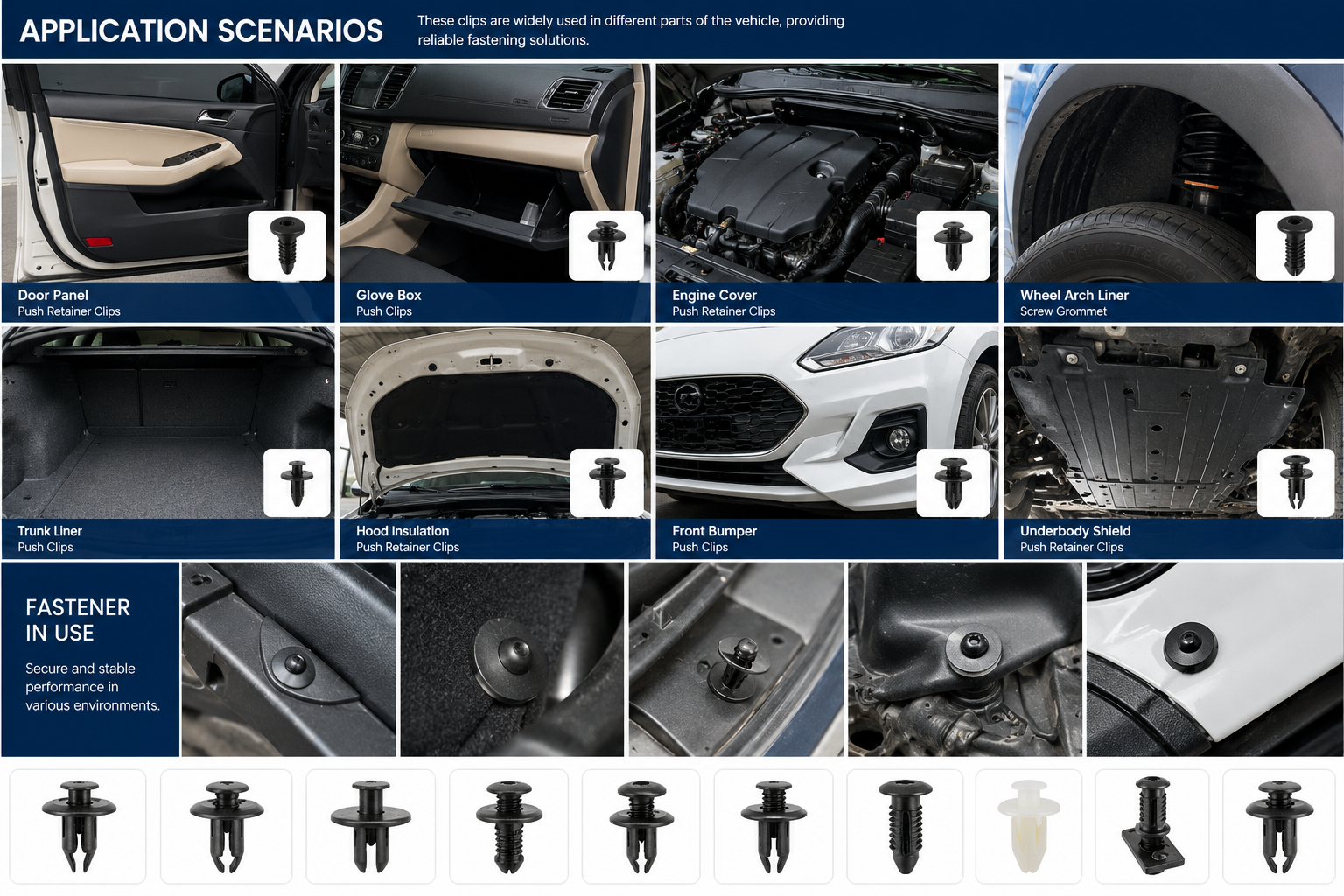
Real-World Applications Across Vehicle Systems
OEM fasteners are essential to every part of the vehicle body:
-
Engine compartment – resistant to heat and oil exposure.
-
Bumpers and fenders – maintaining external alignment under vibration.
-
Door panels – ensuring smooth closure and noise insulation.
-
Interior trims – supporting a refined, rattle-free cabin.
-
Roof and underbody panels – preventing detachment under aerodynamic load.
Each area requires unique material composition and clip geometry, developed through OEM-specific collaboration.
Technical Guidance for OEM Buyers and Engineers
When selecting fasteners for OEM programs, consider:
-
Assembly speed: clips with low insertion force reduce cycle time.
-
Thermal zones: under-hood components need PA6 + GF materials.
-
Serviceability: reusable clips lower repair costs.
-
Color and finish: aesthetic integration for visible panels.
-
Global standardization: consistent part codes simplify sourcing.
OEM-grade fasteners are not just mechanical parts—they are engineered interfaces between design, production, and performance.
Frequently Asked Questions
Q1: Can QEEPEI design fasteners based on OEM drawings?
Yes, we offer CAD-based design and rapid mold development services.
Q2: How do you control quality consistency across large orders?
Through automated visual inspection, tensile testing, and statistical sampling.
Q3: Are materials certified for export markets?
Yes, all materials comply with RoHS, REACH, and ISO9001 standards.
Q4: What is the typical lead time for OEM mold customization?
Generally 7–10 working days, depending on complexity.
Engineering the Unseen Foundation of Automotive Excellence
Every bolt, clip, and retainer contributes to a vehicle’s perceived quality and reliability.
By integrating engineering precision, materials innovation, and OEM collaboration, QEEPEI provides fastening systems that ensure every car rolls off the line with structural integrity and quiet confidence.
Explore the complete OEM fastening range on the Homepage.
For OEM cooperation and project consultation, contact us here.