
Plastic Car Clips Factory: Engineering Precision and Reliability for Global Automotive Assembly
Every automotive assembly line depends on unseen precision. The plastic car clips factory is where stability, sound insulation, and visual consistency begin. A clip that fails by half a millimeter can halt production or distort body alignment. QEEPEI, as a global automotive fastening partner, operates with the same rigor expected of OEM-grade suppliers—combining material integrity, design validation, and automated inspection under one continuous system.
Industrial Pain Points in Clip Manufacturing
Despite its simplicity, the plastic clip segment carries chronic manufacturing pain:
-
Inconsistent dimensional stability between production runs.
-
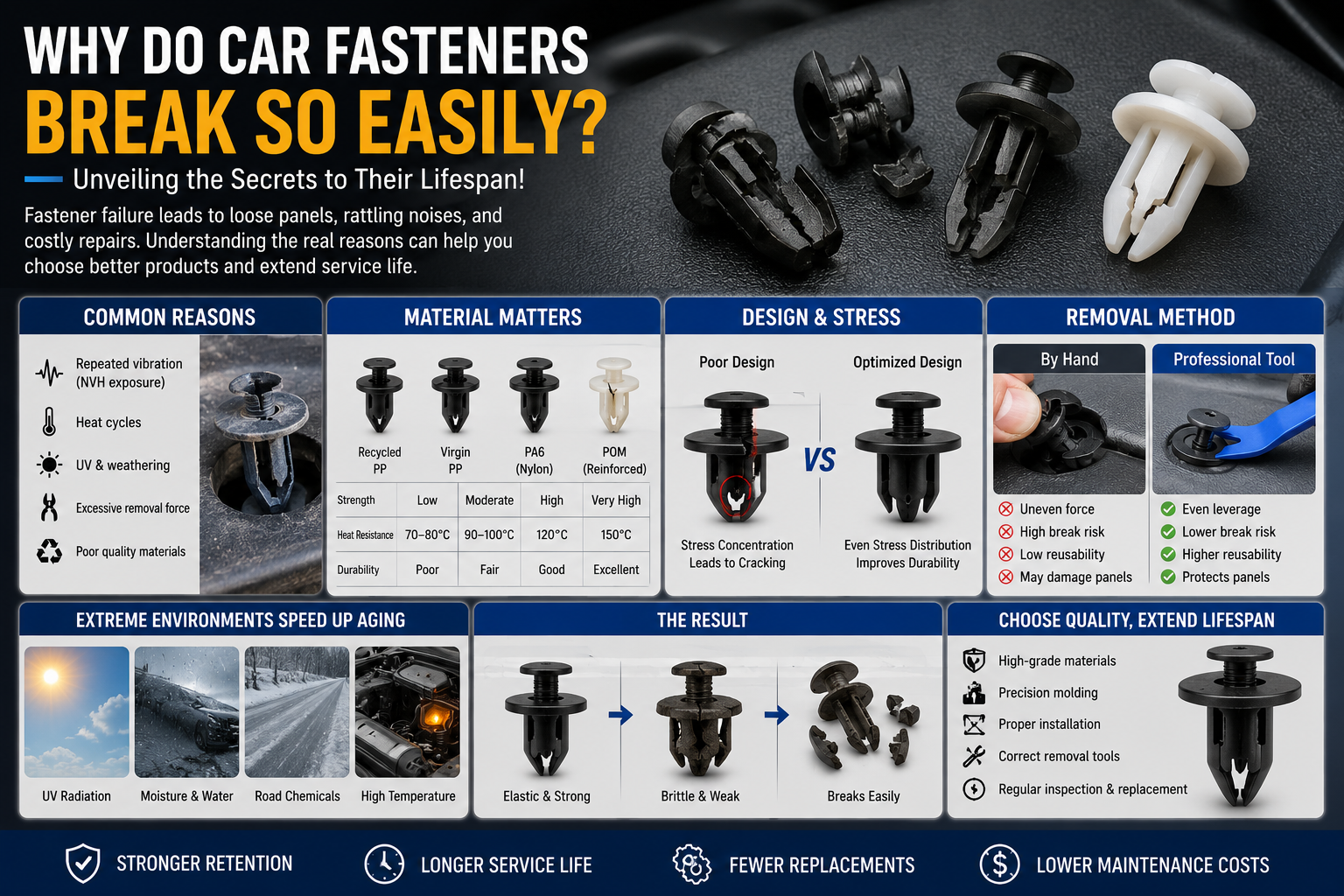
Polymer degradation under prolonged heat cycles.
-
Insufficient data traceability for warranty validation.
-
Disorganized global supply networks increasing lead-time variance.
These inefficiencies inflate total manufacturing cost and compromise assembly reliability. For multinational OEMs, such risk is unacceptable.
Engineering Mechanisms Behind Reliable Clip Performance
The physics behind automotive clips centers on controlled elasticity and precision fit.
-
Retention Force Balance: A clip must compress smoothly yet resist vibration loosening.
-
Thermal Expansion Control: Material must remain stable between –40 °C and +130 °C.
-
Insertion Energy Optimization: Controlled geometry ensures robotic assembly efficiency.
-
Resin Formulation: Blends of PA66 + POM + GF 10 % deliver strength without brittleness.
At QEEPEI, these mechanical parameters are digitally modeled before a mold is cut, ensuring each batch reproduces identical physical behavior.
Local Vendor vs. Global-Standard Factory
| Parameter | Local Vendor | Plastic Car Clips Factory (QEEPEI) |
|---|---|---|
| Mold Tolerance | ±0.10 mm | ±0.03 mm CNC tolerance |
| Resin Source | Generic nylon | Certified PA66 / POM – RoHS & REACH |
| Testing | Manual pull test | Automated tensile + aging QC |
| Packaging | Bulk bag | Barcode + JIT palletized units |
| Traceability | None | Full QR digital batch record |
This manufacturing discipline shifts clips from commodities to performance-critical components.
Integrated Manufacturing Solution by QEEPEI
QEEPEI operates a closed-loop production system:
-
Mold Development: CAD-CAM data sharing across toolshops for global consistency.
-
Injection Automation: Servo-controlled presses with temperature feedback loops.
-
In-Line Inspection: Vision systems detect defects below 0.02 mm variance.
-
Smart Packaging: RFID labeling for assembly-line synchronization.
-
Digital Twin Monitoring: Real-time production dashboards accessible to OEM clients.
This integration guarantees continuity from resin input to shipment delivery.
Advantages for Automotive Buyers
-
Dimensional Accuracy: Eliminates fitment rework on high-speed lines.
-
Predictable Supply Chain: JIT warehousing in Asia + EU hubs.
-
Lower Total Cost: Reduced scrap and defect returns.
-
OEM Certification: Compliance with IATF 16949 and ISO 9001.
-
Sustainability: Recyclable materials with lifecycle tracking.
By aligning process control and logistics, QEEPEI delivers measurable ROI to both OEM and aftermarket distributors.
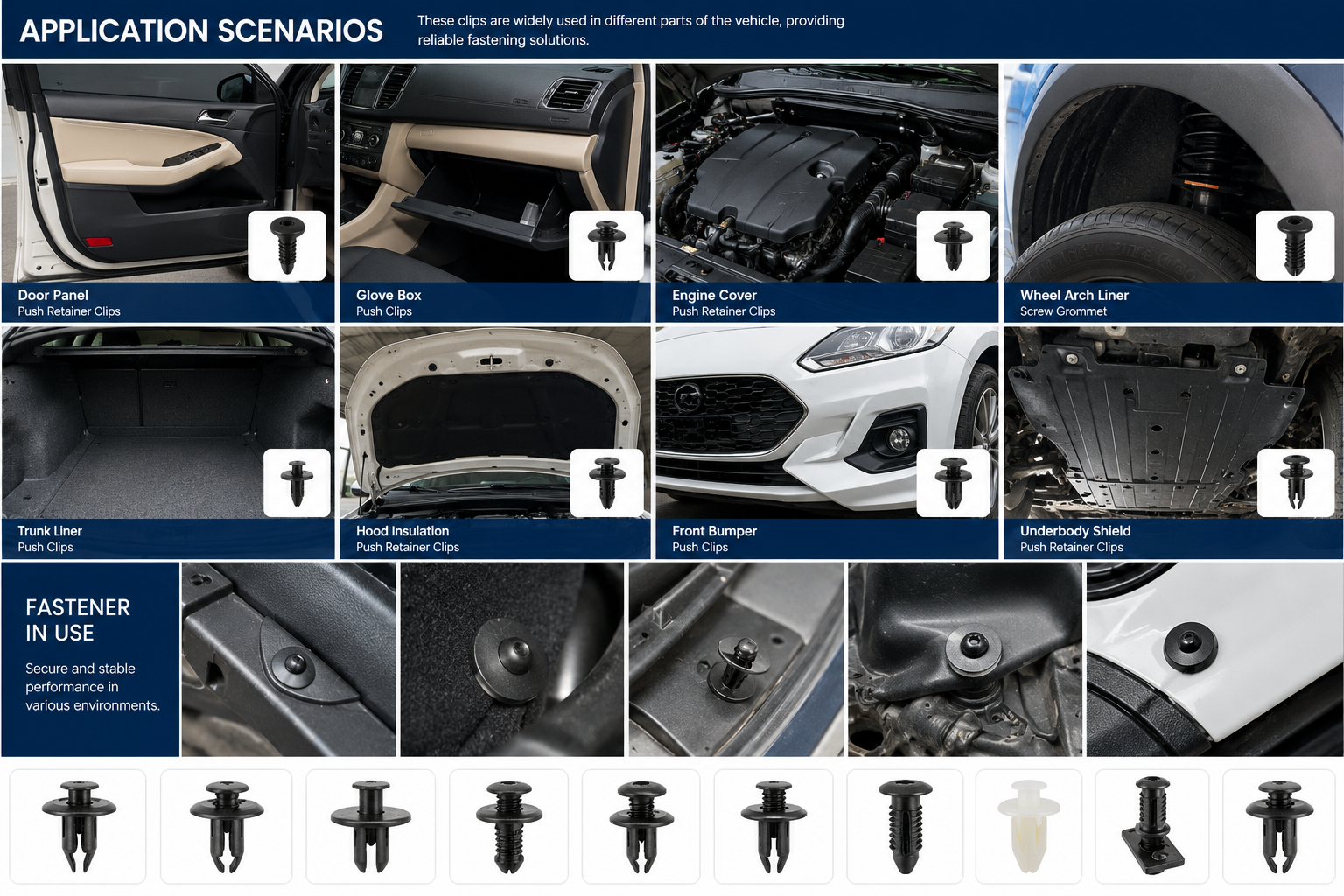
Application Scenarios Across Vehicle Systems
| Assembly Zone | Clip Type | Function | Durability Benchmark |
|---|---|---|---|
| Door Panels | Push-fit retainer | Trim fastening | > 50 000 vibration cycles |
| Engine Bay | Heat-resistant fastener | Cable routing | 1 000 h thermal aging no crack |
| Roof Liner | Insulation clip | NVH reduction | 12 % noise drop |
| Bumper | Rivet clip | Impact fixation | 98 % fitment repeatability |
Each application proves that precision fastening underpins every visible surface of a vehicle.
Selection Guide for Procurement Engineers
-
Confirm Material Spec: Match resin type to temperature / chemical exposure.
-
Inspect Head Geometry: Ensure robotic gripper compatibility.
-
Check Insertion Force Profile: Between 30 – 45 N for trim panels.
-
Audit Factory Certification: IATF 16949 and ESD safety control.
-
Review Packaging Format: Box or pallet configuration per assembly line.
Adhering to these standards ensures seamless procurement-to-assembly continuity.
FAQ
Q: Can QEEPEI produce custom clips for hybrid or EV platforms?
A: Yes, our design team adapts polymer formulas to high-voltage insulation and lightweighting needs.
Q: How is quality consistency maintained across plants?
A: Unified digital mold data and automated feedback loops ensure identical output globally.
Q: Do you offer private-label supply programs?
A: Absolutely. QEEPEI supports OEM and aftermarket branding with serialized labeling.
Conclusion: From Factory to Framework of Reliability
A plastic car clips factory defines more than production—it defines repeatability, safety, and engineering discipline. Through precise tooling, certified materials, and digital logistics, QEEPEI transforms small polymer parts into enablers of large-scale manufacturing efficiency. For automotive producers seeking zero-defect fastening systems, partnership with QEEPEI means confidence from prototype to global delivery.
Explore detailed specifications via QEEPEI Homepage or reach our engineering team through Contact Us.