
What Should an Automotive Push Clips Supplier Help Buyers Confirm?
An automotive push clips supplier should help a professional buyer identify the correct retainer, document the approved specification, organize it under a usable SKU, and reproduce the same purchasing requirement on future orders. Push clips may appear simple, but small differences in stem diameter, head size, locking geometry, overall length, mounting-hole shape, panel thickness, or material can determine whether a clip installs correctly.
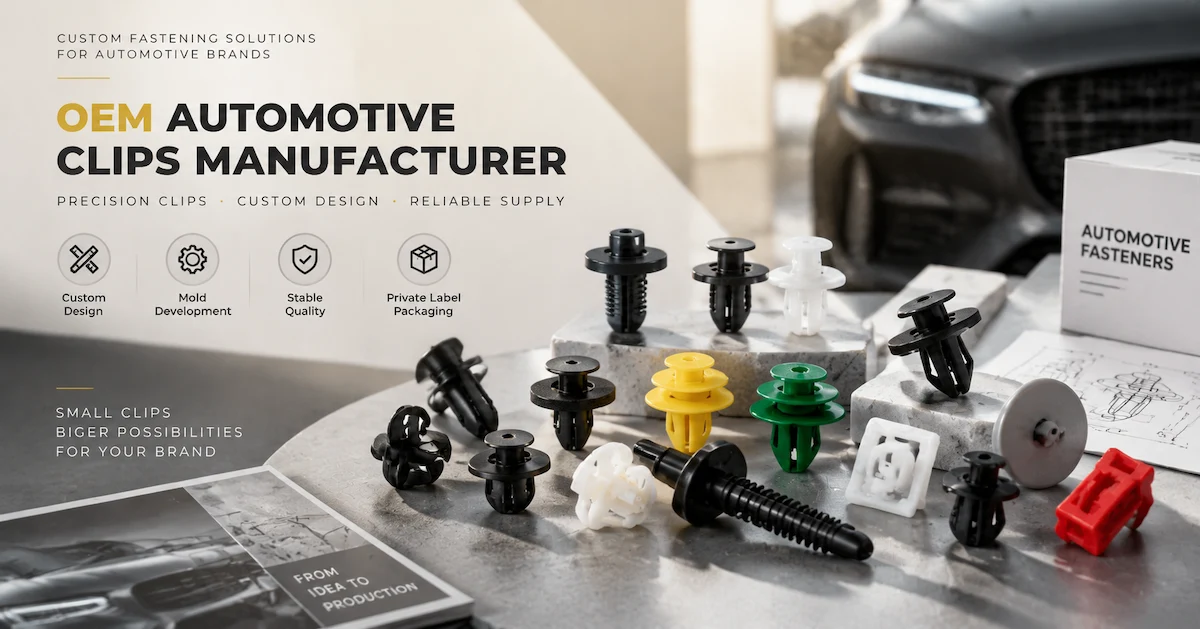
For distributors and repair suppliers, the sourcing problem becomes more complex because many visually similar retainers may be stocked together. QEEPEI's automotive clip product range is organized around body clips, clip kits, vehicle-specific clips, and related tools. These categories are useful for finding candidate products, but a category name or product photo should be treated as the beginning of identification rather than final fitment approval.
A practical sourcing process is therefore: identify the application → measure the mounting interface → compare clip geometry → verify vehicle or reference information → approve a sample → define packaging → establish replenishment records.
Who Buys Automotive Push Clips in Bulk?
Different buyers need different information from an automotive push clips supplier. Automotive aftermarket distributors usually care about SKU breadth, clear identification, warehouse labeling, pack quantities, and repeat-order availability. Collision-repair and body-shop suppliers may focus on frequently replaced bumper, grille, fender, liner, and molding fasteners. E-commerce sellers need accurate dimensions and application descriptions because poor fitment information can lead directly to returns. Private-label brands may additionally need custom packaging, barcodes, assortment development, or product-development support.
QEEPEI's wholesale service is aimed at B2B channels including distributors, online sellers, brand customers, and retail buyers. For these customers, the commercial value of a push clip is not simply its piece price; it is whether the part can be identified, sold, replenished, and supplied consistently.
Push clips are less suitable as a buying category when the application actually requires a different fastening system. Structural bolts, threaded safety-critical fasteners, seat-belt anchorage hardware, and other engineered structural joints should not be grouped into the same sourcing process merely because they are also automotive fasteners.
Start With the Mounting Location Before Choosing a Clip
Push-type automotive retainers can be used around several vehicle areas, but installation location changes the purchasing requirements. A bumper or grille application may require a different locking structure from an interior panel. A fender-liner application may be exposed to moisture, dirt, vibration, and temperature changes, while an interior trim application may place more emphasis on appearance and interaction with the panel.
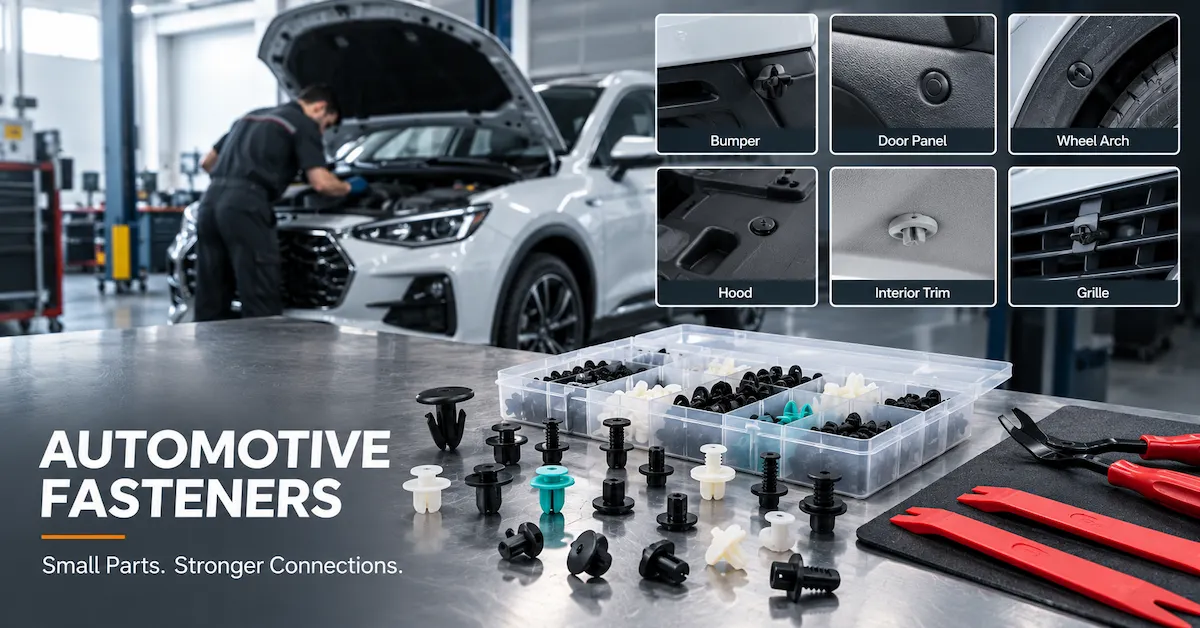
QEEPEI organizes body clips into categories such as bumper clips, inner lining clips, door interior clips, fender clips, hood clips, grille-related clips, dashboard/navigation clips, and wheel-arch molding clips through its product catalog. Buyers can use those application groups to narrow the search before verifying the individual part.
| Application Area | What the Buyer Should Confirm | Common Sourcing Risk |
|---|---|---|
| Bumper and grille | Hole dimensions, locking direction, retained component | Choosing a similar-looking clip with different engagement |
| Fender and liner | Mounting hole, grip condition, environment | Confusing liner clips with exterior molding clips |
| Door and interior trim | Panel thickness, clip seat, head design | Correct hole size but poor panel retention |
| Dashboard/navigation trim | Geometry, orientation, mating feature | Difficult reassembly or loose panel |
| Hood-related lining | Actual retained component and environment | Confusing lining retainers with hood locking hardware |
| Wheel-arch molding | Molding slot, clip geometry, mounting direction | Substituting another wheel-area fastener |
The location helps identify candidates, but final approval should still be based on the actual mounting interface.
Measure More Than One Diameter
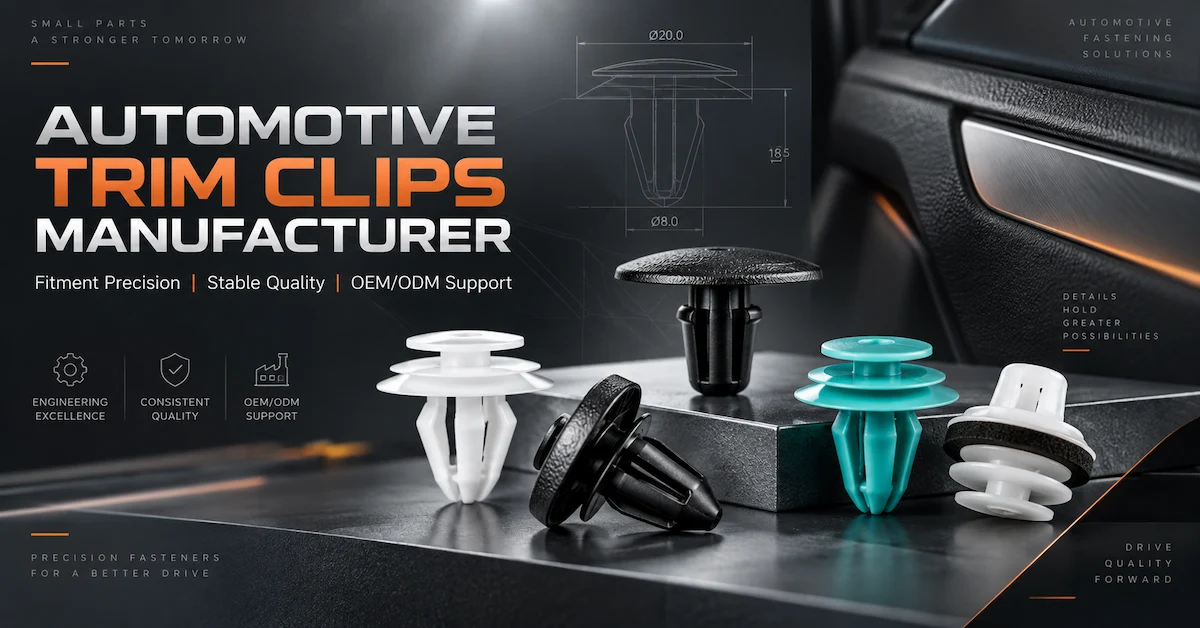
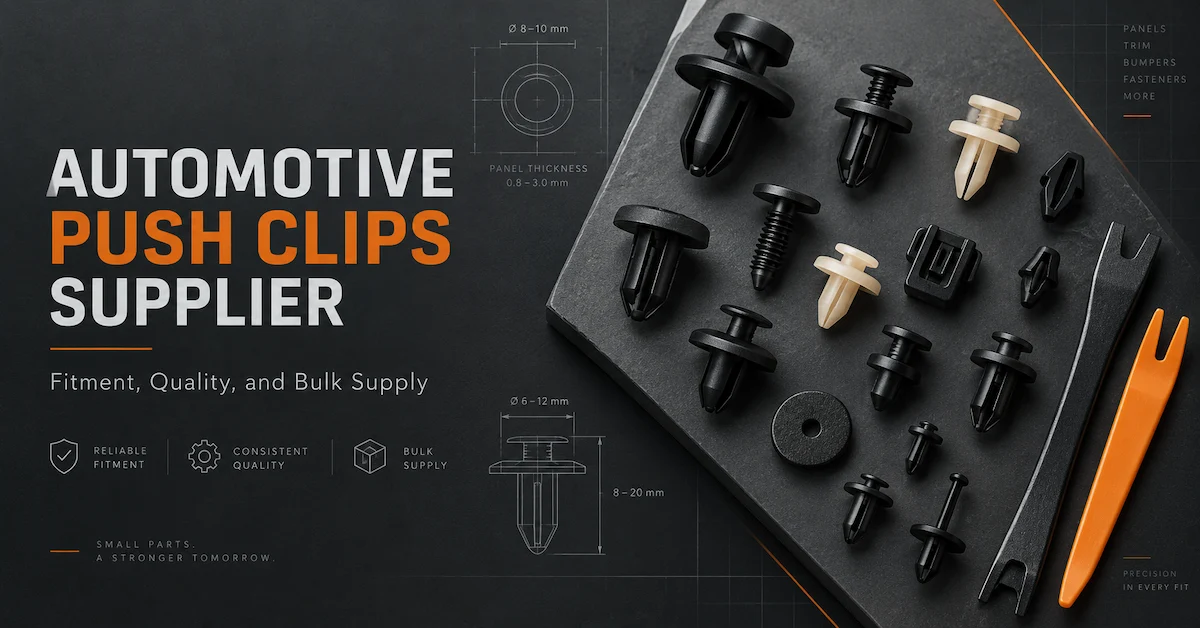
One of the most important responsibilities of an automotive push clips supplier is helping buyers distinguish between different dimensions that are often described simply as “clip size.” A push retainer may have a head diameter, stem width, locking-leg diameter, insertion section, total length, and a recommended mounting-hole dimension. These are not interchangeable measurements.
QEEPEI's car clip selection guide provides a useful starting point for understanding clip dimensions and fitment. When a buyer measures an existing part, the measurement should identify the exact feature being measured instead of recording only one number.
| Specification Field | What to Record | Why It Matters |
|---|---|---|
| Supplier model | Product SKU or controlled identifier | Prevents confusion between similar clips |
| Installation location | Exact vehicle area and retained component | Establishes application context |
| Vehicle data | Make, model, year/generation where relevant | Narrows compatibility |
| Reference number | OE or other cross-reference where available | Provides another identification point |
| Mounting hole | Shape and dimensions | Controls insertion and engagement |
| Head | Diameter, shape and visible style | Affects coverage and appearance |
| Stem/locking section | Relevant diameter, width and geometry | Determines locking interaction |
| Overall length | Controlled product dimension | Helps distinguish similar products |
| Panel condition | Thickness or material stack | Influences usable grip |
| Material | Polymer family and specified grade if required | Connects product to application conditions |
| Packaging | Quantity, label and barcode requirements | Supports inventory and resale |
| Approval record | Sample/date/revision | Controls repeat orders |
A damaged old fastener can also produce misleading measurements. Broken locking legs, stretched stems, deformation, or wear should be considered when reverse-identifying a replacement part.
Understand the Difference Between Push Clip Structures
The term “automotive push clip” can describe more than one retention concept. Some retainers use flexible legs or barbs that engage after the clip is pressed into the mounting hole. Other designs may use an expanding feature or a separate center element. Tree-shaped retainers use multiple flexible ribs or teeth to create engagement along the insertion section.
These mechanisms should not be treated as interchangeable merely because installation begins by pushing the product into a hole. The locking design, intended panel stack, removal process, and mounting interface should be evaluated together.
For example, QEEPEI's QGC-C066 tree-shaped rivet clip represents a specific push-type fastening format. Buyers considering a similar product should confirm the complete dimensions and application rather than assuming that another tree-style retainer with a similar head automatically provides the same fit.
Material Should Match the Clip Geometry and Environment
QEEPEI's automotive clip content discusses PA, PP, and POM among materials used in automotive fastening products. These names identify polymer families, but they should not be used as complete performance specifications. Geometry, grade, molding condition, installation environment, and product function all influence the behavior of the finished clip.
The QEEPEI car clips material guide can help buyers understand material-selection considerations. For a professional RFQ, however, ask the automotive push clips supplier which material is proposed for the specific SKU and whether the application creates additional requirements.
Interior applications may emphasize controlled installation, appearance, and service removal. Exterior or wheel-area clips may need evaluation for environmental exposure. Hood-related retainers can face different conditions again. Buyers should therefore avoid statements such as “nylon is always best” or “all black push clips use the same material.”
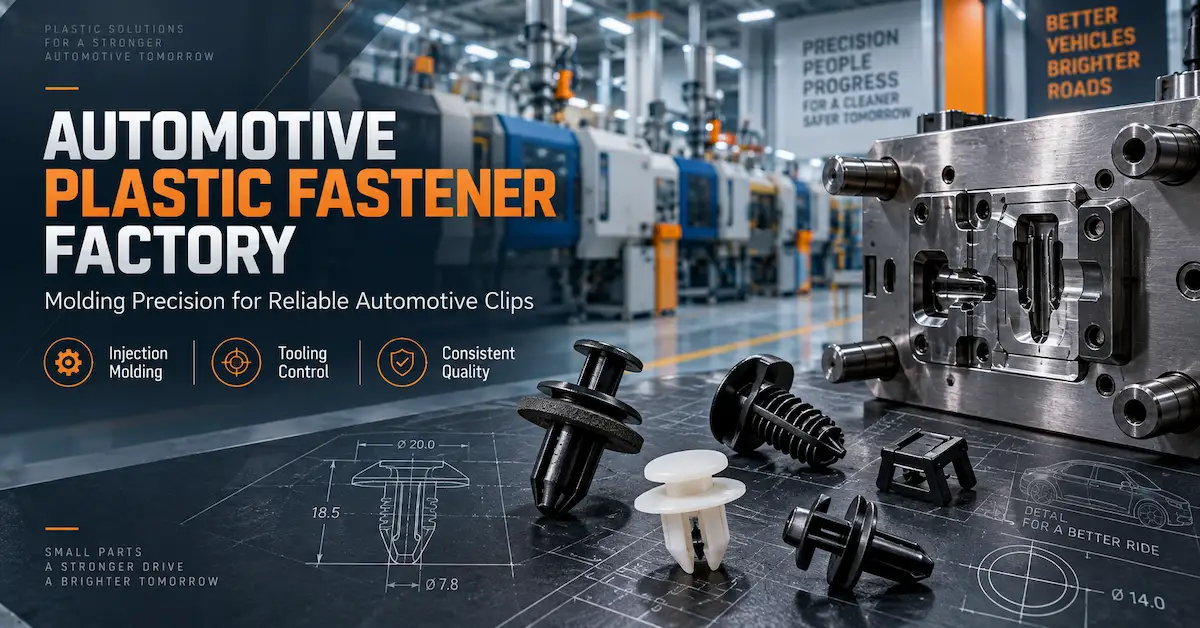
Injection Molding Quality Directly Affects Locking Geometry
Push clips are small components, but their function depends on molded features that may be relatively thin or flexible. Flash around a locking feature can interfere with installation; incomplete filling can weaken a leg; warpage can change alignment; dimensional variation may alter how the clip enters or engages with the hole.
QEEPEI describes molding and mold-development capabilities on its About Us page, while its injection molded car clips manufacturing guide explains the relationship between tooling, molding processes, material control, and product consistency.
When evaluating a supplier, buyers should connect factory capability to the actual part by asking how critical dimensions are controlled, how molding defects are identified, how tooling revisions are documented, and how the approved clip is linked to production. A list of machines alone does not establish that every SKU has the same process capability.
Sample Approval Should Simulate the Real Mounting Interface
A buyer should avoid approving a push clip only because it can be pushed into a loose test hole by hand. The sample should be evaluated against a representative mounting condition whenever possible. The relevant questions are whether it inserts as intended, reaches the correct locking position, retains the actual panel stack appropriately, and can be serviced in the intended manner.
A useful approval record can identify the supplier SKU, sample date, mounting-hole information, application, vehicle details if applicable, material, dimensional reference, packaging requirement, and test observations.
If the buyer has only an old clip, photographs, or an OE reference number, these should be used to locate candidates first. Final bulk approval should then be based on sufficient product and application information rather than visual similarity alone.
Quality Control Should Focus on Functional Characteristics
For a bulk order, quality inspection should connect directly to the approved product definition. QEEPEI's automotive clips quality-control guide discusses dimensions, molding appearance, functional checks, packaging, and related control considerations.
Depending on the SKU, a buyer may need to define critical dimensions, appearance criteria, material requirements, packaging quantity, label information, and fitment-related checks. If installation or retention testing is required, the mounting condition and acceptance criteria should also be agreed.
An automotive push clips supplier should not be evaluated only by whether certificates or report logos appear on a website. For any required document, verify which legal entity, product sample, test method, date, and scope are actually covered. A material-compliance test and a fitment inspection answer different questions and should not be presented as equivalent evidence.
Use Vehicle Information as One Part of Fitment Verification
Push clips are frequently sold with vehicle-brand or model references, but vehicle make alone is not enough to establish compatibility. QEEPEI provides vehicle-specific automotive clip categories alongside application-based categories. Buyers should use these categories to narrow the selection and then confirm more detailed information.
A useful verification sequence is:
make → model → model year or generation → mounting position → reference number → dimensions → sample verification
This process is particularly important for online sellers. If a listing states that a clip fits a broad vehicle group without sufficient support, returns may result even when the physical product itself is manufactured correctly.
For distributors, compatibility data should be stored with the product SKU rather than kept only in sales conversations. That makes the same information available to purchasing, warehouse, catalog, and customer-service teams.
Compare Single Push Clips With Assortment Kits
Professional buyers do not always need the same supply format. Individual push-clip SKUs and mixed clip kits solve different purchasing problems.
| Supply Format | Best for | Main Benefit | What to Verify |
|---|---|---|---|
| Individual push clip | Distributor replenishment | Exact SKU control | Dimensions, application, pack quantity |
| Application-based group | Repair suppliers | Faster selection by vehicle area | Exact fitment of each SKU |
| Vehicle-specific clip supply | Model-focused sellers | Narrows compatibility search | Model/year/location coverage |
| Mixed clip assortment | Workshops and retail | Multiple common parts in one kit | Component list and quantity per SKU |
| Private-label assortment | Automotive brands | Channel-specific packaging | BOM, labels, refill strategy |
QEEPEI's QGZ-763 automotive clip assortment illustrates a mixed-kit format. An assortment can be convenient, but a buyer should not judge value only by the headline total number of pieces. The individual clip mix, quantities, tools or accessories, target applications, and refill plan determine whether the kit fits the intended market.
Plan Replenishment Before the First Bulk Order
For distributors, choosing an automotive push clips supplier should include planning for the second and third order, not only the first shipment. A mixed assortment may reveal that certain push clips are consumed much faster than others. If those fast-moving components cannot be identified and reordered separately, the buyer may end up purchasing complete kits just to refill a few compartments.
Before ordering, divide the proposed products into fast-moving standard SKUs, medium-demand products, and application-specific products. Request individual product identifiers and pack quantities for the items expected to be replenished frequently.
Stock availability should also be confirmed at SKU level. A supplier may maintain a broad overall inventory, but this does not mean that every model, color, quantity, or customized package is immediately available. Packaging customization can also change the applicable schedule.
Calculate the Cost of Correct Fitment, Not Only Cost per Clip
A push clip is inexpensive compared with many automotive parts, but procurement problems can create costs much larger than the component itself. Incorrect fitment can generate customer returns, extra workshop time, support requests, repacking, warehouse corrections, or obsolete inventory.
When comparing quotations, use the same product definition. Confirm material, dimensions, quantity, packaging, labeling, quality requirements, destination, and any sample or customization costs. A very low unit price means little if the quotation is based on a different specification.
For assortment kits, calculate the commercial usefulness of the included SKUs. A kit with a larger number of pieces is not necessarily better if a large portion of those products rarely match the target customer's vehicles or repair work.
Separate Packaging Customization From New Product Development
QEEPEI's wholesale program includes customization support for B2B buyers. However, buyers should distinguish several levels of customization.
Adding a logo, barcode, or label to an existing push clip is primarily a packaging project. Changing the number and combination of clips in a kit is an assortment project. Requesting a different material, geometry, or locking structure can become a product-engineering project. A completely new fastener may require sample analysis, drawings, tooling, testing, and additional approval steps.
Before asking an automotive push clips supplier for an OEM quotation, state which level is actually required. For new development, provide the existing sample or drawing, mounting-hole details, panel thickness, application, target material, expected quantity, and the problem that the new design is expected to solve.
Control Repeat Orders With a Defined Product Record
Repeat-order consistency becomes more difficult when purchasing records contain only a photograph and a supplier description such as “8 mm black clip.” A controlled record should connect the buyer's SKU with the supplier's model, drawing or dimensional reference, approved sample, material, application, packaging, and revision.
If any important element changes, buyers should determine whether a new sample approval is necessary. Changes to locking geometry, material, critical dimensions, or kit composition can affect the product even when the external appearance remains similar.
This process turns the relationship with the automotive push clips supplier into a controlled supply program rather than repeated product searching.
What Should You Include in a Push Clip RFQ?
A useful RFQ should contain enough information for the supplier to narrow the product correctly. If the part number is known, provide it together with quantity and packaging needs. If the part is unknown, send clear photographs from multiple angles, relevant measurements, mounting-hole information, installation location, vehicle make/model/year when applicable, OE or reference information, and the expected order volume.
For private-label orders, add pack quantities, artwork requirements, barcodes, labels, cartons, languages, and assortment details. For new product development, provide drawings or physical samples and clearly identify any known installation or performance problem.
Buyers can review QEEPEI automotive clips before preparing a sourcing list and then submit a detailed request through the QEEPEI contact page.
Frequently Asked Questions
1. What is an automotive push clip?
An automotive push clip is a fastening component installed primarily through a push-in action to retain a panel, liner, molding, cover, or related vehicle component. Different push clips use different locking geometries, so the term does not describe one universal design.
2. How do I choose an automotive push clips supplier?
Evaluate product identification, application coverage, dimensional information, fitment support, material control, molding capability, sample approval, inspection, packaging options, and repeat-order management. Price should be compared only after the product requirement is sufficiently defined.
3. Is mounting-hole diameter enough to identify a push clip?
Usually not. Buyers may also need to confirm head size, stem or locking geometry, overall length, panel thickness, application position, vehicle information, and reference number where available.
4. Can two push clips with the same head size be interchangeable?
Not necessarily. Their stems, locking legs, lengths, grip conditions, materials, or mounting-hole requirements may differ even when the visible heads appear identical.
5. Can a vehicle make confirm compatibility?
No. Vehicle make is a useful filter, but professional fitment should continue to model, year or generation, mounting position, reference information, dimensions, and sample verification where appropriate.
6. Which material should I choose for plastic push clips?
Material selection depends on geometry, installation requirements, application environment, and any specified performance or compliance requirement. Confirm the material for the actual SKU instead of applying one material statement to an entire product category.
7. Are mixed push clip kits suitable for distributors?
They can be useful for workshops, retail, and general repair markets. Distributors should check every included SKU and quantity, determine which parts are likely to move fastest, and plan how those components can be replenished.
8. Can QEEPEI customize push clip packaging?
QEEPEI describes packaging and B2B customization support through its wholesale service. Buyers should provide the required pack quantity, label, barcode, artwork, carton, and assortment details for project-specific confirmation.
9. How should I approve a push clip sample?
Record the sample identity, application, critical dimensions, material information, mounting condition, fitment result, and packaging requirement. Keep the approved record linked to future purchase orders so repeat orders can be checked against the same definition.
10. What should I send when requesting a quotation?
Send the product or reference number if known, or provide clear photographs, measurements, mounting-hole information, installation location, vehicle details, quantity, packaging requirements, and destination. Custom projects should also include drawings or samples and the requested customization scope.
Conclusion
Selecting an automotive push clips supplier is not simply a matter of finding a catalog with many black plastic retainers. B2B buyers need to control the relationship between mounting-hole dimensions, locking geometry, panel condition, application, vehicle fitment, material, molding quality, packaging, and repeat-order identification. A push clip that appears visually similar can still be unsuitable if one of these factors changes.
For distributors, repair suppliers, e-commerce sellers, and private-label brands, the more reliable sourcing approach is to identify the application first, build a controlled specification, approve samples against the actual mounting condition, and establish SKU-level replenishment before scaling the order. QEEPEI provides body clips, clip kits, vehicle-specific clips, related tools, and B2B customization support. Buyers can explore the QEEPEI product range, review wholesale sourcing options, or contact QEEPEI with reference numbers, samples, dimensions, vehicle information, quantities, and packaging requirements for product matching or project evaluation.